Home
Solidarity Federation
IWA
User account menu
  • Contact
  • Log in
  • Home
    • Intro
    • Workplace organiser training
    • Industrial strategy
    • Community strategy
    • Constitution
  • SolFed
    • Brighton
    • Bristol
    • Edinburgh
    • Liverpool
    • Manchester
    • North London
    • Wales
    • Yorkshire
  • Industries & sectors
    • Claimants and unpaid
    • Education
    • Health and social care
    • Hospitality
  • Events & reports
  • Publications
    • Guides
      • Stuff your boss (doesn't want you to know)
      • Stuff your sexist boss (doesn't want you to know) (2018)
      • Stuff your landlord (doesn't want you to know) (2016)
      • Is your cleaning job killing you? A guide to cleaners health and safety (2017)
      • Office worker’s health and safety - your rights and how to use them (2015)
      • A migrant's guide to Manchester (2016) [en es]
      • A migrant's guide to London (2014) [en es pl]
      • Strike - a guide to walking out (2014)
    • Pamphlets and books
      • Anarcho-syndicalism in Britain – a little history (2015)
        • 1. 19th century to 1914 - The First International, growth of industrial unionism and the Great Unrest
        • 2. 1914–1945 - State suppression and the Bolshevik turn – how Lenin’s seeming success drew militants to the Comintern
        • 3. 1945–1994 - The Anarchist Federation of Britain, Syndicalist Workers’ Federation and Direct Action Movement
        • 4. Today’s movement - A short look at the strategy and thinking of the modern Solidarity Federation
      • Office worker’s health and safety - your rights and how to use them (2015)
      • Anarchism and Anarcho-syndicalism (Rudolf Rocker, 2014)
        • Introduction
        • 1. Ideology of Anarchism
        • 2. History of anarchist philosphy, from Lao-Tse to Kropotkin
        • 3. The origins of anarcho-syndicalism
        • 4. Socialism and anarcho-syndicalism in France
        • 5. The role of the trade unions: anarcho-syndicalist view
        • 6. The struggle in Germany and Spain
        • 7. The political struggle: anarcho-syndicalist view
        • 8. Anarcho-syndicalism since the First World War
      • Fighting for ourselves - anarcho-syndicalism and the class struggle (2012)
        • Introduction
        • 1. The mainstream workers' movement
        • 2. Radical currents in the workers' movement
        • 3. Anarcho-syndicalism in the 20th century
        • 4. Capitalism and the class struggle since World War II
        • 5. Anarcho-syndicalism in the 21st century
        • Endnotes
      • Workmates - direct action workplace organising on the London underground (2011)
      • The Economics of freedom (2003)
      • A history of anarcho-syndicalism (2001)
      • Out of the frying pan, a critical look at works councils (1998)
      • Health and safety at work - an anarcho-syndicalist approach (1997)
      • Anarcho-syndicalism in Puerto Real (1994)
    • Leaflets and flyers
      • Solidarity Federation Education Union (SFEU)
      • Solidarity Federation Hospitality Workers Union (SFHWU)
      • Why do we organise?
      • This is our flag - it tells you what we stand for
      • What is anarcho-syndicalism anyway?
      • Anarchism and Syndicalism (short version)
      • Anarchism and Syndicalism
      • Towards a better union
      • Protest is not enough
      • Building beyond elections
      • We should run our workplaces
      • We should run our communities
      • We should run our movements
    • Newsletters
      • Brighton Solidarity
        • Brighton Solidarity #3
      • Education Worker
        • Education Worker #10 Victimisation (2013)
        • Education Worker #9 (2012)
        • Education Worker #8 Academy Special (2012)
      • Wildcat!
        • Wildcat! #13 (Jan 2013)
        • Wildcat! (Winter 2012)
        • Wildcat! #6 (Summer 2011)
        • Wildcat! #5 (Spring 2011)
        • Wildcat! #4 (Dec 2010)
        • Wildcat! #3 (Oct-Nov 2010)
        • Wildcat! #2 (Jul-Aug 2010)
        • Wildcat! Football for the fans NOT for fat cats! (Jul 2010)
        • Wildcat! #1 (May-June 2010)
      • May Day Bulletin (Newcastle SolFed, 2014)
    • Direct Action
      • Direct Action #2 (2024)
      • Direct Action #1 (2023)
      • Direct action #47 (Summer 2009)
    • Catalyst
      • Catalyst #29 (Feb 2012)
      • Catalyst #28 (Oct 2011)
      • Catalyst #27 (Jun 2011)
      • Catalyst #26 (Mar 2011)
      • Catalyst #25 (Dec 2010)
      • Catalyst #24 (Summer 2010)
    • SelfEd
      • A history of anarcho-syndicalism
        • Block 1
          • Unit 1: The Origins of Capitalism
          • Unit 2: Britain: The Radical Period 1750-1840
          • Unit 3: The First International
          • Unit 4: France 1870-1918 Early revolutionary unions
          • Unit 5: Revolutionary Syndicalism in Britain, 1870-1910
          • Unit 6: Revolutionary Syndicalism in Britain and Ireland, 1910-17
        • Block 2
          • Unit 7: Mexico 1870-1920: Colonialism and Revolution
          • Unit 8: USA 1886-1930 - The Wobblies
          • Unit 9: Anarcho-syndicalism in Argentina 1870-1939
          • Unit 10: Sweden 1889-1939
          • Unit 11: Russia I: 1850-1917
          • Unit 12 Russia II: 1917-30
        • Block 3
          • Unit 13: Going Global - International Organisation, 1872-1922
          • Unit 14: Anarcho-syndicalism in Britain, 1914-30
          • Unit 15 Spain, 1868-1936: Build-up to Revolution
          • Unit 16 Spain: Culture, education, women and sexuality
          • Unit 17: Spain 1936-39: Revolution and Civil War
          • Unit 18: Spain - The Collectives
        • Block 4
          • Unit 19: Britain, 1930-1950 - The Era of Reform
          • Unit 20: Britain, 1950-1990 - Decline of Social Democracy
          • Unit 21: anarcho-syndicalism 1939-99
          • Unit 22: Roots of modern anarcho-syndicalism: freedom, oppression & rebellion
          • Unit 23: Roots of modern anarcho-syndicalism: morality, culture & tactics
          • Unit 24: The spirit of anarcho-syndicalism
    • Letters
  • IWA

Breaking glass, building solidarity?

By Joseph Kay, 12 November, 2010

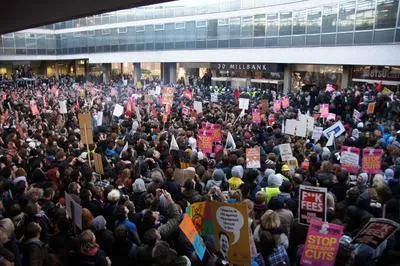
A campaign of demonisation has started against the students who trashed Tory HQ on Wednesday, who are being portrayed as unthinking thugs. We re-publish here an article about what happened at Millbank by one of the participants.

Breaking glass, building solidarity?


Yesterday was glorious. It was inspiring, fun and yes, ‘anarchic.’ I spent most of it laughing and hollering into the brisk air on those sunlit streets. Scary, huh? The news reports seemed to think it was very serious. That may have been because of the seriousness of the cause for which the demonstration was organised, and indeed the violence of the attack on education by the politicians, directors of institutions and the rest, is far greater than anything demonstrators could have dreamed of doing, even the absolute plank who chucked a fire extinguisher from the roof.


Larger demonstrations have at least 3 important functions- inspiring the local campaign work, adding courage and perhaps leverage to the national campaigns by raising their profile, and creating a semi-autonomous space which is a sort of ‘practise’ for a revolutionary situation where people discuss, learn, show their creativity and put their beliefs into action. As such, tactics should be weighed up with these in mind.


It just so happens that on Tuesday I had been reading an article on such tactics as those used at Millbank, only regarding the Toronto G20 demonstrations (http://www.walrusmagazine.com/articles/2010.12-essay-the-question-remains/1/). Much of the article is precisely about ‘the limits of protest,’ and pointed out that discussion of the demonstrations was shut down in what we might call ‘mainstream discourse’ because of the tactics used. I’m not interested in the ‘intrinsic morality’ of property destruction.


My only sympathy is with the invariably low-waged sods that have to clean up. A part of me says that it is not our fault if people use their own deluded sensibilities as an excuse to ignore the issues, and that we shouldn’t pander to such sensibilities. Another says that like it or not, this is a consequence and could be marked up as a downside of such tactics. However, I suspect it simply vindicates those who disagree with our position anyway, and does raise the profile of the cause, nay the movement, in a way that the march and rally alone wouldn’t. Whatever your opinion of it as a whole, in the popular recollection of the British suffrage movement, whose tactics were best remembered and are probably the most inspiring? I’d suggest it was the WSPU, and so I’ll throw it out there that property damage is a valid way to grab public attention. And let’s remember that mainstream media and majority opinion, however linked, are not equal.


The media reaction would be disappointing if it weren’t so predictable. Jeremy Paxman’s attempt at character assassination of Clare Solomon on Newsnight was pathetic for example, but pretty standard. It was, after all just ‘a bunch of rowdy anarchists and other troublemakers, not ‘real’ students.’ The implication that only students currently in formal education, and within that perhaps only HE students, have the right to be there is in itself preposterous of course. The cuts are an assault on us all: lower management, families, school students, teachers, lecturers and practically everyone else in between. Even the bankers are affected, although they probably don’t lose sleep over such long-term repercussions. And more than that the cuts are, in fact, an assault on thought itself.


A more rooted problem in much of the mainstream coverage, perhaps, is the caricature of a student as a twenty-something consumer of Heinz products. This isn’t an accurate reflection of students. It also couldn’t be further from the general concept of each and every individual in society being a student – I know I never want to stop learning, and that concept is something I firmly believe in as a principle of action and organisation. And for the record, if we are to make such concrete distinctions, there was a greater proportion of those ‘ordinary students’ than ‘troublemakers’ in and around that building.


Finally, on the demonstrators’ side of things, I’d say a large number of the people there, and yes there were thousands at Millbank Tower (don’t take my word for it, check the Daily Mail), had never been on a demonstration before. Was it educational for them? Yes. Did it radicalise some people? Yes. Did we descend with some of the fire in our bellies that the French and Greeks are famous for? Yes. Would I say it was a positive experience overall? Certainly. Never surrender!

  • riots
  • education
  • North London

Guides

Your rights at work

Why do we organise? Capitalism is shit, oppression is shit - but what can we at SolFed do about it?

Why do we organise?

This is our flag - it tells you what we stand for

this-is-our-flag

Direct Action #2 (2024)

Direct Action #2 (2024)

Anarcho-syndicalism in Britain – a little history (2015)

Anarcho-syndicalism in Britain – a little history (2015)

Office worker’s health and safety - your rights and how to use them (2015)

Office worker’s health and safety - your rights and how to use them (2015)

Anarchism and Anarcho-syndicalism (Rudolf Rocker, 2014)

Anarchism and Anarcho-syndicalism (Rudolf Rocker, 2014)

Fighting for ourselves - anarcho-syndicalism and the class struggle (2012)

Fighting for ourselves - anarcho-syndicalism and the class struggle (2012)

Theory & Practice 1 - Workmates - direct action workplace organising on the London underground (2011)

Theory & Practice 1 - Workmates - direct action workplace organising on the London underground (2011)

The Economics of freedom (2003)

The Economics of freedom (2003)

A history of anarcho-syndicalism (SelfEd Collective, 24 unit series, 2001)

A history of anarcho-syndicalism (SelfEd Collective, 24 unit series, 2001)

Out of the frying pan, a critical look at works councils (1998)

Out of the frying pan, a critical look at works councils (1998)

Health and safety at work - an anarcho-syndicalist approach (1997)

Health and safety at work - an anarcho-syndicalist approach (1997)

Theory & Practice 2 - Anarcho-syndicalism in Puerto Real (1994)

Theory & Practice 2 - Anarcho-syndicalism in Puerto Real (1994)
RSS feed