Sexism is a constant presence in many workplaces where it can take many forms. From lower pay, to expectations of unpaid work, to sexual harassment by bosses, other workers or customers, sexism means women and workers seen as women are treated unequally on the basis of sex or gender.
This pamphlet looks at the reality of sexism in the workplace and what we can do about it. As anarcho-syndicalists we favour direct, collective strategies that build and maintain a culture of resistance in the workplace. We consider how workers can directly confront sexism or cope when confrontation is not possible, building a culture of solidarity and support at work, which ultimately means you and others experiencing sexism are less isolated and more likely to win.
The Law and its Limits | Your legal situation | Problems with the legal approach
Sexism at work | You are not alone | What does sexism look like? | Unequal treatment | Objectification | Sexual harassment | Structural disadvantage | Microagressions
What to do about it | Strategies, tactics, solidarity | Coping strategies | Tactics of resistance
Solidarity and Support | Mutual aid | Acts of Solidarity | Building Wider Support
Cleaners have a vital role in society, yet their job is poorly paid and routinely dismissed as a job carried out mainly by women to earn a bit of extra cash. Cleaning is also not generally seen as a particularly physically hard or dangerous job. Most people see cleaning as involving a bit of dusting, mopping and hoovering.
Written by a cleaner, this pamphlet draws on research from across the world to show the reality of cleaning and the impact the job has on the health and wellbeing of cleaners. The pamphlet not only examines the more obvious aspects of the job that affect cleaners’ health, such as the physical demands of the job and the effects of cleaning chemicals, but also takes into account the detrimental impact of factors such as low pay, ever- increasing workloads, low status, sexual harassment and family commitments on the everyday lives of cleaners. In doing so, the pamphlet exposes the true cost being paid by cleaners and their families for job that is central to the wellbeing of society as a whole.
As such, this pamphlet is not only essential reading for cleaners but for all those interested in seeing greater justice for one of the most exploited and marginalised groups of workers.
Starting a new life in the UK can be intimidating. Many things are different to how they were at home. Most things are expensive, and some things are just plain difficult. There might be a new language or a new culture to contend with. Dealing with all this whilst struggling to find a job or accommodation can feel impossible. With this in mind, Manchester Solidarity Federation have put together a short guide to the city. We've tried to cover all the basics about living and working here, and where to go for help and what resources are available.
The guide is available at manchestermigrantsguide.org.uk. We hope to have translations into languages other than English in the near future. We must emphasise the guide is a work in progress and if you have any suggestions, corrections or comments please do not hesitate to contact us.
We are so used to landlords - and the power they have - that they can seem unchallengeable. They make profit from our need for a home, and using the courts and the police, can make us homeless.
This pamphlet offers an overview of your basic rights and workplace advice based on the long-term experience of workplace activists.
Contents - Jargon-Buster | Rights and Responsibilities | General Rights | Office Environment | Computer Equipment | What are the Risks? | RSI and ‘Musculoskeletal Disorders’ | Eye Strain and Vision | Stress | Other Risks | Organising Collective Solutions | Further information | About SolFed
Produced by Bristol Solidarity Federation and the SolFed Publicity Commission
This pamphlet offers an overview of your basic rights and workplace advice based on the long-term experience of workplace activists.
Our 12-page pamphlet on organising for a strike, including tips on the official procedures, ways in which opponents sometimes try and undermine things, what to do for the picket line - and we even added a general "why you should join us on the line" leaflet on the back that you can photocopy.
We ain't putting it online as we don't want bosses to be able to get hold of it too easily from online sharing around etc, but if you want one give us a shout. We'll also be leaving a few at Freedom Bookshop in Whitechapel.
For more updates and suchlike, follow our Facebook and Twitter feeds, and if you fancy getting involved you can email us at northlondonsf at riseup.net.
Since the beginning of the crisis more and more migrants are arriving in London and the UK. When people come here, they often find their first steps difficult. We want everyone to feel welcome and help them as much as possible. That’s why we have published a new pamphlet, “London – a migrant's guide”. It is a practical introduction to life in London and the UK.
The following areas are covered in the guide:
Using public transport in London as well as trains and coaches in the UK;
Where to access the internet and how to get a cheap mobile phone;
Libraries and colleges where you may get free English language classes;
Where to buy cheap food and other stuff and where to get it for free;
How to open a bank account;
Accessing health services, regularly and in emergency, including the access to contraception and abortion;
Housing including practical issues such as rent and conditions you may expect, your rights as a tenant, and a few words on homelessness and squatting;
Work including, pay, taxes, your rights at work, and issues you may encounter such as health and safety, bullying and harassment, zero hours contracts and false self employment, etc.
A very basic breakdown of welfare benefits available in the UK;
A few words on the police and the law, including when and where you can get free legal advice and support;
Where to get support if you are a victim of domestic violence or sexual assault;
Contacts for LGBT people.
In order to cover such a wide range of subjects in a short pamphlet we had to keep it very basic. At the same time we tried to put as much information and contacts as possible.
Some of the advice will be useful for everyone, but a lot assume that the reader has the right to live and work in the UK, most likely because they are an EU citizen. We support everyone's right to live wherever they choose to, no matter what passport they hold. Unfortunately things are much more complex for migrants from outside the EU, and we neither have the expertise required nor would be able to fit it in a small pamphlet.
At the moment the guide is available in English, Polish and Spanish.
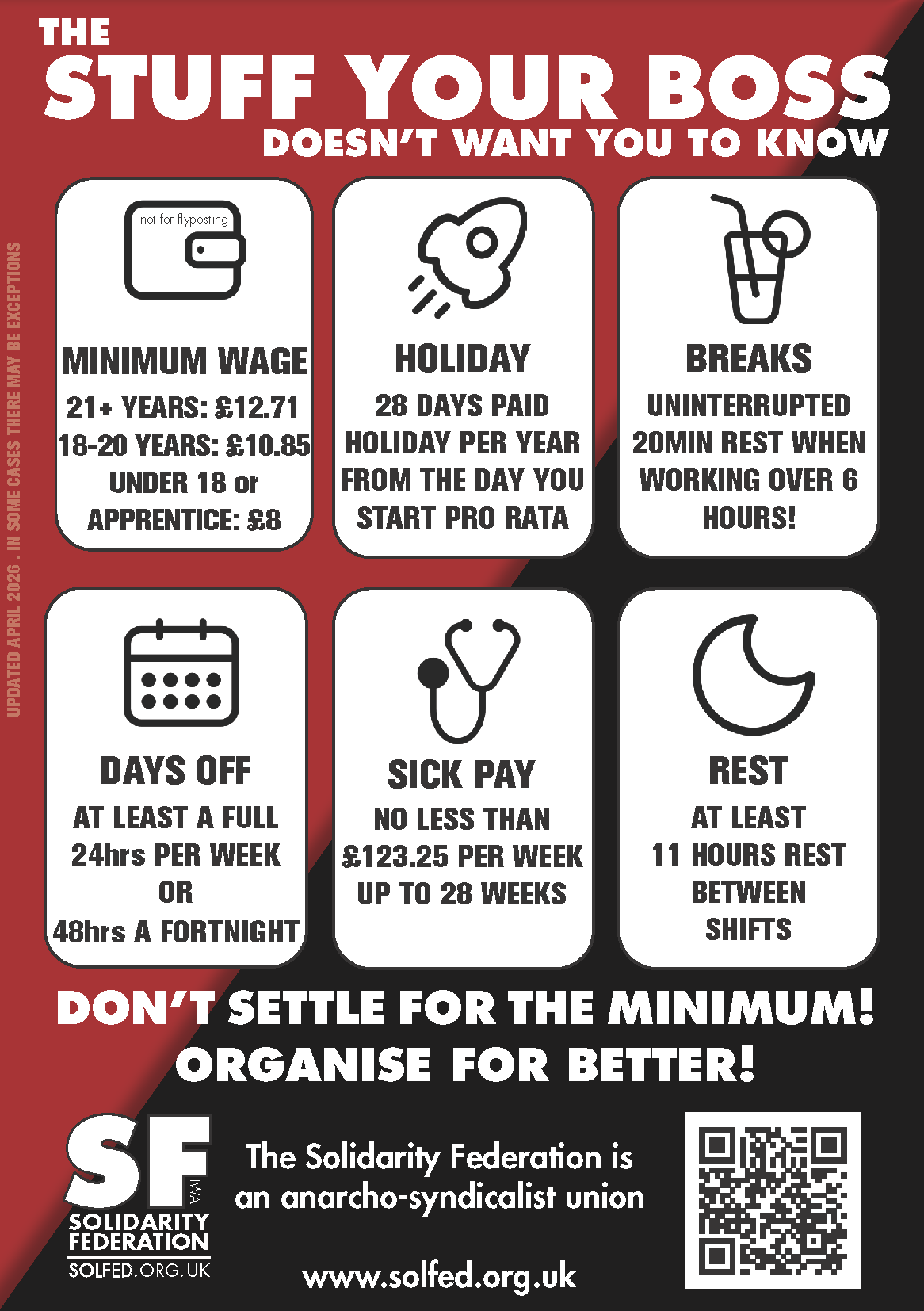 Key rights at work

 Starting a new life in the UK can be intimidating. Many things are different to how they were at home. Most things are expensive, and some things are just plain difficult. There might be a new language or a new culture to contend with. Dealing with all this whilst struggling to find a job or accommodation can feel impossible. With this in mind, Manchester Solidarity Federation have put together a short guide to the city. We've tried to cover all the basics about living and working here, and where to go for help and what resources are available.
 Since the beginning of the crisis more and more migrants are arriving in London and the UK. When people come here, they often find their first steps difficult. We want everyone to feel welcome and help them as much as possible. That’s why we have published a new pamphlet, “London – a migrant's guide”. It is a practical introduction to life in London and the UK.