Home
Solidarity Federation
IWA
User account menu
  • Contact
  • Log in
  • Home
    • Intro
    • Workplace organiser training
    • Industrial strategy
    • Community strategy
    • Constitution
  • SolFed
    • Brighton
    • Bristol
    • Edinburgh
    • Liverpool
    • Manchester
    • North London
    • Wales
    • Yorkshire
  • Industries & sectors
    • Claimants and unpaid
    • Education
    • Health and social care
    • Hospitality
  • Events & reports
  • Publications
    • Guides
      • Stuff your boss (doesn't want you to know)
      • Stuff your sexist boss (doesn't want you to know) (2018)
      • Stuff your landlord (doesn't want you to know) (2016)
      • Is your cleaning job killing you? A guide to cleaners health and safety (2017)
      • Office worker’s health and safety - your rights and how to use them (2015)
      • A migrant's guide to Manchester (2016) [en es]
      • A migrant's guide to London (2014) [en es pl]
      • Strike - a guide to walking out (2014)
    • Pamphlets and books
      • Anarcho-syndicalism in Britain – a little history (2015)
        • 1. 19th century to 1914 - The First International, growth of industrial unionism and the Great Unrest
        • 2. 1914–1945 - State suppression and the Bolshevik turn – how Lenin’s seeming success drew militants to the Comintern
        • 3. 1945–1994 - The Anarchist Federation of Britain, Syndicalist Workers’ Federation and Direct Action Movement
        • 4. Today’s movement - A short look at the strategy and thinking of the modern Solidarity Federation
      • Office worker’s health and safety - your rights and how to use them (2015)
      • Anarchism and Anarcho-syndicalism (Rudolf Rocker, 2014)
        • Introduction
        • 1. Ideology of Anarchism
        • 2. History of anarchist philosphy, from Lao-Tse to Kropotkin
        • 3. The origins of anarcho-syndicalism
        • 4. Socialism and anarcho-syndicalism in France
        • 5. The role of the trade unions: anarcho-syndicalist view
        • 6. The struggle in Germany and Spain
        • 7. The political struggle: anarcho-syndicalist view
        • 8. Anarcho-syndicalism since the First World War
      • Fighting for ourselves - anarcho-syndicalism and the class struggle (2012)
        • Introduction
        • 1. The mainstream workers' movement
        • 2. Radical currents in the workers' movement
        • 3. Anarcho-syndicalism in the 20th century
        • 4. Capitalism and the class struggle since World War II
        • 5. Anarcho-syndicalism in the 21st century
        • Endnotes
      • Workmates - direct action workplace organising on the London underground (2011)
      • The Economics of freedom (2003)
      • A history of anarcho-syndicalism (2001)
      • Out of the frying pan, a critical look at works councils (1998)
      • Health and safety at work - an anarcho-syndicalist approach (1997)
      • Anarcho-syndicalism in Puerto Real (1994)
    • Leaflets and flyers
      • Solidarity Federation Education Union (SFEU)
      • Solidarity Federation Hospitality Workers Union (SFHWU)
      • Why do we organise?
      • This is our flag - it tells you what we stand for
      • What is anarcho-syndicalism anyway?
      • Anarchism and Syndicalism (short version)
      • Anarchism and Syndicalism
      • Towards a better union
      • Protest is not enough
      • Building beyond elections
      • We should run our workplaces
      • We should run our communities
      • We should run our movements
    • Newsletters
      • Brighton Solidarity
        • Brighton Solidarity #3
      • Education Worker
        • Education Worker #10 Victimisation (2013)
        • Education Worker #9 (2012)
        • Education Worker #8 Academy Special (2012)
      • Wildcat!
        • Wildcat! #13 (Jan 2013)
        • Wildcat! (Winter 2012)
        • Wildcat! #6 (Summer 2011)
        • Wildcat! #5 (Spring 2011)
        • Wildcat! #4 (Dec 2010)
        • Wildcat! #3 (Oct-Nov 2010)
        • Wildcat! #2 (Jul-Aug 2010)
        • Wildcat! Football for the fans NOT for fat cats! (Jul 2010)
        • Wildcat! #1 (May-June 2010)
      • May Day Bulletin (Newcastle SolFed, 2014)
    • Direct Action
      • Direct Action #2 (2024)
      • Direct Action #1 (2023)
      • Direct action #48 (Autumn 2009)
      • Direct action #47 (Summer 2009)
      • Direct Action #46 (Spring 2009)
      • Direct Action #45 (Winter 2008)
    • Catalyst
      • Catalyst #29 (Feb 2012)
      • Catalyst #28 (Oct 2011)
      • Catalyst #27 (Jun 2011)
      • Catalyst #26 (Mar 2011)
      • Catalyst #25 (Dec 2010)
      • Catalyst #24 (Summer 2010)
    • SelfEd
      • A history of anarcho-syndicalism
        • Block 1
          • Unit 1: The Origins of Capitalism
          • Unit 2: Britain: The Radical Period 1750-1840
          • Unit 3: The First International
          • Unit 4: France 1870-1918 Early revolutionary unions
          • Unit 5: Revolutionary Syndicalism in Britain, 1870-1910
          • Unit 6: Revolutionary Syndicalism in Britain and Ireland, 1910-17
        • Block 2
          • Unit 7: Mexico 1870-1920: Colonialism and Revolution
          • Unit 8: USA 1886-1930 - The Wobblies
          • Unit 9: Anarcho-syndicalism in Argentina 1870-1939
          • Unit 10: Sweden 1889-1939
          • Unit 11: Russia I: 1850-1917
          • Unit 12 Russia II: 1917-30
        • Block 3
          • Unit 13: Going Global - International Organisation, 1872-1922
          • Unit 14: Anarcho-syndicalism in Britain, 1914-30
          • Unit 15 Spain, 1868-1936: Build-up to Revolution
          • Unit 16 Spain: Culture, education, women and sexuality
          • Unit 17: Spain 1936-39: Revolution and Civil War
          • Unit 18: Spain - The Collectives
        • Block 4
          • Unit 19: Britain, 1930-1950 - The Era of Reform
          • Unit 20: Britain, 1950-1990 - Decline of Social Democracy
          • Unit 21: anarcho-syndicalism 1939-99
          • Unit 22: Roots of modern anarcho-syndicalism: freedom, oppression & rebellion
          • Unit 23: Roots of modern anarcho-syndicalism: morality, culture & tactics
          • Unit 24: The spirit of anarcho-syndicalism
    • Letters
  • IWA

Stuff your boss (doesn't want you to know)

Stuff your boss (doesn't want you to know)Key rights at work

Whether we’re working temporarily or permanently, with an agency, full or part-time, we have certain basic rights ...

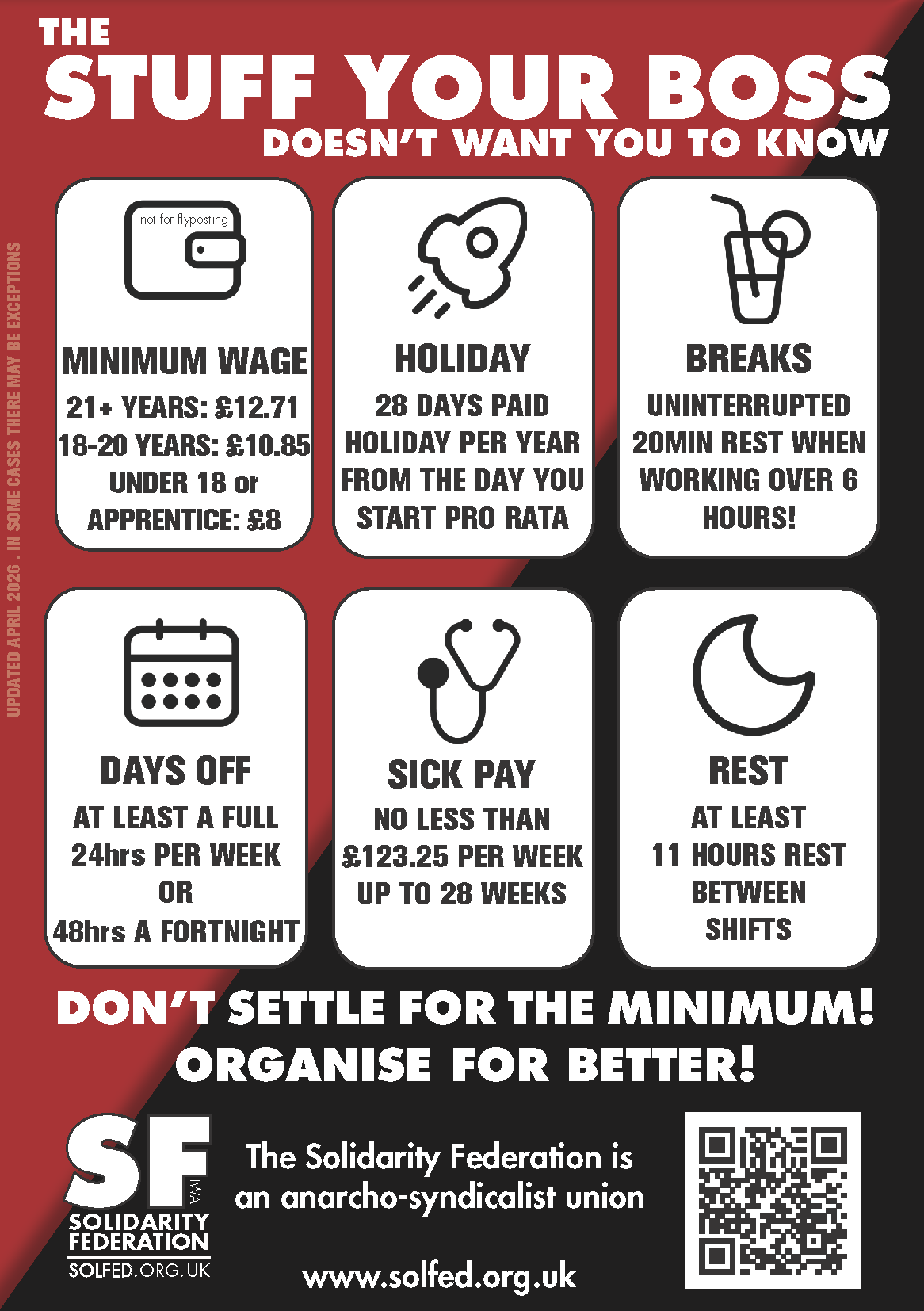
  1. The right to be told in writing how much and when we’ll get paid. The minimum wage for 21 and over is £12.71/hour. For 18-20 years it is £10.85. For under 18 it is £8, and for apprentices it is £8. The rates are updated every year in April.
  2. Most workers have the right to at least 5.6 weeks’ paid leave (holiday) per year. This amounts to 28 days for a normal working week. Job contracts should say what you get but if they don’t, then 28 days is the minimum (including public holidays) unless you’re part-time. For part-timers, multiply an average working week by 5.6. The rule applies to all jobs, no matter how casualised. It applies from the day we get a job.
  3. The right to breaks of at least 20 minutes over six hours of work. We are allowed at least 11 hours’ rest in every 24 and a minimum of a day a week off or two per fortnight. Rest breaks for under-18s are a minimum of 30 minutes every 4½ hours, daily rest of 12 hours, weekly rest of 48 hours.
  4. The right to refuse to work more than 48 hours a week. We can’t be made to go beyond that unless we have agreed in writing. Note: This is worked out by averaging a 17-week period, so we can be forced to do more in any single week.
  5. The right to sick pay. We get statutory sick pay (SSP) of £123.25 per week if you’re too ill to work. It’s paid by your employer for up to 28 weeks.
  6. The right to maternity/paternity leave when we have children. Most mothers are allowed 39 weeks’ paid maternity leave plus 13 weeks’ unpaid leave. To get maternity (or paternity) pay we must earn over £129 per week and have been working continuously for more than 26 weeks by 15 weeks before the baby’s due date (when the employer needs to be notified). For the first six weeks we should be paid 90% of average earnings, then a constant rate of £194.32 for 33 weeks. Or 90% of the average weekly earnings, whichever is the lowest. If we are not eligible for maternity pay we can then apply to get Maternity Allowance from the government. Fathers/male partners get two weeks’ paid paternity leave. Alternatively, eligible parents can share up to 50 weeks of parental leave in the year after a child's birth.
  7. The right to be free from harassment. We should all work without racial or sexual harassment, bullying, prejudice or discrimination. Agency and part-time workers have the same rights as full-time workers.
  8. The right to defend ourselves. We all have the right to protection from being sacked (fired, “let go”) for using our legal employment rights. We also have the right to join with our fellow workers and organise ourselves collectively, and to join a trade union.
  9. The right to refuse work that is unsafe or where training is not given. We all have the right to refuse to work if we find ourselves fearful of danger. Agencies are not allowed to send us to jobs for which we are not qualified, and they must see that proper training is given.

Working time regulations

The basic rights and protections that the regulations give us are:

  • One day off in any given week or two per fortnight.
  • A minimum of 5.6 weeks’ paid leave a year
  • We can’t be forced to work more than an average of 48 hours a week and we can’t be made to work more than 13 hours a day.
  • Right to at least one 20 minutes rest break when working over six hours.
  • At night, work can’t take up more than an average of eight hours per day. And night workers have the right to free health checks.

Health & safety

Employers should...

  • Give us decent working conditions including enough toilets, washing facilities and drinking water.
  • Make a health and safety plan, then give staff proper info and training.
  • Give us procedures for dealing with risks at work.
  • Tell all workers about health and safety agreements, policies and practices before we start work.
  • Consult on health and safety matters. Health and safety at work costs money and time, so bosses often try to dodge doing it. By law they must give healthy, safe conditions to everyone they hire.
  • Remember, we can legally walk out if we feel in instant danger.

Grievance procedures

   ACAS (an independent body which intervenes in boss vs worker disputes) has a Code of Practice which says when we can legally file a grievance
(an official complaint).
   The Code doesn’t apply in court and it won’t always protect us from being sacked due to a disciplinary (behaviour) issue.
   The Code is considered by employment tribunals, other than for redundancies and when a firm decides not to renew a contract.
   A tribunal can sometimes change the amount of compensation we’re paid for being wrongfully fired (by up to plus or minus 25%) if it has not been reasonably followed. Employees facing disciplinary action should be given adequate time to prepare a defence.
   We should be able to give evidence and to call witnesses.We have the right to go with someone else.
   They can be a full-time union official (whether or not the union is recognised), a registered lay official (someone union-trained to go to hearings) or a colleague.
   The worker and companion have protection against any disciplinary or dismissal in connection with using this right. Hearings must be heard within a reasonable time period.

Standing up for ourselves

   Casualisation and so-called flexible working are ways of worsening working conditions and exploiting us more than ever. They also make permanent jobs more at risk. So casualisation does not only affect temporary and agency workers, but all workers.
   Employers will sack workers they do not like, knowing full well that many are unwilling or unable to go through an employment tribunal. It is not enough having a few legal and contractual rights at work; we need to stand together to ensure that the rights we took a long time to win are respected. Only by standing together can we stop bosses from harassing and victimising us. We cannot leave it to the government, the bosses, political parties, or the established trade unions.
   The most effective way of defending our rights is by organising ourselves and taking collective direct action. By forming our own groups where everyone is equal, we can resist exploitation and enforce our rights at work effectively. Defending our rights is just the start. Once we achieve this, we can start to take the initiative. An injury to one is an injury to all!

Attachment Size
Stuff your boss (doesn't want you to know) sticker 2026.pdf (110.63 KB) 110.63 KB

Tags

  • library
  • publications
  • guides
  • accidents
  • employment agencies
  • breaks
  • casualisation
  • deductions
  • dismissals
  • harassment
  • leave
  • lockouts
  • minimum wage
  • pay and conditions
  • racism
  • sexism
  • sickness
  • unemployment
  • unpaid labour
  • victimisation
  • working hours
  • workplace deaths
  • xenophobia
  • zero hour contracts

Guides

Your rights at work

Why do we organise? Capitalism is shit, oppression is shit - but what can we at SolFed do about it?

Why do we organise?

This is our flag - it tells you what we stand for

this-is-our-flag

Stuff your boss (doesn't want you to know)

Stuff your boss (doesn't want you to know)

Direct Action #2 (2024)

Direct Action #2 (2024)

Stuff your sexist boss (doesn't want you to know) (2018)

Stuff your sexist boss (doesn't want you to know) (2018)

Is your cleaning job killing you? A guide to cleaners health and safety (2017)

Stuff your landlord (doesn't want you to know) (2016)

Stuff your landlord (doesn't want you to know) (2016)

A migrant's guide to Manchester (2016)

A migrant's guide to Manchester (2016)

Anarcho-syndicalism in Britain – a little history (2015)

Anarcho-syndicalism in Britain – a little history (2015)

Office worker’s health and safety - your rights and how to use them (2015)

Office worker’s health and safety - your rights and how to use them (2015)

A migrant's guide to London (2014)

A migrant's guide to London (2014)

Anarchism and Anarcho-syndicalism (Rudolf Rocker, 2014)

Anarchism and Anarcho-syndicalism (Rudolf Rocker, 2014)

Strike - a guide to walking out (2014)

Strike - a guide to walking out (2014)

Fighting for ourselves - anarcho-syndicalism and the class struggle (2012)

Fighting for ourselves - anarcho-syndicalism and the class struggle (2012)

Theory & Practice 1 - Workmates - direct action workplace organising on the London underground (2011)

Theory & Practice 1 - Workmates - direct action workplace organising on the London underground (2011)

The Economics of freedom (2003)

The Economics of freedom (2003)

A history of anarcho-syndicalism (SelfEd Collective, 24 unit series, 2001)

A history of anarcho-syndicalism (SelfEd Collective, 24 unit series, 2001)

Out of the frying pan, a critical look at works councils (1998)

Out of the frying pan, a critical look at works councils (1998)

Health and safety at work - an anarcho-syndicalist approach (1997)

Health and safety at work - an anarcho-syndicalist approach (1997)

Theory & Practice 2 - Anarcho-syndicalism in Puerto Real (1994)

Theory & Practice 2 - Anarcho-syndicalism in Puerto Real (1994)
RSS feed