Home
Solidarity Federation
IWA
User account menu
  • Contact
  • Log in
  • Home
    • Intro
    • Workplace organiser training
    • Industrial strategy
    • Community strategy
    • Constitution
  • SolFed
    • Brighton
    • Bristol
    • Edinburgh
    • Liverpool
    • Manchester
    • North London
    • Wales
    • Yorkshire
  • Industries & sectors
    • Claimants and unpaid
    • Education
    • Health and social care
    • Hospitality
  • Events & reports
  • Publications
    • Guides
      • Stuff your boss (doesn't want you to know)
      • Stuff your sexist boss (doesn't want you to know) (2018)
      • Stuff your landlord (doesn't want you to know) (2016)
      • Is your cleaning job killing you? A guide to cleaners health and safety (2017)
      • Office worker’s health and safety - your rights and how to use them (2015)
      • A migrant's guide to Manchester (2016) [en es]
      • A migrant's guide to London (2014) [en es pl]
      • Strike - a guide to walking out (2014)
    • Pamphlets and books
      • Anarcho-syndicalism in Britain – a little history (2015)
        • 1. 19th century to 1914 - The First International, growth of industrial unionism and the Great Unrest
        • 2. 1914–1945 - State suppression and the Bolshevik turn – how Lenin’s seeming success drew militants to the Comintern
        • 3. 1945–1994 - The Anarchist Federation of Britain, Syndicalist Workers’ Federation and Direct Action Movement
        • 4. Today’s movement - A short look at the strategy and thinking of the modern Solidarity Federation
      • Office worker’s health and safety - your rights and how to use them (2015)
      • Anarchism and Anarcho-syndicalism (Rudolf Rocker, 2014)
        • Introduction
        • 1. Ideology of Anarchism
        • 2. History of anarchist philosphy, from Lao-Tse to Kropotkin
        • 3. The origins of anarcho-syndicalism
        • 4. Socialism and anarcho-syndicalism in France
        • 5. The role of the trade unions: anarcho-syndicalist view
        • 6. The struggle in Germany and Spain
        • 7. The political struggle: anarcho-syndicalist view
        • 8. Anarcho-syndicalism since the First World War
      • Fighting for ourselves - anarcho-syndicalism and the class struggle (2012)
        • Introduction
        • 1. The mainstream workers' movement
        • 2. Radical currents in the workers' movement
        • 3. Anarcho-syndicalism in the 20th century
        • 4. Capitalism and the class struggle since World War II
        • 5. Anarcho-syndicalism in the 21st century
        • Endnotes
      • Workmates - direct action workplace organising on the London underground (2011)
      • The Economics of freedom (2003)
      • A history of anarcho-syndicalism (2001)
      • Out of the frying pan, a critical look at works councils (1998)
      • Health and safety at work - an anarcho-syndicalist approach (1997)
      • Anarcho-syndicalism in Puerto Real (1994)
    • Leaflets and flyers
      • Solidarity Federation Education Union (SFEU)
      • Solidarity Federation Hospitality Workers Union (SFHWU)
      • Why do we organise?
      • This is our flag - it tells you what we stand for
      • What is anarcho-syndicalism anyway?
      • Anarchism and Syndicalism (short version)
      • Anarchism and Syndicalism
      • Towards a better union
      • Protest is not enough
      • Building beyond elections
      • We should run our workplaces
      • We should run our communities
      • We should run our movements
    • Newsletters
      • Brighton Solidarity
        • Brighton Solidarity #3
      • Education Worker
        • Education Worker #10 Victimisation (2013)
        • Education Worker #9 (2012)
        • Education Worker #8 Academy Special (2012)
      • Wildcat!
        • Wildcat! #13 (Jan 2013)
        • Wildcat! (Winter 2012)
        • Wildcat! #6 (Summer 2011)
        • Wildcat! #5 (Spring 2011)
        • Wildcat! #4 (Dec 2010)
        • Wildcat! #3 (Oct-Nov 2010)
        • Wildcat! #2 (Jul-Aug 2010)
        • Wildcat! Football for the fans NOT for fat cats! (Jul 2010)
        • Wildcat! #1 (May-June 2010)
      • May Day Bulletin (Newcastle SolFed, 2014)
    • Direct Action
      • Direct Action #2 (2024)
      • Direct Action #1 (2023)
      • Direct action #47 (Summer 2009)
    • Catalyst
      • Catalyst #29 (Feb 2012)
      • Catalyst #28 (Oct 2011)
      • Catalyst #27 (Jun 2011)
      • Catalyst #26 (Mar 2011)
      • Catalyst #25 (Dec 2010)
      • Catalyst #24 (Summer 2010)
    • SelfEd
      • A history of anarcho-syndicalism
        • Block 1
          • Unit 1: The Origins of Capitalism
          • Unit 2: Britain: The Radical Period 1750-1840
          • Unit 3: The First International
          • Unit 4: France 1870-1918 Early revolutionary unions
          • Unit 5: Revolutionary Syndicalism in Britain, 1870-1910
          • Unit 6: Revolutionary Syndicalism in Britain and Ireland, 1910-17
        • Block 2
          • Unit 7: Mexico 1870-1920: Colonialism and Revolution
          • Unit 8: USA 1886-1930 - The Wobblies
          • Unit 9: Anarcho-syndicalism in Argentina 1870-1939
          • Unit 10: Sweden 1889-1939
          • Unit 11: Russia I: 1850-1917
          • Unit 12 Russia II: 1917-30
        • Block 3
          • Unit 13: Going Global - International Organisation, 1872-1922
          • Unit 14: Anarcho-syndicalism in Britain, 1914-30
          • Unit 15 Spain, 1868-1936: Build-up to Revolution
          • Unit 16 Spain: Culture, education, women and sexuality
          • Unit 17: Spain 1936-39: Revolution and Civil War
          • Unit 18: Spain - The Collectives
        • Block 4
          • Unit 19: Britain, 1930-1950 - The Era of Reform
          • Unit 20: Britain, 1950-1990 - Decline of Social Democracy
          • Unit 21: anarcho-syndicalism 1939-99
          • Unit 22: Roots of modern anarcho-syndicalism: freedom, oppression & rebellion
          • Unit 23: Roots of modern anarcho-syndicalism: morality, culture & tactics
          • Unit 24: The spirit of anarcho-syndicalism
    • Letters
  • IWA

'Enough is Enough': Farm Workers Strike in South Africa

By mcm_cmc, 22 November, 2012

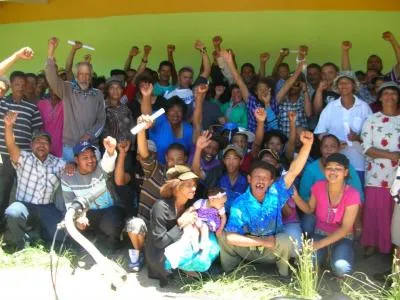
Farm workers in South Africa are currently on strike to demand higher wages and the right to organise in the face of a programme of suppression and intimidation by the predominantly white farm owners and in defiance of the political and Trade Union establishment.

The farm workers are engaged in a wave of strikes seeking to challenge the endemic problem of poor wages and a lack of organisation in South African farms. It is estimated by Human Rights Watch that less that 3% of farm workers in South Africa are organised whilst most earn the minimum wage or below. Farm workers are often isolated due to a lack of public transport and are also highly reliant on farm owners who often own the land they live on, provide access to credit and control the only means of transportation in and out of the farm, giving them great power to discourage organisation. Poor conditions and poor treatment of workers is rife, with stories including workers at one farm being forced to live in pigsties. Some farms continue to ‘pay’ workers through the ‘dop system’, whereby workers are given alcohol in lieu of wages.

Against this the striking workers have demanded increased wages, an end to intimidation by bosses and the right to organise freely. The strike, which began in De Doorns early in November before spreading to other farms across the Western Cape and North West provinces, has so far been largely organic and leaderless, rejecting the established political and union hierarchy and taking COSATU, the ANC-affiliated Congress of South African Trade Unions by surprise. Indeed, what union involvement there has been has come largely from smaller, more independent unions such as the CSAAWU (Commercial, Stevedoring, Agricultural and Allied Workers Union) and Sikhula Sonke, a women-led farm workers union. Furthermore, there are ongoing efforts to organize worker committees on striking farms in order to increase the level of organization, take part in wage negotiations and prepare the workers for further action.

The reaction of the farm owners and the state has been fierce. Efforts at suppression by owners have been heightened, with dismissals of workers, the use of private security thugs, threats of the eviction of workers from their farm-owned homes and one farm owner even arrested for shooting at striking workers. Police too have sought to clamp down on strikers, with several violent confrontations and scores of dawn raids and arrests and taking place over recent weeks, as well as the murder of farm workers Michael Daniels and Bongile Ndleni (who reports suggest may have been killed by private security). The police have also helped to ‘escort’ workers from other towns onto farms where workers are on strike. Simultaneously, the political and Trade Union establishment have sought to regain control over the situation, with COSATU seeking to claim leadership of the movement around its demand for a minimum agricultural wage of R150 a day and joining with acting Labour minister Angie Motshekga to call for a two-week suspension of the strike on the 14th of November whilst they consider the farm owners’ offer of a mere R80 a day.

Nonetheless despite these attempts at suppression and cooption strikes and resistance continue. There are demands for a national agricultural strike if the farm owners do not agree to a R150 a day wage by the 4th December. Furthermore, a statement from the CSAAWU union released on the 20th November illustrated the discontent not just regarding low wages but with the whole structure of land ownership, arguing that “if bosses continue to threaten mass retrenchments, the question of ownership of land will come to the fore.” Finally, some striking workers have gone beyond strike action into acts of sabotage, destroying crops and vineyards in their struggle against the bosses and sabotaging roads to prevent police vehicles from passing. Alongside striking mineworkers, the striking farm workers seem to be mounting a serious challenge to the white farm owners and to the cooptive power of COSATU and the ANC.

Brighton SolFed has links with the South African movement through a former member now active in organizing workers in the country. We are planning to organize a benefit for the CSAAWU union early in the new year.

(Image courtesy of the CSAAWU union) 

  • agriculture
  • Commercial, Stevedoring, Agricultural and Allied Workers Union (CSAAWU)
  • South Africa
  • strikes
  • trade unions

Guides

Your rights at work

Why do we organise? Capitalism is shit, oppression is shit - but what can we at SolFed do about it?

Why do we organise?

This is our flag - it tells you what we stand for

this-is-our-flag

Direct Action #2 (2024)

Direct Action #2 (2024)

Anarcho-syndicalism in Britain – a little history (2015)

Anarcho-syndicalism in Britain – a little history (2015)

Office worker’s health and safety - your rights and how to use them (2015)

Office worker’s health and safety - your rights and how to use them (2015)

Anarchism and Anarcho-syndicalism (Rudolf Rocker, 2014)

Anarchism and Anarcho-syndicalism (Rudolf Rocker, 2014)

Fighting for ourselves - anarcho-syndicalism and the class struggle (2012)

Fighting for ourselves - anarcho-syndicalism and the class struggle (2012)

Theory & Practice 1 - Workmates - direct action workplace organising on the London underground (2011)

Theory & Practice 1 - Workmates - direct action workplace organising on the London underground (2011)

The Economics of freedom (2003)

The Economics of freedom (2003)

A history of anarcho-syndicalism (SelfEd Collective, 24 unit series, 2001)

A history of anarcho-syndicalism (SelfEd Collective, 24 unit series, 2001)

Out of the frying pan, a critical look at works councils (1998)

Out of the frying pan, a critical look at works councils (1998)

Health and safety at work - an anarcho-syndicalist approach (1997)

Health and safety at work - an anarcho-syndicalist approach (1997)

Theory & Practice 2 - Anarcho-syndicalism in Puerto Real (1994)

Theory & Practice 2 - Anarcho-syndicalism in Puerto Real (1994)
RSS feed