All across the UK there is now a renewed sense of optimism and public alignment with the movement for increasing workers’ rights, union rights, pay increases and general improvements in working conditions. As the vast majority of people around the countries wages and pay remains stagnant or face a real terms pay-cut, the 1% are the only group whose economic position is increasing. But it’s always this way – that’s how capitalism functions – especially the financialised, neoliberal model of capitalism which we live under today which restricts the bargaining rights of workers, destroys the public sector, and strives towards a dystopian society where all services, social relationships and ideas are marketized – or as conservative, lib dem and ‘labour’ politicians call it – ‘modernisation’.
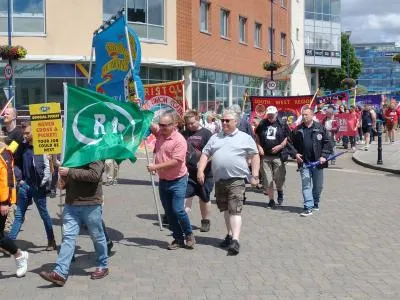
Action is being taken or is being proposed by workers and their unions in transport (RMT, ASLEF), Health (BMA, Unison), Education (NEU, NASUWT), Council Workers, Royal Mail, Open Reach/Broadband workers and as time goes by, as conditions worsen with no negotiations offered – even more. Some of the worst real-terms pay-cuts show Junior Doctors being slapped with a 22% pay-cut since 2008-9, as well as the even worse paid Nurses who will walk out if their demands for a 5% pay increase above inflation are not met “But the Government has so far requested to cap any pay increased for 2022-2023 at 3%” (The Independent).
This illustrates the essential collaboration between state and its capitalist allies, both depend upon each other for the maintenance and further neoliberalisation of society.
This ‘cost of living crisis’ isn’t new – there has always been a cost-of-living crisis under capitalism for the vast majority. Those within the middle and upper classes have not experienced the choice between ‘heating and eating’ as a terrifyingly existential choice they face on a daily basis. However, it is true that things are exponentially getting worse for working people – both due to unforeseen factors such as the pandemic and the disruption to supply chains for essentials which the war in Ukraine is bringing about, but also, more importantly purposeful, concerted efforts by the ruling class and the political system which they prosper from and exploit, to make workers even worse off. By denying rights to collective action against employers, de-funding social services and all the classics from the Thatcherite rulebook.
It is the fundamental understanding of any anti-capitalist or class-conscious worker that
“Everywhere you will find that the wealth of the wealthy springs from the poverty of the poor” (Pyotr Kropotkin)
The Russian Anarcho-Communist Kropotkin wrote down these words in 1892, and whilst many aspects of capitalism have changed since then, the fundamentals remain the same – that the existence of poverty and the subsidiary position of the working class in relation to the ruling class is maintained by their exploitation.
And so today we see that the ruling class are heating up their iron sticks to pierce the working class and their movement for decent wages, conditions, and fundamental democratic rights. It’s no surprise that the new unelected prime ministers to be chosen by the conservative party members are both supporting banning strike action within essential services such as transport and health, just as the biggest wave of strike action in decades is quickly fomenting amongst workers of the country. If such legislation is successful, it means that the entirety of the movement for workers rights and the unions will be pushed into unofficial strike actions, to operating outside of the already draconian, restricted and undemocratic confines of what the British state deems acceptable. Legislation on workers rights are designed to quash worker and societal solidarity with disputes, for example, striking in solidarity with another exploited workplace is illegal, the legalisation and further utilisation of scab-labour is increasing, all to divide and rule the workers movement, to destroy disputes in their stride. Unofficial action, under an increasingly authoritarian and nakedly pro-bourgeoise system becomes the only effective measure against the increasing control of the capitalist state.
For many in the ‘mainstream’ or reformist labour movement, this is unthinkable – everything to them, particularly the bureaucrats and aspiring campaigners, must be done within the official channels, by asking their oppressors for permission for a protest or being deferential to the archaic people, institutions and processes that this semi-feudal, class-based, elitist & white supremacist system reproduces and protects.
Working people are not getting a pay raise, whilst the ruling class are getting a pay rise, so workers respond by mobilizing and uniting, the ruling class respond by moving to restrict their rights to such an extreme level that the leaders of right-wing banana republics would blush. This is class war, pure and simple. Its class war now, it was class war under the post-war years, and it has been class war since before the days of capitalism proper.
As Anarcho-Syndicalists, what the Solidarity Federation will do and always has done, is to support the disputes the unions and their workers are taking up against their employers. We do not agree that the hierarchical, leadership-based, business model of many trade unions is the most effective – as any movement or organization that replicates the unequal power-divisions of broader capitalist society are doomed to replicate its unequal social conditions. As a comrade within SF puts it:
“... Union leaders are powerless unless members are organising unofficial action from below
The left needs to get real about this. We didn’t get the rights we have now because of legal or peaceful industrial action. The laws were put in place to STOP unofficial action, that’s the only reason union leaders have power as mediators – they are expected to be a speed bump on direct action
So long as we depend on legalised action to win, the government will take away those rights the second we start to use them effectively
Restriction on ballot numbers were just the beginning
As a bare minimum, even official action needs to be coordinated from below. So the government requires us to ballot before we go on strike? In response, we should have the same turn-out thresholds when it comes to going back to work!
If the decision to end a strike and go back to work had to be voted on at mass meetings, that would give us the experience to be able to pull those things off when our unions are made illegal. The leaders aren’t just going to hand that power over to us, but even they have to see that without that kind of measure, their days on a union salary are numbered
As a starting point, learn how to organise unofficial action. Learn about the kind of methods we used to use – the lightning strike, the go slow, marching on the boss. The SolFed workplace organiser training is an excellent place to get all of that."
Therefore, we support all workers in their struggle for better pay, conditions, and in the long haul – liberation from exploitation.
We can see that a concerted effort from the workers movement to unite all sectors, especially against the business-government duopoly and the quasi-fascistic call by our next potential Prime Minister to ban strikes in essential services – is essential. When the ‘labour’ party bans its representatives from supporting picket-lines or even whispering the words ‘socialism’ or ‘collective bargaining’ we know that party-politics and the whole ideology of relying on the powerful and the officials to protect our rights and livelihoods is a sham. We need a general strike, a general strike to paralyze the power-dynamics of late-stage, neoliberal capitalism. We need a mass-mobilization of workers into free, non-hierarchical movements of working people, who succeed through their autonomy from union bosses, party leaders and the like. We need to offer the alternative strategy and the new society that the bureaucrats wont.
The Solidarity Federation offers its full support and solidarity with workers all across the country fighting for better rights, work and pay!