Home
Solidarity Federation
IWA
User account menu
  • Contact
  • Log in
  • Home
    • Intro
    • Workplace organiser training
    • Industrial strategy
    • Community strategy
    • Constitution
  • SolFed
    • Brighton
    • Bristol
    • Edinburgh
    • Liverpool
    • Manchester
    • North London
    • Wales
    • Yorkshire
  • Industries & sectors
    • Claimants and unpaid
    • Education
    • Health and social care
    • Hospitality
  • Events & reports
  • Publications
    • Guides
      • Stuff your boss (doesn't want you to know)
      • Stuff your sexist boss (doesn't want you to know) (2018)
      • Stuff your landlord (doesn't want you to know) (2016)
      • Is your cleaning job killing you? A guide to cleaners health and safety (2017)
      • Office worker’s health and safety - your rights and how to use them (2015)
      • A migrant's guide to Manchester (2016) [en es]
      • A migrant's guide to London (2014) [en es pl]
      • Strike - a guide to walking out (2014)
    • Pamphlets and books
      • Anarcho-syndicalism in Britain – a little history (2015)
        • 1. 19th century to 1914 - The First International, growth of industrial unionism and the Great Unrest
        • 2. 1914–1945 - State suppression and the Bolshevik turn – how Lenin’s seeming success drew militants to the Comintern
        • 3. 1945–1994 - The Anarchist Federation of Britain, Syndicalist Workers’ Federation and Direct Action Movement
        • 4. Today’s movement - A short look at the strategy and thinking of the modern Solidarity Federation
      • Office worker’s health and safety - your rights and how to use them (2015)
      • Anarchism and Anarcho-syndicalism (Rudolf Rocker, 2014)
        • Introduction
        • 1. Ideology of Anarchism
        • 2. History of anarchist philosphy, from Lao-Tse to Kropotkin
        • 3. The origins of anarcho-syndicalism
        • 4. Socialism and anarcho-syndicalism in France
        • 5. The role of the trade unions: anarcho-syndicalist view
        • 6. The struggle in Germany and Spain
        • 7. The political struggle: anarcho-syndicalist view
        • 8. Anarcho-syndicalism since the First World War
      • Fighting for ourselves - anarcho-syndicalism and the class struggle (2012)
        • Introduction
        • 1. The mainstream workers' movement
        • 2. Radical currents in the workers' movement
        • 3. Anarcho-syndicalism in the 20th century
        • 4. Capitalism and the class struggle since World War II
        • 5. Anarcho-syndicalism in the 21st century
        • Endnotes
      • Workmates - direct action workplace organising on the London underground (2011)
      • The Economics of freedom (2003)
      • A history of anarcho-syndicalism (2001)
      • Out of the frying pan, a critical look at works councils (1998)
      • Health and safety at work - an anarcho-syndicalist approach (1997)
      • Anarcho-syndicalism in Puerto Real (1994)
    • Leaflets and flyers
      • Solidarity Federation Education Union (SFEU)
      • Solidarity Federation Hospitality Workers Union (SFHWU)
      • Why do we organise?
      • This is our flag - it tells you what we stand for
      • What is anarcho-syndicalism anyway?
      • Anarchism and Syndicalism (short version)
      • Anarchism and Syndicalism
      • Towards a better union
      • Protest is not enough
      • Building beyond elections
      • We should run our workplaces
      • We should run our communities
      • We should run our movements
    • Newsletters
      • Brighton Solidarity
        • Brighton Solidarity #3
      • Education Worker
        • Education Worker #10 Victimisation (2013)
        • Education Worker #9 (2012)
        • Education Worker #8 Academy Special (2012)
      • Wildcat!
        • Wildcat! #13 (Jan 2013)
        • Wildcat! (Winter 2012)
        • Wildcat! #6 (Summer 2011)
        • Wildcat! #5 (Spring 2011)
        • Wildcat! #4 (Dec 2010)
        • Wildcat! #3 (Oct-Nov 2010)
        • Wildcat! #2 (Jul-Aug 2010)
        • Wildcat! Football for the fans NOT for fat cats! (Jul 2010)
        • Wildcat! #1 (May-June 2010)
      • May Day Bulletin (Newcastle SolFed, 2014)
    • Direct Action
      • Direct Action #2 (2024)
      • Direct Action #1 (2023)
      • Direct action #47 (Summer 2009)
    • Catalyst
      • Catalyst #29 (Feb 2012)
      • Catalyst #28 (Oct 2011)
      • Catalyst #27 (Jun 2011)
      • Catalyst #26 (Mar 2011)
      • Catalyst #25 (Dec 2010)
      • Catalyst #24 (Summer 2010)
    • SelfEd
      • A history of anarcho-syndicalism
        • Block 1
          • Unit 1: The Origins of Capitalism
          • Unit 2: Britain: The Radical Period 1750-1840
          • Unit 3: The First International
          • Unit 4: France 1870-1918 Early revolutionary unions
          • Unit 5: Revolutionary Syndicalism in Britain, 1870-1910
          • Unit 6: Revolutionary Syndicalism in Britain and Ireland, 1910-17
        • Block 2
          • Unit 7: Mexico 1870-1920: Colonialism and Revolution
          • Unit 8: USA 1886-1930 - The Wobblies
          • Unit 9: Anarcho-syndicalism in Argentina 1870-1939
          • Unit 10: Sweden 1889-1939
          • Unit 11: Russia I: 1850-1917
          • Unit 12 Russia II: 1917-30
        • Block 3
          • Unit 13: Going Global - International Organisation, 1872-1922
          • Unit 14: Anarcho-syndicalism in Britain, 1914-30
          • Unit 15 Spain, 1868-1936: Build-up to Revolution
          • Unit 16 Spain: Culture, education, women and sexuality
          • Unit 17: Spain 1936-39: Revolution and Civil War
          • Unit 18: Spain - The Collectives
        • Block 4
          • Unit 19: Britain, 1930-1950 - The Era of Reform
          • Unit 20: Britain, 1950-1990 - Decline of Social Democracy
          • Unit 21: anarcho-syndicalism 1939-99
          • Unit 22: Roots of modern anarcho-syndicalism: freedom, oppression & rebellion
          • Unit 23: Roots of modern anarcho-syndicalism: morality, culture & tactics
          • Unit 24: The spirit of anarcho-syndicalism
    • Letters
  • IWA

Brighton SolFed supports workers in sexual harassment dispute against Mange Tout

By www, 11 February, 2022
bsf

Brighton SolFed started a public campaign against Brighton restaurant, Mange Tout, on Sunday 6th February. We had been contacted by three former workers, who had all experienced and/or witnessed various forms of sexual harassment from both a colleague and an owner. After raising the issue with management, one worker was unfairly dismissed and the other two faced constructive dismissal, with the work environment becoming so uncomfortable they did not feel safe returning.

We are supporting all three former workers together in a direct action campaign to collectively demand Mange Tout address their failings, implement meaningful changes and compensate the workers for the financial losses and emotional damages they have incurred.

Their demand list is as follows:

  • Implementing Anti-Harassment training (#OvertoYou Scheme of the Survivor’s Network provides training)
  • Implementing a formal Grievance Procedure at Mange Tout
  • Addressing the toxic culture within the workplace
  • Providing financial compensation

While it is important for the affected workers to receive compensation for personal losses and damages, the three workers are conscious that the work culture needs to drastically change for the sake of any future employees. This is why they have taken a transformative justice approach in demanding steps that will hopefully begin real, structural change at the establishment.

Mange Tout were given two weeks to respond to our initial letter, but have not yet engaged meaningfully or made satisfactory steps to resolve the issue. They have rather been deflecting blame by claiming that the perpetrator is no longer employed there and there has been a police investigation. This is not the full truth, the complaint was raised about more than one person and there are still perpetrators at Mange Tout. The issue goes deeper than just one individual and involves multiple cases of harassment as well as unfair dismissal and the attempts by management to cover this up.

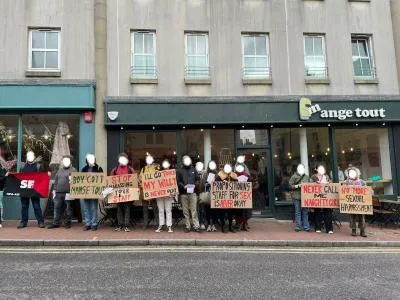
We began our public dispute this week by picketing the restaurant, handing out leaflets and holding signs to inform the public about what happened. The public reaction was overwhelmingly supportive, and we succeeded in turning away the vast majority of their customers during the hour we were outside. As we were leaving, we were approached by two police officers who took issue with some language on a sign (‘“I’ll go touch my willy” is never okay to say’), deeming it offensive. We find these comments (made by a colleague) deeply offensive too, which is why we are publicising them!

Since the picket, SolFed has been contacted by an independent HR consultant, inviting only one of the workers to what they have described as a “grievance investigation”. The Mange Tout management's strategy seems to be to act as if they didn't fire this worker for raising a grievance. Despite the former worker rejecting this as inadequate and too late, the HR consultant has said that the hearing will take place whether they are present or not. Their sole engagement with the issues raised so far has been to impose a meaningless process on a former employee that feels more like disciplinary than a grievance.  It is an attempt to individualise the dispute and isolate the workers, through only acknowledging one of their complaints. This is a performative gesture - Mange Tout are attempting to squirm out of responsibility now that this dispute is public to avoid any accountability. This issue is a collective one, and the three affected workers will not be isolated and divided. 

Sexual harassment is especially prevalent in the hospitality industry, but all too often goes unacknowledged or dismissed as simply “part of the job”. This kind of sex discrimination is however completely unacceptable and illegal under the Equality Act 2010. With the mean average employment tribunal award in 2019/20 being £17,420 for sex discrimination and £10,812 for unfair dismissal, we know that our demands are more than reasonable (https://www.morton-fraser.com/insights/employment-tribunal-award-statistics).

With this dispute now in the public eye, we hope to set a precedent that survivors of harassment will not be silenced, and that the businesses perpetuating this culture face real, material consequences. Until Mange Tout meaningfully engage with us to remedy these issues, we will continue this public campaign.

Guides

Your rights at work

Why do we organise? Capitalism is shit, oppression is shit - but what can we at SolFed do about it?

Why do we organise?

This is our flag - it tells you what we stand for

this-is-our-flag

Direct Action #2 (2024)

Direct Action #2 (2024)

Anarcho-syndicalism in Britain – a little history (2015)

Anarcho-syndicalism in Britain – a little history (2015)

Office worker’s health and safety - your rights and how to use them (2015)

Office worker’s health and safety - your rights and how to use them (2015)

Anarchism and Anarcho-syndicalism (Rudolf Rocker, 2014)

Anarchism and Anarcho-syndicalism (Rudolf Rocker, 2014)

Fighting for ourselves - anarcho-syndicalism and the class struggle (2012)

Fighting for ourselves - anarcho-syndicalism and the class struggle (2012)

Theory & Practice 1 - Workmates - direct action workplace organising on the London underground (2011)

Theory & Practice 1 - Workmates - direct action workplace organising on the London underground (2011)

The Economics of freedom (2003)

The Economics of freedom (2003)

A history of anarcho-syndicalism (SelfEd Collective, 24 unit series, 2001)

A history of anarcho-syndicalism (SelfEd Collective, 24 unit series, 2001)

Out of the frying pan, a critical look at works councils (1998)

Out of the frying pan, a critical look at works councils (1998)

Health and safety at work - an anarcho-syndicalist approach (1997)

Health and safety at work - an anarcho-syndicalist approach (1997)

Theory & Practice 2 - Anarcho-syndicalism in Puerto Real (1994)

Theory & Practice 2 - Anarcho-syndicalism in Puerto Real (1994)
RSS feed