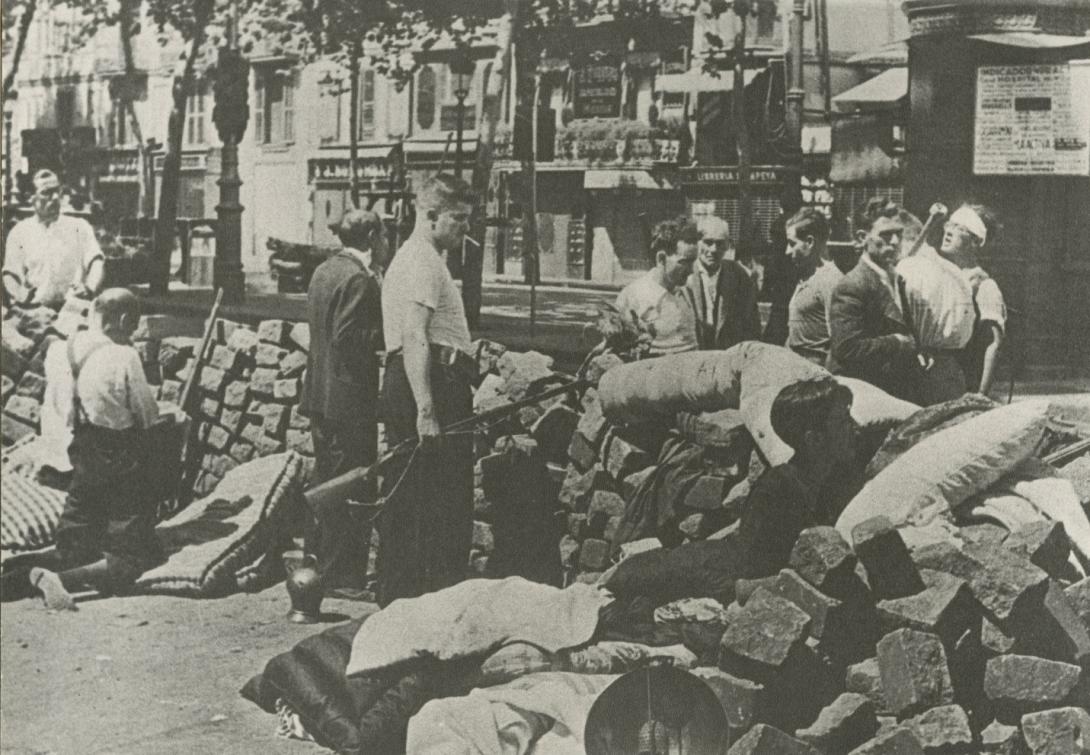
In July 1936, in response to a military-fascist mutiny of right-wing generals against the Spanish Republic, in Barcelona – the capital of the region of Catalonia and the largest industrial centre of the country – a general strike flared up and grew into a worker revolt. The core elements of this uprising were armed members and supporters of the CNT.
The uprising was prepared and organized by “committees of defense” which were created in Barcelona’s working class neighbourhoods from members of the CNT, the Federation of Anarchists of Iberia (FAI), and Libertarian Youth. The most active role in the uprising was played by members of one of the anarchist groups – Nosotros (Buenaventura Durruti, Francisco Ascaso, Juan García Oliver, Ricardo Sanz, Aurelio Fernandez, and others), which constituted something like a Central Revolutionary Committee of Defense.
The army mutiny in Barcelona was suppressed. But the workers did not limit themselves to simple clashes with army units. They spontaneously began to carry out the social revolution: they seized enterprises and introduced workers’ selfmanagement; they took supply, transport, and social services into their own hands; they organized a new life. The CNT union of food industry workers opened communal cafeterias where people could eat for free. Even during the fighting, in each working class quarter of the city food committees were organized to arrange the requisition of food products from warehouses and to set up the exchange of manufactured goods for food with the peasantry. Market commerce and the money system were replaced to a significant extent by non-monetary exchange. The food supplies acquired in these exchanges was distributed according to norms established by the committees. Clothing and other consumer goods were distributed through shops and stores. There were instances where workers raided banks and monasteries and burned the money confiscated as a symbol of the hated Capitalism. Items from pawn shops were returned to the people who had been compelled to pawn them. The labour unions (syndicates) confiscated large government and privately-owned buildings and set up their headquarters in them. At the majority of industrial enterprises, in transportation, and in social services, general meetings of worker collectives took place which elected management committees, most of the members of which were representatives of the CNT. Such a seizure of production units by a collective received the name “collectivization.” In several sectors (woodworking in Barcelona, bakeries, railway transport, and others the collectivization of industry went on to the next stage of socialization: the whole production process from start to finish was subject to the self-management of workers, who created the appropriate organs. Within a few days life in Barcelona had already normalized: transport was running, enterprises were working, shops were open, and communications systems were operating. Researchers concur that all the revolutionary measures and the normalization of daily living were, basically, the spontaneous actions of workers belong to the CNT; the corresponding orders had not been issued by some higher committee of the union federation. Initiatives most often came from rank-and-file members of the unions (syndicates) of the CNT or from front-line anarcho-syndicalist and anarchist activists.
“... the proletariat of Catalonia,” according to Andre Capdevilla, a member of a CNT syndicate of textile workers, “was saturated with anarcho-syndicalist revolutionary propaganda. Over a period of many decades the notion had taken root among the workers that they should make the most of any opportunity to carry out the Revolution. So they acted as soon as the possibility presented itself.”
The Revolution also took hold in other cities (above all, in Catalonia), and also rural areas (in Catalonia, parts of Aragon, Andalusia, and Valencia). In regions with large estates the peasants seized the land from its owners. In many regions they agreed to carry on agricultural work on a group basis – by forming “collectives.” In regions such as Aragon and Andalusia, the anarchists had carried on agitation among the village population over a period of many decades. “In those most backward regions to which they were sent,” according to [URL=/tags/gaston-leval] Gaston Leval, an eye-witness, participant, and researcher of these events, “our comrades joined in working in the fields and were able to communicate more advanced technical ideas, and teach the children to read. The result was that the Good News [anarchism] penetrated into the socially most backward areas of the countryside.” The German anarchosyndicalist Augustin Souchy told the story of an anarchist from the Aragonese village of Munesa, who worked for a long time in Barcelona, and then went back to his native village and acquainted the peasants with libertarian ideas. Under his influence his fellow-villagers organized a collective – a free commune. “A Spanish edition of Kropotkin’s book The Conquest of Bread lay on the table. In the evenings members of the collective would gather, and one of them would read the book out loud. This was the new Gospel.”
During the first days of the Revolution, new structures of social self-management appeared, spontaneously formed by revolutionary workers and peasants in enterprises, village communes, and urban neighbourhoods. At the base of these structures one always found general meetings (“assemblies”) of the residents or of the labour collective. They elected revolutionary committees, committees or councils of enterprises, councils of soldiers and sailors, etc. to carry out routine, coordinating, technical, and executive functions. The members of the committees acted within a framework where they were obligated to carry out the orders of the assembly which elected them, and could be recalled at any moment. All important decisions of the committees were adopted only in accordance with the wishes of the collective of the commune.
In Barcelona the revolutionary committees, which grew out of the neighbourhood committees of defense of the CNT and “barricade committees,” occupied themselves with street-level organizing – arranging food and other services, and maintaining order. In many villages, immediately after the failure of the military mutiny, the inhabitants removed the local administration, and a revolutionary committee, elected at a general meeting, took over administrative as well as economic functions. Often the revolutionary com- mittees immediately applied themselves to such revolutionary measures as the burning of all documents about private ownership; the confiscation of the land, buldings, crops, and inventory of big landowners; the conversion of churches into storage facilities; the collectivization of land, and the organization of a volunteer militia.
Of course it was not only the anarcho-syndicalists who took part in the formation of popular organs. There were also other workers, mainly rank-and-file members of the other trade union central – the General Union of Workers (UGT) – which was oriented towards the Socialist Party Consequently, the composition of these organs reflected the correlation of forces between the CNT, the UGT, and other forces.
In any case, the power of the State ceased to function over a significant part of the territory of Spain. The central government of the Republic in Madrid was completely discredited by its inability to oppose the military mutiny and lost all its authority. The regional government of Catalonia (the Generalitat) headed by Luis Companys controlled only its own building. Local administrations were either removed or neutralized. The army and police were either disbanded or destroyed. Barcelona was controlled by workers’ militias, primarily anarcho-syndicalist in composition. “... power was lying in the street, and it was embodied by the people armed,” noted the contemporary researcher Abel Paz. The anarcho-syndicalists, who now enjoyed a dominant influence among the workers of Catalonia, were confronted by a decision about what to do with this power: whether to destroy it, take it into their own hands, or hand it over to others.