Home
Solidarity Federation
IWA
User account menu
  • Contact
  • Log in
  • Home
    • Intro
    • Workplace organiser training
    • Industrial strategy
    • Community strategy
    • Constitution
  • SolFed
    • Brighton
    • Bristol
    • Edinburgh
    • Liverpool
    • Manchester
    • North London
    • Wales
    • Yorkshire
  • Industries & sectors
    • Claimants and unpaid
    • Education
    • Health and social care
    • Hospitality
  • Events & reports
  • Publications
    • Guides
      • Stuff your boss (doesn't want you to know)
      • Stuff your sexist boss (doesn't want you to know) (2018)
      • Stuff your landlord (doesn't want you to know) (2016)
      • Is your cleaning job killing you? A guide to cleaners health and safety (2017)
      • Office worker’s health and safety - your rights and how to use them (2015)
      • A migrant's guide to Manchester (2016) [en es]
      • A migrant's guide to London (2014) [en es pl]
      • Strike - a guide to walking out (2014)
    • Pamphlets and books
      • Anarcho-syndicalism in Britain – a little history (2015)
        • 1. 19th century to 1914 - The First International, growth of industrial unionism and the Great Unrest
        • 2. 1914–1945 - State suppression and the Bolshevik turn – how Lenin’s seeming success drew militants to the Comintern
        • 3. 1945–1994 - The Anarchist Federation of Britain, Syndicalist Workers’ Federation and Direct Action Movement
        • 4. Today’s movement - A short look at the strategy and thinking of the modern Solidarity Federation
      • Office worker’s health and safety - your rights and how to use them (2015)
      • Anarchism and Anarcho-syndicalism (Rudolf Rocker, 2014)
        • Introduction
        • 1. Ideology of Anarchism
        • 2. History of anarchist philosphy, from Lao-Tse to Kropotkin
        • 3. The origins of anarcho-syndicalism
        • 4. Socialism and anarcho-syndicalism in France
        • 5. The role of the trade unions: anarcho-syndicalist view
        • 6. The struggle in Germany and Spain
        • 7. The political struggle: anarcho-syndicalist view
        • 8. Anarcho-syndicalism since the First World War
      • Fighting for ourselves - anarcho-syndicalism and the class struggle (2012)
        • Introduction
        • 1. The mainstream workers' movement
        • 2. Radical currents in the workers' movement
        • 3. Anarcho-syndicalism in the 20th century
        • 4. Capitalism and the class struggle since World War II
        • 5. Anarcho-syndicalism in the 21st century
        • Endnotes
      • Workmates - direct action workplace organising on the London underground (2011)
      • The Economics of freedom (2003)
      • A history of anarcho-syndicalism (2001)
      • Out of the frying pan, a critical look at works councils (1998)
      • Health and safety at work - an anarcho-syndicalist approach (1997)
      • Anarcho-syndicalism in Puerto Real (1994)
    • Leaflets and flyers
      • Solidarity Federation Education Union (SFEU)
      • Solidarity Federation Hospitality Workers Union (SFHWU)
      • Why do we organise?
      • This is our flag - it tells you what we stand for
      • What is anarcho-syndicalism anyway?
      • Anarchism and Syndicalism (short version)
      • Anarchism and Syndicalism
      • Towards a better union
      • Protest is not enough
      • Building beyond elections
      • We should run our workplaces
      • We should run our communities
      • We should run our movements
    • Newsletters
      • Brighton Solidarity
        • Brighton Solidarity #3
      • Education Worker
        • Education Worker #10 Victimisation (2013)
        • Education Worker #9 (2012)
        • Education Worker #8 Academy Special (2012)
      • Wildcat!
        • Wildcat! #13 (Jan 2013)
        • Wildcat! (Winter 2012)
        • Wildcat! #6 (Summer 2011)
        • Wildcat! #5 (Spring 2011)
        • Wildcat! #4 (Dec 2010)
        • Wildcat! #3 (Oct-Nov 2010)
        • Wildcat! #2 (Jul-Aug 2010)
        • Wildcat! Football for the fans NOT for fat cats! (Jul 2010)
        • Wildcat! #1 (May-June 2010)
      • May Day Bulletin (Newcastle SolFed, 2014)
    • Direct Action
      • Direct Action #2 (2024)
      • Direct Action #1 (2023)
      • Direct action #47 (Summer 2009)
    • Catalyst
      • Catalyst #29 (Feb 2012)
      • Catalyst #28 (Oct 2011)
      • Catalyst #27 (Jun 2011)
      • Catalyst #26 (Mar 2011)
      • Catalyst #25 (Dec 2010)
      • Catalyst #24 (Summer 2010)
    • SelfEd
      • A history of anarcho-syndicalism
        • Block 1
          • Unit 1: The Origins of Capitalism
          • Unit 2: Britain: The Radical Period 1750-1840
          • Unit 3: The First International
          • Unit 4: France 1870-1918 Early revolutionary unions
          • Unit 5: Revolutionary Syndicalism in Britain, 1870-1910
          • Unit 6: Revolutionary Syndicalism in Britain and Ireland, 1910-17
        • Block 2
          • Unit 7: Mexico 1870-1920: Colonialism and Revolution
          • Unit 8: USA 1886-1930 - The Wobblies
          • Unit 9: Anarcho-syndicalism in Argentina 1870-1939
          • Unit 10: Sweden 1889-1939
          • Unit 11: Russia I: 1850-1917
          • Unit 12 Russia II: 1917-30
        • Block 3
          • Unit 13: Going Global - International Organisation, 1872-1922
          • Unit 14: Anarcho-syndicalism in Britain, 1914-30
          • Unit 15 Spain, 1868-1936: Build-up to Revolution
          • Unit 16 Spain: Culture, education, women and sexuality
          • Unit 17: Spain 1936-39: Revolution and Civil War
          • Unit 18: Spain - The Collectives
        • Block 4
          • Unit 19: Britain, 1930-1950 - The Era of Reform
          • Unit 20: Britain, 1950-1990 - Decline of Social Democracy
          • Unit 21: anarcho-syndicalism 1939-99
          • Unit 22: Roots of modern anarcho-syndicalism: freedom, oppression & rebellion
          • Unit 23: Roots of modern anarcho-syndicalism: morality, culture & tactics
          • Unit 24: The spirit of anarcho-syndicalism
    • Letters
  • IWA

A letter to UK Uncutters from the 'violent minority'

By Joseph Kay, 28 March, 2011

We're writing this to you to try and prevent the anti-cuts struggle being split up and weakened by the media.

We are anarchists (well, anarcho-syndicalists, technically) – a word that is much misunderstood and misrepresented. We are also students, workers and shop stewards. We co-organised a 'Radical Workers Bloc' on the South London feeder march. The aim was to provide a highly visible radical presence within the workers movement of which we are a part, advocating strikes, occupations and civil disobedience.

Saturday's demonstration was far bigger than anyone expected, and saw thousands go beyond a simple A-B stroll to take direct action. The UK Uncut actions on Oxford Street and in occupying Fortnum and Masons provoked harsh treatment from police, including mass arrests.

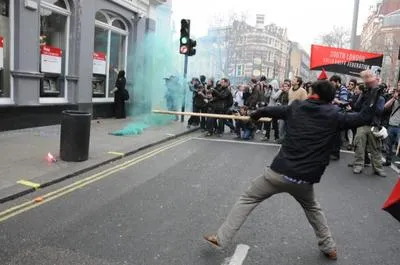
When we reached Trafalgar Square, we headed for Oxford Street for the 2pm actions to put some of these words into action (anarchist and UK Uncutter were not mutually exclusive on the day!). When we arrived, we met up with other anarchists who had had the same idea. Wary of being kettled, we chose to stay mobile, causing disruption on Oxford St and the surrounding area, including to UK Uncut targets which were closed and guarded by riot police. Subsequently, several banks, the Ritz and other buildings were damaged or hit by paint bombs. There were some minor scuffles with police. There is a valid debate to be had over tactics - which ones further the anti-cuts movement or are counter-productive - and many of us would favour mass direct action over property destruction. Let's have that debate within the anti-cuts struggle, and not let the media divide us.

But think about it from the store owners' point of view: a broken window may cost £1,000. A lost Saturday's trade through a peaceful occupation would cost many times more. Perhaps this helps explain the harsh police response to the UK Uncut occupation: it hits them where it hurts, in the pocket. Traditionally, workers have used the weapon of the strike to achieve this. But what about workers with no unions, or unions unwilling to strike? What about students, the unemployed? UK Uncut actions have been very successful at involving such people in economically disruptive action – and this seems to be on the right track in terms of forcing the government to back down on its cuts agenda. More and bigger actions in this vein will be needed to stop the cuts (in France, they call these 'economic blockades'). Like those in UK Uncut, we recognise that just marching from A to B or waiting for the government to be fair is not enough. The government, rich and tax avoiders will continue to seek to make the poorest in society pay for the defecit unless we make doing so the more expensive option. As UK Uncut announced on the demonstration 29th January "If the economy disrupts our lives, then we must disrupt the economy". 

The press coverage since Saturday has gone into a well-rehearsed frenzy of 'good protestor/bad protestor'. Some UK Uncutters have expressed outrage at being lumped in with the 'bad protestors', (correctly) stressing the peaceful nature of the F&M occupation. We think the whole idea of dividing 'good' and 'bad' protest serves only to legitimise police violence and repression. As we saw on Saturday, repression is not provoked by violent actions, but by effective actions – there is a long history of peaceful pickets and occupations being violently broken up by police, from the Chartists to the Miners Strike. Indeed, UK Uncut have frequently been at the blunt end of this in recent memory yourselves, with police responding to non-violent occupations with pepper spray and violent arrests.

In this light, we would say keep up the good work. Let the mass arrests strengthen your resolve not deter you. And let’s not fall into the divide-and-rule tactics that are the oldest trick in the rich’s book. If we can help or offer any practical solidarity to the arrestees, please get in touch. We’ve previously hosted legal advice and training sessions with Fitwatch and the Legal Defence and Monitoring Group – we’d be happy to do this again. Or if the arrests are causing problems with employers, we'll help arrestees organise against victimisation. On Saturday most of the arrestees were UK Uncut activists. Next time it could be us. We – those of us fighting the cuts – are all in this together.

Signed, Brighton Solidarity Federation

Plus individuals from: Northampton, North London, Manchester, Thames Valley, Liverpool and South London Locals (our federal democratic structure means statements can only be issued in the name of a group if the group has had the opportunity to discuss it, and time is against us!)

  • cuts
  • demonstrations
  • occupations
  • solidarity
  • UK Uncut
  • police
  • repression

Guides

Your rights at work

Why do we organise? Capitalism is shit, oppression is shit - but what can we at SolFed do about it?

Why do we organise?

This is our flag - it tells you what we stand for

this-is-our-flag

Direct Action #2 (2024)

Direct Action #2 (2024)

Anarcho-syndicalism in Britain – a little history (2015)

Anarcho-syndicalism in Britain – a little history (2015)

Office worker’s health and safety - your rights and how to use them (2015)

Office worker’s health and safety - your rights and how to use them (2015)

Anarchism and Anarcho-syndicalism (Rudolf Rocker, 2014)

Anarchism and Anarcho-syndicalism (Rudolf Rocker, 2014)

Fighting for ourselves - anarcho-syndicalism and the class struggle (2012)

Fighting for ourselves - anarcho-syndicalism and the class struggle (2012)

Theory & Practice 1 - Workmates - direct action workplace organising on the London underground (2011)

Theory & Practice 1 - Workmates - direct action workplace organising on the London underground (2011)

The Economics of freedom (2003)

The Economics of freedom (2003)

A history of anarcho-syndicalism (SelfEd Collective, 24 unit series, 2001)

A history of anarcho-syndicalism (SelfEd Collective, 24 unit series, 2001)

Out of the frying pan, a critical look at works councils (1998)

Out of the frying pan, a critical look at works councils (1998)

Health and safety at work - an anarcho-syndicalist approach (1997)

Health and safety at work - an anarcho-syndicalist approach (1997)

Theory & Practice 2 - Anarcho-syndicalism in Puerto Real (1994)

Theory & Practice 2 - Anarcho-syndicalism in Puerto Real (1994)
RSS feed