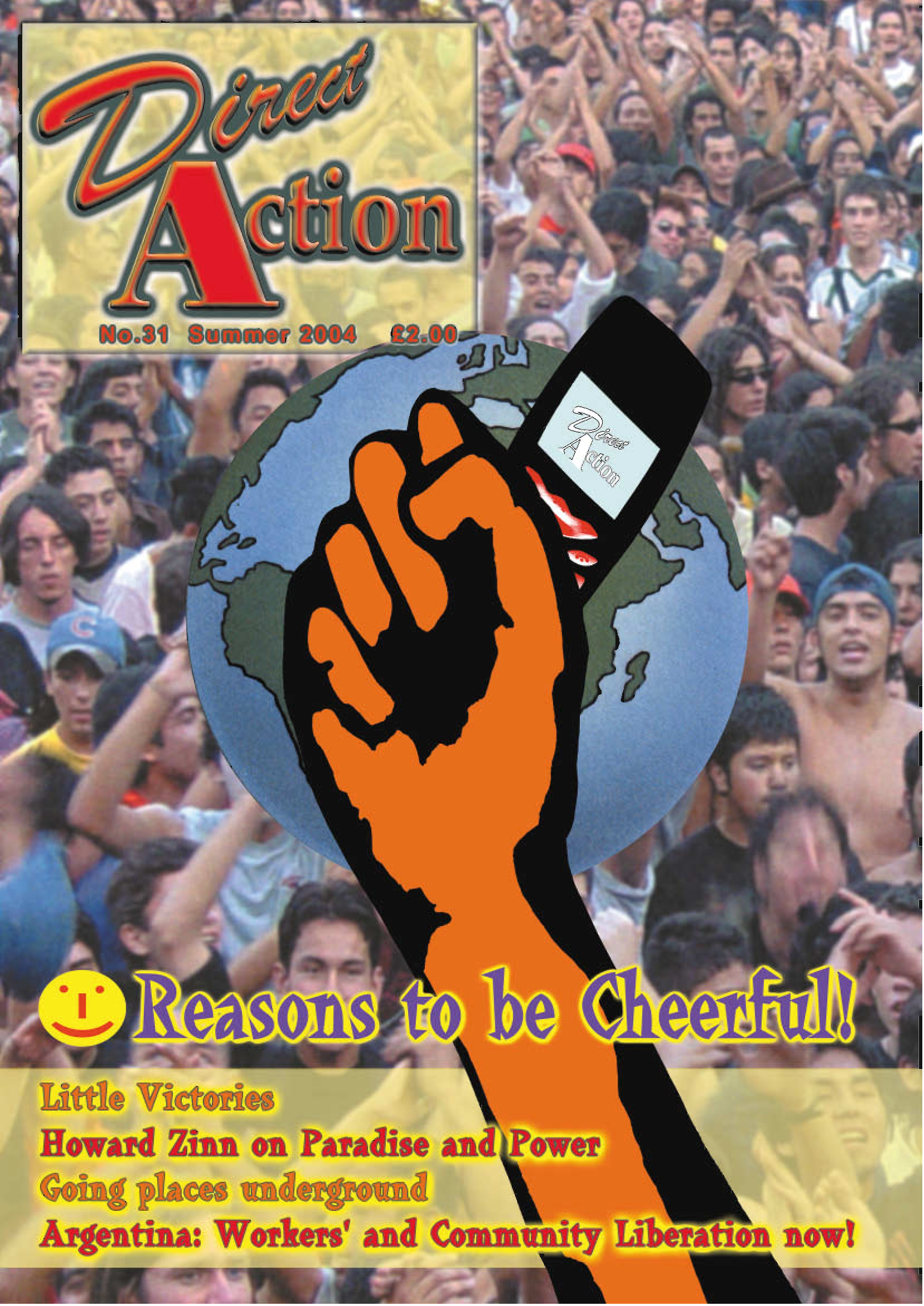
Direct Action #31 Summer 2004
Editorial • Our Turn
Regulars:
Actions & comment • MayDay'04 - Lancsfocus; Seeing around the corner; Why we hate some Americans; Le Pen sent packing; NHS sell-off; All AUT?; Iraq occupation in Pictures...
On the edge • Nike Offensive; Blair Doesn't Care; Hypocrites Disunited; Football Fans; Work Kills More Than Wars...; GM update; Naked Bike Ride; Greece reasons
International news • USA; West Papua; El Salvador; Haiti; Zambia; Spain; China; Belize; Iran; Colombia; India; Slovakia; Pakistan; Trinidad & Tobago
Features • Yo No Quiero Taco Bell; Coca Cola Criminals
Ideas for change • Anarchist Federation - Comradely comments
Justicepages • Tony and George's torture chambers
Notes & letters
Reviews:
Feature • Of Paradise and Power
Books and pamphlets • The Burning Tigris - Peter Balakian; Peace Signs - The anti-war movement illustrated; 2/15 the day the world said NO to war - Hello NYC; Radical Priorities - Noam Chomsky; Controlled Flight into Terrain: Stealworks; Anthology 3.0 - John Yates; Workers' Councils - Anton Pannekoek
Music and film • The Passion of Christ - dir. Mel Gibson; The Insanity Clause - Deja Vue e.p.; 1-Speed Bike - Droopy Butt Begone!; Desaparecidos - Read Music/ Speak Spanish; Calvin Party - Lies, Lies & Government, & Life and other sex tragedies
Theme:
Reasons to be cheerful; Little Victories; Why no good news?
Centrespread • Going places underground
Globalfocus • Argentina
Closerlook • Sick boy of Europe
this issue's theme - thegoodnews
Direct Action is published by Solidarity Federation, the British section of the International Workers' Association, and is edited, typeset and printed labour-free by the Direct Action Collective. DA is produced under direct workers' control, without help from the state or rich benefactors.
Subscription Rates: £5 Basic £12 Supporters (form inside back pages)
All correspondence to: Direct Action, PO Box 29, South West PDO, Manchester M15 5HW, England. Email: da@direct-action.org.uk Ansaphone Enquiryline: 07984 675 281 www.direct-action.org.uk
About DA: Views stated within these pages are not necessarily those of the Direct Action Collective or the Solidarity Federation. Contributions come from various places, and DA has a policy of not normally crediting these personally. If you want to know about authors or sources (including web sources), contact the DA Collective. On any other issue, readers' views are welcome, whether opinions, additional information or letters responding to articles or raising issues of interest. If you want to help out with DA, or would like to know more about the Solidarity Federation, contact us. Do not expect high pressure sales, paper-selling quotas or demands for this or that; do expect a reasonably prompt reply. "The Direct Action Collective and Direct Action Magazine are not intended to incite illegal activity of any sort" - in case you were wondering.
To Contribute: If you would like to contribute more than brief opinions, we request you send articles (between 500 and 1500 words if possible) in hardcopy and on disk in either Word for Windows PC version or ASCII format. Contact us for electronic mail addresses or alternative formats. Failing that, any decent typewritten script will do, or even neat handwriting, if necessary. While unsolicited articles are welcome, they can only be returned if a request and SAE is enclosed. Send all contributions to: DA, PO Box 1095, Sheffield S2 4YR. Email; da@direct-action.org.uk
Bulk Orders: Bookshops: If you would like to order DA by bulk, contact AK Distribution, PO Box 12766, Edinburgh EH8 9YE, Scotland. Phone; 0131 555 5165 Email; ak@akuk.com Alternatively, you can order direct from DA's Manchester address above.
Direct Action ISSN0261-8753
Our turn
Following last issue's crestfallen but realistic `clampdown' theme, it seems only fair that this issue's theme is `reasons to be cheerful', or `thegoodnews', for short. So, you should find within these pages a few articles about good things that are happening, or things that we can look at more constructively, and so on. Of course, before you take out a writ under the trades descriptions act, we must point out that it is not all good news, it would be just silly to pretend that now wouldn't it?
And it is not all about 'lightening up', keeping on taking the prozac or going on holiday and everything will be alright. There is real good news, hard won in some cases, but nevertheless essential reading. Going places underground (centrepages) is a classic example of working class solidarity in action, despite Labour Britain 2004.
At the drier end of things (you'll see what i mean), put your Blairedvision shades on and lie in the sun to read Reasons to be cheerful (p.4). Or maybe muse on why the media doesn't feed us good news very often (Why no good news?, p.7). If you are in any doubt about why you bother being into activism, get your teeth into Sick boy of Europe (p.30), 3,000 words of scary stuff about the world we all live in and why and how it can change.
All this leads us on to a topic not unusual for these pages, but which we all struggle with from time to time... the dreaded self-reflection bit. Am I spending my time doing the right things? Should I pack it in? Should I do more? Can we do things better? How do I keep going, after all, even if I do participate in a successful campaign or action, there are always hundreds more - it's neverending...
Little Victories (p.6) is one person's take on being into activism and making it work for them - we all have to find our way. On this topic, a couple of US pm activists wrote an open letter to the anti-capitalist movement raising some of the questions we all think about in moments of cogitation. For example, why do the necessary numbers of people in a coherent and strategic revolutionary movement not turn up and help win a social revolution. Many people are transcending single-issue thinking and moving towards a broader anti-corporate, anticapitalist analysis. Some are overcoming false dichotomies like 'labor vs. environment.' It's not just deforestation, and it's not just sweatshops; its all that and more.
These activists highlighted three 'dualisms' or conflicts. The first is 'practice vs. theory', the basic idea being that because of years of Marxist theory, and dusty library types preaching anarchist tomes, many people have reacted and now focus primarily on practice (what they do on a daily basis) while ignoring theory (reasoning what is the best way to go about these daily doings). The problem is, to know what is appropriate at what time in a revolutionary struggle, we need to think rationally about changing contexts so that our movement can grow and evolve dynamically. We need well thought-out ideas, and means of implementing them everywhere. So, we need both practice and theory.
The second is 'spontaneity vs. institutionalisation', the basic idea being spontaneity=good (autonomy, personal freedom, and free association) and institutionalisation=bad (grey suits, bureaucracy, dogma, hierarchy). The problem is, institution - a lasting organization of stable relationships with a specific purpose - is essential. Not bad, state-linked ones, but good, autonomous ones. If we don't create community-based revolutionary infrastructure that makes the movement relevant to our neighbours in between mass mobilizations, we won't ever get real revolution - i.e. lasting systems of self-governance and community decision-making that mirror the free society we want to build.
The third is security culture vs. organisational transparency. As the authors put it, "the Feds are watching us". The concern here is that the security we adopt to deal with "them" can take on a life of its own, which can interfere with the democratic sharing of vital information. When some activists deny important information, which may be critical to making informed decisions about how to best contribute to the movement or action, organisations can fall apart, leaving participants with a bitter, disempowering, and antidemocratic feeling.
Now, you and I may be a long way from Vermont, but these activists' ideas and observations ring bells, right? Since we have set ourselves the seemingly impossible task of transforming the fundamental institutional structure of society, we might as well not make it any harder for ourselves. As they put it, "our vision for the future should inform how we organise in the present. Theory informs practice; vision informs strategy". Of course, those of us in the Solidarity Federation talk regularly about theory and practice, plan and do actions, overcome conflicts, concentrate on real opportunities rather than perceived differences, generally keep level-headed but aware of security issues; and as for creating free, democratic and auton mous organisations, you can't get much more so than SolFed. Now, that's a reason to be cheerful for a start.
[The letter referred to is by Doyle (doyle@riseup.net) and Ben (www.social-ecology.org)]
thegoodnews
regulars
9-13 actions+comment
9; MayDay'04 Lancsfocus;
10; Seeing around the corner; Why we hate some Americans;
11; Le Pen sent packing; NHS sell-off;
12; ALL AUT?;
13; IRAQ occupation in pictures...
On the edge; Nike Offensive; Blair Doesn't Care; Hypocrites Disunited; Football Fans; Work Kills More than Wars...; GM update; Naked Bike Ride; Greece reasons.
14-17 international news
USA; West Papua; El Salvador; Haiti; Zambia; Spain; China; Belize; Iran; Colombia; India; Slovakia; Pakistan; Trinidad & Tobago.
Features: Yo No Quiero Taco Bell; Coca Cola criminals.
22 ideas for change
Anarchist Federation - comradely comments.
23 justicepages: Tony and George's torture chambers
24 notes+letters
34 DA resources
Info., upcoming events, campaigns, friends & neighbours.
25-29 Feature: Of Paradise and Power
Howard Zinn on Robert Kagan's book
books and pamphlets
The Burning Tigris - Peter Balakian
Peace Signs - The anti-war movement illustrated 2/15 the day the world said NO to war - Hello NYC Radical Priorities - Noam Chomsky
Controlled Flight into Terrain: Stealworks Anthology 3.0 - John Yates
Workers' Councils - Anton Pannekoek
music and film
The Passion of Christ - dir. Mel Gibson
The Sanity Clause - Deja Vue e.p.
1-Speed Bike - Droopy Butt Begone!
Desaparecidos - Read Music/Speak Spanish
Calvin Party - Lies Lies & Government, & Life and other sex tragedies
4 Reasons to be cheerful
New Labour are clamping down on laughing and farting. I'm dead.
6 Little Victories
The work/life balance of the politically active.
8 Why no good news?
Good news is not news to the mainstream media, but we all know there's a wealth of 'good works' and feelings out there.
18 centrespread: Going places underground
Ken Livingstone talked the talk against tube privatisation. More recently, groups of tube workers, with lives as well as livelihoods at stake, have been walking the walk.
20 globalfocus: Argentina
21st Century workers' and community liberation.
30 closerlook: Sick boy of Europe
With long working hours and proven links to disease and death, the UK is the sick boy of Europe.
The move to a service based economy and the resulting social change is being exploited by Capitalism to prevent working class organisation, keep down wages and attack working conditions.
thegoodnews: Blairedvision
Reasons to be cheerful
Despite that cheerful, bright and lovely 'Big Toe' (Mr Blair) 'leading' us to the promised land of the future, with his cute pixie ears and thoroughly modern ways, some people are still miserable, moaning bastards. He must get distraught and those ears twitch to buggery when he hears how some people aren't as cheerful as he is. Some 'mindless' people (probably those who drink in 'binges' and smoke) even slag him off. A few 'morons' have a go at his lovely lady wife 'Cherry' too.
If the critics were good `christian socialists' they'd realise how far we've come and how many reasons to be cheerful there actually are. For example, there's an abundance of silver cars on the roads and even more beautiful mobile phones. It's now possible to get 'designer' phones (these have been designed rather than just the bits coming together of their own accord as they did before). There's a new advert on our 20 foot, wide screen, silver telly's (itself a reason to be cheerful) showing how you can use these new mobile phones to send messages (`texts' in this wonderful world of 'the future') to the person you're stood next to. Our mouths can be saved for the cheerful job of drinking `starfucks coffee', coca-cola tap water and bright coloured fizzy pop laced with pure alcohol (or are these those binges they don't want us to drink?).
We could even send a 'text' to the person behind the counter of one of these trendy, modern 'café bars' and save our mouths for eating a dozen, or so, of those panninis. They used to make football stickers, but in line with `big toe's' modernisation programme they now supply hot butties to minimalist, designer, fast food outlets. What's more, we can order our silver cars, silver phones, silver telly's, silver ethanol and multicoloured food from the comfort of our own couch. With futuristic, push button technology our every desire can be ordered on the PC (made from recycled policemen in line with 'Big Toe's' save the world campaign — Muslims not included). We can even get the dosh to pay for it all by going `on-line' to Loan Shark.com, a friendly debt arranger who allows us to sit there and get to a healthy 25 stone in weight (hence the loss of interest in football stickers) and £25,000 in debt. Our every whim can be satisfied without ever having to use our mouths.
But this brave new world doesn't seem to make everyone cheerful.
Take last Friday's Manchester Evening News as an example. The letters page was full of people ignoring the fantastic progress that's been made and moaning about anything. One was about the modernised buses not turning up, five of them, thereby causing a crush when one did, which allowed someone to nick the writers purse in the melee. Another two were on about how shops in Salford have got iron fences round the outside as they get robbed that much. There was one about a taxi driver charging £40 for a ride from the airport. Another slagging off the `thoroughly modern' Urbis building and how Manchester ratepayers had to pay for something they have no interest in (if they drank Starfucks they might be trendy enough to see the point of it all). One about how a load of trees has just been chopped down without asking anyone. Another about how kids are demonised for playing soccer in the street (should stick to lard burgers and spending money on the intemet, it's safer). Two more were on about how where they live is a filthy, stinking mess. That was just one nights moaning.
Mind you, they have a point. A look through the rest of the paper doesn't give many reasons to be cheerful apart from a story about a woman knitting jumpers for penguins in Australia (and that was because of oil pollution). There's a story about how kids in Stretford burned a bus out on the way home from school, thereby making the 'bricking buses campaign' in Little Hulton look a bit soft. Another about how a sterilised woman got pregnant. One about cuts to the Fire Service (just in time for the burned out bus trend). Another about a dying shopping precinct. But the worst of them all was about a disabled old lady who was battered and kicked in the head for the money she was saving for her grandchildren. She is now dead.
It's stories like these (and you'll know of many more) that suggest Blair, Cherry and all the other big noises live on a different planet from the rest of us. To expect us to think that silver this and that, designer underpants and butties made out of football stickers make life a cheerful paradise just shows how thick they think we are. The problem is that it's their version of what the planet should be that dominates. It's their ideas on 'reasons to be cheerful' that gets pushed. Right through school, the telly (even different coloured ones), the press, teenage magazines, all push the drug of greed, consumerism and putting yourself first.
The middle class lackeys, like the Blair's, the writers of 'official knowledge', upholders of the state and apologists of massive inequalities; all support the idea that someone with 'designer' glasses is a better person than one with 'Ready-Spex'. Doing this suits the people with the real power, the real rich, as it shows that the greed and disgusting morals they display are 'normal' and that they deserve to be where they are because they are better than us. Their robbery of the rest of humankind and the idleness they are famous for becomes legitimate. Loads of people copy them, conned into believing that silver this and that makes them 'superior' and `sophisticated', giving them a reason to be cheerful. But it's fool,s silver.
Does this mean there are no 'reasons to be cheerful' at all?
For some people there definitely are reasons to be cheerful; there's this magazine for a start. It shows that not all people are taken in by the alien thinking pushed by the scum that's risen to 'the top'.
Even 'out there' on the real planet not all people are taken in. On the same letters page mentioned earlier there was one letter about the banning of smoking. This chap points out that many of us became addicted years ago when the sophisticated, 'in thing', was a fag (`You're never alone with a Strand'). He reckons other drug addicts are treated better. The government made millions, so did the tobacco barons (still do). They even used slaves to grow it and made millions out of human flesh too. Now, they want to ban it (McDougals dog burgers are next on the list after them 'binges') to save money on the NHS and keep taxes down. This is the realm of the 'do-gooders' and puritanical 'clamp-downers' (see DA30). What they've done in Ireland is not democratic "it's the politics of `we know what's best for you", he says. This kind of stuff gives me a reason to be cheerful, as it shows that people don't necessarily accept the power that shoves us around.
One day we will challenge it en masse. Even now, we can see signs of people working together, for no money or power, just because they are human beings. People help each other and ask for nothing in return. For example, the money stolen from the woman in the scrum for the bus was a collection for a local hospital. All are reasons to be cheerful.
People still have a laugh and you can still get the odd good pint.
Also, without trying to sound like some drugged up hippie from the eighteenth century, the daffodils came out again. The planet still lives and the fish still swim, and the best of those are silver too.
thegoodnews: personal activism
Little Victories: The work/life balance of the politically active
There is something deeply specific about political activity. Whilst the rest of society spends its free time trying to recover from the stresses and strains of work and every day grind to survive, the politically active seek out and confront the problems that everyone else seemingly spends weekday evenings, weekends - or whenever their casualised job shift patterns allow -trying to avoid. Not only that; many of the causes and campaigns have the odds stacked against them.
Even when there are successes, there are still other campaigns, things to be protested against and for. Why on earth? This article attempts to take a broad look at this phenomenon, it is not overtly looking at anarcho-syndicalist activism, although an anarcho-syndicali st perspective informs it. Some of the ideas and proposals are not particularly revolutionary, then again, not all worthwhile ideas and activities are exclusively revolutionary, but none run counter to the ideas and principals of anarchism. It would be a shame to overlook something positive just because it wasn't 'revolutionary' enough.
Fabulously interesting
Why be politically active? Well for a start its fun, not exactly a belly holding side aching sort of thing, but generally its is really enjoyable. Now I am not saying there are not tedious meetings, plods through the back streets of major cities on some demo or other, hours spent trying to think of how to write down ideas in a way that will get across a point without being too simplistic, jargon-ridden, or just plain old fashioned dull (how am I doing mum?), there probably will. On the other hand, there will be the chance to meet some fabulously interesting people with bizarre senses of humour and have a cup of tea/pint with them; to see the interesting bits of major cities tourists seldom visit, and the chance to share ideas with others. There is a joy in the huge range of people around, all with different histories that brought them to political activism, many with years of experience, many with vast amounts of knowledge, many with endless energy and enthusiasm, and some combining all three.
Activists can be a curmudgeonly and argumentative lot, but there is remarkably good humour out there and people who care enough to want to get their point across. (Although to be honest some seem to forget to stop once their point has been got across, and a few even have trouble stopping when its got across more times than a cross channel ferry).
Hobby horses
Now you could get these individual experiences by taking up a hobby, but you'd need to have three or four quite diverse ones to get the range of experiences that can be gotten from political activism. Politics covers the whole range of human activity, from where you live to where you work to where people you are never going to meet live and work. One day there can be a demonstration in London with millions of people (well, OK, not every week), a couple of days later a small meeting to discuss problems at work, the next a local community discussing how to stop local open space being flogged of for development, followed by a trip to the countryside to protest against some attempt strip the land bare for an open cast mine or bypass, then a union meeting at work to look at how to make gains on pay and conditions. All the while, sharing ideas and information, reading the anarchist press - even writing for it or local leaflets or web sites, chatting to people, arranging further action, entering into discussions. Look at the range of items and the scope of the topics in this one issue of just one magazine. There are all sorts of possibilities out there for all sorts of activism.
Revolution during tea break
Once in the swing of things as an activist there is even the opportunity to contemplate world social revolution, or give your anarcho-syndicalist perspective on the loss of the tea break. Little things, like making helpful suggestions, getting into discussions to challenge assumptions, not letting racism creep in at work. Now, for a while, some may think you're a bit of an oddity, but as long as you're informed and helpful and not insulting you will be a friendly oddity. Many of these things might seem far from revolutionary, but there is nothing more sure fire to turn people off than having full-on political debate thrust upon them during every chat round the kettle. It might only be a small difference at the start, but all this political activism can become a positive part of everyday life, not just something you do once every four or five years, or every time there is a convenient demo.
Standing up for yourself and others, seeking collective responses to those who want to make money out of us or run our lives, whether at work or in the community, is not purely a matter of waving banners, standing in the cold and arguing semantics. Political activists generally make very bad preachers -there not being any divine guarantees of "happy ever after" to bribe with and no external damnation to bully with - so its probably best to avoid the pulpit approach.
Little victories
However the real, real joy of political activism, better than all the fun things an activist can get to do, better than all the marvellous personalities that can be engaged with, better even than the opportunity to learn and understand about all sorts of things and places and to seek to share this information, are the little victories. Initially, it may look a bit bleak, what with massive amounts of power in the hands of the state and corporations, but little victories do happen. Sadly, there is unlikely to be a successful anarcho-syndicalist social revolution in the next couple of years; but what there can and will be are chances to snake significant differences.
Collective action does make a difference. At minimum, we can make the life of those who are screwing with us a lot less convenient than if we all roll over. Even this low-level victory can be satisfactory. A demo at an office or workplace related to a company behaving objectionably inevitably provides plenty of anecdotes of managers called in on their day off, losing their rag and generally getting in a tiz. Even better is when concessions are won, when sacked staff are reinstated, pay is increased, or workers are actually 'permitted' to go to the toilet. In isolation, these things are small, but think of the benefits of one lot of playing fields saved from the builders, then multiply that by the benefits from the myriad of actions, strikes, protests and boycotts going on. Just think how happy we'll feel when we lose Blunket's ID cards. And after that ...as a start try anonymously leaving the `Stuff Your boss doesn't want you to know leaflet' round a work place... spread a little joy.
Postscript: Real world politics
A parting note, given all the joy and fun to be had as an anarcho-syndicalist activist, there is a danger you might be tempted to spend all your time running between picket, demo, meeting, march and what have you, and forget about the joy and fun to be had doing other things. Politics is about the real world Anarchist politics should be all about the real world. Let's face it, you may not get another chance to see a particular gig, film, match, sunset, group of friends, but there will be plenty more pickets, demos, meetings, marches, and whatever - so make sure at least a couple of toes remain in the real world.
There is a work/life/activism balance to be had and it is worth getting.
Why no good news?
It is well known that, for the mass media, there is little mileage in good news. The odd little story at the end of the TV news is there to make the blood and gore seem normal and point up human frailty. Strikes aren't a noble stand by workers but "mindless militancy". A firm making a zillion pounds profit is yippee time, trebles all 'round for the bosses and, somehow, we're all supposed to be sharing in the' good' news. Our futures are, allegedly, more secure because the elite gets richer.
Values in capitalist society are basically the opposite of those which would be regarded as necessary- for building solidarity in society. Division is regarded as progressive. "Competition" is a euphemism for unnecessary duplication and the continued waste of resources, with profit at any cost, human and environmental. As competition is so vital to capitalism, it seems odd that every firm desires to establish as much of a monopoly as possible and destroy competitors, but then capitalism really is an irrational system. If it didn't exist no-one would invent it.
The capitalist media role in all this is, of course, propagandist. Humans are insecure creatures, we are all aware that, as the poet said, "For whether we last the night or no, I'm sure it's always touch and go". This integral insecurity causes people to demand solutions based on symptoms because, for many, "life's too short" to look for causes. This is not a very mind-blowing revelation and most people like to think they are not overly influenced by such media-induced reasoning, but remember the death and funeral of that royal, the clothes-horse gift to the rag trade? Recall the hush in the streets and the feeling that it might be unwise to say a contrary word? Scary. A media-driven cult fantasy from start to finish, though some have claimed her as a royal rebel. That's a good one. All we need are more 'royal rebels' and our problems will be solved.
The Cold War was begun as an attempt to keep US citizens in fear of being invaded by "Reds", and to enable the military-industrial complex to keep raking in billions of dollars by keeping the US on a permanent war footing. This continues in the new and endless "war on terror" – a gift to politicians, weapons makers, traders and media alike.
As was pointed out in DA30, we are some of the most watched citizens on earth. This is part of the risible "war on crime", whereby the well protected elite extend the "fear of crime" in order to further extend their control. This fear, stimulated by endless crime novels, TV and radio cop shows, soaps and pseudo-investigative programmes, is half-truth propaganda. Good news is not entertaining, and dealing with the causes of crime has never been on the agenda of any mainstream political party, even though it makes a good soundbite. "Capitalism creates crime" is a truism that never passes the lips of any media commentator; it wouldn't serve "the public interest".
So, good news is not news to the mainstream media, but we all know there's a wealth of 'good works' and feelings out there. People give to charity in the belief that it alleviates some of the suffering. Charities (which are but businesses) are not allowed by law to be political – why not? It would seem a reasonable part of charitable giving that the cause of the suffering be addressed or the situation might continue indefinitely. Therein lies the rub; for capitalism, the duffering needs to go on – a sense of schadenfreude being part of the whole phoney capitalist 'caring' scenario. The resources spent on bringing death and destruction to "Third World" societies could remove much human suffering. This has become a wearisome cliché, but true none the less. Many charities would become redundant.
It seems trite to say it needn't be like this; in the current political climate, almost naïve. The question, "What do you expect me to do?" begs many replies. Recognise the real problem? Stop tacitly supporting the system that gives rise to so much misery? Ern... Get off your arse and do something? We start from where we are and there are organisations eager to extend the 'good news' of necessary change. What we lack are enough bodies to make this change a politically immediate probability. So, not next week maybe, but just think what we could change in a couple of years of direct action, whereas prattling politicians take decades to come up with non-solutions that require more years of talk. The choice seems clear.
MayDay'04 - Lancsfocus
May Day this year wasn't the media spectacle as created by the police in the last few years. There was, of course, still the customary march to Trafalgar Square in London, and the fact that the May Day Collective stayed at home didn't stop thousands of people around the country and the world from protesting against the ravages of neoliberalism and war on May Day. In Europe, of course, it coincided with the accession of 10 (predominantly east European) states to the European Union, where there were large street parties... (do these people really know what they are getting themselves into?) Anywaym back to May day, here's an account of what happened in Lancashire.
Besides being a day of recognising the continuing struggle between capitalism and the working class, May day has always been about having fun and sticking two fingers up at authority. In that spirit, Lancashire Solidarity Federation and Lancaster Anarchist Group decided to reclaim it and put on the Lancashire Reclaim May Day Roadshow.
The first event of the weekend kicked off on Friday night in Preston. Here two bands, The Sanity Clause and Confrontation along with Jessi from the band Eastfield played. There was a stall of freebies, May Day Mayhem t-shirts, an exhibition of IWA posters, and a good atmosphere.
Next day being the May Pt, various events took place. A wreath was laid in Preston at the memorial of the strikers of 1842 who were shot by the militia. This has been done for the past three years by Lancashire SolFed to mark the continuation of the struggle for freedom and justice. The usual May day stalls that used to be organised by the Radical Preston Alliance were nowhere to be seen, much to the annoyance of the local animal rights group who had turned up. The main reason for this is that the organising group had been usurped by RESPECT who managed to put everybody off by doubling the cost of a stall. The Solidarity Federation had not received an invite anyway, obviously not being submissive enough to their plans.
Meanwhile, in Lancaster, the annual Trades Council May day march took place. A fascist BNP member turned up demanding to take part and take photos. This put the various left groups in a bit of disarray. The TUC officials didn't know what to do, the SWP/ANL were too busy with their stall, the Greens wanted to debate with the guy and the Marxist Party members decided that everyone should ignore him. Only when the anarchists turned up was the situation resolved and the fascist ejected.
At the end of the march the speeches began and there was a spontaneous exodus to the Roadshow picnic. Music and games were played in preparation for the evening festivities.
That evening at the Gregson Centre, bands from the night before plus a young band called Dead Generation played, while videos were projected onto the wall showing events like the miners strike, the poll tax riot, and even Durruti's funeral! There was even an exhibition of anarchist bellydancing with audience participation.
On Sunday, stalls and exhibitions were put up in the Gregson featuring IWA posters from around the world. There were videos for all ages and kids were shown how to screen print their own Mayhem t-shirts, while the adults relaxed and some nice food was provided.
Finally, it was on to Burnley, where The Sanity Clause and Jessi were joined by Burn All Flags for a final May Day Mayhem gig. This went down well and everyone seemed to appreciate an alternative to the BNP and the pious ranting of the SWP/ANL, no wait, "Socialist Alliance", oh, sorry, "RESPECT" cadre.
All in all the weekend was a success. Everyone involved pitched in and we are already talking about next year and how we can make it bigger and better. If there is one message we would like to convey though, it is to encourage others to try something in your own locality next May day. You may be pleasantly surprised at the result.
On the edge
Blair doesn't care
Remember the cocklers -do you think Blair really cares? Surprise surprise, the new Government regulations for agency workers will not protect workers from exploitation by employment agencies, A TUC undercover investigation reveals that employment agencies are charging individuals to find them work, but that the new regulations will do nothing to stop these illegal practices.
Two thirds of the agencies approached told TUC investigators posing as undocumented migrant workers that they could get them work but only after they paid a fee. One said £100 could lead to waiter's job, whilst £50 would get you in as a kitchen porter.
The TUC says, 'Our research shows many agencies cannot be trusted to operate within the law ... it seems the more vulnerable an agency worker, the more likely an agency is to charge.'
Meanwhile, the UK Government is blocking an EU Directive that would provide equal pay and decent rights for agency workers.
Hypocrites disunited
Some like it hot... Kings of Fizz Coca Cola have unveiled plans for a new type of vending machine. Sensitive to the climate outside, the machine raises the price of a can as the weather gets hotter. That bastion of socialist economics, Pepsi, have accused Coca Cola of "exploiting consumers in hotter climates".
Nike offensive
In Santa Monica, California, Nike, the Bank of America, and others, are taking legal action to try to stop environmental, consumer, and poverty groups from exposing unfair business competition and cases were there is harm to the public. Election Watchdog have called this action, "a declaration of war on the public interest movement". This comes on the back of Nike's unsuccessful attempt to gain the right to "free speech" for corporations -enabling them to tell lies without fear of comeback.
Football fans
Rebaz Ali, a 23-year-old asylum seeker from Iraq, was one of 10 people recently arrested in Manchester and held for 8 days as a terrorist suspect. Rebaz's parents, two sisters and two brothers, were all killed by Saddam Hussein's henchman, 'chemical' Ali,
In an interview, Rebaz said he had 'no idea' why he was arrested by armed police who burst into his flat, seizing 3 Manchester united ticket stubs from games he had been to see earlier in the year. They also took his United T-shirts, posters, and a fixture list. The neo-fascist tabloids such as the Daily hate Mail had field day, gleefully alleging that there was a plot to bomb Man United's ground on a match day, and everyone who doesn't have a nice `English' name should be shot or locked up on suspicion, etc. etc.
All detainees were released without charge, although some were alleged to be 'illegal' immigrants. While no evidence (bogus or otherwise) has yet emerged that they were tortured during their detention, the
police are now advising that `funny non-white bloke in possession of used match tickets' could soon become a criminal offence, so the
message is; stash your football memorabilia very carefully.
Work kills more than wars...
...according to the International Labour Organisation, who produced a report for Workers Memorial Day (28th April) detailing the scale of the atrocity - one death every fifteen seconds - 6,000 a day - two million a year, And it injures and mutilates, too. Almost 270 million accidents are recorded each year, of which 350,000 are fatal.
Many of these tragedies could be prevented, the ILO believes. And yet, twenty years after Bhopal, which killed 2,500 people and injured 200,000, the situation has scarcely changed. The full report can be read at: http://www.tuc.org.uk/h_and_s/tuc-7931-f0,cfm
Seeing around the corner
CCTV is being installed everywhere it seems. We in the UK are among the most watched citizens on the planet (see DA30), and it is all part of the Blairist deception of being "tough on the causes of crime".
Rural crime and vandalism (can they be separated?) has long affected countrydwellers' lives, but was often ignored unless it impinged on the activities of the rural elite. Introducing CCTV is supposed to act as a deterrent and small town and city administrators are installing it in the hope that being caught on camera will lead to court action and reduced instances of anti-social behaviour.
Workers at the bus station in Wells called police recently to escort a bus carrying 30 or so passengers to Bristol, following threatening behaviour from a group of youths. The same day, police were also called to the same bus station when an elderly woman was hit on the head by a stone, but the perpetrator(s) had gone by the time they arrived. No doubt such incidents are all too common in your area too but Wells is generally assumed to be a haven of tranquility, the air imbued with angelic choirs and archaic Christian religiosity. At least, that's the impression the tourist industry promotes.
A Transport 2000 spokesman put it simply: "CCTV is having no effect — they just carry on regardless". Then. labouring the point somewhat: "I would expect a response but nothing has happened". The current 32 camera system across Mendip cost £500,000 and you might feel something more imaginative could have been done with the money, but that would require a general change of attitude.
There are complaints from some in the country town of Frome that not enough of the cameras are located there (6 are in place with £30,000 to be spent on more); perhaps one should be installed on everyone's head, as a third eye; "Make sure you've got your camera switched on before you go down the pub."
The current government under psuedo-President Blair, has no answer beyond increasing authoritarianism, tied as it is to the worship of capitalism and self-enrichment. Small wonder membership of the misleadingly named Labour Party is dropping through the floor, as things are far from "getting better" for the majority. You can't fool all of the people all of the time and making promises about tackling the causes of crime, poverty and social injustice demands fundamental analysis of the problems. As more people are recognising, we'll not get that from Labour.
Why we hate some Americans
0K, so they tend to have torture fetishes, but why be so hard on the poor old US army? Actually, it is the 'controlling minds' of US Gov.Inc that really explains how their subordinates get ordered to commit sadistic acts. The following quotes were collected over the last 3 years...
"I don't understand how poor people think." - George W. Bush, confiding in the Rev. Jim Wallis, The New York Times.
"Why should we hear about body bags and deaths and how many, what day it's gonna happen? It's not relevant. So why should I waste my beautiful mind on something like that?" - Barbara Bush, said on `Good Morning America' the day before the Iraq war started, The New York Times.
"And there is, I am certain, among the Iraqi people, a respect for the care and the precision that went into the bombing campaign." -Donald Rumsfeld.
"I know this is painful for the ladies to hear, but if you get married, you have accepted the headship of a man, your husband. Christ is the head of the household and the husband is the head of the wife, and that's the way it is, period." - Pat Robertson, The 700 Club.
"The truth is that for reasons that have a lot to do with US government bureaucracy, we settled on the one issue that everyone could agree on, which was weapons of mass destruction as the core reason." - Paul Wolfowitz, quoted by Tim Russert on 'Meet The Press', NBC.
"Two things made this country great: White men & Christianity. The degree these two have diminished is in direct proportion to the corruption and fall of the nation. Every problem that has arisen (sic) can be directly traced hack to our departure from God's Law and the disenfranchisement of White men." -State Rep. Don Davis (R-NC), e-mailed to every member of the North Carolina House and. Senate.
"I'm the commander. See, I don't need to explain. I don't need to explain why I say things. That's the interesting thing about being the President. Maybe somebody needs to explain to me why they say something, but I don't feel like I owe anybody an explanation." - George W. Bush, Washington Post.
Le Pen sent packing
In May, the racist, xenophobic BNP held a press conference in Manchester as part of their Euro-election campaign.
They proudly plugged the appearance of that notorious French fascist Jean-Marie le Pen, who had come over to try and help their ailing campaign along. However, unfortunately for them and fortunately for decent humanity, the press conference was terminated when demonstrators gained entrance to the hotel venue (the Cresta Court) and set off the fire alarms.
Eventually, Le Pen and Griffin, leader of the motley crew they call the BNP, emerged under the protection of the state in the form of a police escort. However, the hotel hadn't been designed with quick and easy get-aways in mind, as all cars have to make a full circuit of the building before leaving! Hence, the police had great difficulty getting the Nazis out while groups of demonstrators sat down in front of the convoy, and bits of scaffolding poles and fencing from a nearby building site found their way onto the road.
Somehow, in the excitement, two entire wheelie bins of domestic refuse got tipped over the fascists car, and their vain attempts to get the washers and wipers going just smeared the mess further, to the delight of the gathered throng.
Despite the last minute nature of the action (the venue was only discovered at the mast minute) Le Pen was left in no doubt about the strength of antifascist feeling in Britain.
NHS sell-off
In their efforts to build up the NHS into a healthcare provider on a par with Europe, New Labour's decided... to sell off its assets. Here is a list of NHS sites that will be sold off to be developed as housing following April's announcement by John Prescott and John Reid.
Land at Heath Close, Billericay
Land adjoining Reckett House, Clacton
Severalls Hospital site, Colchester
Turner Village, Colchester
St Margaret's Hospital, Epping
St Clement's Social Club, Ipswich
Runwell Hospital, Wickford
Rush Court, Bedford
St Mary's House, Norwich
Cane Hill, Coulsdon
Springfield, Tooting South West
Land at St Mary's, Axminster
Land at Brown's Brook, Dawlish
Budock Hospital, Falmouth
Cashes Green Hospital, Stroud
St Leonards, Ringwood
Part of Old Manor Hospital, Salisbury
Tiverton District Hospital, Tiverton
Belmont Hospital, Tiverton
Newfoundland Court Office, Bristol
Brunel House, Gloucester
Cottages 1 to 5, Herrison
Lower Farm: Buildings, Herrison
Sewer Field, Herrison
Countess of Chester, Chester
Whittingham, Preston
Piccadilly Gardens, Lancaster
Winwick Farm, Warrington
Winwick Social Club, Warrington
Land at Lancaster Moor, Lancaster
Homelands Hospital, Crook
Hartlepool General Hospital, Hartlepool
Killingworth Stores, Killingworth
Maiden Law Hospital, Durham
St George's Hospital, Morpeth
Aycliffe Hospital, Newton Aycliffe
Birney Hill Farm, Ponteland
Prudhoe Hospital, Prudhoe
Stannington Children's Hospital, Stannington
Cherry Knowle Hospital
Ashington General Hospital, Ashington
Shotley Bridge Hospital, Consett
Tindale Crescent, Bishop Auckland
Hull Maternity Hospital, Hull
Land at Seacroft Hospital, Leeds
Wharfdale Hospital, Otley
Grimsby District General Hospital, Grimsby
Land at Springfield, Grimsby
Scartho Hall, Grimsby
Land opposite Scartho Hall, Grimsby
Land at Norton Aerodrome, Sheffield
Lord Mayor Treloar, Alton
Dog Kennel Wood, Aylesford
Park Prewett, Basingstoke
St Augustine Hospital, Chartham
The Crescent & The Downs, Chartham
Graylingwell, Chichester
Mabledon Hospital, Dartford
Stone House, Dartford
Alpha House, Droxford
St. Ebbas Epsom
Epsom Cluster. Horton Farm, Epsom
Epsom Cluster Retail Centre, Epsom
West Park Hospital, Epsom
Coldeast Hospital, Fareham
Knowle Hospital, Wickham
St Francis Hospital, Haywards Heath
Leybourne Grange, Maidstone
Linton Hospital, Maidstone
Royal Sea Bathing, Margate
Milford Hospital, Milford
Royal Earlswood, Redhill
Land at Hill House, Rye
Sheppey Hospital, Sheppey
Southlands Hospital, Shoreham
Hazel Farm, Southampton
Land at St John's Hospital, Stone
Tatchbury Hospital, Calmore
Fair Mile Hospital, Cholsey
Celsea Place, Cholsey
Unit 7 Merlin Court
Beaumont Villa, Northampton
Coach House, Kingsworthy
Renny Lodge, Newport
Pagnell Manor/Kingsway Hospital, Derby
Stretton Hall Farmland, Oadby
Towers Hospital, Leicester
Ashover House, Lincoln
Carey House, Skegness
Derby City Chest Clinic, Derby
Land at Barnsley Hall, Bromsgrove
Limes, Himley
Lea Castle Hospital, Kidderminster
Ledbury Cottage, Ledbury
Smallwood HC, Redditch
Royal Shrewsbury - South
Royal Shrewsbury - Area E
Land at Chelmsley ADR, Solihull
Middlefield, Knowle
Bucknall main site, Bucknall
The Beeches Hospital, Telford
GM update
In May, the European Commission announced it is to approve the sale of a single brand of GM corn for human consumption - ending a 6-year ban that was challenged by the US, The ruling means that Syngenta Bt-11 will be allowed to be sold, although growing it in Europe will remain illegal for the moment. Under new EU rules, canned vegetables have to be clearly labelled as having been harvested from a GM plant and, since many supermarket chains require suppliers to guarantee that their goods are GM-free, the product is unlikely to be a huge success. Polls show that 70% of the European public remain opposed to GM foods, and even the biotech industry mouthpiece EuropaBio conceded the corn is unlikely to be on sale soon.
Meanwhile, Monsanto has abandoned all its GM wheat plans, despite investing years and hundreds of millions of dollars developing it, Massive consumer resistance to GM crops in Europe and Japan mean growers would have had very little export market. Monsanto have also announced that they are pulling out of developing GM oil seed rape in Australia and sugar beet in Europe (with Syngenta) - another blow for the GM industry, hot on the heels of Bayer backing out of growing GM crops in Britain. See also www.geneticsaction.org.uk/testsites
Naked bike ride
Forget Critical Mass, it's time to strip off for the World Naked Bike Ride on 12th June -sure to slow traffic down to a snails pace as drivers strain their necks for a peek,
The fad started in Zaragoza, Spain three years ago with the slogan 'Stop the dependence on oil! Down with the pollution! Down with texlile industry! - and of course, down with those pants, When 250 took their kit off they decided to make it an international event. So be as 'bare as you dare' but remember a word of warning from the website "naked riders must take special care to protect their vulnerable bodies while riding." www.worldnakedride.org
On the edge
Greece reasons
Here's a pub topic for you. Critical analyses of the Olympics receive virtually no attention compared to the massive government and commercial promotions. Here are 10 reasons to oppose all Olympic games (no criticism is intended of dedicated and talented athletes and their supporters):
1. Nationalism - They are an arena for power politics.
2. Commercialism - Corporate interests penetrate the Olympics through sponsorship, and the media fosters them as a giant spectacle, promoting professionalisation and commercialisation. Through massive TV revenues, the IOC has become a major commercial enterprise itself, operating like a transnational corporation.
3. Competition - They are exclusively competitive, so most involved are ultimately losers. The focus is on a few top winners.
4. Male domination - Female athletes have received less funding and have fewer Olympic sporls in which to compete.
5. Racism - They were set up by European elites and built on western sports. This is not to mention the racism within and between Olympic teams.
6. Violence - Many sports, such as boxing, archery, javelin, etc. are modelled on war skills.
7. Celebrity - They foster a culture of celebrity that focuses on stars at the expense of non-elite participants.
8. Techno-intensification -Olympic-level competitions are increasingly a struggle between applications of advanced science and technology to equipment, training, psychology, and drugs (legal and illegal).
9. Spectatorship - They integrate spectators into the dominant value system of competitive striving for success, under the guise of enjoying entertainment.
10. Government repression - Olympic Games are sites of reduced civil liberties, So, take your pick; fundamental reform, activism around the games, or promoting an alternative!
(Extract from full version published in Freedom in 1996)
All AUT? Smoke and Mirrors in Higher Education
In April, AUT (Association of University Teachers) members (academic and academic-related staff – librarians, administrators, technicians – in the 'old, pre-1992' universities) voted to accept new terms and conditions. This followed industrial action, partially over pay, but more importantly, over proposed new pay scales which would seriously affect medium to long term earnings.
The AUT had refused to negotiate on the original terms set by the employers' UCEA (Universities and Colleges Employers Association), as they sought to attack national bargaining, strengthen job/role appraisal, and abandon the link between academic and academic-related staff. In response, UCEA barred AUT from negotiations last December, hence the strike ballot and strike action at the end of February followed by 'action short of a strike' during March. The other campus unions (bar the EIS in Scotland) accepted the negotiated deal but AUT members rejected it overwhelmingly. By the end of March, the employers had revised their terms in talks arranged by the conciliation service, otherwise known as the TUC.
Recent history has seen a steady erosion of pay and conditions on university campuses, coupled with increasing workloads. While student numbers have almost reached the government's magical 50% participation target, there's been nothing like an equivalent rise in staffing levels. Meanwhile, increasing paperwork, government interference, and temporary and fixed term contracts have spread everywhere. Departments are closed, staff are sacked or swapped to 'alternative' posts and creeping privatisation, already well advanced in support areas like catering and accommodation, has brought 'enterprise' to the centre of academic activity. Higher education is ever more akin to the battered further education sector, where an artificial 'competitive' market has brought wholesale assaults on staff conditions, as institutions bid against each other for minimal amounts of money hidden in countless government schemes that require ridiculous amounts of paperwork to access. All of which simply undermines time and resources for teaching and research.
Until this year, there's been little action against these changes so the fact that the AUT decided this was an attack too far is more than welcome. The two day strike in February was largely observed and pickets were in place at all institutions. Workers boycotted appraisals, cover for absent staff, call out cover (especially among IT staff members), and all setting and marking of assessments and examinations. The fact that the action was taking effect was confirmed by the employers' quick return to negotiations.
The new offer (recommended by the AUT Executive), while undoubtedly an improvement, is very unclear – a lot of nice-sounding words, but a confusion of interpretations. There are guarantees of sorts that pay will be protected when staff transfer to the new single pay scale; and that the link between academic and academic-related staff will remain (what this means has yet to be seen); that there is an ongoing role for national bargaining. But some of this is little more than a statement here, and a statement there. Also, the deal is so complicated that members had to spend hours reading it, re-reading it, discussing it, and were still unsure they were any the wiser (or maybe that's just me!).
What is clear, is that what we've ended up with is not a great deal. All the smoke and mirrors cannot hide that. There remains the real threat, explicit in the original offer, that what is really at the heart of the employers' agenda is the fragmentation of higher education. Elite institutions wish to be free to do as they will; management elsewhere want quick fixes and shiny solutions to creep up the league tables. The government, for all its talk of a single level of higher education, would love a smaller group of top end prestige universities to pump money into, leaving the vast majority of staff and students running around after smaller and smaller pots of money.
Whilst the AUT action is welcome, it is just the start. As the details of implementation of the deal become clear, there will undoubtedly be further attacks on university workers, especially at the local level, where job evaluations are going to be part of the bargaining process. Without job evaluation as the basis of transfer to the new scale, employers can refuse to negotiate. All such attacks must be resisted with the kind of solid response we saw in February and March, which showed once more that the only way to get better deals is to refuse to back down in the face of employer bullying. Bosses want an easy life, so let's make it more difficult for them – we want a decent life, so let's defend what we've got and hold out for decency.
Iraq occupation in pictures...
USA - Yo No Quiero Taco Bell
According to the US Department of Labor, the average farm worker currently earns under $7,500 per year. These miserable wages have stagnated for decades, lagging sharply behind rising costs of living. International trade agreements such as NAFTA and the WTO place increasing pressure on growers to keep overhead costs low; paying farm workers sub-poverty wages is one way to accomplish this.
In Immokalee, Florida, the situation is dire. South Florida is the nation's leading producer of fresh tomatoes. Pickers there earn 40-50 cents for every 32-pound bucket they fill. At this rate, a farm worker must pick and haul nearly 2 tons of tomatoes to earn $50 in a day. Put another way, farm workers must pick 320-pounds per hour to simply earn federal minimum wage. Florida pickers have received the same piece rate since 1978, although it's worth 65% less today. Predictably, they do not receive overtime pay or benefits such as healthcare.
Eric Schlosser, best-selling author of Fast Food Nation, recently wrote in the Los Angeles Times, "In the fields near Immokalee, a new form of indentured servitude flourishes. Illegal immigrants have been forced to work for below minimum wage to pay off their debts to people-smugglers and labor contractors. Since the mid-1990s the Justice Department has successfully prosecuted five cases of slavery in the region." These prosecutions would not have been possible without the Coalition of Immokalee Workers (CIW), a farm worker organization of mostly Mexican, Guatemalan and Haitian immigrants. The CIW formed in 1995, by organizing a general strike to defeat proposed wage cuts. Since its initial success, it has garnered a broad range of support.
In their ongoing fight for dignity and living wages, CIW is now targeting Taco Bell, a major purchaser of Florida tomatoes. Their enormous purchasing power gives them a unique opportunity to intervene on behalf of farm workers who subsidize corporate profits with sweatshop tomatoes. CIW is asking the fast-food giant to pay one more penny per pound for its tomatoes. This meagre increase would nearly double farm workers' wages, while costing consumers only a fraction of a penny. For three years, Taco Bell has refused to budge, myopically insisting that slavery and abuse is not their problem. Taco Bell refuses to negotiate with CIW and cannot guarantee that it does not use forced labor in its tomato supply chain. Now, CIW is spearheading a national boycott against Taco Bell.
Corporations such as Taco Bell must recognize the vital role they play in bringing justice to the fields of America.
For more information about the Taco Bell boycott and to send an e-mail expressing your dismay for the abhorrent working conditions in Florida, visit www.ciw-online.org
West Papua
Two West Papuan tribespeople who blocked a road trying to stop illegal logging have been jailed. Please send letters of support to: Matius Nasira and Manase Furitna - both at Lembaga Pemasyarakatan Manokwari, Sabang No.4, Manokwari, Papua, Indonesia. For more info check out www.westpapua.net
Colombia
Colombian oilworkers on strike over pay and the threat of privatisation have been told they face the use of anti-terrorism laws. The strike, which has been declared illegal by the Government (although selling off the countries oil industry to corporations that will plunder Colombia's natural resources is fine), has led to the arrest of 17 strike leaders and the threat of military force. www.colombiasolidarity.org.uk
El Salvador
In May, global resistance against the US occupation of Iraq continued apace, as even countries forced to how to US economic might began withdrawing their support. Fifty demonstrators wearing ski masks burst into the main cathedral to protest against the decision of their president not to withdraw troops from Iraq. The soldiers will have to wait till August to come back home. Police initially used tear gas and clubs to clear away dozens of protesters left outside the Church. Many protesters were injured and the police detained three people.
Belize (etc.)
A massive hydroelectric dam is to be built in Belize, flooding an area which, according to scientists, is "one of the most biologically rich and diverse regions remaining in Central America." It is home to endangered species such as the jaguar, tapir, and the last 200 remaining scarlet macaws in Belize. The plans are going ahead, after a split vote by the UK Privy Council (bizarrely, still the highest authority for the island). The three-judge majority acknowledged that the proposed dam would flood the rare wilderness area, but gave the go-ahead anyway.
Meanwhile, in a remote corner of north-eastern Anatolia, Turkey's dam building program is now surging ahead. The fearsome torrent of the Çoruh river is the latest sad casualty of Turkey's merciless Hydroelectric Power (HEP) program. Elsewhere, the Itoiz dam project in Spain is also going ahead against massive resistance (see story in this DA), and the Indian govt are raising the water levels of the Sardar Sarovar dam project by a further 10 metres, which will submerge thousands of peoples' land, on top of the many who have already lost their land to dam catchment areas (www.narmada.org). Read more... www.corporatewatch.org/news/dambusters.htm
China
Going on strike in China is generally a task which is best undertaken by the brave and well-prepared. In April, brave and well-prepared workers at the "Stella" and "Selena" production facilities of the Xinxiong Shoe Factory in Dalingshan Town in Dongguan city, Guangdong province, held a strike in protest at new overtime policies announced by the factory management. The strike was in response to the factory's decision to change the workers' overtime shift from the weekend to weekdays - a plan which would result in a reduced salary for the majority of the workers. Over the few days of the strike, a dozen or so workers were detained after a rowdy protest. More on this story, the latest on jailed unionists Yao Fuxin and Xiao Yunliang and more from the China Labour Bulletin: www.china-labour.org.hk/iso/
Spain
On 15 March 2004, Ibai Ederra was arrested in a routine traffic police check. Ibai is one of the 8 Solidarios who famously cut the cables of the concrete pump at the construction site of the Itoiz Dam, stopping construction for a year.
Ibai faces 4 years 10 months in prison for the action. Iñaki Garcia Koch, from the same group, is already in prison having been detained in similar circumstances in 2001.
After a 20-year struggle by tens of thousands of people against the dam, and despite the fact that experts believe it is unstable and could endanger the lives of thousands, the darn is currently being filled. Those who know the beautiful area will be saddened to hear that the flooding is now extensive, brutal deforestation has taken place and a road is being built very close to the peaceful village of Lakabe. The dam was declared illegal by the Supreme Court due to the fact that it will flood several nature reserves, but this was overturned in 2001 by the Constitutional Court which changed the law specifically for Itoiz.
Since the arrest Solidari@s have done several noise demos outside the prison, and their struggle continues. Please write to Ibai and Iñaki in prison. A letter in any language is better than no letter at all.
Ibai Ederra or Iñaki Garcia, Carcel de Pamplona. Apdo. 250. Iruña. Nafarroa. E-mail: stopitoiz@yahoo.co.uk Homepage: http://www.sositoiz.com
The dam is now being filled, but the anti-dam activists are planning to stop it; "Our objective is to paralyze the dam works...Sometimes we stop the work for minutes, sometimes for weeks, sometimes for days - but our objective is to paralyze the works." Read an interview with the activists: www.corporatewatch.org/news/dambusters.htm
Zambia
February saw the first general strike in Zambia for sixteen years, held because of a wage freeze and income tax rise proposed in the 2004 budget and which unions reject as a clear recipe for prolonged confrontation with the government. The strike went ahead despite government threats to sack striking workers and to deregister unions that participated. The gap between wages and the cost of living has been widening for years, and poverty now grips 80% of Zambia's population. No surprise then that IMF hands are pulling the strings. Zambia is currently under pressure to cut spending to qualify as a `Highly Indebted Poor Country' for US$3.8 billion debt relief. While the political and economic elite squeeze working class Zambians even further, they baulk at the notion of making sacrifices themselves. Unions have pointed out many examples of double standards, including; a free hand-out of more than £4 million to MPs; the unnecessary number of 62 ministers (compared with South Africa's 15); and huge tax rebates for mine owners and other multinationals. Cutting this and other waste would not only make a wage freeze unnecessary but also allow spending on primary education, essential drugs and on immunisation and Roll Back Malaria campaigns.
Haiti
It is 200 years since the only successful slave revolution in history won independence for Haiti from France. Today, the country is torn between supporters of the pro-free market regime of Aristide and the "rebels" led by sweatshop bosses and death squad leaders. The situation is made even more perilous by the presence of large numbers of US marines protecting US interests, but turning a blind eye as union activists are beaten by company thugs. Union activists sacked after the beatings at Grupo M desperately need support.
No Sweat are collecting money and you can send cheques, payable to No Sweat and marked "Haiti" on the back, to No Sweat, PO Box 36707, London SW9 8YA. Or donate online at www.nosweat.org.uk and email admin@nosweat.org.uk to say that your donation was for Haiti. More info on the website.
Coca Cola criminals
Just a few examples of how Coke are behaving across the world, Intimidating and shooting people, stealing and contaminating their water supply, offloading carcinogenic water at vastly inflated prices, that sort of thing...
As Schnews put it; "Stick some tap water in a fancy bottle, give it a poncy name, brag about the "highly sophisticated purification process" based on Nasa spacecraft technology and then sell it back to the public with an astronomical mark-up!" Back in March, the scam back-fired for Coca-Cola when its entire UK supply of Dasani water was pulled off the shelves because it was contaminated with bromate, a cancer-causing chemical.
Colombia
Meanwhile, back in Colombia, Coca-Cola union workers began a hunger strike in front of the Coke bottling plants in Barrancabermeja, Bogota, Bucaramanga, Cali, Cartagena. Cúcuta, Medellín, and Valledupar. Juan Carlos Galvis, vice president of the local union in Barrancabermeja, said, "If we lose the fight against Coca-Cola, we will first lose our union, next our jobs and then our lives."
The action stemmed from last September, when Coca-Cola FEMSA, Coca-Cola's largest Colombian bottler, closed the production lines at 11 of their 16 bottling plants. Since then, they've pressured over 500 workers into "voluntarily resigning" from their contracts in exchange for a lump-sum payment. Most of the union activists have refused to sign and the company has now escalated the pressure against them. In February, the Colombian Ministry of Social Protection (Labor) authorized Coca-Cola FEMSA's plans to dismiss 91 workers.
According to Articles 18 and 91 of the current collective bargaining agreements, Coca-Cola FEMSA is required to relocate the workers to other positions within those plants or to transfer them to other plants and, in January, a Colombian judge ordered the company to do just that for the workers in Barrancabermeja and Cúcuta.
Incidentally, Colombia is not the place to be if you are a trade unionist - over 3,000 have been murdered since 1987. One of them, Isidro Segundo Gil, was killed inside a Coke bottling plant and his wife murdered by the paramilitari es for campaigning for justice.
A hunger strike Communiqué from SINALTRAINAL, the Coke workers' union, says: "We're doing this to denounce, nationally and internationally, that nine Coca-Cola workers have been killed and 67 have been threatened with death; and that we've been the victims of attempted murder, kidnappings, forced displacement, and the burning of one of our union offices by the paramilitaries. We're also denouncing the unjust termination of employment contracts, the use of illegal confinement to force workers to resign, the subcontracting of more than 88% of the workers and the impact this has had on living conditions, and the attempt by Coca-Cola to eliminate rights in the negotiations of collective bargaining agreements. We're struggling for truth, justice, and reparations." Send a letter to Coca Cola Media Relations Issue Director Lori George Billingsley (see website below).
India
Insufficient rains for the past three years has pushed the state of Kerala in India into severe drought. So what are the caring Coca-Cola Company that "exists to benefit and refresh everyone it touches" doing? Sucking peoples water dry so they can produce their sugary crap of course.
Coke have been the focus of protests across India for the past few years. In Plachimada, the company arrived three years ago, building a plant in the middle of fertile agricultural land, for the plentiful supplies of groundwater. But it wasn't long before problems began. Farmers living nearby began noticing changes in the quantity and quality of well water. Water from a well in the village of Plachimada became unfit for drinking, cooking andbathing, with a district medical officer eventually telling the villagers their water was now toxic. Crop yields began to plummet. The water scarcity eventually hit Coke. Until recently, the company was drawing 1.5 million litres a day from the common groundwater resource - now it is only able to extract 800,000 litres - the remainder being brought in by truck from borewells from neighbouring villages. Fed up with this, people recently blocked two of these transporters and instead distributed the water to local people and emptied the remaining water into paddy fields!
For more about Colombia and the boycott campaign see www.killercoke.org and on the Indian protests go to www.indiaresource.org
Iran
Hundreds of workers and their families staged a peaceful rally and march in the City of Saqez (Kurdistan province), in order to celebrate Labour Day. The event was organized by "the First of May Council", an organisation of workers' in Saqez, consisting of labour activists acting independently from government-controlled structures. At about 5:00pm, the marchers were attacked by the Governments' security forces, including plain clothes' agents of the security service. Over 40 participants were reportedly detained and taken into custody. Among those arrested were Mahmoud Salehi, a well-known labour activist who has previously been arrested and imprisoned for 10 months in 2001, Jalal Hossein, a local labour activist and Mohsen Hakimi, another well-known activist and a member of the Iranian Writers' Association. The security forces subsequently raided Mahmoud Salehi's home and his computer and documents were confiscated. Families of the arrested workers and other citizens gathered outside the Security Ministry's offices to demand the release of all those arrested.
For more information, contact the ICFTU Press Department on +32 2 224 0206 or +32 476 621 018.
Slovakia
For centuries Roma people, the largest minority in the super expanded EU, have faced the sharp end of racism. As the May expansion date loomed the hate sheets competed in the hype and hysteria stakes, claiming that anything from tens of thousands (the Scum) to 1.6 million (the Daily Excess) east Europeans were waiting to invade. Of course, it never happened.
Especially singled out for bigotry were the Roma; especially the Slovakian Roma, who make up 10% (and rising) of Slovakia's population, and especially because of their part in the February mass protests which ensued after the government slashed welfare benefits. Resistance and anger at the benefit 'reforms' included: 6th Feb – parents from Hran, near Trebišov, kept children off school;
8th – several hundred-strong Roma rally in Pavlovce nad Uhom;
11-14th – a supermarket in Levoèa was looted four times;
12th – 300-strong rally in Michalovce, openly threatening expropriation;
18th – joint protest by Roma and non-Roma in Vranov nad Topl'ou;
20th – shops were looted in Drahnov and Eierna nad Tisou;
23-24th – in Trebišov, police besieged the Roma area after a rally, while expropriations spread to central and southern Slovakia and 600 soldiers were sent to the region;
24th – in Zemplín, non-Roma joined in the collective expropriations;
25th – Roma and non-Roma demonstrated together in Humenné.
Through a combination of repression and concessions, calm was restored. Nevertheless, joint activity between Roma and non-Roma, overcoming deeply rooted racism, are a very positive outcome of the collective direct action.
Indeed, this sort of collective mass action could be the beginning in confronting the blatantly racist policies and attitudes in jobs, housing and education that Roma people in Slovakia and elsewhere face everyday. While unemployment in Slovakia is below the EU average, among Roma it is above 80%. Although investment is pouring into the country, only 1.8% of it goes to the eastern regions where the Roma live.
Also on Slovakia: See letter, page 24 for details of Slovakian students' movement.
Pakistan
In May, clerks in Lahore were striking and staging demonstrations to press for better pay and allowances in the federal budget. The All Pakistan Federation of United. Trade Unions (APFUTU) General Secretary Pirzada Imtiaz Syed said the federal government had neither sought budget proposals from the associations of the employees, nor proposed any increase in their pay and allowances in the budget.
The clerks led a procession from the Punjab Highways Department office on Lake Road. Meanwhile, APFUTU Women Workers General Secretary AlSyeda Sayira Bano demanded an end to gender discrimination against women in the workplace and increases in their pay and allowances. She said that workers were being forced to commit suicide because they could not meet even the basic requirements of their families in their meagre pay and allowances. Recent increases in utility bills and prices of essential commodities mean wages are effectively going down. Alongside the pay and allowances claims, APFUTU officials are also calling for the government to abolish the anti-trade union Industrial Relations Ordinance.
Things hotted up in early May, and after two nights of raids by the police and threats against their liberty, APFUTU officials went underground on 4 May. They reappeared on 6 May 2004 wearing masks and veils, and joined a rally. In spite of the fact that the local administration had blockaded the area from every angle, repeated but foiled police attempts to make arrests made them frustrated, so they broke into the Union House and Imtiaz Labour Hall and vandalised the premises, destroying office records. They then removed office equipment and set fire to the office as they left.
Protesters showed their anger by breaking through the police control circle, shouting anti-inflation and antiwar slogans. Reinforcements duly arrived in the form of hundreds of police commandos, and they eventually arrested nearly 40 people, including women. The usual modern day tactics were used as seen the world over -aggressive attacks on defenceless protestors by the police, with batons, tear gas, etc. Police are now using their powers to push for death penalties for the jailed activists.
Trinidad & Tobago
Over 1,400 sub-contracted construction workers employed to build the world's largest gas field installation at the Atlantic Liquefied Natural Gas project downed tools in mid-February. After ten weeks, the strikers won their demands for improved pay and conditions from the subcontractors and the main contractor Bechtel International (yes, the same Bechtel that has profited from and exacerbated the ongoing war in the Democratic Republic of Congo; and the same Bechtel that is currently raking over the ashes of occupied Iraq for profit). With combined losses of over US$7 million per month some subcontractors faced closure. Without doubt, this action proves again that hitting the bosses where it hurts them most – their precious profits, that is – is one sure way for workers to win improvements.
The strikers, represented by the Oilfield Workers Trade Union (OWTU), a union which traces its roots back to the 1937 labour rebellion against the British colonial authorities, were helped out by the actions of other workers. For instance, 500 workers on a new gas pipeline came out over their own wage demands. Meanwhile, the flow of gas from Trinidad & Tobago, three quarters of which goes to the US market, was completely halted for over two weeks in March, when tugboat operators went on strike, hitting energy companies such as BP, Repsol and British Gas.
In fact, Trinidad and Tobago is a bit of a hotbed with members of the OWTU, which organises beyond the energy industry, also taking action at the University of the West Indies and the Trinidad and Tobago Electricity Commission. In both cases, workers demonstrated their unwillingness to put up with employers dragging their feet over the pace of wage negotiations.
Photos: - www.trinidadexpress.com/index.pl/article_news?id=22956459; www.guardian.co.tt/news12.html; www.trinidadexpress.com/index.pl/article_news?id=22956440
This international news could not have been brought to you without the following excellent WebSources:
A-Infos News Service; www.ainfos.ca/
IWA (International Workers' Association); www.iwa-ait.org
SchNEWS; www.schnews.org.uk
Labourstart; http://www.labourstart.org/
ASeed - Roots; http://antenna.nl/aseed/
Earth First - Action Update; http://host.envirolink.org/ef/
Corporate Watch; www.corpwatch.org www.corporatewatch.org
No Sweat; http://www.nosweat.org.uk
thegoodnews: Workmates
Going places underground
What do you do if your job is privatised, casual labour is brought in, health and safety and decent working conditions go down the toilet overnight, and your trade union stands by, making noises but doing nothing? Centred around a West London depot, a bunch of enterprising workers have been putting up their own spirited defence of their basic working rights. How? By practising basic human rights, and the spirit of solidarity. The key to success has been the organisation they call, simply, "Workmates".
Ken Livingstone talked the talk against tube privatisation. More recently, groups of tube workers, with lives as well as livelihoods at stake, have been walking the walk.
The backdrop to the events of the last few years is of course, New Labour's so-called 'Public Private Partnership' (PPP) for London's Underground system. Resistance to the PPP started early, and it has been gathering pace and evolving ever since.
Very early on, it became clear that the "Infraco's" who now maintain the Underground infrastructure were very keen on casualising the workforce. There are three Infraco's in all; Tubelines, and two under the Metrolink banner, one for Bakerloo, Central and Victoria lines (BCV) and the other covering sub-surface lines (SSL). They take care of permanent way (rails and infrastructure) replacement and maintenance. As an aside, the train and station staff are retained within London Underground, which comes under the public body, Transport for London.
So, as the Infraco's started taking on more and more agency workers, on worse and worse contracts, you might think they would naturally approach the official union, the Rail, Maritime and Transport Workers (RMT). Er, no, actually very few joined, because, for one, the agency sub-contracting firm wouldn't recognise RMT so they could get no negotiating rights. This meant the RMT had very little to offer, except basic legal cover. To make it worse, there were a few permanent workers in the RMT who were hostile to the agency workers, seeing them as people coming to undermine their jobs. Well, of course, the first rule of workers' solidarity is that the agency workers weren't choosing to be in this position; after all, it is the bosses who undermine jobs by casualising, not the casual workers themselves choosing it!
Inevitably, having a split and disempowered agency workforce, the Infraco's started taking them on when there was work to do and laying them off whenever they thought they could do without them. There was no justification for this; the privatisations are long term, 30 year contracts, so there is plenty of scope for sensible long-term planning and permanent, qualified workforces to be maintained. Out for a quick buck, the Infraco's started depending on this transient workforce of temporary labour.
Very quickly, around 1998-9, local RMT activists started arguing that the agency staff (subbies) should be invited to the union meetings. Some came, and the meetings became more open, Then, the first strike was organised against the PPP, and the subbies refused to cross the picket lines. This was a turning point for those who viewed the subbies with suspicion - they started to see what basic working class solidarity was all about. About this time, local permanent way activist Steve Hedly was sacked, and the rank file union members were appalled at the lack of support for Steve from full-time union officials. The workers started to unpick the motivations of the RMT official hierarchy, and found them wanting.
A group of more active local workers started organising support for Steve's campaign, This ad-hoc group started meeting regularly, outside the RMT machinery, and the regulars started calling the group "Workmates", More people started coming, and the subbies were actively invited and encouraged. Very soon, "Workmates" were having mass meetings to discuss their grievances in an open and equal setting. The result was a spontaneous growth in basic human solidarity - and a realisation of the strength which always flows from it. Regularly, meetings ended up organising strikes and sabotage actions. One very common tactic was to organise in advance to stop work at a crucial moment on Health and Safety grounds - walkouts became a regular thing.
A couple of times there were more structured strikes over wages, and the subbies stayed away too. They didn't stand to gain anything personally directly from participating in the RMT local action, in fact they lost their pay, but the importance of basic solidarity and the long term strength which comes from it was now firmly recognised. Even when the subbies were assigned to permanent way groups elsewhere, away from the west London depot, they kept up their sympathy actions, Initially, it was bizarre to the local permanent workers in these places, who weren't out themselves, to witness subbies taking action in sympathy and solidarity with their workmates in West London.
Since they have no real rights, the main option for the subbies to take action for themselves is by using Health and Safety rules. These issues are talked through at the mass meetings, for which everyone gets together in the huge canteen after work (although this is now under threat, as the bosses have realised what's going on and are breaking up the canteen space), With the recent Metrolink strike in March, the bosses instructed Workmate delegates that they weren't allowed to tell the subbies what was going on. Fat chance - this simply proves that the bosses just don't understand how solidarity works.
As Workmates grew and grew, it became clear that full mass assemblies weren't going to be possible all the time, so they started talking about forming a council. This happened in February 2003, The general idea is that each gang or group chooses their own delegate - the exact structure is flexible as groups are formed in different ways and have different connections. This would give a total size of about 2530 members if every group had a council member, at the time of writing (May 2004) it is around half that, so there are still groups who haven't got involved.
There are about 250 subbies, of which only about 20 are in the RMT, and typically, a track relaying unit consists of 6 permanent and 10 subbies. So, they get a council member, who represents the views of all the gang members. The council meetings are organised by a simple phone tree, there's no set programme, so we meet as necessary. Sometimes there's no meeting for several weeks, then, when something comes up and actions have to be organised, we'll meet every few days for a while.
To give an example, one day, the bosses called everyone back to the depot. There is always some pretend reason, but the real reason they do this is to exercise their power and remind us they are in charge. It is also a waste of time for the workers, whereas it massages the egos of the bosses. So, on this occasion, some lads started talking about showing them our power, why don't we start working to rule and have an overtime ban? The bosses needed us to keep up productivity, whereas if we follow all the correct Health and Safety (etc.) procedures slowly and carefully, we get hardly anything done. Anyway, so the council members were listening to this in their gangs and they asked them what they thought and what they wanted to do. The phone tree went off, and the council met to put together the views of the workers; which were to take action.
Often, actions are small and short-lived, but they get results and they keep the bosses on the edge of their seats. They don't tend to mess around so much with us anymore. Everything's done on a shoestring within Workmates, but we still continue to grow. There are over 300 card-carrying members now (there are no subs or dues at present - you become a member simply by getting a card from the council, which has a contact phone number on it and a little red and black flag logo).
Recently, we had a successful campaign around the site diary. Everyone is supposed to sign this to say they are on site, but people who forgot to sign it started to have their pay stopped. The subcontracting firm doesn't get paid if they don't fill in the diary. Word spread fast about the pay stoppages, and we had a mass meeting in the canteen. The idea was put forward that we should have a mass boycott of the site diaries, which would mean the firm wouldn't get paid. The upshot of it was that the bosses caved in once they were faced with wildcat actions.
So, where are we at? Well, as a result of Workmates, solidarity and spirits are high, Health and Safety has much improved (though it is still a constant struggle to get the basic gear provided), and the subbies no longer get treated like second class citizens by RMT old-timers. In fact, there's real mutual respect between the subbies and most of the RMT full-timers now. The bosses are always wary and not so cavalier and sure of themselves nowadays. Of course, currently our actions are short-lived - and that is how to get the best results. The next step is to get more people involved and show what we can really do with greater numbers. So far, so good. And meanwhile, work life is worth living more than it was.
Temps week
In May, Temping agencies, those corporate scum who rob you each week then sack you, had their Temporary Workers Week. In response, Bristol Against Casualisation brought us "Fighting Temporary Work Week - National Picket of Employment Agencies' on 17th-21 May. In Bristol, they picketed Manpower offices, others picketed their least favourite agency to let them know we are fighting back. This success was followed by "Fight Temporary Work" - a one-day conference at Easton Community Centre in Bristol, where people engaged in fighting casualisation came together to discuss strategies and build alliances. The theme was, agencies work together to shape the world to their advantage, so how do we, united in opposition to casualisation, fight back?
More info. Bristol Against Casualisation bristolacc@hotmail.com
Meanwhile, the Solidarity Federation casulisation campaign continues; for info and free 'Stuff your Boss' leaflets, contact solfed@solfed.org.uk or write, to the contact point address (page 34).
Workmates - for workers' solidarity
Argentina: 21st Century workers' and community liberation
The idea of workers' and community liberation sits at the heart of anarcho-syndicalism. For many people, though, capitalism's seemingly unshakable stranglehold on the world economy and our daily lives means that such notions feel literally a lifetime away. But events over the last three years in Argentina provide a welcome antidote to such a depressing thought.
The economic crisis that hit Argentina in December 2001 didn't only decimate jobs and savings, jack up prices of basic foodstuffs, and leave wages and salaries unpaid. It also brought millions onto the streets to vent their anger. In the aftermath, collective organisation, already a feature of the `piquetero. unemployed movements, spread into communities stricken by poverty, and workplaces facing obliteration through bankruptcy.
workplaces occupied
At the time of writing (May 2004), workers have seized control of between one and two hundred workplaces. Despite Argentina's worst ever economic climate; despite lacking access to the kind of credit enjoyed by former owners; despite active hostility orchestrated by powerful economic interests within the political elite - despite all this, self-management has brought an impressive turnaround in many cases and has proven that workers' control is as relevant as ever in the 21' century.
The general pattern has been for workers to occupy premises abandoned by bankrupt owners, or mount a permanent presence outside to prevent asset stripping. Organised mainly as cooperatives, their aim is usually legalised 'expropriation' or handing over of the premises to the workers by municipal and provincial authorities. To name a few examples, this is the route taken by the Union and Force metallurgical cooperative, the Ghelco ice cream factory and the Grissinópoli bread stick factory, all situated in or around Buenos Aires.
Especially in the months immediately after the economic meltdown, this measure was part of the state's strategy to defuse the obvious threat og insurrection, given that over half of Argentina's 37 million people are below the poverty line and about a third of the workforce is unemployed or underemployed. Even so, getting official sanction has not always proved straightforward. For instance, the women occupying the Brukman textile factory, also in Buenos Aires, suffered three violent evictions by riot cops before dogged perseverance got them an expropriation this year.
Occupations have not been confined to factories, nor to Buenos Aires — sectors like oil, health, retail, mining, transport, printing/ publishing and others are represented; so too are Córdoba (`Junin' clinic), Rosario (`Tigre' hypermarket), Rio Negro Province ('Fricader' refrigeration plant) and Rio Turbio in Patagonia (coal miners), among other locations outside of the capital. Equal pay and equal participation in decision-making through regular workplace assemblies is the norm.
communities organise
Even before the crisis there were `piquetero' movements among the unemployed. These were based on direct action to support demands for food, housing, state benefits and employment schemes. An especially favoured tactic is the road blockade (`piquete), but some groups have also taken to expropriating basic necessities from storehouses and seizing land for communal gardens and orchards. While some piquetero groups are tied to various left wing parties, others are autonomous; while some have hierarchical structures, others are horizontally organised.
When the crisis began to bite, the piquetero movement spread rapidly among the rising ranks of unemployed workers. At the same time, similar forms of organising were taken up by district assemblies, in which employed and unemployed alike came together for mutual aid. Various initiatives have sprung from this assembly movement, including community vegetable gardens, community purchases of food at reduced prices, reconnection to gas, water and electricity supplies by volunteer brigades of skilled workers, and campaigns to pressurise utility companies to suspend cut-offs and to provide discount rates for the unemployed. Such activities have been the difference between starvation and survival for many desperate people.
living the dream?
Assemblies have also discussed more general political/economic issues, questioned the role of government, and posed the assembly as the basis of running society. The revolutionary potential is obvious, and has not gone unnoticed. On one hand, meetings and individual activists have been violently targeted by traditional political parties. On the other hand, many assemblies have been hijacked, first by the marxist left, then by more traditional social democrats. The toll in terms of attendance and participation is predictably disastrous in such cases. So much so, that even the secretary general of the Communist Party was moved to admit that the left's interference has derailed the assembly movement.
The ease by which assemblies were taken over and the reliance of workers on legal hacking for their occupations are but two indications that this isn't another "Spain 1936". The kind of revolutionary culture in which millions of workers came to the anarcho-syndicalist CNT and created the Spanish revolution clearly does not yet exist in Argentina.
groundwork for the future
That said, there is much that is positive and inspiring. As our IWA comrades in FORA (Federación Obrera Regional Argentina) put it: `after any revolt, things never go back to their exact former point, given the fact that people have enjoyed a period of freedom and also experienced their strength'. Many of the ideas surrounding the assemblies, occupations and piquetero groups are undoubtedly part of the groundwork for the future.
But perhaps what we should take most heart from is the Argentinean people's self-organisation. Come the day when capitalism hits the buffers, when state power begins to weaken, and when our daily lives begin to slip beyond the control of state and capitalism, the working class is immediately capable of responding with workers' and community control. Our ideals might be subdued for decades by capitalism. However, as Argentina proves, given the right conditions, they will blossom amazingly quickly. Our ideals might be subdued for decades by capitalism. However, as Argentina proves, given the right conditions, they will blossom amazingly quickly.
ideas for change
Anarchist Federation - comradely comments
A look at the "Presentation of the Anarchist Federation of Britain to the IFA Congress in Besancon (France) 9-12 April 2004."
"...The nature of unionism in Britain has posed many problems for us when trying to decide on a workplace strategy. The unions are not only reformist but are often totally implicated in the exploitation of the working class. Our experience led us to adopt what some may call an 'anti-union' position. We argue that people should not take up positions in the union and that in many cases there is no point in even being a member of the union as its role is counter revolutionary".
[What does the AF mean by "in many cases"? This a non-definite definition. Either you're against the unions per se or you're in the anarcho-syndicalist fellow-traveller camp. Anarcho-syndicalists have no problem with the idea of not "taking up positions" in the union. We are opposed to all bureaucracies, even union ones. So in reality this distinction is of little value.]
"There is no point in trying to 'democratise' the unions or try and make them more combative. It is in their nature to negotiate with capitalism, not to seriously undermine it. They cannot be reformed. This position has caused some difficulties because as most workplace activity takes place within the context of the official union, what do we actually do? We have argued that we should be trying to organise informal groups of militant workers, whether they be union members or not".
[Nor do anarcho-syndicalists want to `democratise' the unions, or reform them, but if workers who hold union membership become "more combative" would the AF not welcome this upsurge of militancy? We also welcome the informal activity of workers – as part of that potential future upsurge in combativity.]
"The aim is not to establish an alternative union structure, which would only end up becoming another reformist union, but to be a source of revolutionary propaganda and a catalyst for action".
[This is the major difference, but the AF has no industrial strategy beyond the informal affinity group and workers' councils. The latter would federate of necessity, forming something very close to a revolutionary union. Why a revolutionary union is invariably bound to become "another reformist union" is a form of crystal ball-gazing. It's as though no one has learned anything from the past, or that the past was all a series of dreadful mistakes.]
"We would like to help develop workplace organisation, but not in the sense of an alternative structure. We have had some members demonstrate the possibility of such a strategy, but only around particular issues for a limited time".
[It would have to be an alternative structure or it wouldn't be organised. If it wasn't organised it would remain as part of the orthodox workplace structure. Or would these people be atomised workers acting individually? "Particular issues" implies single-issue campaigning – isn't the AF opposed to such short-termism? Isn't single-issue campaigning generally reformist?]
"At this year's conference we are going to rediscuss our workplace strategy and we expect this will be ongoing. This is one area where the greater experience of other anarchists in Europe would be very helpful. One of the reasons for rejecting anarcho-syndicalism as a strategy is because of the importance we place on organising in the community".
[Yes, I expect the workplace strategy to be ongoing, as it is within Solidarity Federation. Anarcho-syndicalists don't organise in the community? Well, that's news to this commentator. It would be a surprise to the many dead comrades of Russia, Spain, Portugal and elsewhere, if the dead could be any more surprised. The persistence of the notion that workers are separate from their communities is a nonsense, as is the idea that "the union" is a thing in itself, beyond the workplace and the community.]
"We are well aware that community in the traditional sense does not really exist, but there are issues that affect the localities where people live. These issues include transport, provision of public services and the effect of the environment on health. Members have set up local anarchist groups which have been successful in at least raising awareness and, in some cases, actually mobilising the wider working class on a small scale..."
[Community, locality. We are all keen to organise in our communities/localities. Distinctions can be positive providing they do not become ossified into intense sectarianism. SF and AF do work together when occasion demands and any theoretical distinctions are not as important as workers' struggle.]
Tony & George's torture chambers
Poor George Dubya, caught with his pants down. If only johnny foreigner would realise that our friendly yanks ain't really like that at all, it's just not the American way, they love everyone....not.
As recently as May 2004, Reuters reported that horrific abuses, some similar to those revealed in Iraq, regularly occur in US prisons. "We certainly see many of the same kinds of things here in the United States, including sexual assaults and the abuse of prisoners, against both men and women," said Kara Gotsch, public policy coordinator for the national prison project of the American Civil Liberties Union.
Going back a few years, the pattern of abuse becomes depressingly familiar. In 1997, the repeated abuse by prison guards of Missouri prisoners being housed in a Texas jail facility was revealed. After obtaining a 1996 video tape of the abuse, which included guards forcing dozens of prisoners to crawl naked along prison floors while guards kicked and beat them, zapped their backsides and genitals with stun guns, and had guard dogs bite prisoners, Missouri cancelled its $6 million contract with the Detention Center in Brazoria, Texas, which was housing 415 Missouri inmates as part of Missouri's cell-leasing program.
On August 26, 2001, the Milwaukee Journal Sentinel reported; "The way they whupped on that guy last night was unbelievable. He was naked and handcuffed, lying on his belly, and three guys were still beating on the guy," said William Brainard, an inmate awaiting trial on charges of exploiting the elderly. "I believe if you get in an argument with a deputy, they have to subdue you. But even after they had him subdued they kept kicking and hitting him", Brainard said.
Male rape is apparently "a persistent problem in all prisons". And if you find yourself on death row, then things don't look good since courts approved the forcible medication of inmates who would otherwise be incompetent - that is, too mentally impaired - to be executed.
Meanwhile, back in... well, somewhere, 10,000 prisoners from the so-called war on terror are being held around the world in secretive American-run jails and interrogation centres similar to the notorious Abu Ghraib Prison, Even the most senior members of the United States Congress have no idea where some of them are. These American gulags are apparently driven by the pressure to obtain "actionable" intelligence from prisoners. In so-doing, of course, they are using the same techniques that Saddam Hussein is likely to have used in order to maintain his particular empire. The fact is, holding prisoners (many of whom are clearly innocent people swept off the streets) without access to lawyers or their families, together with a willingness to use "coercive interrogation" techniques, suggests the abuse of prisoners at Abu Ghraib is likely to be widespread.
Back in Afghanistan, hundreds are still detained and the CIA runs a denention centre in Kabul that is known by special forces and others simply as "The Pit". At Guantanamo Bay, more than 600 prisoners remain incarcerated more than two years afler they were captured in the aftermath of the US operation against the Taliban, In May, the US admitled that two guards at the camp had been disciplined for using "excessive force" against prisoners. Michael Ratner, vice-president of the New York-based Centre for Constitutional Rights, which has represented many of the Guantanamo prisoners, said yesterday it was clear that a patlern was emerging: "To me it means they are breaching international law as well as domestic law. The treatment is obviously illegal," he said.
The pattern suggests that not only is torture meted out with the full knowledge of intelligence interrogators, who let military police know which prisoners co-operate with them and which do not, but this is a tactic which is condoned from high in the US military ranks, In fact, just look at Bush's body language (and verbal language, when it makes any sense) and you'll see where the orders come from, whether tacitly or directly.
Systematic, officially approved torture and abuse of Iraqis by the Coalition is openly being perpetrated, after all, even 'official' information tells us that:
* They have no access to legal representation.
* When they are detained, their families are not immediately informed (relatives often have no access whatsoever to detainees and where they do, it routinely takes three months or more).
* There is no requirement that detainees be released within days if no evidence of a case against them has been assembled: indeed they face indefinite detention without trial.
* 0fficially approved US interrogation techniques in Iraq include: Stripping detainees naked, tight binding of hands and/or feet for extended periods, making them hold stress positions, prolonged sleep deprivation, intimidating prisoners with dogs, isolation longer than 30 days, and sensory deprivation.
* Detainees may be secretly removed from Iraq, passed on to other 'security' forces, and/or simply murdered.
The British government is fully aware of the US techniques and endorses or does not oppose them, and so British forces routinely hand detainees over to US authorities for this kind of treatment, Of course, these exposures of rape and sexual humiliation in Iraq have focused on the torture of men; the rape and torture of women and girls has been largely hidden. Global Women's Strike received the following via email from Canada: "Dozens of former detainees and their families came forward Sunday, May 9, to tell their experiences of physical, sexual, and psychological torture at the hands of US soldiers in Iraqi prison camps. The press conference in Baghdad was organized by several Iraqi and international human rights organizations, including CPT, which have been documenting violations against detainees and their families since last summer. A fifty-year-old man in traditional dress who was in Abu Ghraib prison camp last winter testified that US soldiers herded detainees into a room in groups of ten to twenty men and stripped them naked. The soldiers ordered one detainee to rape the others. The soldiers then ordered half of the detainees to sit on the ground and engage in oral sex with the standing detainees. "Still there was a younger man with me, very handsome. The soldiers stripped him naked. When he refused sexual advances from the soldiers, they tortured him for three days. A woman soldier blindfolded him and led him naked into the women's prison. He was there for twenty days, naked. He witnessed the sexual abuse of the women detainees by the US guards."
Such torture is a syptom of power - so it is inevitable wherever states and capitalism exist. The good news amongst all this inhumanity is that so many people are prepared to be tortured ratherthan give in and abandon their beliefs. The tortured end up broken physically but with their beliefs intact, and in this respect, human nature is on our side.
Fairford 5
The Fairford Ave have been told by the judge in their case that they cannot challenge the legality of the war in Iraq as part of their defence. The five will now appeal against the judge's decision. Margaret Jones hopes "that a jury will recognise the spirit in which we undertook our action - that they will understand our arguments about "lawful excuse.' An action normally considered a crime can be justified when you are trying to prevent a worse crime taking place." www.tridentploughshares.org/antiwar/mjones.php
Slick solidarity
"Slick" is an anti-fascist who took part in the October 1993 demonstration against the British National Party offices in Welling, London. The police aggressively defended the BNP, and fighting broke out between anti-fascists and cops. Slick was sentenced to 5 years for this, but disappeared until he was recently arrested and is now inside and would welcome letters of support. Write to him at C.Varkki JR9335, HMP Elm lea, Church Rd, Eastchurch, Shearness, Kent. ME12 4AY
Animal Rights solidarity
Kerry Whitburn has been sentenced to 4 months in prison in connection with actions against Newchurch Farm where guinea pigs are bred for vivisection. Send letters of support to Kerry Whitbum LC7479, HMP Nottingham, Perry Road Sherwood, Notts NG5 3AG www.liberation-now.org
notes+letters Send letters to: DA-SF (letters), PO Box 1095, Sheffield S2 4YR.
All letters are welcome, but space is always very short. Make yours incisive, brief and questioning if you want it printed in full.
Information and support needed - students struggle in Slovakia
Kosovo collective Pristina, 8th April 04
Dear DA Friends,
Thank you for sending us via the Swiss address the back issues of DA for the radical library in Pristina, Kosovo. Thank you for your Solidarity with our group. A library open for workers here is a very precious commodity in our turbulent times. Excuse us for not writing you sooner but a paramilitary muslim unit (UEK) (trained military for the war here by USA troops) was responsible for killing few dozen civilians, burning few hundred of their houses and few 12th century churches and monasteries, and looting what was left from the christians emigrating in panic. In fact that was the last small group left after the war. The biggest exodus of christians was after the war when the systematic tenor forced all those to leave in a hurry so their houses were immediately taken by the UEK paramilitary.
With the recent violence now only muslims are living here. Our group was born muslims but we are against this kind of violence which even KFOR/UNMIK was not able to stop. We feel ashamed from all what happened, but it seems that the real situation is not given abroad from western media.
Also any other publications which friends from Solidarity Federation/IWA would be able to collect for our project be so kind to address to the Swiss address because the postal services here are total chaotic and fully unreliable.
For real International Solidarity,
United we will be stronger.
Please send library materials to; RLP(K), Postfach 256, CH-4142 Münchenstein – 2, Switzerland.
Hello friends!
We are members of Prima akcia (IWA/AIT Slovakia) and Czechoslovak anarchist federation – Slovakia (IFA). Perhaps you've heard about a fresh students movement being formed in Slovakia. We would like to introduce you briefly with some details and ask you for your HELP.
The students' strike committee (SVS) was formed in March 2004 by students of the biggest Slovak University, Comenius University in Bratislava. Its members are common students from whole Slovakia.
We are not politicians, we are not leaders. Our political views differ but we are radical and want to keep it this way. What brings us together is our interest in the future of this society. We appeal to students as well as non-students who feel the same interest to join us. We want the government to fulfil 8 demands:
1. Keep the university study tuition fees free.
2. Immediate earmarking of 25 million Euro from state budget for universities.
3. Gradual rise of financial means from state budget for universities so that they reach 1.33 % of GDP in 2006.
4. Putting into practice a system of reallocation of finances that reflects quality of schools rather than number of students.
5. Rise of financial means into social system and an area pay out of benefits for students' accommodation.
6. Keep the Students' loans fund.
7. Create an independent rating agency that will evaluate study programs of universities and faculties.
8. Making feedback and evaluation of quality of study by students more effective.
SVS is a collective of students meeting together. Everyone is welcome and each voice is equal to anyone else's. The vast majority of decisions are decided by consensus. The principle is that it is not people who win in discussions - it is arguments. Presently, SVS meetings take place 1-2 times a week.
On March 20th a meeting on SVS and government reform was organised. Around 400-500 students took part. This meeting brought together many new activists. From 21st March to 4th May, preparations for organising a demonstration in Bratislava went on with meetings of SVS collective from 2 to 4 times a week. On May 5th SVS organised the biggest students demonstration in Slovakia since 1989, with more than 1,000 university and high school students as well as workers, pensioners and others in the streets of Bratislava!
Several other activities are planned for the future from info stalls in the streets, to broadening of SVS activities to the rest of Slovakia and the world, improvement of the website, summer activities, mass media work, and preparations for a students' strike. Although some of us wish also to put pressure and hopes into opposition politicians, essential principle remains the same - direct action.
If you have any questions or rather if you feel you have experiences to offer (we bet you do!), please, get in touch us as soon as possible!!! We do not want to repeat mistakes of people who were in situation we are in now. Let us know what are the main obstacles in effective students struggle and how to keep the movement alive. What would you suggest to us in our struggle? What have you or students in your country been through? Problems and solutions you experienced? Also, let us know about the details and main problems with education reform in your country. We would like to exchange information with you and compare it with what is going on in Slovakia.
If you are interested in knowing more and helping us in any way, please write to michal2lik@yahoo.com (English) or martinh@csaf.cz (German).
Thank you beforehand!
Greetings,
Michal Tulik and Martin Horvath
PS: Spread widely, please!!!
Demo photos www.poplatky.kis.sk/foto/protest/page_01.htm
reviewfeature: Zinn on US imperialism
Of Paradise and Power
Robert Kagan
Robert Kagan's book Of Paradise and Power is important, not because it's logic is unassailable, or his values admirable, but because it serves as intellectual justification for the foreign policy of the United States, and therefore (as the New York Times reviewer put it) demands "serious attention".
Kagan's chief concern in Of Paradise and Power is that Europe (representing Paradise, an unrealistic place where diplomacy, compromise and law replace war as a solution for international problems) is suspicious of Power, wielded by a "realistic" United States. He attributes this to the fact that Europe is militarily weak compared to the United States. As he puts it, someone facing a bear but armed only with a knife may think it more dangerous to attack the bear, whereas someone armed with a gun would not hesitate. "Why should he risk being mauled to death if he doesn't have to?"
This is a convenient analogy for someone making a case for violent attack. Convenient, but based on a premise which Kagan does not examine: that the target of the hunter is truly a dangerous animal. But what if the target is a wounded bear, not really a threat, but whose death is desirable so the hunter can have its skin, or perhaps so that the hunter can show off his prowess. Might the hunter not lie about the danger posed by the bear in order to conceal his real motives, and justify destroying the animal? All analogies are imperfect, but I would argue that mine is closer to the truth than Kagan's: substitute for the hide of the bear the oil of the Middle East.
Unquestionably, Iraq was ruled by a brutal tyrant but that tyranny was not the primary reason given either by the Bush administration for going to war, or by Kagan, for defending the war. Kagan describes the threat, in the closing pages of his book, as "the threat posed by terrorism and weapons of mass destruction". As I write this, both the claim that Iraq had weapons of mass destruction, and the claimed connection between Iraq and the terrorist act of 9-11 have been shown to be false. If Kagan wants to make this problem a general one, beyond. Iraq, then he would have to be willing to wage war on any nation possessing nuclear weapons (eight of them, including Israel) and on any of the many nations that have given some kind of aid to terrorists (Bush in his 2003 State of the Union spoke of tens of thousands of terrorists, operating in at least a dozen countries).
Kagan must think that his readers either know no history or have historical amnesia. In the long history of US national expansion, where is the dedication to "morality and justice"? What of the long and savage set of wars against the Indians to move into their lands? What of the act of aggression against the Mexicans to take half of their territory? What of the Spanish-American War, in which the US used the excuse of regime change (ending Spanish tyranny) to establish its fifty-year control of Cuba? What of the brutal conquest of the Philippines, in which perhaps 600,000 Filipinos were killed? What of the repeated military interventions in Central America on behalf of United Fruit and other corporations, establishing not democracy but dictatorship all over the Caribbean?
What of the overthrow of democratically-elected governments in Iran, Guatemala, Chile, bringing military dictatorships to power and causing the deaths of hundreds of thousands of people? Where was the "morality and justice" in the invasion of Vietnam, the carpet-bombings, the napalm and cluster bombs, bringing about the deaths of several million people? What of the invasion of Panama, again with the excuse of "regime change" but really to establish US control over the country and the canal. Europe, Kagan laments, has a different perception of "threat" than the US. For most of the book, one gets the impression that the Europeans simply don't understand the threat, while the US does. But at a certain point, Kagan acknowledges that "Iraq and other rogue states objectively had not posed the same level of threat to Europeans as they have to the United States."
Kagan doesn't ask why it is the US that is uniquely threatened, why the US was the object of the 9-11 attacks. He comes close to an answer when he says that since World War II "the United States took upon itself the burden of maintaining order in far-flung regions of the world - from East Asia to the Middle East, from which European power had largely withdrawn". If for the words "maintaining order" we substitute "imperial domination" then it becomes clear that the US was attacked, not because, as Bush absurdly claimed, the terrorists envied our liberty and democracy, but that the US has replaced the older imperial powers. And imperial power is the historic enemy of the poor, mostly non-white people of the world.
To put it another way, the US has become the "rogue state" of the world, and as such, angers millions of people who have been victimized by its power, and out of whom a small number become terrorists.
It is not surprising that Kagan does not want to ask the important questions. His job is - like Henry- Kissinger, like Condoleza Rice - to supply an intellectual justification, superficial as it is, for the bullying and violence of US foreign policy. What is more troubling is the timidity of book reviewers in the mainstream press.
This is an abridged version of the review by Howard Zinn which first appeared in February 2004.
The Burning Tigris: The Armenian Genocide, by Peter Balakian
William Heinemann, 2004, 473 pages, £18.99.
Visiting the library a few days before a birthday recently in search of intellectual sustenance, a word on the front of a tome in the new books stand caught my eye, "...Tigris". Ah, a new work on Iraq, I thought, grappling with aged memories of school geography. It wasn't.
In common with others I have been partly aware of the Armenian Genocide for years, but had not searched for details, having a surfeit of human-inspired disaster.
The planned annihilation of the Armenian people by the Turkish state in 1915 amid the bloodbaths of the First World War foreshadowed aspects of the Nazi holocaust. Balakian says the first use of the term "holocaust" may have been by the New York Times in relation to Turkish slaughter of Armenians in 1895. Like the genocide of the Jews, the genocide of the Armenians had a long gestation.
The spiritual leader of the Sunni Muslims announced a jihad against the "infidels and enemies of the faith" two weeks after Turkey entered the war; German and Austro-Hungarian Christians were exempted. Nationalism, the religion of the state, was also a powerful factor: Turkey sought to gain its 'natural' borders with Russia, the old enemy, and "unite all branches of our race". The Armenian Christians were, like Jews in Nazi Germany, regarded as pariahs and potentially dangerous to state interests. As we are aware, modern-day nationalists follow a similar course.
To illustrate the actions detailed in this work would be to fall into clichés of horror. Those with an interest in history and current events become inadvertent connoisseurs in massacre, carnage, slaughter and butchery perpetrated by one group against another for "reasons of state" and/or religion. The Nazis industrialised genocide, the Turks and their allies used any means at hand. Humans seem to be adept at such improvisation.
The euphemistic terminology used by the Turks and their allies of 1915 was similar to that used later; "deportation", "suspicion of espionage", "military necessity". Those 'deported' were told their goods and chattels would be protected. In fact, the looting and murder began immediately; many young girls and women were raped and Islamised. Blue tattoos adorned their features, to indicate servitude in Muslim harems. The girls used lemon juice in attempts to erase these "badges of slavery".
Western powers' reactions to the Armenian genocide at the time, and many of their reactions since, followed a similar pattern to WW2; reasons of state (oil, US bases and realpolitik) determining what should be done and how the genocide and the perpetrators should be described, if at all. Such terms do not fall easily from politicians' lips. For years, the Turkish state and media have distorted or denied the facts, and blamed the victims or "foreign intrigue". Threats to Western military interests have ensued when attempts to mark the genocide have been made. Like denazification, few suffered for their actions and rehabilitation came quickly.
This is a disturbing and revealing read, buf a necessary one. We are bound up in historical decisions in which we played no part but which continue to influence thought processes and daily events. As for me, I wonder if remembering birthdays will be quite the same in future.
The Passion of Christ
The Passion of Christ by the right-wing religionist Mel Gibson has caused some fuss, the scenes of sado-masochism causing distress among elderly viewers.
You may have read that clerics in the south east decided this was such a heaven-sent propaganda opportunity (sorry, couldn't resist it), that they spent £20,000 on tickets which they intended to distribute free. They clearly thought that these would be snapped up, and throughn it they would convert the ungodly. or at least bring waverers back to the true path. Not so. It turns out they had to trawl the old folks' homes to wheel in enough punters.
Similarly, in Wells, Somerset, the film was brought in and huge disappointment ensued as the promoters found that attendance was "the worst in the country". Nice to know we're first at something. Reaction to this wondrous occasion was regarded as "bizarre", with only 77 people attending over the first weekend. The film had been b000ked to run for six to eight weeks. The print has been recalled to be used "where demand is higher".
There was concern at the lack of response from Christians in the Wells district at this "golden opportunity" to perform "Christian outreach". As one comentator noted, "Christians around the country have supported the film but in Wells there appears to be a reaction that is the opposite". Presumably, the local godly were expected to attend on their knees. Maybe the good citizens of Wells have witnessed enough Christian hypocrisy on their own doorsteps, without succumbing to Hollywood flim-flam.
Noam Chomsky
Radical Priorities - Noam Chomsky
Third Edition ISBN 1902593693 £10 AK Press www.akuk.com
Controlled Flight into Terrain: Stealworks Anthology 3.0 - John Yates
ISBN 1902693677 £7 AK Press www.akuk.com
Workers' Councils - Anton Pannekoek
ISBN 1902593561 £9 AK Press www.akuk.com
One way or another, there's something of everything in this trio of unconnected books (except by publisher). Let us start with a real grand master - Chomsky. This 2003, 3rd edition of Radical Priorities is classic Chomsky - meticulous, razor sharp, scholarly, yet timelessly relevant.
There is a real mixture here - from the incisive deconstruction of US foreign policy for which Chomsky is so legendary, to philosophical discourse on Orwell's 1984 (and ours - for the second edition which was produced in that year), to revolutionary rants about the US war on terror - updated for this 2003 edition. Although this is a timeless classic in every sense, referenced and, in places, dense and demanding, it can also be used as a dip-in text, being broken down into bite sized chunks - that is how I read it, like a magazine rather than from page 1 to 322. And if you attempt it on the train, the facial expressions are bound to gather questioning looks from bored onlookers, ranging as they will from knowing smiles to tortured questioning to 'right-on' gestures.
Much of the ground covered is typical Chomsky territory (a large chunk survives from the previous editions). In other words, US military involvement in imperialist wars, such as Vietnam, Cambodia, Indonesia, Timor, Latin America, and so on. However, less usual for Chomsky, here you will find neat little sections on protest, organising, facets of a postrevolutionary 'democratic' society, tasks for students, radicals and intellectuals, and so on. There is even a chapter dedicated to the relevance of anarcho-syndicalism, where he answers interview questions with his usual fluency on such topics as government, defence, democracy and organisation.
Chomsky's books have a habit of turning up regularly and rather expensively, but if you are new to Chomsky, or you want a handbook - a momento, if you like - of a truly great critic of our times, then for a tenner you can't go far wrong.
This brings us neatly to a much more flimsy text, for which you may well be asked to part with seven quid. Yates' Controlled Flight into Terrain: Stealworks Anthology 3.0 has a wierd title but an unmistakeable style. As soon as you open the book you will recognise the genre from T-shirts, probably on protest arrestees, in the world's media. Remember the T-shirt of a US bomber dropping its payload with the bold words 'DEMOCRACY - WE DELIVER" emblazoned across it? That's Yates,
There's well over a hundred designs, mostly along the same lines of thinking, not all quite so earth-shatteringly good, but many are going to make you want to remember the slogan and graphic juxtaposition so you can pretend you thought of it. What about a First World War corpse shot with the words "IF WAR SOLVED ANYTHING THERE WOULDNT BE ANY"? Or "YOU'RE SPOON-FED - SPIT OR SWALLOW"? Or, a line of child soldiers with their Kalashnikovs, barely clothed, with the slogan "DEVELOPING NATIONS DO NOT MAKE ARMS"? Then there's the poignant "SUPPORT WARS - REMAIN SILENT" and "THEY CAN'T AFFORD OUR CLEAN AIR". There is a strong war theme, which is timely, but Yates also uses photographs of children to great effect.
In short, two things will happen if/when you first get hold of Yates' book - first, you'll be shocked, second, you'll want to photocopy bits or lend/show/tell to others, in other words, you'll be impressed.
OK, it is now time to turn the clocks back. AK Press do occasionally reprint old classics, although they tend to try to pick the less dowdy ones - the ones that have stood the test of time. Pannekoek's Workers' Councils, which was written while he was under Nazi occupation in the Netherlands during the Second World War (apparently, this print is based on the 1950 Melbourne edition), is such a book. As so often with visionary anticapitalists of the early to mid-twentieth century, although workplaces, technology, language and the world generally have changed enormously since then, there remains an urgency and relevancy about Pannekoek's book. Having said this, be prepared, like all such historical contemporary texts, there aren't a lot of pictures and a lot of the sentences and sections take a while to end. But, if you are up for this kind of stuff, then there's plenty to look for in here. Specifically; an original left communist construct of a grass-roots form of workers' organisation, backed up by an excellent contemporary critique of capitalism, from war through colonialism to class, racism, fascism and nationalism. It is not a dry and detailed style, in fact, it might be best to approach this as though you are reading a novel - the style is set very much in a dreamy 'as if' type of world, which is inherently logical and believable. Oh, and Chomsky gets a bit in there too, in the interviews section.
Peace Signs - The Anti-war Movement Illustrated
It has been said that great art comes from times of great strife; this has never been truer than leading up to and during times of war. This book is a prime example. Consisting mostly of posters created in opposition to the last Iraq war, it invokes the spirit of similar examples of profound creative expression; the Dada movement, John Heartfield's anti-Nazi photomontages, Picasso's Guernica, the list goes on... The graphics involved are as varied as the artists. Grass-roots organizations sit side-by-side with the more professional graphic satirists, to vividly condense one of those times when the majority of the population of the world said NO.
2/15 the day the world said NO to war
AK Press/Hello NYC. Hardback
A book of photographs of from 15 February 2003, when up to 30 million people in over 100 countries got up and went out to protest against war. This is a living record of those protests. Mixed in with the photographs are 'critical statements from popular voices around the world', but it is the images that dominate and make the book interesting: A mixture of art style pieces against war, of photojournalism of demonstrations, and of set pieces where people make CND symbols or similar (with or without clothes). Some of the images are fairly standard shots of lots of people holding placards and flags. Other images are far more captivating, such as the old man in Tokyo holding what looks to these eyes (untrained in baked products) like a giant peace pretzel. The various windows in Milan with `no war' or 'peace' banners and flags works well. The image used on the cover of a close up of a face with a bright red 'NO' painted on it is particularly striking, and an image worthy of attention in its own right.
The book is an odd but interesting concept - a coffee table style book, a bit bigger than a postcard, and over 200 pages thick in a chunky hard cover. The quality of reproduction is high, hence the price tag. As a commemoration of the day its pleasant, but by no means essential. Some of the texts are an irritating distraction, but the images do generally override them. While it is definitely the sort of thing most people could flick through and find something of interest from a political, factual or aesthetic point of view, whether most people beyond those with an interest in the photographic image would be wanting to actually buy one more open to question.
The Sanity Clause
Deja Vue e.p. Manky Moo Records, 2004 thesanityclause@boltblue.com http://thesanityclause.mysite.freeserve.com/index.jhtml c/o P.0 Box 467, Preston PR1 8XF
Punk's not dead its just living in semi-retirement in Lancashire. Fortunately for us, every now and then it gets up out of its armchair and, bile still intact, hacks up something of the old spirit. The Sanity Clause's first release is a prime example. It is a proper d.i.y. effort; a hand coloured sleeve containing a CD of five tracks of what at first listen is basic old style '70's punk, but subsequently the near heretical use of keyboards provides a hint that, musically, it is a bit more varied than that implies. There is plenty to jump up and down to; guitar riffs, pounding drums, steady bass and keyboards flourishes, and nary a solo to be heard. The sleeve provides a helpful guide to the lyrics written in bright capitals in the shapes of things like red and black flags and stars; very pretty.
Apparently, they are excellent live and many lucky people have managed to see them, unfortunately this reviewer was not one of them. Most recently (at the time of writing) The Sanity Clause managed to play in three towns at the mammoth three day Lancaster May Day celebrations. If you are in the North West keep an eye out on the web page and you never know, if you are further afield you can but hope and, meanwhile, it has to be worth sending £3 payable to the band to the address above.
1-Speed Bike - Droopy Butt Begone!
Constellation, 2000 --LP/CD www.cstrecords corn
Starting a string of reviews of old releases, here is a relatively recent one - only four years old. 1-Speed Bike is the drummer/percussionist with Godspeed You Black Emperor! a Canadian combo who make music of a sweeping hypnotic and resolutely independent nature. As might be expected from a drummer, this is a bit more beat-led, but it is not a Bonhamesque wink-off drum solo blow out. Droopy Butt Begone! is a collection of electronics, the slow and moody end of techno, sparse, but a bit too involved to be minimal, but definitely not crammed to the rafters with stuff.
The manifesto contained with this release is all post-revolutionary, free goats cheese, hockey riots, changing our heads and being prepared to be heart-broken. If read as slightly tongue in cheek its pretty funny, but every now and then the worry is that its all written as intended with tongue firmly in the middle of the mouth then it reads like one of those people that is convinced that juggling is a revolutionary force to be reckoned with.
Desaparecidos
Read Music/Speak Spanish Witchita Records 2002 - CD www.wichita-recordings.com
Angstyangryswoppingpunkpop. Big riffs, underplayed melodies with a shouty singing sort of vocal. It is a fairly familiar format, but here it has got some great underplayed melodies, the riffs and the rhythm makes your head nod even against your will, and the shouty singing voice is just the right side of annoying to be compelling. And this punk pop is angry and bitter; similar to Sheffield's Bear (reviewed in previous DA's), but less delicate English pop put through the punk mangle and mixed with bile and discontentment, this is American grand statement smashed off its pedestal and ground into punk dirt with an angry, alienated heel. You could almost here this on the sound track to a teen melodrama about the troubles of growing up as a quirky outsider, which ends happily when black make-up and spiky hair gets put on. As always, then adolescence and youth rebellion passes away, and the protagonists settle down to sensible maturity and have pretty babies and all. All the songs are about peeling away the veneer, recognising that rebellion is not a passing youthful phase. They are about the rejection of the corporate, predestined future of conformity and consumption.
Calvin Party - Lies Lies & Government
Probe Plus, 1995 CD & Life and other sex tragedies Probe Plus, 1994 - CD
Even by DA's standards it has taken a while to get around to reviewing this outstanding record. Heck, I can hear people saying, why not wait and do a tenth anniversary review? Well, the thing is, Calvin Party were a fairly regular live act around Manchester and, at the time, I managed to get hold of a blank cassette with them on, but never saw the record when I actually had any money. Over the years, this tape more or less wears away when
the CD is stumbled across. According the people in the shop it should still be possible to get this, so hopefully a review isn't completely superfluous.
Released on the Liverpool independent label, this is a record that is so familiar its hard to describe, except to say it sounds like Calvin. Party. It all happens from a bog standard band set up of two guitars, bass and percussion (with the odd extra instruments thrown here and there), the vocals with a male lead that would only appear on pop idol in the first "humiliating the public" phase, and female vocals throwing this in to sharp contrast. Songs such as 'tell me about poverty', `caspers ballroom', 'lies, lies and government' and 'heart and soul' rely on driving rhythm, repetitive patterns and vocals, and an anger about the fag ends of Tory rule, capitalism and the oppression of the working class. Without quite ever knowing exactly what is being sung, even if all the songs are about specific subjects or more a collage of phrases, plaintive cries and shouted bile, it all sounds superb. There are lots of sadly overlooked gems out there and Lies, Lies and Government is one.
closerlook - work kills
Sick boy of Europe
With long working hours and proven links to disease and death, the UK is the sick boy of Europe. The move to a service-based economy and the resulting social change is being exploited by Capitalism to prevent working class organisation, keep down wages, and attack working conditions.
We all know that if you take a job and you happen to live in the third world, you take your life in your hands. But workplaces in the so-called advanced economies remain dangerous places to be. You might have thought that shifting from manufacturing to a service economy would have made for a safer working environment and less mindless repetitive work on production lines. Sadly, capitalism does not work like that. Cutthroat modern management, driven by greed, is ensuring that the workplace remains as dangerous and as alienating as ever.
As workplace organisation has been crushed, capitalism has sought ever-greater productivity gains. The modern workplace now endures unending reorganisation, the constant threat of downsizing, outsourcing, privatising or some other "ing"... all hanging like a guillotine over the heads of the workforce.
Job insecurity is a permanent fact of life, and under this threat, workers are being forced to take on ever-increasing workloads, put in longer hours, and take shorter holidays. This is not only driving down wages in real terms and making working life ever more intolerable, it is also beginning to have dire effects on workers' mental and physical well-being.
Studies are increasingly showing that long hours, overwork and stress cause profound damage to our health. A 1998 study of the link between long working hours and heart attacks in Japan found that men working over 11 hours a day were more than twice as likely to have a heart attack than those averaging 7-9 hours. The authors conclude "that there seems to be a trend for the risk of acute myocardial infarction (heart attack) to increase with greater increases in working hours". A major study recently published in the British Medical Journal also found that workers who suffered stress at work were more than twice as likely to die from heart disease. These studies are borne out in research by the International Labour Organisation, which found 23% of deaths from circulatory diseases are work-related, with stress playing a major factor.
UK; sick boy of Europe
All this is particularly relevant for Britain, where working hours are longer than any other European country, and still rising dramatically (along with the accompanying stress levels). Latest figures show that 1 in 6 people now work over 60 hours a week - up from 1 in 8 in just two years. There is a class divide within these figures, with manual workers stating that they have to work long hours to make up for poor pay, while white collar workers state that pressure of work is the reason for the rising hours. Whatever; long hours are detrimental to workers health. The latest figures from the Health & Safety Executive (HSE) show that the number of people suffering from stress and stress-related conditions caused or made worse by work has more than doubled since 1990. According to the HSE, last year 13.4 million lost working days were attributed to stress, anxiety or depression, with an estimated 265,000 new cases of stress.
Mental illness is devastating in itself, but there is growing evidence that illness caused by work stress is increasingly resulting in workers taking their own lives. Official figures in Japan indicate that work-related suicide accounts for 5% of the total. If these figures were to prove similar in Britain, then work-related suicide would already be one of the biggest industrial killers here.
There is also mounting evidence that the constant threat of losing your job causes ill heath. A study over 7 years of 22,430 municipal employees in four Finnish towns, who kept their jobs during a national recession between 1991 and 1993, found that downsizing did not just effect those sacked, it also left those in work far more insecure, more likely to be ill, and more likely to develop permanent, debilitating health problems. The report also found that employees who had experienced major downsizing were also twice as likely to die from cardiovascular disease, particularly during the first four years after downsizing.
This study was backed up by a 2003 study reported in the Journal of Epidemiology and Community Health (November), which assessed 1,188 white collar workers, aged 40-44 years, for depression, anxiety, physical, and self-rated health. The report concluded: "The results of this study raise concerns about the adverse health effects in people who might be experiencing both high job strain and high job insecurity".
Such studies make daunting reading, and health experts are already predicting that that the top occupational diseases of the 21" century look set to be heart attack, suicide and stroke. Given the facts established by the above studies, a sizeable proportion of the 245,000 deaths caused by circulatory illness each year in Britain are work-related. The epidemic of deaths due to overwork is already with us.
USA; dying to make money
And it looks like things could get much worse. In the LISA, that model economy so beloved by just about all British politicians (including that great hope of what's left of the Labour left, Gordon Brown), is already working people to death. As the Washington Post (hardly a radical newspaper) recently noted, "We're now logging more hours on the job than we have since the 1920s. Almost 40% of us work more than 50 hours a week". Figures from the US Bureau of Labour Statistics show that Americans now have the shortest holiday entitlement in the industrialized world (8.1 days after a year on the job, 10.2 days after three years).
So, while many trendy commentators are still bleating on about the service economy ushering in a new, more liberated society, transformed by new technology, sadly, the transformation can only be enjoyed if you have a private income, and not if you are stuck in a call centre or serving fast food 12 hours a day. Inevitably, behind the radical liberalism of such commentators lies ideas steeped in free market orthodoxy. They are consequently blind to the simple fact that capitalism may be going through rapid change, but the one thing that stays constant is its exploitative nature.
The same old methods used to extract profit from workers are still rampant, albeit concealed beneath glossy advertising, not to mention the non-existent world of "Sex in the City". The marketing gurus have been let loose to gloss over the reality of our own lives. Thus the dreaded 24-hour shift pattern is re-branded to become the exhilarating 24/7 society.
Behind this thin veil of virtual reality gossamer lies growing inequality, work-related illness, and plunging quality of life for the majority. increased workloads and poor pay is ensuring that people are spending more and more time working and less and less time with family and friends. The post-modern pundits would have it that this is because in the brave new world, technological change has made work exciting and rewarding. Socialists and anarchists have long-argued that work should be a means of self fulfilment and individual development. However, we have also long-pointed out that capitalism is a fundamentally alienating system. You cannot enjoy work if you do not have any control over what you do or produce, because this is nothing more than an economic form of slavery, which leads inexorably to a sense of alienation from oneself, and from society as a whole.
Europe; crap jobs
Contrary to the spin, modern capitalism has lost none of its alienating properties. An October 2002 report from the European Commission entitled Social precarity and social integration, reports the findings of Europe-wide surveys and notes: "Only a minority of employees in 2001 were in jobs of high quality. Only 27% thought that it was true that there was a lot of variety in their work, and 28% that they kept on learning new things on the job. Only 18% reported it was very true that they had a lot of say over what happened on the job, and 21% that they had the ability to take part in decisions that affected their work". And the trend is worsening, the researchers noted; in all four measures "task quality has grown poorer between 1996 and 2001".
The fact that, for the majority, work in the service sector remains as boring as work on the production line not only contributes to an empty life, it also makes us ill. A government report in 1997 "Whitehall II" found that "Low control in the work environment is associated with an increased risk of future coronary heart disease among men and women employed in government offices". This ties in with the 2002 European Commission report which found that "those who were in higher quality jobs were very significantly more satisfied with their lives and had substantially lower psychological distress (conversely, those with poor quality work tasks had much lower levels of personal wellbeing). Moreover, both higher work pressure and particularly job insecurity had strong negative effects for life satisfaction and psychological wellbeing".
It is true that work has changed in the service economy, but its central nature has not. Work remains as bad and dangerous in the new glamorous service economy as it was in the grey world of manufacturing. There is, however, one vital difference; the factory system spawned worker organisation rooted in an independent working class culture, whereas in the service economy, this has been rapidly eroded.
The good old days
With large pools of workers working together in conditions that bosses didn't care for, day-to-day factory life was very much dominated by relations between workers rather than between workers and bosses. This daily camaraderie between workers helped foster independent worker organisations within the workplace. These organisations, controlled by and for workers were based on a totally different set of values to that of capitalism. Within their own organisation, workers were able to express their ideas and develop a completely different culture based on solidarity and mutual aid, in opposition to the prevailing capitalist culture based on greed and narrow self interest.
Within this growing working class culture, people recognised that workers and management had nothing in common and were in fact in opposition. This in itself was a liberating process, and workers took confidence and pride in their own collective power. Though they had little control over what was produced, they were able to control the workplace as a social space. In the newsprint industry, management were not even allowed onto the factory floor. This truncated form of workers' control did at least give workers a degree of control over aspects of their working lives.
There is a stark contrast when we turn to today. Modern service sector management have been determined to take control of the workplace as a social space. These 'new' bosses have realised that if profits are to be maximised, it is not good enough just to ensure that workers carry out their work; they must also control what they think and how they interact. In other words, human resource management seeks to control social relations within the workplace, and the way they impact on the production process. For this, there is a whole gambit of control mechanisms, including management controlled workplace meetings, 'team' meetings, and staff development programmes, not to mention the endless refresher courses. All are aimed at dispelling any collective thought or ideas that lead workers to identify with each other as opposed to management. Their trick is to replace it with a workplace culture in which workers to see themselves as part of a team, whose aim is to meet goals set by management.
The Orwellian future is here
Once isolated from each other, it is far easier to persuade people, and control, manipulate and ultimately bully them into submission. The Washington Post caught some of the sense of this strategy in the already-mentioned article, when it stated: "Vacations are being downsized by the same forces that brought us soaring work weeks, labor cutbacks, a sense of false urgency created by tech tools, fear and, most of all, guilt. Managers use the climate of job insecurity to stall, cancel and abbreviate paid leave, while piling on guilt. The message, overt or implied, is that it would be a burden on the company to take all your vacation days -or any".
Under the service economy, the dignity and control exercised through workplace organisation that existed in manufacturing is in danger of being lost. As a result, management are more free to impose their will.
Capitalism's desire for control is now reaching Orwellian proportions. New technology, from body part scanners to spy technology to lab tests, means the boss can now monitor workers constantly (and secretly) for supposed defects or aberrant behaviour, ranging from what workers say to what genetic testing tells them. More and more companies are bugging, harassing and monitoring their workers for drugs and alcohol, and whatever. Keystroke rates, web usage and emails are monitored, and telephone conversations eavesdropped.
Smart cards, introduced partly for `greater security', are also used as a form of electronic tagging. They track workers' movements, monitor rest breaks, and hold personnel and occupational health records.
McDonalds have done away with swipe cards and this year introduced hand and thumb scanners into some of their Canadian outlets. These biometric devices - machines that identify fingerprints, hands, eyes or faces - are getting cheaper all the time. Computer software is becoming extremely sophisticated at listening and monitoring, while "black box" and "works manager" devices can monitor and distribute work to offsite employees, who know what you do and where. Checkout workers and some warehouse staff have their every work action policed by stocktaking software. GPS devices use satellites to track vehicles from delivery trucks to snow ploughs. Remote listening devices are now used routinely to eavesdrop on telephone calls in call centres and telephone exchanges, and one US company set up its closed circuit television (CCTV) cameras to spy on union activists. Guy's hospital in London was criticised for using hidden cameras in rest rooms.
Manufacturing may have reduced human beings to robots, but technological know-how is ensuring that social interaction is now under management control. From the union office to the locker room, big brother is watching. Monitoring is not just a means of checking production, it is also a way of intimidating workers, to deny them social space to act, to think, or to organise outside the prescribed company norms.
The 'roll over and whimper' tactic
Sadly, far from resisting this nightmarish world, the unions, in a vain attempt to bolster their power, are attempting to buy into it. They may bluster on about intrusive surveillance techniques in the workplace, but in reality they help prop-up management control over the workplace. Rather than resistance, they now preach partnership based on the management logic of inclusiveness. They embrace the crazy idea that we should all be working as a team for capitalism, and see this (totally unequal) partnership as a good thing that increases productivity. Their only critique is that capitalism would be even more efficient with union involvement.
Rather than challenge and expose the true nature of capitalism, the unions reinforce the marketing myth of a service-based high-tech economy staffed by far-sighted 'nice' employers. In place of a real alternative, they offer the utopia of a high-tech, high-waged capitalist economy, with the union linchpins there to smooth over any minor differences that crop up. The fact that this is Walt Disney fantasy and we all know it does not seem to occur to them. They can't understand why workers aren't flocking to join organisations that argue we should embrace the bosses as "partners" to ensure greater productivity and profit.
The 'reasons to be cheerful' tactic
The promise of a better life in a brave new post-modern world may be fine for the glossy Sunday supplements, but it does not match up to reality. Capitalism remains as exploitative, alienating and dangerous to workers' health as ever. Hence, the need for an alternative system is as acute as ever, if we are ever going to be able to live interesting, meaningful and fulfilled lives.
Politically corrupt, the unions offer barely a thread of day-to-day support, and no hope for any decent future. An alternative movement is clearly needed; one based both in the workplace and the community, and one through which we can all overcome our increasing isolation, and gain the confidence to defend ourselves against capitalism's excesses.
The driving force of this new movement must be the fact that, under `free' market capitalism, quality of life is getting worse. Capitalism by its very nature is brutal, and no amount of service sectorisation or technological innovation will alter that.
The decent future our movement must aim for is one based on human cooperation instead of greed. The aim must be human fulfilment, happiness and development, a society in which work will not just be a means of meeting basic needs, but also a way of achieving real individuality and personal development.
Such a society is not some far-off dream. Every act of solidarity in the face of management brutality is helping to create an alternative culture upon which that new society will flourish, here and now. As anyone who has participated in such an act knows, there is nothing more empowering. Even if it is small and local, it has long-term and global potential. Such day-to-day action, however small, is part of building the reality of the new society within the shell of the old.
DA resources SF
ABOUT SOLIDARITY FEDERATION...
ction
- delivered
Why not do it here and now while you're thinking about it? With a supporter's subscription, you get & other stuff from
SolFed. With a Basic Sub, you get it cheaper than in the shops.
Q Make me a Supporting Subscriber (fill in SO form/enclose £12) Q Basic Sub - make me a subscriber for a fiver (enclose £5) Q Rush me FREE information about DA and SolFed
Make me a Friend of DA. I realise DA is non-profit, keeps open books, is always strapped, etc. and I'd like to help. I will get DA Collective publications, plus the knowledge that I am contributing to its long-term development (fill in SO form, we suggest £2, £5, £10 or £25 per month depending on income and circumstances - & THANKS FOR YOUR SUPPORT!)
Name
Address
STANDING ORDER (SO) FORM:
To the manager, Bank, Branch, Address of your Bank:
Please debit my/our account no sort code .....
Please pay Solidarity Federation - Direct Action, account no.: 98963732; NatWest, Leeds City, 8 Park Row, Leeds LS1 1QS; sort code 60-60-05. First
payment of £........ to be made on and subsequent
payments of £ on the same day each month until further notice.
federation in 1994, SolFed is a federation of groups and
individuals across England, Scotland and Wales. Everyone involved is helping to build a nonhierarchical, anti-authoritarian solidarity movement. The basic foundation used for doing this is the Local group.
locals
Locals put solidarity into practice, organising and joining local campaigns in communities and workplaces. Issues are wide-ranging: defending our natural and local environment and health; opposing racism, sexism and homophobia; in fact, anything which defends or contributes to our mutual quality of fife It is all part and parcel of building a solidarity movement.
direct action
Direct action is what locals do. At a basic level, this can be simply the spreading of information through leafiets, local bulletins and public meetings to raise awareness and involvement locally. However,it also means a physical presence in defending and promoting a better quality of life. Fundamental to Direct Action is the reality that we can only rely on ourselves to achieve our goals. While we reserve the right to take opportunities to fight for improvements to our quality of life now, the solidarity movement must always remain independent from those we are demanding from. Solidarity Federation will accept neither leadership, charity, nor guidance from government or business - instead, we must couple our principle of solidarity with the practice of self-reliance.
networking
SolFed members who work in the same sector have formed Networks, to promote solidarity and use direct action where possible to fight for better pay and conditions. They form a basis for a completely new labour movement, nothing like the weakened and hierarchical Trade Unions.
where next?
As Locals and Networks grow, they practise community and workers' self-management. Eventually,
industries will be run by producers and consumers. In other words, by workers (in Networks) and people in the wider community (Locals), who want the goods and services they provide. And this is no fiight of fancy or text-book dream. As the solidarity movement grows in members and influence, so does the scope for action. Both the Locals and Networks have already established a reputation and are showing real results in membership and effectiveness.
global solidarity
Capitalism is international, so we need to be organised globally to oppose it and build a viable alternative. Nationalism and patriotism lead to pointless and false divisions, used as tools to fuel economic and bloody wars. SolFed opposes these in favour of a movement built on global solidarity. It is the British section of the anarcho-syndicalist International Workers' Association (IWA), which provides global solidarity and experience from much larger sections, such as the CNT (Spain) and USI (Italy). The IWA has a long history of solidarity in action. Today, there are sections ranging from a few dozen to thousands of members, and growth is rapid. At the last IWA Congress in Granada, Spain, three new groups were welcomed into the IWA, to add to the seven new sections welcomed at the previous Congress.
getting involved
A global solidarity movement can only gather strength as many more people who share the same aims get involved. Contacting Solidarity Federation offers the possibility of contributing to this growing momentum. It is not like joining a club, union or political party – rather, it is an opportunity to channel your efforts for change and, at the same time, benefit yourself from the experience. No experience or background in politics/activism is necessary. SolFed groups are open and egalitarian. Do not expect to be patronised; do expect to be made welcome. FilIl in the form below to meet your local SolFed.
SF Contact Point:
SF, PO Box 1681, London N8 7LE.
Answerphone 07984 675 281
Email; solfed@solfed.org.uk
www.solfed.org uk
Networks - make contact with others in your type of work-
Education Workers' Network, PO Box 469, Preston PR1 8XF.
Public Service Workers' Network, Box 43, 82 Colston St Bristol BS1 5BB.
Locals - get involved locally in regular meetings and action-
North & East London SF, PO Box 1681, London N8 7LE.
Tel 0208 3745027 jacob16@btopenworld.com
Red & Black Club, PO Box 17773, London SE8 4WX. Tel. 0207 3581854. South West Solidarity and Solidarity Bristol, Box 43, 82 Colston St, Bristol BS1 5BB. www.southwestsolidarity.org.uk
South Herts SF, PO Box 493, St Albans ALI 5TW. Tel. 01727 862814. Northampton SF, do Black Current, 4 Allen Road, Northampton NN1 4NE. northamptonsolfed@hotmail.com.
Lancashire SF, PO Box 469, Preston PR1 8XF. Tel/Fax 01772 734130
http://mysite.freeserve.com/LancashireSF/index/jhtml
Manchester SF, PO Box 29, SW PDO, Manchester M15 5HW.
Tel. 07984 675281. www.manchestersf.org.uk
Sheffield SF, PO Box 1095, Sheffield S2 4YR. da@direct-action.org.uk West Yorks Solidarity Federation PO Box 77, Leeds LS8 3XX.
SF includes contacts across England, Scotland and Wales. Use the
SF Contact Point above to make contact with people near you.
Solidarity Federation Membership Application
I wish to join the Solidarity Federation
I have enclosed a cheque for £5.00 (made out to "Solidarity Federation" to cover my initial three months membership. I understand that my details will be passed on to the nearest SF Local who will contact me shortly.
Name
Address
Tel. No Email
Occupation (If any)
Name (s) Signature (s)
All Cheques to 'Direct Action' . Overseas subscriptions: £10 basic, £20 supporters.
Return this form to: DA-SF, PO Box 29, SW PDO, Manchester M15 5HW, England. Fill in as much as you like and return to the SF Contact Point address (above left)
DA resources
EVENTS/CAMPAIGNS/GATHERINGS...
SOLIDARITY FEDERATION
North & East London SolFed
Free Solidarity Bulletin out now. Socials: Last Thursday of the month, 8pm, near Camden Tube. Plus, advice surgeries/discussions. Also for people SE of London and along the S. Coast. Contact details p.34.
SelfEd Collective
Self-education - developing and sharing ideas and skills. Download pamphlets FREE in FULL VERSIONS from the SelfEd website. SelfEd, PO Box 1095, Sheffield S2 4YR. www.selfed.org.uk
Freesheet of the Solidarity Federation - IWA
If you like DA, you'll like Catalyst.
New issue out now featuring:
Tesco - greedmerchants
£75K - the price of life
Temp workers' campaign
Striking back
Asbestos injustice
and
Let us Sack You Happy
Send a stamp or phone for your
copy - or for a bunch to hand out
at work or play.
Catalyst, PO Box 29, SW PDO,
Manchester M15 5HW.
Tel. 07984 675281. Email;
manchestersf@manchestersf.org.uk
South Hells SolFed
St Albans Discussion Meetings. Tel. 01727 862814.
Northampton SolFed
New SolFed group in the
Northampton area -
looking for more
members and contacts -
c/o Black Current,
4 Allen Road,
Northampton
NN1 4NE
northamptonsolfed@hotmail.com
Southmoor School
A free CD is now available:-
Soulmates - a 20 minute film by young people aged 15 and 16 year from Southmoor School in Sunderland which explores the subject of bullying.
Sunderland - a nice place to live. 30 minute documentary on the struggle by local people against racism and fascism.
The films are suitable for youth projects, community groups, trade union branches etc. Speakers can be provided. Copies and details from Mark Metcalf on 07967
886257 or email to:
sunderland fans against racism@hotmail.com
PO Box 601, Sunderland SR2 7XY.
FRIENDS AND NEIGHBOURS
[To get listed here, write to, DA (F&N). PO Box 1095, Sheffield S2 4YR, da@direct-action.org.uk
Kate Sharpley Library
Dedicated to recording and
revealing the history of Anarchism -send SAE ; KSL, BM Hurricane, London WC1 N 3XX. www.katesharpleylibrary.net
Loombreaker
Send a stamp for a copy- c/o Manchester EF!, Dept 29, 22a Beswick St, Manchester M4 7HS. Now online - www.earthfirst.org.uk/ loombreaker.
Cultureshop
Online shop for independent/radical/ political issue-based videos. www.cultureshop.org
Networking Newsletter
Networking in Greater Manchester working for positive social change. Tel: 0161 226 9321. www.networkingnewsletter.org.uk
Toxcat
Essential exposures of polluters, polllution and cover-ups. £2 or sub £12 from ToxCat, PO Box 29, Ellesmere Port, Cheshire CH66 3TX.
Resistance
Freesheet of the Anarchist Federation. Anarcho news, views and comment from: AF, c/o 84b Whitechapel High St, London El 70X. www.afed.org.uk
Eroding Empire
Monthly listing of gigs, events, actions and classifieds for London. Punk, anarcho, squatting, etc. info. from: Eroding Empire, c/o 56A Crampton St, London SE17 3AE, Tel. 07890 350448, eroding@eroding.org.uk
Manchester Anarchist
Youth
Organising group, meetings every other Sunday, Cafe Pop, Oldham St. 07816 420391 manchester@anarchistyouth.net
Rebel Bull
Hereford's freesheet, from Herefordshire Anarchist Group (HAG), c/o PO Box 7, Pontypool, Gwent NP4 8YB. info@herefordanarchists.cjb.net
Office Temps Co-op
A new discussion list for people interested in creating a workers co-- op for office temps has been created; join by emailing blackstarcoop-
Bradford Anarchist
Group
Local anarchist group for the Bradford/Wakefield area, contact; BAG, c/o 17-21 Chapel St, Bradford BD1 5DT.
Norwich Anarchists
£1 for newspaper 'Now or Never'; PO Box 487, Norwich NR2 3AL. norwichanarchists@hotmail.com. Web - http://twotins.tripod.com
Organise!
Working Class Resisitance is back on the streets of Ireland - freesheets and info. from PO Box 505, Belfast, BT12 6BQ
Anarcha project
The Anarcha Project is a people's history project covering interviews with anarchist women; http://www.anarcha.org
56a Infoshop
Bookshop, records, library, archive, social and meeting space. Anarchist, eco-activist, queer, feminist, DIY, squatting, class struggle. Open Thur 2-8, Fri 3-7, Sat 2-6. Near Elephant and Castle/ Kennington tube: 56 Crampton St, London SE17 3AE
Jubilee Iraq
Jubilee Iraq is organising a protest in Geneva on July 1. More details: www.iubileeirag.org Take action to oppose Blair sending additional troops to Iraq at: www.owos.info/ no more troops/
take action now.php
Coca Cola Nazis
Mark Thomas has organized a Coca Cola - Nazi advert challenge to highlight the links between the company and the Nazi regime, 10th to 30th June at The Foundry, 86 Great Eastern Street, London, EC2A 3JL. Tube: Old Street. www.foundry.tv
Bush Ambush!
Protest at the EU-US summit in Dromoland castle, Clare, Eire, on the 26th of June, against the US/ UK war machine, and its use of Shannon airport as a military transit point on the way to Iraq and Afghanistan. International peace camp, come self-contained, we will sort camping areas for some days before and during the summit. ambush2004 international@yahoo.com
Clean Clothes Campaign
2 new reports; 1. Garment Industry Subcontracting and Workers Rights - Report of Women Working Worldwide action research in Asia and Europe 2003; 2. East and Southeast Asia Regional Labour Research Report. Read more and find links to the CCC website to read in full at www.nosweat.org.uk
Earth Activist Training
Earth Activist Training, 10th-24th July 2004, Ragmans Lane Farm, Gloucestershire. Read more... http:/ /www.corporatewatch.org/news/ eat.htm
Bristol Against Casualisation
Ongoing campaign following May conference and week of action -more info. bristolacc@hotmail.com
SF Manchester SolFed SF
Discussion - info. - solidarity - support
Summer 2004 discussions:
Weds July 7th – Reefer Madness: Drugs & Society Weds August 4th – Campaigns: are they Reformist or Revolutionary?
Weds September 1st – Education versus Schooling
All meetings first Wednesday of the month, 8.30pm. All sessions open &
free at; Hare & Hounds, Shude Hill, Manchester.
Any queries, contact Manchester SF (address in contacts, p.34).
www.manchestersf.org.uk www.solfed.org.uk
The STUFF YOUR BOSS
does not want you to know
The 2004 "stuff your boss" leaflet is still available for free/donation from: SolFed, PO Box 1095, Sheffield S2 4YR. solfed@solfed.org.uk Write to the same address for info on stickers and other stuff.