What is wage theft? | I’m worried about wage theft. What should I do? | How does wage theft happen? | Unpaid trial shifts | Non-payment of travel time | What if you work in social care? | What does this have to do with anarchism? | Deductions for uniforms, clothing and equipment | “Punitive” deductions | Other deductions | Non-payment of the National Minimum Wage | Unpaid overtime | Sources
What is wage theft?
Wage theft is when an employer takes money that rightfully belongs to the worker.
Wage theft is often illegal, but sometimes your boss can steal your pay without breaking any laws.
We believe that all wage theft is wrong, whether it's legal or illegal. Just because your boss isn’t breaking the law, doesn't mean you should put up with how they are treating you.
 I’m worried about wage theft. What should I do?
- Talk to us! We can talk through your situation with you, figure out if your boss is stealing your wages, and see if we can help you. You don’t have to join SolFed (although you can). We never charge people for helping them.
- You can also use the government’s “Check Your Pay” service at checkyourpay.campaign.gov.uk
- For more information about your legal rights, see the ACAS website acas.org.uk
- Most importantly, talk to your colleagues. The best way to stand up to your boss is to stick together.
 How does wage theft happen?
Wage theft can happen in lots of ways. Some examples of wage theft are:
- Being paid below the national minimum wage
- Unpaid overtime (working over your contracted hours for no extra pay)
- Unpaid travel time
- Unpaid trial shifts
- Deductions (for things like training, uniforms, equipment)
Wage theft happens in all industries, in big and small employers, to all different kinds of workers.
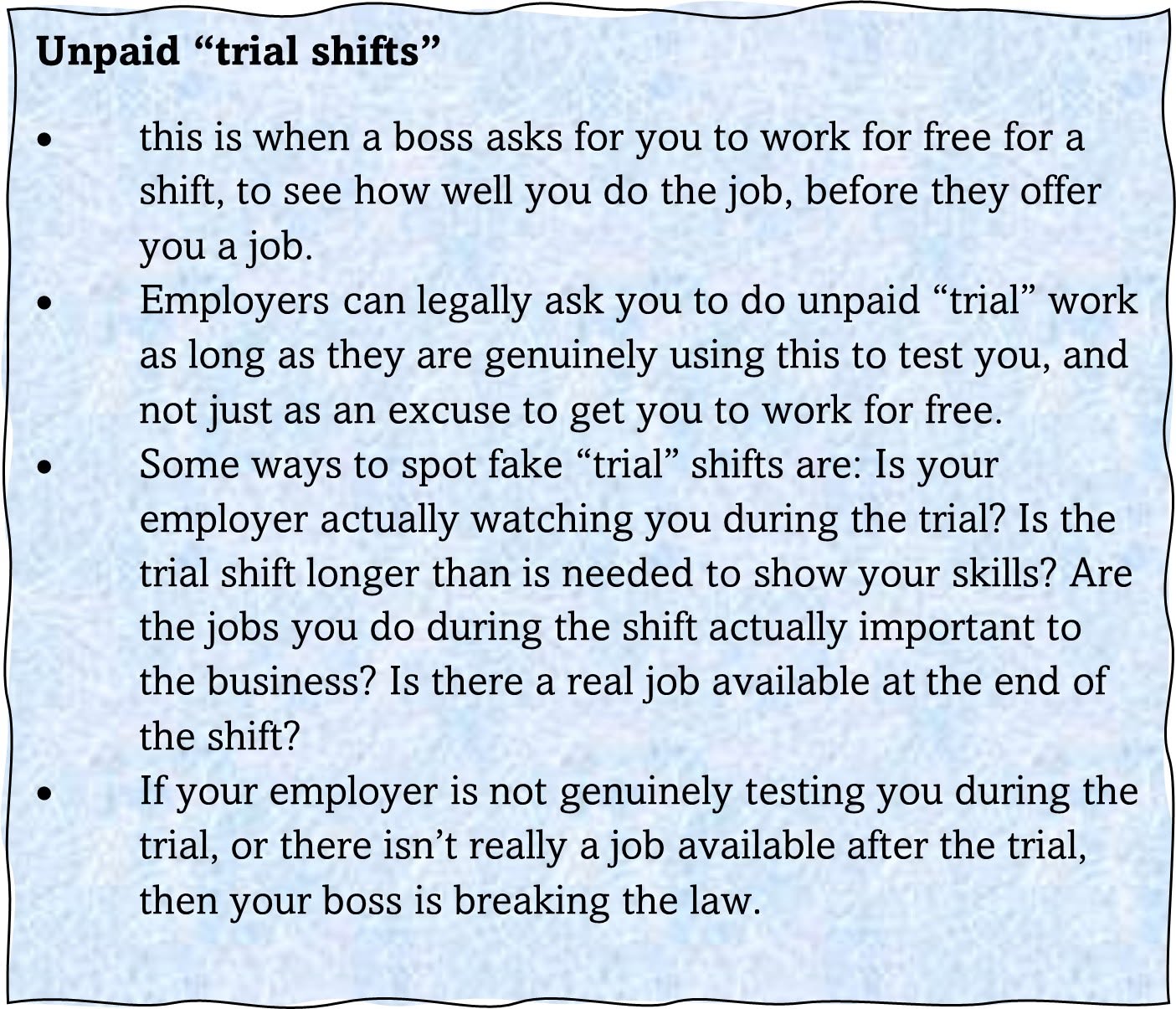 Unpaid “trial shifts”
- this is when a boss asks for you to work for free for a shift, to see how well you do the job, before they offer you a job.
- Employers can legally ask you to do unpaid “trial” work as long as they are genuinely using this to test you, and not just as an excuse to get you to work for free.
- Some ways to spot fake “trial” shifts are: Is your employer actually watching you during the trial? Is the trial shift longer than is needed to show your skills? Are the jobs you do during the shift actually important to the business? Is there a real job available at the end of the shift?
- If your employer is not genuinely testing you during the trial, or there isn’t really a job available after the trial, then your boss is breaking the law.
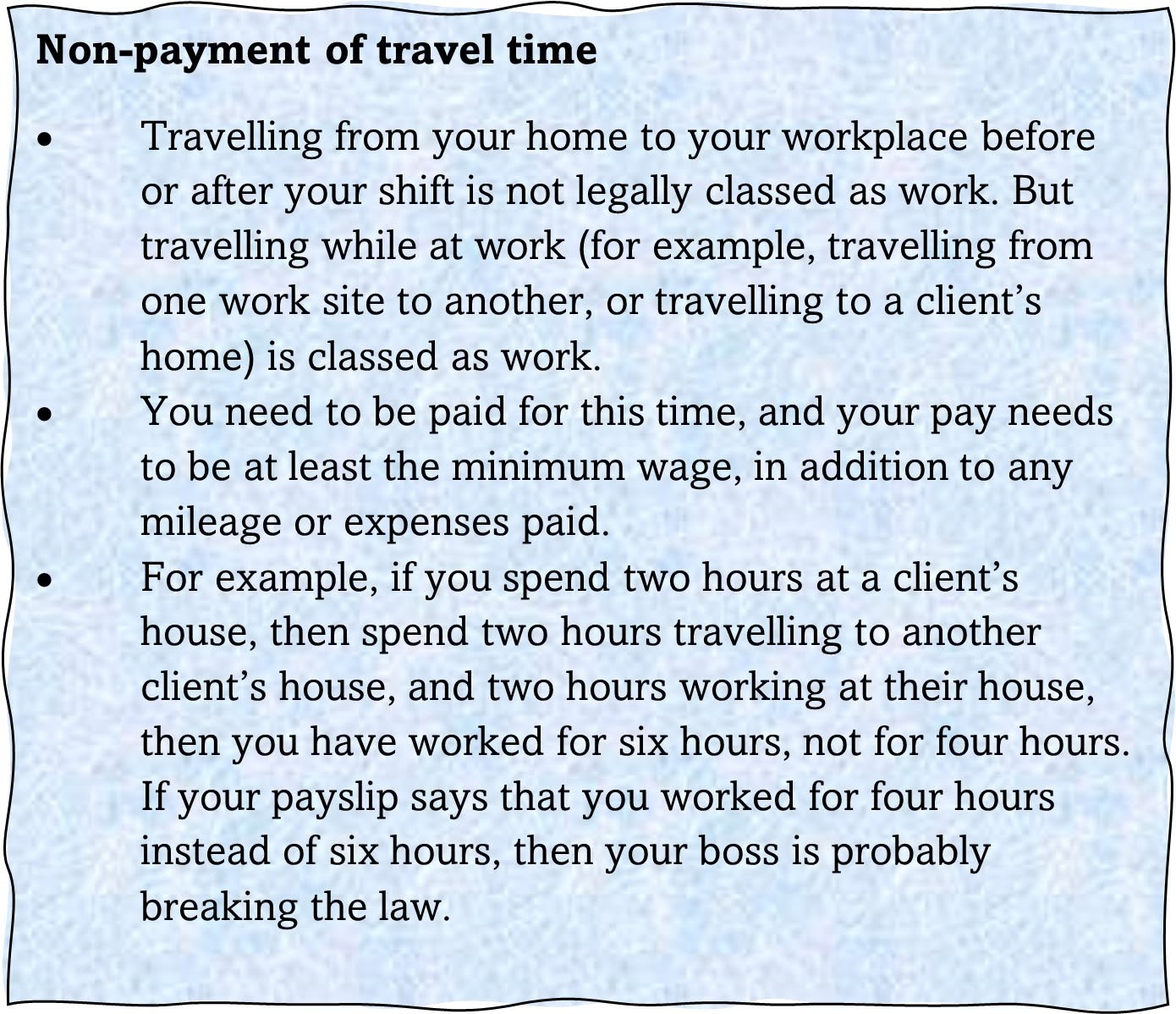 Non-payment of travel time
- Travelling from your home to your workplace before or after your shift is not legally classed as work. But travelling while at work (for example, travelling from one work site to another, or travelling to a client’s home) is classed as work.
- You need to be paid for this time, and your pay needs to be at least the minimum wage, in addition to any mileage or expenses paid.
- For example, if you spend two hours at a client’s house, then spend two hours travelling to another client’s house, and two hours working at their house, then you have worked for six hours, not for four hours. If your payslip says that you worked for four hours instead of six hours, then your boss is probably breaking the law.
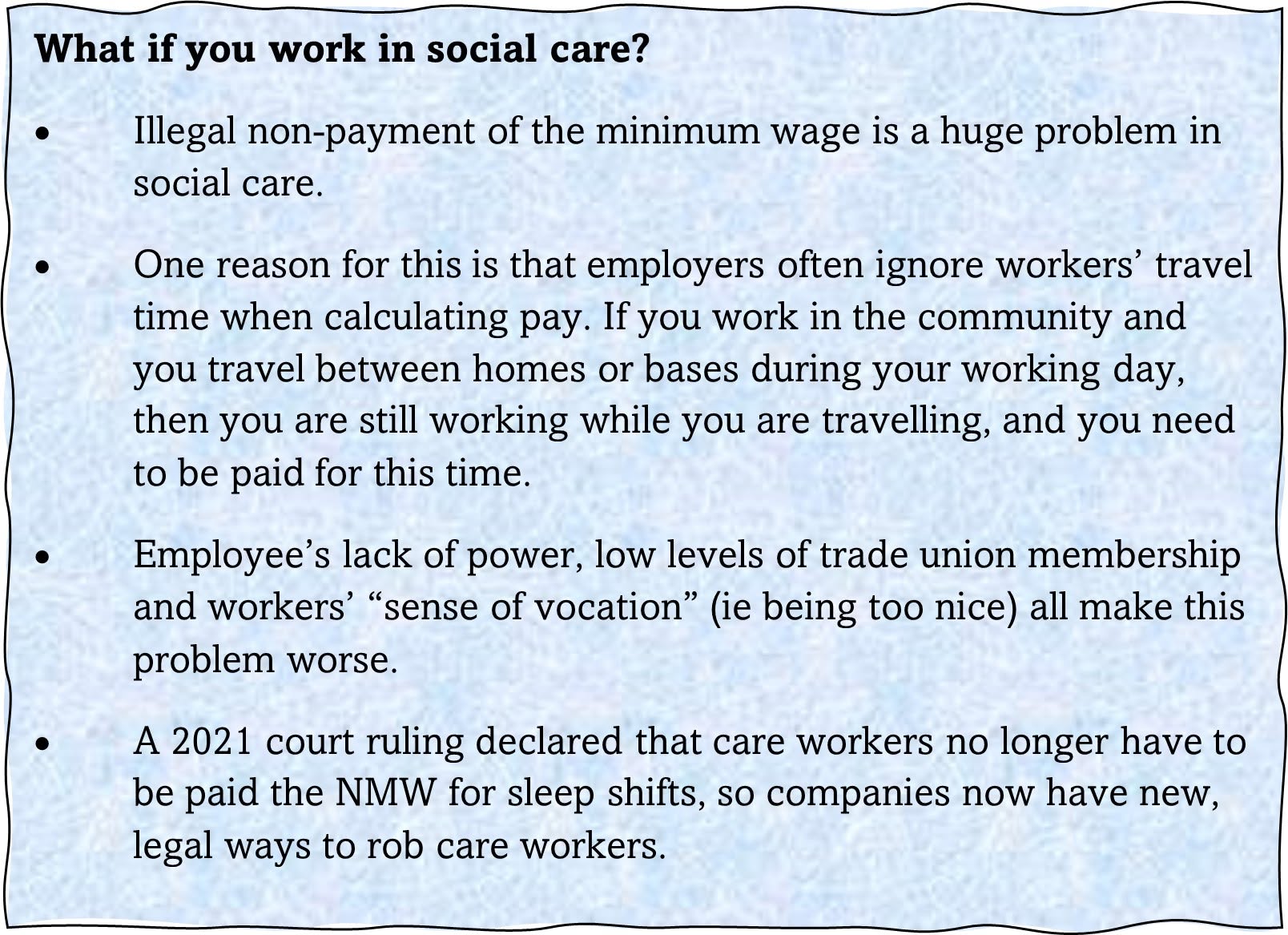 What if you work in social care?
- Illegal non-payment of the minimum wage is a huge problem in social care.
- One reason for this is that employers often ignore workers’ travel time when calculating pay. If you work in the community and you travel between homes or bases during your working day, then you are still working while you are travelling, and you need to be paid for this time.
- Employee’s lack of power, low levels of trade union membership and workers’ “sense of vocation” (ie being too nice) all make this problem worse.
- A 2021 court ruling declared that care workers no longer have to be paid the NMW for sleep shifts, so companies now have new, legal ways to rob care workers.
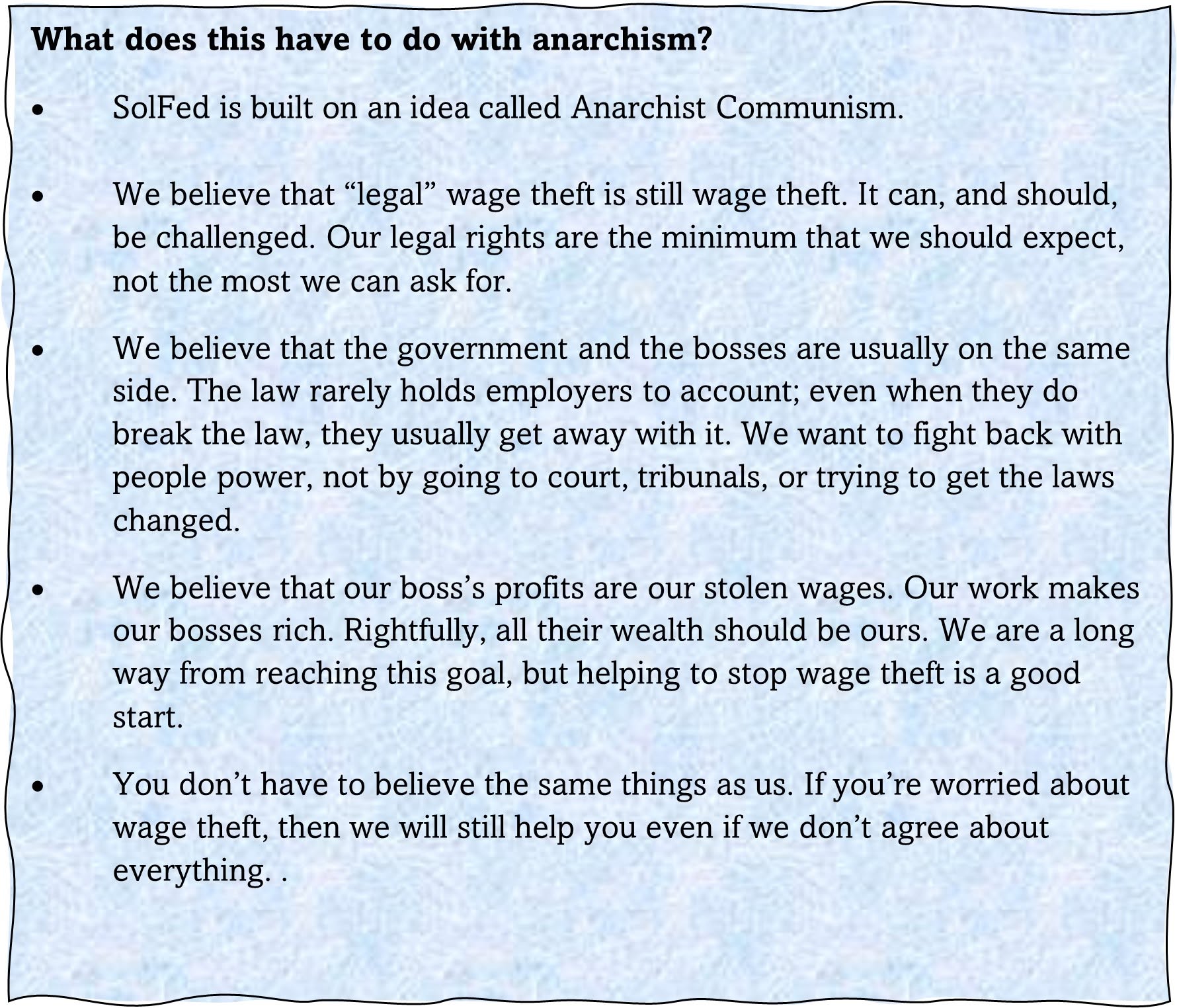 What does this have to do with anarchism?
- SolFed is built on an idea called Anarchist Communism.
- We believe that “legal” wage theft is still wage theft. It can, and should, be challenged. Our legal rights are the minimum that we should expect, not the most we can ask for.
- We believe that the government and the bosses are usually on the same side. The law rarely holds employers to account; even when they do break the law, they usually get away with it. We want to fight back with people power, not by going to court, tribunals, or trying to get the laws changed.
- We believe that our boss’s profits are our stolen wages. Our work makes our bosses rich. Rightfully, all their wealth should be ours. We are a long way from reaching this goal, but helping to stop wage theft is a good start.
- You don’t have to believe the same things as us. If you’re worried about wage theft, then we will still help you even if we don’t agree about everything.
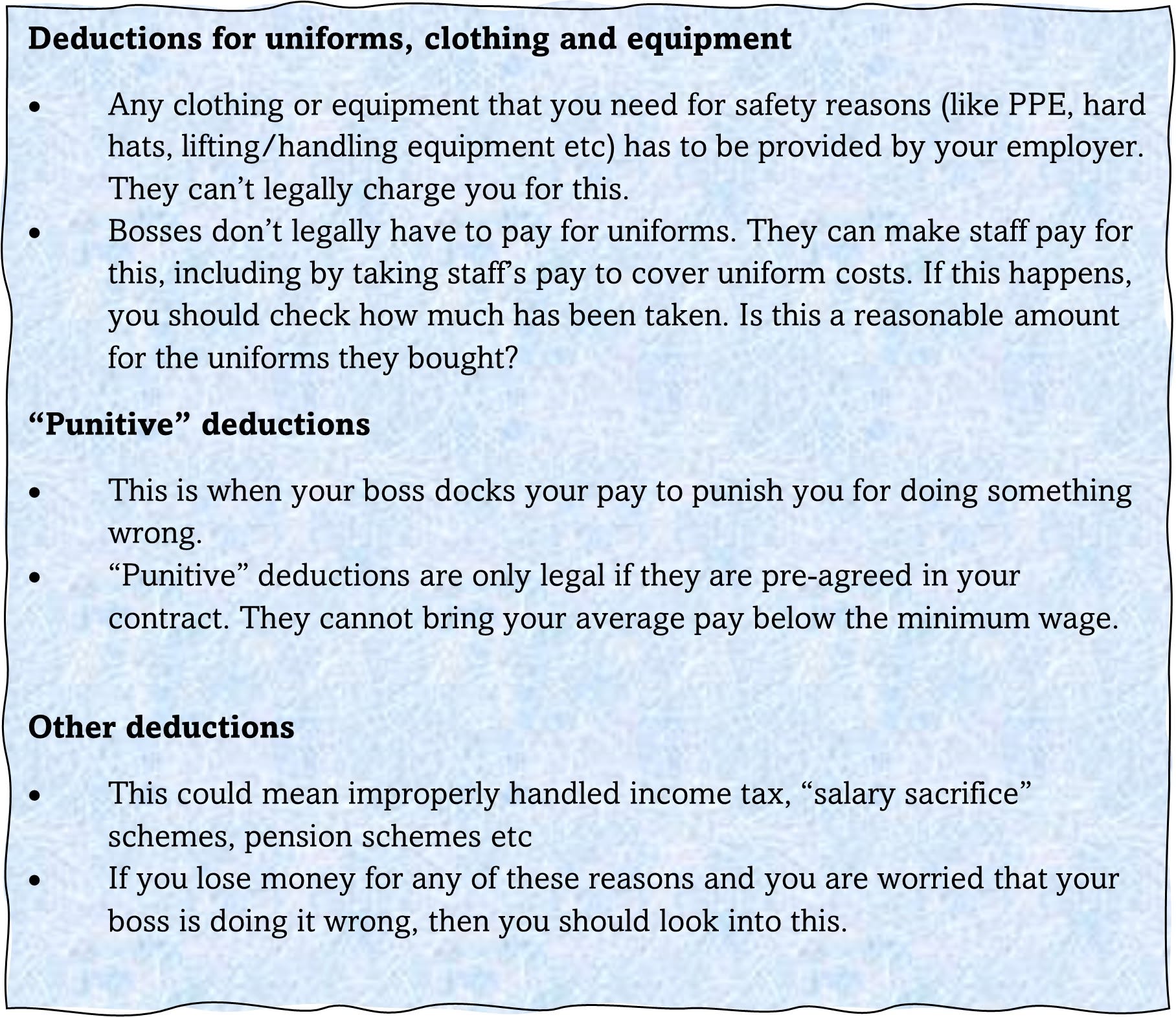 Deductions for uniforms, clothing and equipment
- Any clothing or equipment that you need for safety reasons (like PPE, hard hats, lifting/handling equipment etc) has to be provided by your employer. They can’t legally charge you for this.
- Bosses don’t legally have to pay for uniforms. They can make staff pay for this, including by taking staff's pay to cover uniform costs. If this happens, you should check how much has been taken. Is this a reasonable amount for the uniforms they bought?
“Punitive” deductions
- This is when your boss docks your pay to punish you for doing something wrong.
- “Punitive” deductions are only legal if they are pre-agreed in your contract. They cannot bring your average pay below the minimum wage.
Other deductions
- This could mean improperly handled income tax, “salary sacrifice” schemes, pension schemes etc.
- If you lose money for any of these reasons and you are worried that your boss is doing it wrong, then you should look into this.
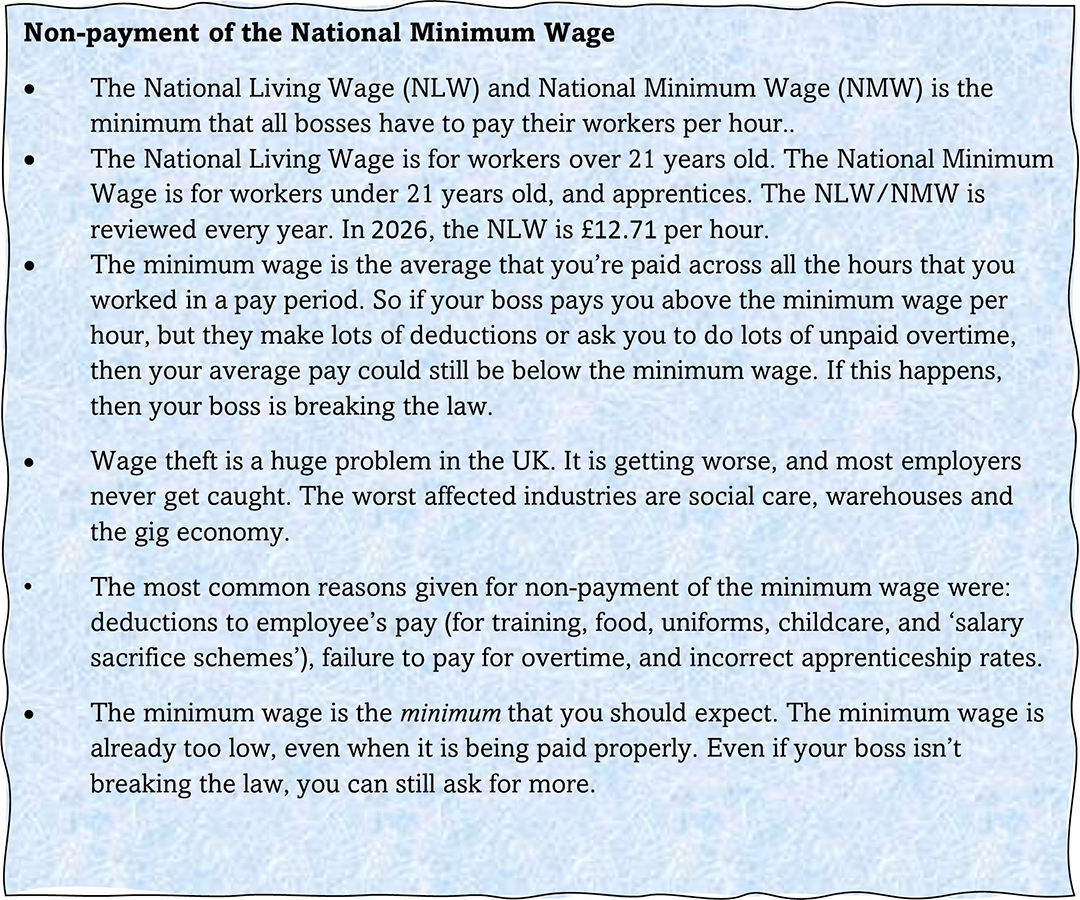 Non-payment of the National Minimum Wage
- The National Living Wage (NLW) and National Minimum Wage (NMW) is the minimum that all bosses have to pay their workers per hour.
- The National Living Wage is for workers over 21 years old. The National Minimum Wage is for workers under 21 years old, and apprentices. The NLW/NMW is reviewed every year. In 2026, the NLW is £12.71 per hour.
- The minimum wage is the average that you're paid across all the hours that you worked in a pay period. So if your boss pays you above the minimum wage per hour, but they make lots of deductions or ask you to do lots of unpaid overtime, then your average pay could still be below the minimum wage. If this happens, then your boss is breaking the law.
- Wage theft is a huge problem in the UK. It is getting worse, and most employers never get caught. The worst affected industries are social care, warehouses and the gig economy.
- The most common reasons given for non-payment of the minimum wage were: deductions to employee’s pay (for training, food, uniforms, childcare, and ‘salary sacrifice schemes’), failure to pay for overtime, and incorrect apprenticeship rates.
- The minimum wage is the minimum that you should expect. The minimum wage is already too low, even when it is being paid properly. Even if your boss isn’t breaking the law, you can still ask for more.
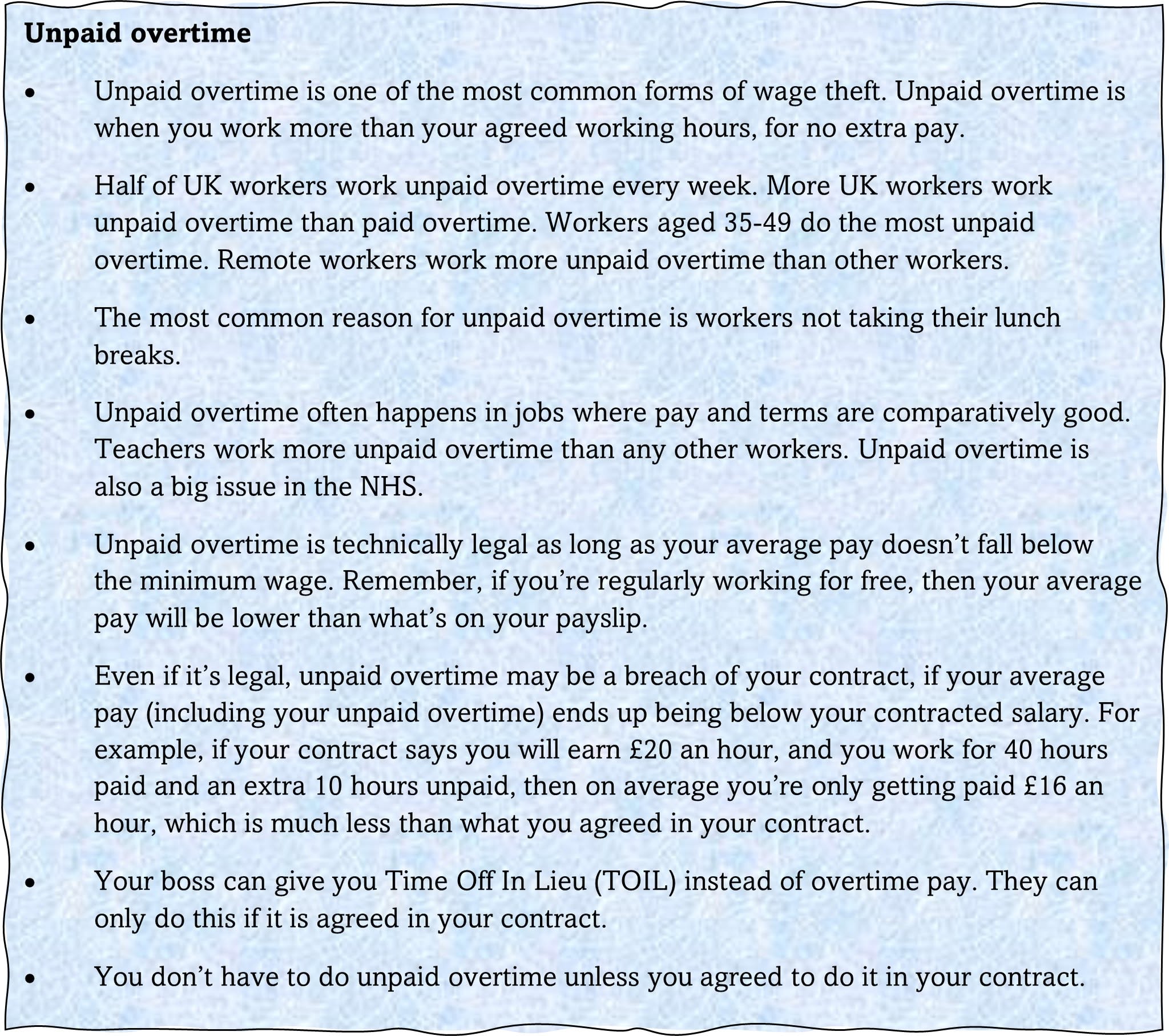 Unpaid overtime
- Unpaid overtime is one of the most common forms of wage theft. Unpaid overtime is when you work more than your agreed working hours, for no extra pay.
- Half of UK workers work unpaid overtime every week. More UK workers work unpaid overtime than paid overtime. Workers aged 35-49 do the most unpaid overtime. Remote workers work more unpaid overtime than other workers.
- The most common reason for unpaid overtime is workers not taking their lunch breaks.
- Unpaid overtime often happens in jobs where pay and terms are comparatively good. Teachers work more unpaid overtime than any other workers. Unpaid overtime is also a big issue in the NHS.
- Unpaid overtime is technically legal as long as your average pay doesn’t fall below the minimum wage. Remember, if you’re regularly working for free, then your average pay will be lower than what’s on your payslip.
- Even if it’s legal, unpaid overtime may be a breach of your contract, if your average pay (including your unpaid overtime) ends up being below your contracted salary. For example, if your contract says you will earn £20 an hour, and you work for 40 hours paid and an extra 10 hours unpaid, then on average you’re only getting paid £16 an hour, which is much less than what you agreed in your contract.
- Your boss can give you Time Off In Lieu (TOIL) instead of overtime pay. They can only do this if it is agreed in your contract.
- You don’t have to do unpaid overtime unless you agreed to do it in your contract.
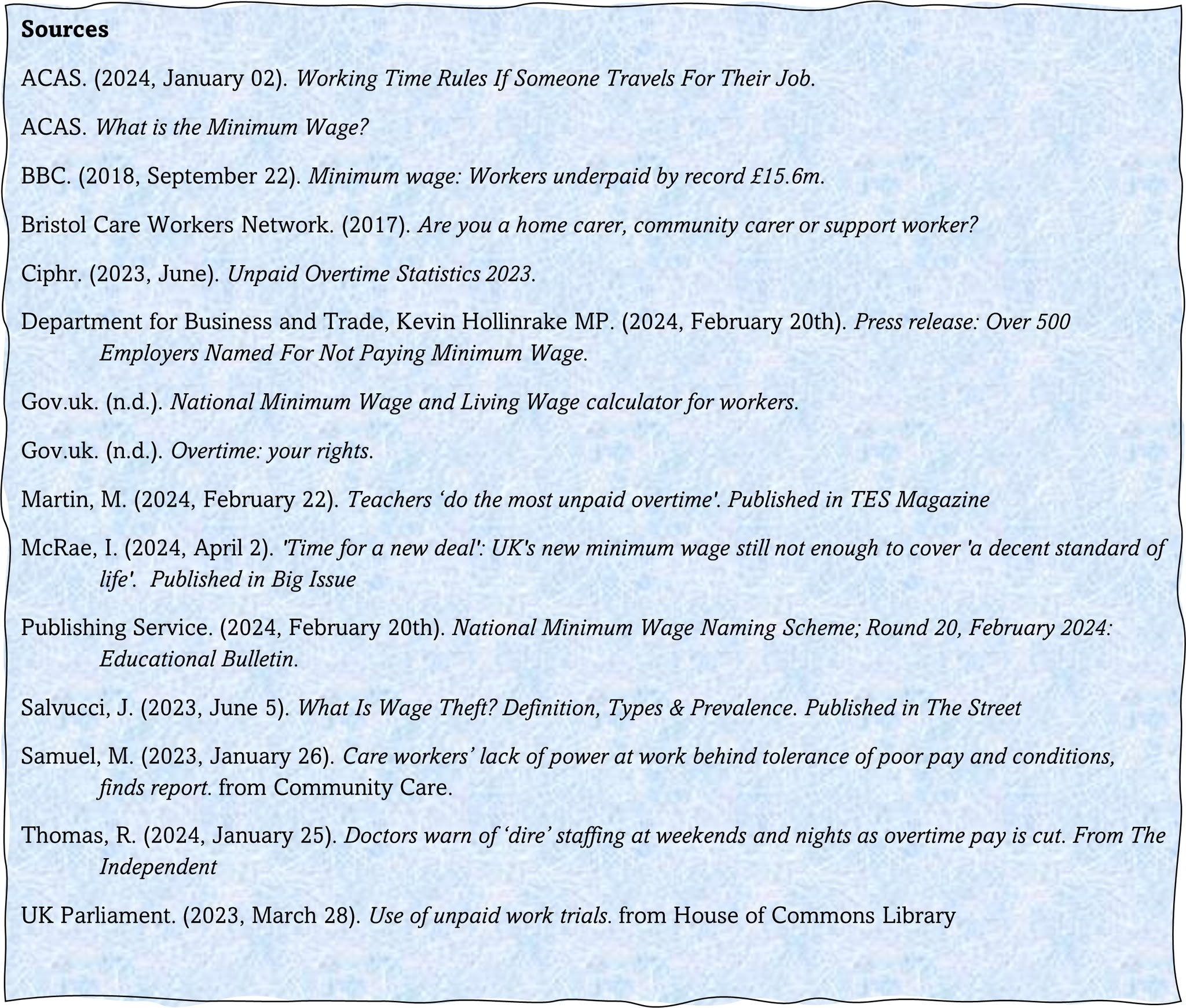 Sources
ACAS. (2024, January 02). Working Time Rules If Someone Travels For Their Job.
ACAS. What is the Minimum Wage?
BBC. (2018, September 22). Minimum wage: Workers underpaid by record £15.6m.
Bristol Care Workers Network. (2017). Are you a home carer, community carer or support worker?
Ciphr. (2023, June). Unpaid Overtime Statistics 2023.
Department for Business and Trade, Kevin Hollinrake MP. (2024, February 20th). Press release: Over 500 Employers Named For Not Paying Minimum Wage.
Gov.uk. (n.d.). National Minimum Wage and Living Wage calculator for workers.
Gov.uk. (n.d.). Overtime: your rights.
Martin, M. (2024, February 22). Teachers ‘do the most unpaid overtime’. Published in TES Magazine
McRae, I. (2024, April 2). ‘Time for a new deal’: UK's new minimum wage still not enough to cover ‘a decent standard of life. Published in Big Issue
Publishing Service. (2024, February 20th). National Minimum Wage Naming Scheme; Round 20, February 2024: Educational Bulletin. [.pdf format]
Saivucci, J. (2023, June 5). What Is Wage Theft? Definition, Types & Prevalence. Published in The Street
Samuel, M. (2023, January 26). Care workers’ lack of power at work behind tolerance of poor pay and conditions, finds report. from Community Care.
Thomas, R. (2024, January 25). Doctors warn of ‘dire’ staffing at weekends and nights as overtime pay is cut. From The Independent
UK Parliament. (2023, March 28). Use of unpaid work trials. from House of Commons Library