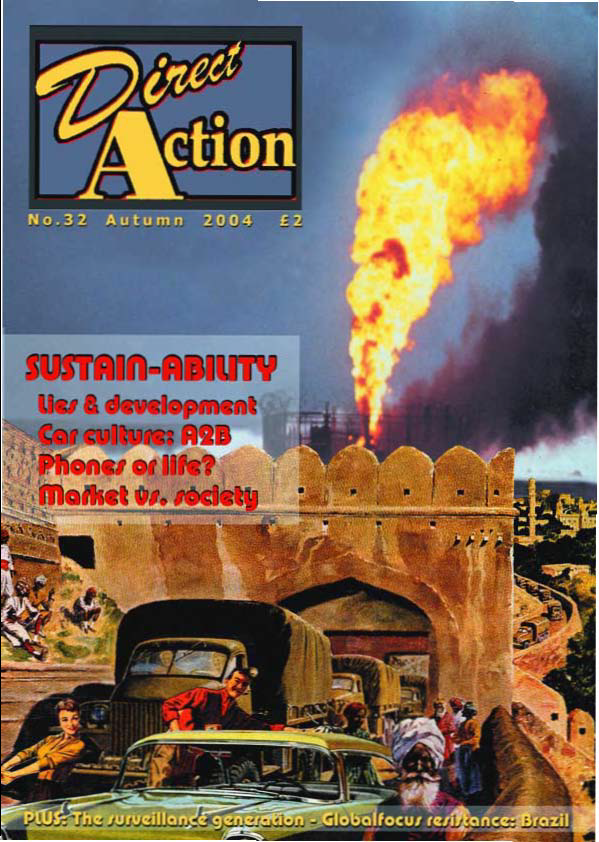
Direct Action #32 Autumn 2004
Editorial • Sickworld
Regulars:
Action & comment • All Children to go on 'Big Brother'; Sustaining Anarchism; Manufacturing Apathy; Politicians and Prostitutes; Manchester Electricians Win Case; Bathing in Gravy
On the edge • Ethnic Cleansing in East Anglia; Olive-picking for peace; WRR in the trees; A Burning Issue; Steal the Water; Push the Powder; Sheffield Bus Drivers Strike; Canary Cleaners organising; Gulf War Syndrome update; Asbestos 'games'; Leave out Levi's
International news • Greece; Argentina; Venezuela; Spain; Italy; Indonesia; Iraq; Israel/Palestine; Serbia; Honduras; Bangladesh; Turkey; Pakistan; Philippines; Russia
Features • Olympics - Hidden truths; United States of Aggression; Slavery2004
Globalfocus • Brazil
Ideas for change • Free your head
Notes & letters •
Justicepage • UK Prison Slavery
Reviews:
Feature: Gulag • Galug, A history - Anne Applebaum; Ice Road - Gillian Slovo
Books and pamphlets • The Buenos Aires Tragedy - KSL; The Monkeywrench Gang - Edward Abbey; The Great Diverstiture - Massimo Floro; Underwriting Bribery - Corner House
Music and TV • Living After the Coal Face; Various Artists: Por Vida - A tribute to the songs of Alejandro Escovedo; Various Artists; Rock Against Bush vol.1
Theme:
Sustaing Lies; Phones or Life?
Centrespread • The Meaning of Sustainable Development; Getting from A2B Sustainably
Closerlook • Sustainability: market vs. society
Theme: Sustain-abilty
Sickworld; Sustaining Lies; Phones or Life? Why capitalism won't ask you the right questions; Centrespread: The meaning of Sustainable Development; Getting from A2B Sustainably
Action + comment
All children to go on 'big brother'; Sustaining Anarchism; Manufacturing Apathy; Politicians and prostitutes; Manchester Electricians Win Case; Bathing in Gravy
On the Edge
Ethnic cleansing in East Anglia; Olive picking for peace; WRR in the trees; A Burning Issue; Steal the water, push the powder; Sheffield bus drivers strike; Canary cleaners organising; Gulf War Syndrome Update; Asbestos 'Games'; Leave Out Levi's
International News
Olympics - hidden truths: Greece; Argentina; Venezuela ; Indonesia; Spain; Italy; Iraq; Israel/Palestine; Serbia; Honduras; United States of Aggression - Iraq; Israel/Palestine; Serbia; Honduras; Bangladesh; Turkey; Slavey2004 - Pakistan; Philippines; Russia
Globalfocus: Brazil - MaSTers of their own destiny
Ideas for change: Religion and culture - Free your head
Notes + letters: M. AGA; AGB; GH; Use Your Loaf Collective
Justicepage - A private affair: How the UK prison system is sliding further into licensed slavery; Rape survivors give evidence
Reviewfeature: Gulag
Reviews - The Monkey Wrench Gang (Edward Abbey); The Miners Strike 20 years on - Living after the Coal Face (BBC Radio 4, April 4th 2004); The Buenos Aires Tragedy - The last flight of Severino di Giovanni & Paulo Scarfo (Pub. Kate Sharpley Library, 2004); Underwriting Bribery: Export Credit Agencies and Corruption (Comer House Briefing no. 30, Dr Susan Hawley); The Great Divestiture (Massimo Florio); Various Artists: Por vida: a tribute to the songs of Alejandro Escovedo (Or Music, 2004); Various Artists: Rock Against Bush vol. 1 (Fat Wreck Chords, 2004 CD/DVD)
Closerlook: market vs. society
Direct Action; Solidarity Federation Networks and Locals; About SolFed
Events/Campaigns/Gatherings...; Friends and Neighbours; Resources
Sickworld
Sustainability is an over-used and often misused term, so why have several articles on it in this issue? As you will see, these articles on sustainability take a very different perspective from those you may have come across in the commercial media.
For a start, Sustaining Lies (p.4) is really about how unsustainable governments are (they never last), and how they are desperate to sustain their privileges and those of their fellow rich and powerful. After the Hutton whitewash, as I write, snippets of the true story behind the 45 minutes scandal are leaking out. There was the apparent dodgy deal behind closed doors where Tony Blair promised not to call for BBC resignations (which he lied about), then there was the bullying from Downing St (by Campbell and Blair plotting together), then there was the actual 45 minutes claim and, of course, the whole WMD fiasco itself (which Blair clearly lied about). He is a good politician, in the sense that their main skill is being able to lie with a straight face - but it is always unsustainable in the long run.
Meanwhile, 47,000 UK troops were mobilised for the first Gulf War in 1991 and 45,000 for the second war in Iraq. In the US, nearly 700,000 troops were mobilised for the first Gulf War; currently there are 130,000 US troops in Iraq. Quite apart from Gulf War Syndrome (about which there's news in these pages), that is a hell of a lot of life, grief and torment being meted out because of these big lies - and that's not to mention dead civilians or the army body bags.
Even if the capitalist and state system was rejigged to become more democratic, and actually take notice of what people want, one of its fundamental problems is that it will never ask people the right questions (Phones or Life, p.6). Given the opportunity, would we prefer to cut down on mobile phone use in favour of more resources being spent on health provision to save and extend our lives? Would we rather make/ receive one less mobile phone call (e.g. wait 'til we get home), safe in the knowledge that, by doing so, we are making sure the hospitals are adequately funded? Would we rather, as a society, value our quality and quantity of life more, and our 'quick fix' superficial consumption less? We will never know the answer to such questions under the current capitalist system, because they won't be asked.
This brings us into the centre ground of the debate over sustainability - the tension between economy, society and the environment (The Meaning of Sustainable Development, p.18). Official report after report suggests we can have our cake and eat it - i.e. make all three thrive, but so far all we have seen is more global warming, more traffic and consumption, and more poverty and destruction of communities. Any sane person can see that right now, the capitalist economy is the only thing that these official reports really care about. So, when we ask ourselves whether the revised UK sustainable development (SD) strategy makes some crucial breakthroughs, I think we all know the answer. Even the green reformists arguing for environmental taxes aren't happy, as these have declined in total tax terms steadily over the last decade.
That isn't to say that SD is a nonsense term - it could be useful, if only we had a system where society and environment were really taken as seriously as people want them to be. It's even more stark when we come to car use (Getting from A2B Sustainably, p.21), where I could sit in traffic taking the kids to school while listening to the radio go on superficially about fossil fuel use and traffic congestion, yet I couldn't let the kids walk or go by bus - the roads are too dangerously crammed with mad car drivers trying to get to work, etc. If this isn't a situation crying out for collective democratic decision making instead of everyone for themselves (and all lose in the end), I don't know what is. Instead, we have a system set up to get people accelerating en masse towards environmental oblivion, with very little real alternatives on offer. Luckily, I don't have kids so I can cycle to work, but I pity those, who do, not to mention the fact that their queuing cars fill my lungs with benzene on a daily basis.
All this whinging on about how bad shit we are in because of capitalism is crying out for some sort of discussion of alternatives, and luckily, here it is (Sustainability: market vs. society, p.31). Critiques of capitalism are common, as are visions of a sustainable future, but analysis of actually what ingredients we need to make such a change are rarer, so this is a must-read. If you haven't time right now, then, in summary; massive harm has been and is being done to humanity by the market; solidarity is the only path toward a sustainable, decent society, and; the market is an obstacle to solidarity, and therefore to a sustainability and society...
Sustaining Lies
Sustaining lies is all part of modern government - and if you don't believe me, just listen to Big Toe.
Sustainability - the word sounds like one of those that trip off 'Big Toe's' lips by the dozen. The sort of thing you hear and think 'what is this balloon talking about?'
Just like the word 'stakeholders', which tries to make out that somebody struggling to make ends meet has the same stake in society as businessmen, and those professionals in the poverty industry. A word designed to make the parasites look clever and the rest of us look thick. The 'higher orders' use it a lot when they go on about economic growth, whenever the rip-off merchants make even more dosh out of the rest of us this year than they did last. This is supposed to be good for us as they spend and invest the loot, so giving the 'lower orders' wonderful jobs. It's called 'trickle down' and the more they make, the better it is for all (as if).
The problem they have is how to keep it going, or sustain it. Too much of it can mean they can sell anything and get more and more workers to make more and more money for them. When this happens everybody spends more and more and prices go up. They might run out of cheap labour and have to import it so they don't have to pay decent wages. Prices might go up so much that people start buying their stuff somewhere else. Firms might close and the owners might look to make more dosh in another way, maybe in another country. Then unemployment goes up, the trickle stops and ''loansharks.com', move in to bail everyone out (including governments), or misery and smack move in together.
Too little growth means more unemployment, prices go down, and shops with them. Poverty increases, and all the other things we all know about. It can go on like this for years and years, like the 1920's and '30's.
So, for the 'Thieving Idle Bastards' in the higher orders, sustainable growth is best. That's where there's good economic growth, but not too much; price rises, but not too much; unemployment, but not too much, and so on. It becomes stable and 'sustainable'.
To help the system work (because after all capitalism can't work on its own) the fat cats use government lackeys like 'Big Toe'. They give them some glory (and money) and buy them into being 'business friendly' (to use another one of their 'clever' words).
Thoroughly modern new labour will make sure there's low wages, shite contracts and health and safety, no getting pissed, no standing around in gangs of more than two, no smoking and all the other things mentioned in the Clampdown issue (DA30). They'll make countless new laws up, privatise this and that, make sure kids know they're only here to work and buy, make them pass tests in it every three minutes, and if they can't they'll be 'excluded', then the poverty industry moves in and so on.
This goes on all over the western world and, as back up, they all use the popular press and the telly. If it still goes wrong, there's the police, the army (yes, they can use them on people in other countries too), the lawyers and the judges, there's even the god squad to tell us we're not nice for having a tab and a shag after a session on ethanol and butane alcopops.
There's another problem though, some miserable moaning bastards (usually in fairisle jumpers and sandals) think all this consuming more and more 'nike', silver telly's, silver cars, golden petrol (as on TV), dog burgers, plastic bags, aeroplane rides, non 'biodegradable' (another clever word) plastic lighters at 250 for £1 and whales, think this is unsustainable. They reckon that it's causing slavery, child prostitution, drug 'misuse' (poverty industry word) and very bad poverty all over, even more in some parts of the world. They also say it's going to mean the end of the world too.
Look at China now, there's been fantastic economic growth in the past few years. Production's been shifted over there, more jobs, more wealth, more `trickle down', more cars and more fridges. The problem is, prices are going up, so are house prices. When wages go up, as anywhere, the whole cycle starts, and 'international investors' will look around for cheaper workers, in cheaper countries where there is a 'flexible labour market' (another one of those sustainable terms 'Big Toe' uses). This could be why they've been looking for life on Mars.
Another reason why they've been looking at Mars could be to weigh up the estate agents and see the prices of property. As production has increased in China, as everywhere, so has all that goes with it - the rivers are black, the air is putrid, clouds are picking it up and dropping it on Japan as acid rain (non hippyfied) and they've already got bad air through car fumes, chemicals and their own industry. There's the hole in the ozone layer, cows eating chickens, trees being chopped down, less fish in the sea, oil on beaches (not just suntan oil) and loads of other bad things that mean if nothing is done soon the whole world is not sustainable (not even the palaces with bunkers and a hundred year supply of gin).
A lot of people worry about this and say the governments of the world should do something about it. They should have agreements on this and that and ban the other. So they have, they had one in Japan (Kyoto) where, presumably, they used special acid repellent umbrellas'. They all agreed to do nothing except pretend to do something. We've got recycle bins for this and that, special fridges, things on top of chimneys and other thoroughly modern ways of saving the world. But the top priority is still economic sustainability, and that means even more money for the scum at the top and basically ignoring any problems with bad air.
For the businessmen (sic), the main problem with too much growth in China is that petrol prices have been going up. While the planet burns the scum gets on with business, and that means making a cost benefit analysis of their every move. Lawyers do it too, like the `Big Toe and Cherry Duo'. When you get combinations of politicians and lawyers you get a real set of selfish bastards. There are even professors who have been 'bought off', who say global warming is a load of hot air, the planet recycles itself, and just think of the dosh compared to a few black rivers, dead fish and dead riff-raff. The weakest always go to the wall for the benefit of the rest, nothing's new. When you get this kind of mentality mixed with religious maniacs, then you've got a right mess of those who think the market will provide (not god), and those who think god will provide (they'll go to heaven, so sod it) -but, just in case, lets check out those Martian estate agents on the internet...
The real point of so-called economic sustainability is to sustain wage slavery through sustained lies and bullying. In the Manchester Evening News a few weeks ago, Adolf Hitler said, "its easier to maintain a big lie than a small one" (you all thought he was dead for a start). The lie is that the state and all its various parts; government, army, police, judges, education and health, sustain economic growth for the benefit of us all. People who invade other countries and other people's lives sustain this lie by both force and brainwashing. They use any method they can and when one doesn't work, they'll try another. That's why government policies are always changing to keep on top of any changes to economic growth and any rumblings about the lie from the 'lower orders' (Big Toe has loads of modern words for these). If they think not enough of us are voting they let' us do it by post, or even by electricity (electric elections?). If they realise we have worked out the police are not there for our protection, but for theirs, then they send a few cheaper versions into 'disaffected' areas. If they think we're not working hard enough toward economic growth, they send people out to these areas to train people into grafting for some 'Thieving Idle Bastard' and how its all great fun sustaining wealth. Community groups that mop up the costs of economic growth now have to be sustainable too. It all adds to the lie.
The way to make a sustainable lie unsustainable is to question it, then we can start to sustain the planet by realising we are just a piece of dust on it and it came first.
Phones or Life? Why capitalism won't ask you the right questions.
OK, you know the deal: We have never been richer as a society, the money is there to eradicate poverty, educate our children, ensure a decent health service, and to make society a truly fit place to live .... Yet, despite this, poverty is rampant, children go without education, and the sick and infirm without care. We work longer hours than at any time since the 1930's, stress is in epidemic, and we are going to have to work 'til we are 70 - the longest ever.
To those in full-time employment earning a passable income; if this life is far from ideal, pity the large and increasing numbers dependent on welfare or poverty wages. Low income makes for zero credit rating and a bar on entry to the debt so essential to getting by in modern Britain. Low income prevents entry onto the property ladder, marooning families in so-called sink estates; where poor housing, low income and total demoralisation results in poor health and low life expectancy.
Cut off and alienated from the mainstream, such estates are increasingly awash with drugs. While mainstream society use drugs as a form of recreation, in poorer areas, alcoholism and drug abuse has become a means of blocking out the banality and hopelessness of everyday existence.
So why is it that our society is in such a state? A big part is inequality: The banks get rich on the back of our mounting debt, while the bosses prosper on our ever-longer working hours. But its not just growing inequality, its how society as a whole spends the wealth created. For example, in 2000, some 24.7 million people bought mobile phones at a cost of £12,700,000,000.
The question is, given the opportunity, would we prefer to cut down on mobile phone use in favour of more resources being spent on health provision to save and extend our lives? Would we rather make/receive one less mobile phone call (e.g. wait 'til we get home), safe in the knowledge that, by doing so, we are making sure the hospitals are adequately funded? Would we rather, as a society, value our quality and quantity of life more, and our 'quick fix' superficial consumption less? We will never know the answer to these questions, because they will never be asked; at least not under the current capitalist system.
The fact is, capitalism needs us to superficially consume more and more, to drive its insane over-production system. Such idle shopping helps sustain capitalism, but, as to a long term future, this system is manifestly unsustainable. And, of course, capitalism needs a tiered health service, where the poor die for lack of adequate equipment and staff, so that we will be 'persuaded' to aspire to all being middle class, so we can move up the tiers and afford decent healthcare.
Its not just that wealth is concentrated in the hands of the few, but that power is concentrated in the hands of the rich. The rich own and control the economy, and so have the power to decide what we produce as a society. Thus, desperately needed houses never get built, because there is no profit to be made in building houses for the lower orders, while billions of pounds goes on the production of mobile phones. A walk around any council estate will reveal young people playing with their mobile phones, surrounded by a world based on poor housing, poor health and few prospects.
At the heart of the failing of our rich and bloated society is lack of democratic control of the economy. Sure, we can elect useless politicians, but we have no say as to what or how we produce as a society. Anarcho-syndicalism seeks to overcome this most basic of failings, by striving for a society based on democratic control of the economy. We seek a society based on workers' control, under which the economy is seen both as a means of fulfilling our collective and individual needs, and ensuring that everybody has a say in how society is run. Until that time comes, we may be getting richer as a society every year but, under capitalism, that simply means producing crap to make the rich richer, in a society deprived of any real humanity.
All children to go on 'big brother'
The surveillance generation...
A national database containing confidential details about every child in Britain is to be set up by the government. An unique identifying number will be assigned to each child so that the authorities can access their records.
All parents will receive letters from the government informing them of the plan, which will be added to the Children's Bill in the autumn. The central electronic register will hold information on a child's school achievements, GP and hospital visits, police and social services records, and home address.
Under the plans, parents will not have access to the database, but will be able to apply to see details held on their children under the Data Protection Act. It will also include information on their families, such as whether parents are divorced or separated.
The "universal children's database" will allegedly be made to identify problem relatives, including aunts and uncles who have a history of alcoholism or drug misuse. The decision to create it was approved by the ministerial committee on children, young people and families, chaired by Charles Clarke, the education secretary. However, the move amounts to intrusive, Big Brother-style authoritarianism, and would be a clear invasion of civil liberties.
Barry Hugill, a spokesman for Liberty, the civil liberties group, said: "They are creating a national database through the back door. You start with information about all children, but, in 20 years' time, you've got almost half the population. The government may justify it in terms of child protection, but it is way beyond what even the children's charities wanted or thought necessary".
The plan follows the publication last year of a report by Lord Laming into the death of Victoria Climbié, the eight-year-old who died from neglect and abuse. Laming recommended the establishment of a national database, although the government had previously played down its interest in the idea. However, "restricted" minutes of a ministerial meeting have revealed that ministers privately agreed to the national children's database, rejecting proposals for a system designed to cover only those children thought to be at risk.
The minutes in question read: "Turning to the question of who the database should cover, the minister for children, young people and families (Margaret Hodge) said that all children should be included. This fitted with the prevention agenda and reduced the risk of stigmatisation. Information collected could also be used to support service planning and delivery".
The only concerns raised by Ministers at the meeting, including Hodge, Paul Boateng, Lord Filkin, Estelle Morris and Alun Michael, were about the technical challenge of setting up the database. The government has been hit by the failure of several new computer systems, including the Child Support Agency, Inland Revenue and the Criminal Records Bureau. No-one there raised concerns over civil liberties.
A feasibility study has already been commissioned into the plans, and negotiations have been held with several firms, including Experian, which runs national credit-checking services. According to the leaked minutes: "To overcome the technical problems associated with a national database it might be better to start small and build up".
Once again, the government has shown its lack of respect for basic civil liberties. We are slowly but surely becoming the most spied on society in history - something Hitler and Stalin could have only dreamed about.
On the Edge
Ethnic cleansing in East Anglia
Travelers or Roma have faced oppression, murder, sterilisation and genocide from successive European governments, including the Nazis and the current regimes, In Essex, the situation is
currently worsening. The British National Party (BNP) have won 3 seats on Epping Forest District Council with their neo-Nazi pledge to drive out the local 'gypsy' people.
A young mother with triplets and an elderly couple, who had lived on their own land at Paynes Lane, Lower Nazeing, Essex, for 14 years, were evicted in June, along with other families. Another man was sent to prison for 28 days for living on his own land, and a judge is threatening to imprison his wife and children if they don't move from land they bought at Colney Hatch.
Anti-racist and Gypsy Council campaigners have been resisting the eviction at Paynes Lane and demonstrating outside the Oakington Immigration Detention Centre, www.indymedia.org.uk
Olive picking for peace
The Olive Co-operative is once again running tours in October and November, during the Olive Harvest season in Palestine. The tours will allow people to witness and participate in this vital part of the Palestinian economy, and will include opportunities to meet groups involved in the struggle for peace for the Palestinian and Israeli peoples.
The Olive Harvest tours are also intended to promote interest in Palestinian olive oil in Britain, and the November tour will be run in collaboration with Zaytoun, a London-based company which sells organic, fair trade Palestinian olive oil. Zaytoun is a UK-based nonprofit project to buy pesticide free fair trade extra virgin olive oil as an act of solidarity with Palestinian farmers.
Info: sarah@olivecoop.com Tel: 0161 232 8177 www.olivecoop.com
WRR in the trees
In June 1996, Weymouth Relief Road protesters set up Teddy Bear Camp in opposition to the 'brown route' of the proposed WAR, In July 2004, protesters set up camp at Two Mile Coppice in opposition to the 'orange route'. The Department for Transport has already approved the £54,6 million orange route, which goes straight through Two Mile coppice, one of the area's only remaining rare ancient woodlands.
Not only will ancient mixed woodland and breeding grounds for bats and voles be destroyed, if this road were to be built, the Dorset Downs, Heaths and Coast AONB and Lorton Valley SSSI (which includes ancient woodland) would also be under threat. Protesters at Two Mile coppice urgently need help, please get down there if you can. The camp is just off the roadabout where Dorchester Road meets Weymouth Way A354 - the nearest railway station is Weymouth, a brisk 15 minute walk south from Two Mile Coppice, Info: www.roadalert.org.uk Onsite mobile: 07800760257 Email: weymouth@roadalert.org.uk
A Burning Issue
Residents in Slough are fighting to remove the planning permissions for a monster incinerator on their doorstep. Severe health concerns, and the revelation of shady deals between the waste management company and local politicians, have led to public outcry and are fuelling a powerful public campaign. Read More: www.corporatewatch.org/
Steal the water, push the powder
Nestle is again on top of the list for corporate violations around breast-milk substitutes, a UK report reveals. Meanwhile in Brazil, residents are opposing a Nestlé/Perrier bottling plant, which is drying up one of the country's historic sources of mineral water. Read More: www.corporatewatch.org/
Sustaining Anarchism
In Britain, anarchist ideas first emerged in the 19th century, although they remained diluted and unfocused until around the turn of the century, when the first inklings of an anarchist 'movement' appeared, including specific anarchist journals and papers such as 'Freedom' and the 'Voice of Labour'. However, the promise of these beginnings have not yet been fulfilled, and anarchists have struggled to build a sustained presence here.
Every so often, there is a flowering of anarchist ideas within movements, that seem to dissipate when those issues change. For long periods, there has been little or no anarchist activity to speak of. Today, there is a small anarchist movement, with three national anarchist federations, as well as several local groups. Local and national publications are produced of varying content and quality. Some campaigns have a marked anarchist input and presence, yet the influence of anarchist ideas has yet to spread beyond a small milieu of activists.
For the vast majority of people, anarchism is a very odd idea advocated by strange people. The only time it really reaches the public consciousness is in the run-up to May Day, when the newspapers are suddenly full of anarchist plots to disrupt London.
It has to be said that some people do seem to thrive on this publicity, apparently welcoming the kind of outlaw image anarchism has. They see themselves as voices in the (capitalist) wilderness crying out the truth if only the people could hear. Others are trying to shed this image and spread anarchist ideas within the working class, so they are seen as an alternative set of values that can be measured against the prevailing capitalist ones (and distinct from Marxist ideology).
Only once has this happened in Britain. Ironically, it was within a current that was not specifically anarchist. That time was just before WWI, when the syndicalist movement was able to exert an anti-parliamentary influence within working class politics. Many workers accepted anarchist ideas as a legitimate way forward and not as some utopian dream. Anarchists like Ted Leggat and John Turner were able to command respect from their fellow workers and not hide their politics.
The cause of the eventual collapse of the syndicalist movement is the subject of debate. Anarcho-syndicalists generally would argue that it needed to develop something more than its anti-parliamentary approach and expand its ideas into community and cultural organisation - and not limit itself to workplace organisation.
Today, some anarchists seem to have gone in completely the opposite direction. Community politics is held up as the way forward, while workplace organisation is seen as somehow tainted and despised. Yet it is in the workplace where ordinary people come face to face with the harsh reality of capitalism. Our safety is compromised every day. Pay and conditions are under constant attack. Meanwhile, other anarchist notions of how to fight back against the twin oppressions of state and capitalism remain on the periphery of resistance movements.
Only when anarchist ideas become accepted within the working class at both community and workplace level can we hope to build a movement and maintain its momentum. This does not mean watering down these ideas to accommodate reactionary opinions, or looking to short cuts by buying into the present power structures. Rather, it is essential that we challenge racism, sexism and homophobia, etc., not from a liberal middle class perspective, but from the perspective of working class militants.
Anarchists need to lose their fear of organisation and, instead of remaining isolated in small local groups, be actively inclusive and open. The buzz words of the last decade have been 'act locally think globally', but that does not preclude us from organising in a meaningful way locally and in workplaces, and federating horizontally to offer mutual support and solidarity to each other and to the wider working class.
Manufacturing Apathy
Are those who criticise political apathy also to blame for its creation?
Voter turnout has been plummeting in most democratic countries since the early 1950's. In the 2001 UK parliamentary elections, voter turnout reached its lowest ever levels (59.4%). This prompted some media speculation regarding the whole process of democracy. America got only 49.27% participating in the Presidential elections of 2000. What is the cause of this decline? And how worried should our leaders be by it?
Without credible alternatives to choose from, what pressure is there on the government to provide all it promises? And what motive is there for people to vote when it is often perceived to be non-con sequential vote anyway? Even when farcical opposition leaders such as lain Duncan Smith are replaced, e.g. by Howard, the repetitive and unimaginative style combines with a self-portrayal as more of a media lapdog than anyone with any integrity. Taking cheap shots at government policies which do not stray wildly from historically held conservative ideologies hardly seems conducive to an effective democratic process.
However, one of the main reasons the general public have become generally more cynical and distrusting in the last decade is the direct consequence of being misled by a series of unfulfilled promises and blatant lies. The re-branding and rise to power of the Labour party as `New Labour' has led to it marketing itself to the younger generation as the leaders of a new and radical Britain. Seven years on, declining public services, race riots and a highly contentious war have exposed it as the sham it is. The widely opposed Iraq war becomes yet another in a series of depressing incidents for the mass of unmotivated and disillusioned people.
But what can people do about it? Vote for Michael Howard? By advocating gay rights and "tough new measures" on asylum, he hopes he and his party will be taken seriously. The fact is that everyone knows these new found liberal views are transparent attempts at vote mongering, which only further alienate the public.
Meanwhile, the present government has succeeded in exacerbating already high levels of public cynicism and distrust. The divide between citizens and government has grown wider, as political spin and outright lies have emerged to characterise the government's time in power. The public are endlessly exasperated by politicians who robotically spout party spiel, and/or unquestioningly follow the US' lead.
Following the Second World War, Hitler's designated successor, Hermann Goering, explained: "The people can always be brought to the bidding of the leaders... all you have to do is tell them they are being attacked and denounce the pacifists for a lack of patriotism and exposing the country to danger". Before the Iraq war of 2003, President Bush's spoke of "mushroom clouds" from Iraqi nuclear weapons, which evidently did not exist. At the same time, Blair supported the document which warned us our lives could be over in 45 minutes unless "we act now". Both leaders clearly applied Goering's theory of circulating fear in order to manufacture public consent when making these statements, and now, the lie is complete. Only last week a man was arrested for wearing a 'Give peace a chance' t-shirt in a shopping mall in Ohio, because it was seen as anti-American.
Some MP's have suggested that increasing voter apathy is the result of growing laziness and disinterest amongst people in general. The irony is, this only serves to further reflect a government hopelessly out of touch with people. We live in an information age, where access to almost anything is just a click away. Yet, at the same time, young people are being fobbed off by seemingly never-ending public inquiries and highly convenient secret service acts.
To suggest a mass of people are not voting because of ignorance is absurd. Many people are choosing not to vote for precisely the opposite reason; because they are only too well aware. They are choosing not to involve themselves in a system which fails to offer credible political alternatives, and a government which fails to live up to its promises.
Perhaps it should come as no surprise that, in an era of image over substance, power itself becomes commodified, as leaders package false democracy for the public. Having marched into Ten Downing street in 1997 with his guitar and apparent determination to transform dowdy Britain into 'Cool Britannia', Blair now looks haggard and dejected. His promises have disappeared into the same Bermuda triangle Saddam Hussein's weapons of mass destruction have fallen into.
Sheffield bus drivers strike
"First Drivers in South Yorkshire are making a stand for a decent working wage in an industry that fails to keep its employees due to poor working hours, abusive customers and a fat cat profiteering company that's raking it in through its monopoly control of South Yorkshire's services." — Striking First Group bus driver.
Eight hundred bus drivers throughout South Yorkshire went out on strike in July in their fight for more pay. Their demands added up to a £368,000 extra wage bill -hardly a dent in First Group's annual profit of over £160 million. Instead, First Group wanted drivers to lose the first 3 days of sick pay and two bank holidays and not back date the pay rise they promised in April.
The strikers also wanted a quicker increase in pay for new drivers, who currently have to wait three and a half years to earn more than £5.85 an hour. With picket lines across the region, none of the companies 307 buses left their depots.
Not surprisingly, First Group has a major recruitment problem, with a 30% turnover of drivers. Many previously worked in the coal mines or steel industry, and have seen the damage that privatisation has done. In South Yorkshire, a brilliant bus service that was as "cheap as chips" was been systematically destroyed, and workers pay and conditions worsened.
Canary cleaners organising
Cleaners working for cleaning contractors ISS on Canary Wharf have been organising and actively demanding a living wage. In July, They won recognition for their union, the TGWU, but they don't intend to stop there. They are currently demanding a wage of £6.70 an hour. ISS is one of many cleaning contract companies that operate on Canary Wharf. Read more at: www.nosweat.org.uk/
ON THE EDGE
Gulf War Syndrome Update
An independent public inquiry has finally been called into the causes of illnesses that have plagued and even killed veterans of the 1991 Gulf War.
The decision came after Scottish veteran Alex lzett's 40-day hunger strike, Alex has campaigned for an independent public inquiry for over 10 years. He was vaccinated nine times in the space of 24 hours in preparation for the first Gulf War in 1991, but was never sent to the Gulf. In 1993, aged 23, he developed auto-immune osteoporosis, severe depression, mood swings, stomach ulcers, and a number of allergies.
He has paid a high price for his action. Not only has his health suffered, but his campaigning costs had to be covered out of his meagre war pension of just £61,50 per week. Currently, he is fighting to keep even this limited amount, as the MoD is appealing against the mobility component of his disability benefit.
To ensure that we get the whole truth and nothing but the truth, the inquiry must investigate all possible causes of GWS, including vaccination and anti-nerve gas agents, pollution from burning oil wells, depleted uranium, organophosphate pesticides, exposure to chemical agents, as well as the trauma of being trained to kill, and of killing itself.
As Ben Martin of Payday put it: "Not only are soldiers used as cannon-fodder during wars. They are also used as guinea pigs to test drugs, vaccines and even (as with nuclear bombs and depleted uranium) the likely lasting effects of weapons. Those who survive these trials are discarded when they are no longer needed for fighting or become too ill to fight."
The inquiry is expected to run for three months and hold public hearings after a period of collecting data.
Inquiry website: www.lloyd-gwii.com Payday website: www.refusingtokill.net Tel: Alex lzett 0049 170 803 1398; Payday 020 7209 4751
Politicians and prostitutes
David Blunkett's recent self-comparisons with Josephine Butler are disgusting. Josephine Butler was a compassionate woman who campaigned against the criminalisation of sex workers and the segregation of prostitute women away from their sisters. Blunkett's policies have been nothing but punitive, and have made sex workers more vulnerable to violence and exploitation.
Blunkett brought us Anti-Social Behaviour Orders against sex workers and clients, resulting in prison sentences of up to five years, wrecking families in the process. He brought Anti-trafficking legislation, which is primarily used to deport sex workers. Police and immigration raids in Soho have demonstrated how immigrant prostitute women are being particularly targeted for arrest and removal, and nowadays, fear of deportation prevents women from reporting violent assailants.
Blunkett has also brought more targetting of clients for arrest, including disqualification from driving for those convicted of kerb-crawling. Working women in Sweden report that new laws criminalizing clients have driven women further underground and made women more vulnerable to exploitation by pimps and others. Women have less time to check clients out before jumping into a car, and have to work harder and take more risks to meet increasingly scared clients. Attacks have risen as a result. What is needed is: A change of police and court priorities from prosecution to protection. 60 prostitute women murdered in 10 years is 60 too many (and the figure is probably conservative)! Anthony Hardy, the `Camden Ripper' was able to murder so many women because the police refused to take his killing of sex workers and his domestic violence seriously.
Decriminalisation, i.e., abolition of the laws which criminalise sex workers and clients. In New Zealand, where offences of soliciting, brothel-keeping and pimping have been abolished, street workers have begun to leave the streets to work in premises, and violent attacks have gone down. `Managed safety zones' in non-residential areas away from the community become dumping grounds. Only 12% of women agree to work in the Netherland zones - sex workers report that "prostitutes prefer to keep their anonymity, their freedom and their complete earnings".
Increase benefits and the minimum wage, housing, the reinstatement of housing benefits to under 18s, abolition of students loans. Without these measures, women will still be driven into the sex industry by poverty and debt, and will not be able to afford to leave prostitution if they want to. Contact: International Prostitutes Collective, Crossroads Women's Centre, 230A Kentish Town Rd; London NW5 2AB Tel (0207) 482 2496 / 07956 316 899.
E-mail: ecp@allwomencount.net
Manchester Electricians Win Case
A full 16 months after going on strike against their employers (contractors DAF Electrical and the construction giant Carillion), four Manchester Electricians have won their case for unfair dismissal, which, the industrial tribunal found, was on grounds of their trade union membership. However, the other 7, who had walked out in solidarity with the 4, were judged to have been lawfully dismissed for taking unofficial industrial action.
According to one of the four, TGWU steward Steve Acheson, "The lads who stood with us deserved more, but this is still an important victory for trade union freedom. We were sacked for our trade union activities, and the tribunal has confirmed this. We will continue to campaign to end the corrupt Joint Industry Board (JIB) agreement that keeps workers compliant and stops us fighting for better safety conditions on building sites".
The case highlighted the moral bankruptcy of the JIB agreement, a union-employer sweetheart deal, which requires all electricians on construction sites to hold membership of the Amicus AEEU. Employers effectively pay union subscriptions that are estimated to be worth around 1 million a year to Amicus AEEU. The JIB agreement was cited by the company several times in the proceedings to justify their refusal to even consult with the TGWU official.
Recent revelations that Employment Agencies are now asking workers in the industry to join Amicus has raised serious doubts about the advantages of the sweetheart deal to workers. Evidence revealed in the tribunal also shows clearly that the JIB has created a vicious brand of business unionism. The tribunal found that it was "more likely than not" that the Amicus steward had informed DAF that they had employed a "well known troublemaker" and cited a letter produced by DAF that confirmed he had given the green light to the company to sack the 4 electricians.
The tribunal found that DAF Electrical Boss Dave Fahey was not a reliable or credible witness, and repeated this fact no fewer than three times in their decision. The tribunal did not believe him, or DAF's witnesses, whose evidence was described as "concocted", "wholly unconvincing", and "frankly incredible". The tribunal pointed out that "it was an extraordinary coincidence that the respondent decided to dismiss the 4 applicants and let go four sub-contractors on one day" and concluded, "Mr Fahey had decided it was an appropriate time to dismiss some trade union members".
The case uncovered the brutal realities of industrial relations in the building trade, and the illegal screening by Employment Agencies of known troublemakers in the industry was once again confirmed in evidence to the tribunal. However, the tribunal's verdict does not touch on the most important aspects of the case. It says nothing, for example, of the role of the main contractor Carillion in all of this, nor of Manchester City Council's compliance, nor of the more general process of casualisation and deskilling that employers are encouraging in the industry. Deaths and injuries on building sites continue to occur at an alarming rate. At least two people died on Manchester sites during the electricians' dispute alone.
Bathing in Gravy
The Bath Spa 'project' is becoming as big a joke locally as the Millennium Dome did nationally. There has been water leaking into the foundations (which might be viewed as some sort of natural return for the money 'leaching' out), and the estimated cost has now spiralled to £37.5 million. £750,000 has already gone on lawyers' fees ("study law my child, you'll never be out of work so long as capitalism survives"). Then there is the cost of using the 'wrong paint' (£4.3 million — the mind boggles at the way bureaucrats spend other people's money, yet no one is responsible).
Elsewhere in the BANES (Bath and North East Somerset) region (and you need to be pretty stupid to go for that acronym for a local authority; they changed it to B&NES but its too late), council finance is exercising the minds of bureaucrats. With spending up from £16 million in 1996-99 to a projected £78.3 million by 2007, things aren't looking good; even The Royal United Hospital is £24.8m in debt, and relying on the hope that the Blair regime will overlook this small problem.
Social services already have a £1m overspend for this year, which seems irrelevant in terms of the SpaDome, but it causes concern among the political elite. One of the problems, apparently, has been the buying of care from independent providers, up 37% in four years. Providing care is a "problem", whereas grandiose schemes are not, nor is the privatising of care, which, as we know, is about providing "choice" and cost-savings in order to provide for more SpaDomes.
Spending in 2002/3 on secondary schools in the area was the tenth lowest in the country according to research by the GMB union, with each pupil receiving £2,668; well below the national average of £3,452. Needless to say, spending in private schools was £5-9,000 over the same period. A council survey found primary school spending to be 20th from the bottom. "The fact is we don't hit all the right bells" said Jonathan Gay, a defector to the opportunist 'independents' from the ossified Neo-Labour Party, who was given the lucrative post of education in the executive. Does he actually know where the bell is?
The official LP and the 'independent' Labourites resemble a couple of spitting cats in the same room. Following the electoral coronation of Mr. Tone, none of these former "socialists" have anything to offer but repackaged Toryism.
The SpaDome is likely to be finished, as it has gone too far to be abandoned (unless the springs beneath the city, or the people, rise up) and we will all continue to pay. The only hope is it might make some think a little more about representative democracy, how unaccountable electoral "accountability" blunders on like a dinosaur, spending vast sums on lawyers and claiming this to be worth every penny (which it is, to you personally, if it gets you out of a political hole and someone else is paying).
Asbestos 'Games'
The Government has successfully passed the buck on some of its potential £3.5 billion liability to miners who damaged their respiratory systems while working underground. In a recent High Court ruling, Judge Sir Michael Turner said that independent contractors employed in tunnelling work by British Coal from the late 1950s should shoulder 30% of the cost of compensating former members of their workforce who suffered damage. This workforce numbered up to 6,000 at any one time.
However, this is still only the tip of the iceberg. The Department of Trade and Industry, which took over British Coal's liabilities, faces more than 550,000 claims from miners who suffer from conditions such as chronic bronchitis, emphysema, small airways disease and temporary exacerbation of asthma.
Leave Out Levi's
"Levi's is a rock and roll brand. They pitch themselves at young people and we know from recent campaigns by Oxfam and War on Want that young people support the principles of fair trade. Who wants to wear jeans made by workers denied the basic human right to form a union?" (Geoff Martin, Battersea and Wandsworth TUC).
Levi's recently closed down their last factory in North America and transferred production overseas. In the free trade zone in Haiti, Levi's production is sub-contracted to a company called Grupo M. In June, workers making Levi's in northern Haiti were threatened by factory supervisors and beaten up by soldiers.
Following a one day protest strike, half the workforce -more than 350 workers, including all but one of the union leaders - were fired.
Trade unionists and campaigners protested at Levi's central London flagship store in Regent Street recently, as part of an ongoing campaign against the company's sweatshop and anti-union tactics. www.haitisupport.gn.apc.org
International news - Olympics: hidden truths
Greece
The Greek state killed dozens of workers in order to finish the Olympic stadiums on time. They also poisoned thousands of animals (mostly dogs and cats), installed surveillance cameras, brought in two surveillance Zeppelins, and deployed 80,000 police, riot police and anny troopers. To complete the picture, they then forcibly removed thousands of immigrants, beggars, drug addicts and homeless people from the capital's streets. Human rights activists said they feared vulnerable people, including asylum seekers from war-torn countries such as Iraq, were falling victim to the campaign.
"There is a climate of absolute terror on the streets," said Spyros Psychas, a member of Arsis, a charity working with the homeless and underprivileged youth. "People are afraid. They're ringing in saying how unbearable the police controls have become." Underlining the concern, the UN High Commissioner for Refugees urged the Greek government to ensure that "international standards", including the Geneva conventions, were not being breached. UNHCR's Athens branch said in a statement: "Many asylum seekers lack proper identification documents and are at risk of arrest, detention and possible deportation in contravention of international standards."
Some people are thought to have been put in psychiatric institutions where doctors have complained of being deluged with sectioning orders from public prosecutors. The authorities deny that the police have conducted a sweep, saying that no group had been deliberately targeted.
Meanwhile, agreements over 7-hour days for construction workers were long-forgotten in the run-up to the games, as contractors threatened and forced workers to put in 12 hours and even 19 hours, seven full days a week, in terrible conditions with no locker rooms, toilets, ambulances, scaffolds, qualified staff, and so on. Shop opening and delivery restrictions have been abandoned, and, as the games progress, the Greek working class is bracing itself for the inevitable oppression following the games, as they are expected to pay extra taxes and work harder in order to pay off the debts run up by the state and big business (the games have cost 6.5 billion Euros, with 2 billion going on security'). State-owned trade-union organizations like the National Workers' Union of Greece, have of course gone along with the craziness of the games, the associated prohibition of demonstrations and strikes, and the mass of other oppressive `security' measures.
The ecological destruction is also blatant; the Olympic village is built on the cliffs of mount Parnitha, a place of outstanding natural beauty, while the Olympic rowing facilities are at Shinias, a site of great ecological importance. Mount Imitos has been destroyed in order to manufacture the facilities for the distribution of high voltage electricity, and the Kifissos river has been filled with rubble in order to become motorway as a part of the Olympic ring. Like the 'emergency' security measures and oppressive labour laws, of course, the environmental destruction will never actually go away after the games.
The Antiauthoritarian Movement organised actions including anti-olympic, anti-capitalist and anti-war demonstrations and other activities during the run-up to the games, to publicise these atrocities and give voice to the resistance.
Argentina
When Argentina exploded in a popular uprising in December 2001, overthrowing four presidents in two weeks, the mainstream international press reported on the news as the 'collapse' of a country. Indymedia Argentina instantly transported us to the streets of Buenos Aires, where unemployed workers, middle class neighbours and university students were staging a revolt against the same neo-liberal economic program that is failing around the world. The protests did not represent the collapse of a country, but the end of passivity.
For tens of thousands of international visitors, Indymedia became our only window to this remarkable uprising, inviting us to not just to look but also participate by writing directly to those involved, and posting stories of resistance from around the world. A national movement went global.
Over the past year, Indymedia Argentina's reporters have been there, cameras in hand, at virtually every protest, road blockade, occupied factory, and important assembly in Buenos Aires. The Indymedia site is genuine community media, and the primary space for non-partisan debate about movement ideas and tactics.
Now, Indymedia Argentina is facing eviction, the local government having counted on the fact that when the world is focused on a massive war, smaller local battles can seem unimportant. Now is the time to prove them wrong.
Support Indymedia's anti-eviction campaign: http://argentina.indymedia.org/
This international news could not have been brought to you without the following excellent WebSources:
A-Infos News Service; www.ainfos.ca/
IWA (International Workers' Association); www.iwa-ait.org
SchNEWS; www.schnews.org.uk
Labourstart: htto://www.labourstart.org/
ASeed - Roots;http://antenna.nl/aseed/
Earth First - Action Update. http://host.envirolink.org/ef/
Corporate Watch' www.corpwatch.org, www.corporatewatch.org
No Sweat. http://www.nosweat.org.uk
Venezuela
In August, following a nasty campaign by the right, which forced the left-wing government of Hugo Chavez to seek re-election, the controversial Chavez administration won a convincing victory. Despite the fact that election observers from the Carter Center and the Organization of American States officially accepted the results of the referendum, stating that "observers have not found any element of fraud in the process", the right-wing opposition maintained that voting fraud had taken place. There were tense days in Caracas as the stand-off ensued, the left waiting to see what the anti-popular forces would do next, while hundreds of thousands of people partied in the streets.
Venezuelan social movements have put President Chavez on notice that their support for him during the referendum does not mean that they see his presidency as an end in itself; rather, his presidency should protect the grassroots from Venezuela's ruling elites so that the reach of directly democratic neighbourhood assemblies can be extended. As they put it: "While Chavez has done some to improve the lives of the poor in Venezuela, the revolution can only advance when the people themselves seize control of all the resources and means of production owed to them".
Indonesia
Over the past year, workers at Dae Joo Leports Indonesia (DJL Indonesia), who make backpacks for Jansport, Eastpak, Adidas, REI and other well known brands, have dared to exercise their right to organise.
The union's efforts have resulted in huge improvements at the factory, like health care and a union contract. Now Jansport and Adidas, along with other brands, are shifting all of their orders that were formerly produced at DJL's Indonesia facility to DJL's factory in China. As a result (or perhaps as a coordinated plan with the brands), DM, Corporation is planning to shut down their Indonesian factory altogether. This factory's closure means that DJL Indonesia's workers will be punished for having the courage to take at their word the basic labour rights guaranteed in the brands' own codes of conduct.
Protest Now at: www.unionvoice.org/campaign/daejoo/i73wu34r8mti5
Spain
The CNT-AIT in Sevilla have been calling for solidarity, support and action for the CNT-AIT cleaning workers of TOMARES. As their 2-month strike (started at the end of March) has progressed, it has become increasingly difficult for them to pay their bills.
The strike was originally called to make the company fulfil an agreement made last year, where it promised to provide fixed contracts and improvements to working conditions. The firm, Ferrovial, will be profiting from the Iraq invasion, as they have signed contracts with the new regime, and the "socialist" Mayoress Antonia Hierro, who was formerly opposed to the war against Iraq, now helps Ferrovial in its war against the workers.
The strikers comrades are seeking financial support for them, as well as faxes, letters, and e-mails in support of the workers and protests to the company Ferrovial and the "socialist" Mayoress Antonia Hierro. More information can be found at: www.cnt.es/tomares CNT information telephone: +34 600 019 658. Or send donations directly to: Banco Santander Central Hispano, Account n°: 0049-5423-23-2695021674.
Italy
Sabatino Catapano has been convicted for demonstrating on May Day in Sarno, and is currently appealing. The following reasons make his conviction a very serious matter for activists in Italy:
1) The state is applying a fascist law from 1931 against the union freedom of demonstration
2) In Sarno there is a very strong local relationship between mafia and politicians, and they are attempting to criminalize and eliminate local activists who are campaigning for popular and self-managed solidarity.
These factors are also framed within the tremendous increase of police and government repression and the action of provocative nazi-fascist groups all over Italy. In August in Milano, a group of people from the Social Centre COX18 were seriously injured by a small fascist group. The anarchist movement is being particularly attacked, with many arrests, inspections, searches and prosecutions. Again recently, a large gathering of police attacked and seized materials from the locals of the "'AM -Florence Anarchist Movement, site of the Florence Section of the USI-IWA.
International news - United States of Aggression
Iraq
Over a year after Saddam fell, his financiers are still squabbling over the debts he failed to pay them, leaving Iraq's economic future hanging in the balance. Meanwhile, the long-ignored issue of the UN Compensation Commission reparations cost the new Iraq $1.64bn in the period April-June; more than its combined health and education budgets. The UNCC met at the end of June to award yet more reparations to the $3Obn already outstanding. The Iraqi people are not responsible for Saddam's bills and crimes, yet they are being made to pay.
As Condoleezza Rice emphasised recently, Iraq will be required to submit to a long-term IMF structural adjustment program in return for partial debt reduction. This will remove a large part of economic sovereignty from Iraq. It is likely to include policies such as rapid privatisation, leading to even greater unemployment and concentration of Iraqi assets in the hands of wealthy individuals and foreign companies.
A leaked letter from the State Department recommends deducting $360-640m from the $18.4bn of appropriated reconstruction money to pay the "budget cost" of cancelling debt. In effect, the US would be taking debt payment from money it had pledged to rebuild Iraq.
Since Saddam was never expected to repay his debts, neither the US nor the other creditors could prudently had have expected revenues from debt payments in their forward budgets, so the true budgetary cost of writing off these debts is actually zero.
The US is flagrantly ignoring the odious nature of its debts, which resulted from credit extended to support Saddam during the devastating Iran-Iraq war and the Al-Anfal genocide of the Kurds. It cannot claim the moral high ground by using the language of "forgiving" such odious debts to "help the Iraqi people." Instead, it should be asking Iraqis' for forgiveness for financing Saddam in the first place, and writing off its bad debts as a first step of penance. Similar criticisms apply to Britain, France, Germany and the other EU countries who financed Saddam. More info: www.jubileeiraq.org/
Israel/Palestine
In July, the national port workers demonstrated the great potential of workers' solidarity in a "wildcat" strike, as they stood against the government's forced privatisation of the ports, in defiance of a return to work court order. During the actions, Israeli police detained eight people for questioning, including the president of the Manufacturers' Association, Oded Tyrah, one of the most loyal servants of Israel's finance minister, Binyamin Netanyahu.
The state-owned trade unions were doing their best to stop the strike. Tyrah threatened that unless the strike ended within a week, 17,000 workers would be laid off. The manufacturers estimated the damage from the strike at MS 4.4 billion. Figures provided by the Israel Shippers Council show that goods destined for Israel worth NIS 3.2 billion have been unloaded at Middle Eastern ports, mainly in Egypt.
Haaretz daily reported that the Histadrut admitted it had lost control of the port workers because of Finance Minister Benjamin Netanyahu's legislation to privatise the ports. The law disrupted a balance that had existed for decades in labour relations, and the Histadrut thus lost its moderating influence on the workers, labour federation sources said. The strike eventually ended on August 5th, after the government promised not to go ahead with the privatisation without due notice, consultation and compensation.
The port workers' determination to fight against the bureaucratic and state-owned trade unions and against the capitalists reflects their understanding of who is serving their class interest - only themselves. Through such actions, it is hoped that workers in Israel, Arab and Jews, can form their own mass workers' organisations, build their revolutionary popular communities, and bring forward a victory over the bosses' government.
Meanwhile, the Anarcho-Syndicalist Initiative in Israel/Palestine, which is growing and is now seeking affiliation to the International Workers Association (IWA), released a statement which included the following: "Recent years have been especially bad for the Israeli and Palestinian workers. No political organisation or party offers any kind of decent way forward; all of them are serving the ruling capitalist elites. The state-owned trade unions in Israel and the corrupted trade unions in the Palestinian Authority have nothing to propose but compromises with big capital, alliances with some "progressive" bourgeois elements, and rude betrayal. The revolutionary ASI calls for multinational workers' unity, and joint struggles for workers in the region against the Zionist movement headed by the local capitalists, the Arab reaction headed by the Palestinian Liberation Organization, and the Islamists and the collaborative regimes headed by the loyal puppets of US imperialism."
Serbia
Martial law was imposed in Serbia following the murder of Zoran Djindjic (Serbian prime minister). The state immediately took this 'opportunity' to embark on a wave of oppression. Bans on the right to strike and other syndicalist activities, public gatherings and public comment on government, were designed to re-establish its dominance.
Two days after the ASI (Anarcho-syndicalist Initiative) released a statement to the media related to the murder, police raided the flat and confiscated the computer equipment and mobile phone of one of its members. Serbian Minister of Labor, Dragan Milovanovic, had apparently issued the order to which the police were working.
Following this, over 300 workers at the IMT factory went on strike, providing a clear indication that the workers are not going to go along with what the state has tried to impose. The arrested ASI member was questioned for over six hours about the local group's actions, membership and methods of organizing. No explanation was given as to why he had been arrested; he was simply told they had decided to hold him for thirty days. While staying in the cell he saw other prisoners who were systematically beaten up by the police (for example, being hit with baseball bats over their whole body, especially the knees). They were then forced to sign blank statements and threatened with torture and assassination by special plaintiff.
In fact, the ASI member was released after three days. A document that was given to him to explain the sentence states that: "The named person has been detained on the basis of legitimate suspicion that his freedom could jeopardize the security of the citizens and of the Republic". Clearly, the state considers that the safety of its citizens is much more threatened by those who act in solidarity with them than by the state itself, which constantly lays off thousands of working people, makes a living on the stolen surplus value of those working people, and trains young men to kill.
The repression against the local ASI has continued. One member, who works as a ballet dancer in the National theatre in Belgrade, has been exposed to intimidation and threats by her superior, after the police approached management instructing them to conduct surveillance on her. Amongst other things, she was accused of participating in the distribution of leaflets in front of the Ministry of culture and distributing the ASI newspaper Direct Action to other workers. ASI phone: ++381-63-263-775, E-mail: info@inicijativa.org
Honduras
Montreal-based T-shirt manufacturer Gildan Activewear is set to close its El Progreso factory in Honduras on September 30, leaving 1,800 workers unemployed. Gildan's decision to cut and run from the factory is a violation of corporate membership requirements. The Maquila Solidarity Network is demanding that Gildan reverse its decision to close the factory and instead implement the recommendations for corrective action which were made following investigations into the factory.
Please send a letter to Gildan today. Key questions to ask Gildan include:
1. Will Gildan reverse its decision to close its highly productive El Progeso factory?
2. Will Gildan commit to fully implementing all the recommendations for corrective action from the investigations by the FLA and WRC?
3. Will Gildan provide full back pay to any workers who were fired for union activity or union sympathies?
4. If the FLA and WRC reports indicate that Gildan has violated workers' right to freedom of association, will Gildan acknowledge this, compensate workers, and pledge to ensure that such violations do not occur in other Gildan factories in the future?
Send your emails to slemay@gildan.com (copy to the Maquila Solidarity Network at info@maquilasolidarity.org) More details at: www.nosweat.org.uk/
Bangladesh
Workers in Bangladesh have been hard-hit by the horrendous July-August floods, but they have refused to bow down. The union federation for shop employees (NSEF) has put a 4-point challenge to the bosses:
1. Pay each worker an extra month's salary to help relieve the financial problems caused by the floods.
2. Pay workers a transport allowance of 30 taka per day during the period of the floods.
3. Start the working day at loam to give workers more time to get to work.
4. Stop all overtime and night work until the flood's effects have gone.
There is also an appeal for solidarity from overseas (see below). The National Garment Workers' Federation (NGWF) has also appealed for emergency support, for the garment workers.
The floods inundated huge areas of Bangladesh, including the capital city, Dhaka. It is estimated that over 500 people lost their lives, and millions have been made homeless.
As the flood waters have receded, the problems have not gone away, nor will they for months. Flood victims still need emergency support, and Malaria, Diarrhoea and other diseases have raised their ugly head, affecting thousands.
NSEF Bangladesh: E-mail: epost2@bttb.net.bd NGWF Bangladesh: Phone: 88 02 7160110, Fax:88 02 7171711, E-mail: ngwf@aitlbd.net
Turkey
At the NATO Conference in June, aliens against NATO landed at Beyoglu, Istanbul in Galatarasaray Square, shouting slogans like "Imagination to Act Against NATO!" and "Bread, Justice, Freedom". Lots of people on the street, including police and press, got very surprised as the flags and placards against NATO materialised. Afterwards they shouted slogans: "Imagination to Action Against NATO", "NATO are Murderers", etc.
It is important to emphasize that when the action began, there were intense police measures in Galatasaray Square. In those conditions, starting the action was a real problem, but the anarchists overcame it.
As police harassment continued through the action, alien activists resisted the police saying "You can detain us, since there are no `alien rights'". As one of the main issues in Turkey's candidacy for EU membership is human rights, the activists were using a bit of irony, which needless to say was lost on the police.
One of the alien activists pointed to another activist wearing a Bush mask and said "Are you afraid of us aliens? We have never thrown bombs over Iraqi people. We are not the cause of hunger. We don't torture people. Don't be afraid of us, you should be afraid of Bush, he is the one you have to be afraid of."
The police eventually massed to stop the march, and, after a stand-off, police attacked the demonstrators, but they faced strong resistance. Police used tear gas and detained the anarchists, yet the slogans continued. Police detained all ANARSISTANBUL activists who resisted all together in solidarity.
www.ozgurhayat.org/anarsistanbul/ anarsisteng.htm
International news - Slavey2004
Pakistan
A group of over 67 family members, including women and children, has been freed from a 'private jail' of M/s M Irfan, owners of a brick factory, in the Sambrial (Sialkot) area of Pakistan. All of them were bonded to the employer, i.e. they were being used for forced labour. Each night, they were chained up in the private jail.
The Pakistan Brick Kiln Labour Union (PBKLU ) alerted the All Pakistan Federation of United Trade Unions (APFUTU) to the case, and they took action through the courts to get the illegally detained workers freed. When the police raided the brick factory they found all the workers restrained with tight iron chains. They were recovered and all taken to the High Court, Lahore, where the judge freed all 67 on 26 June.
At the time of writing, all 67 are staying in the APFUTU office, as they have nowhere to go. The Federation is trying to rehabilitate them, and providing food and clothes, etc. However, as APFUTU spokesman Zia Syed said; "there are thousands of brick kiln workers families under illegal confinement of the brick kiln industries employers. The said industries are located in far flung areas ... The Government has passed a law (Bonded Labour (System) Abolition Act 1992), but there is no implementation of this law ... there is capitalist system in our country and the landlords as well as the capitalists do not want to free the brick kiln workers".
Apparently, there are over 8.6 million brick kiln workers in Pakistan. The Government has fixed their wages at 184 Pak Rupees (about £2) per 1000 bricks. This piece work is done in pairs, and, as Syed put it; "they start their work in the light of stars and they finish their work in the late hours of evening". The work is seasonal, and two workers make about 2000 bricks in the summer season (February to July) and 1500 bricks in the winter season (September to December), making a pitiful total salary in horrendous working and living conditions.
The APFUTU is calling for pressure on the International Labour Organisation (ILO) to force the Pakistan Government to implement the Bonded Labour (System) Abolition Act 1992. Info/support: APFUTU, Union House, Imtiaz Manzil, Qasim Pura, Railway Road, GUJRAT (Pakistan). Phone: (+92-433) 533 736. Fax : (+92-433) 52 53 02.
Philippines
Maynilad, a consortium of French giant Suez and Benpres (owned by the influential Lopez family), won the west zone concession of Metro Manila when the water system was privatized in 1997. Manila Water, a consortium of UK's United Utilities, Japan's Mitsubishi Corporation, the World Bank's International Finance Corporation (IFC), and another powerful clan, the Ayala family, took the east zone.
In 2002, Maynilad declared an early termination of its contract after government refused to approve its rates hike. A series of backdoor talks and court hearings followed, before the state and bosses came to an agreement in March 2004. Public pressure, however, has since forced the Philippine government to reject the compromise deal, which would burden government with Maynilad's debts.
The Water for the People Network has been pressuring government to kick out Suez and Benpres; to make them pay for US$180 million in deferred concession fees and for PhP7.5 billion (around £100 million) in illegal collections from customers; and to take over the west zone concession. As they put it: "Seven years of Suez and Benpres is enough.
Since they took over, water rates have increased by more than 230 percent, while services have deteriorated. They made the Maynilad concession a milking cow. They blackmailed our government and our people to bear their hunger for profits. We can no longer allow this to go on".
In August, the Water for the People Network organised a Conention on water. About 400 participants came, including consumer groups, water district unions, organizations of peasants, fisherfolk, and indigenous peoples, urban poor communities, progressive legislators, non-government organizations, etc. As Antonio Tujan, research director of IBON Foundation, said: "Globalisation has not improved water services for the people, whether for household use, agriculture, fisheries, or enterprises. Neither has it improved conservation, nor ensured water supply. Globalisation merely established foreign corporate control over our water resources".
Aside from concrete proposals on strategies and actions, the delegates came up with 'The Filipino People's Water Code', outlining the basic principles for how to view water as a human right, as part of the national resource, as a people's resource, and as a public good.
Russia
In May, antifascist, anarchist and independent journalist Alexey Cherepanov was arrested in Krasnodar by the state drug enforcement agency. He is being framed for drugs possession in what is actually a purely political case.
They had placed one gram of Marijuana on him and arrested him for "disobedience against officers of the drug enforcement agency". Further drugs were "found" during a police raid, when the officers broke into his apartment without any legal search warrant and in absence of the arrestee himself, as well as of any witnesses (by Russian law, two must be present in any legal raid). The prosecution of political dissidents is a `tradition' in Krasnodar. Although the police have only charged him with drug offences, during questioning, they concentrated on Alexej's political activities, and took all the anarchist literature and press cuttings from his home. Anyone of us could be sitting there in place of Alexey Cherepanov. His trial has already started - and he needs support.
Ivan Kuligin (Alexey's lawyer) fax: (8612) 32-74-65 Further information: lager_perm@mail.ru
globalfocus: Brazil
MaSTers of their own destiny
The Movimento dos Trabalhadores Rurais sem Terra, or MST for short, is probably one of the most successful direct action movements of the last century.
Founded in 1984 through a bizarre collaboration of radical Catholic clergy and Marxists (though the clergy have since been told to back off by Vatican City), the MST are based in Brazil - a country still wreathed in poverty and a history of inequality stretching back to colonial times.
The group fights for land reform in a country where just three per cent of the population owns 66 per cent of all arable land, and 25 million people are living as landless peasants.
Tactics are simple and highly effective. Hundreds of people will descend on unused land, setting up temporary homes there. Under Brazilian law, they are then entitled to take control of that land permanently, as long as it is otherwise unused by the owner and they grow something on it.
In the last 20 years, over 250,000 people have been given land and a new start thanks to such tactics. However, despite the peaceful nature of these actions, it may not come as an enormous shock to learn there have been casualties.
The fallow ground - comprising between 40 and 60 per cent of all Brazil's arable land -is owned by a powerful and vastly wealthy group known as the Latifundistas who have huge political sway, along with dangerous guards to physically intimidate settlers.
Their most notorious move has been to form the Rural Democratic Union (UDR), which, during Brazil's last administration, hired mercenaries to drive out MST communities. Over 1,500 people have died as a direct result of clashes with police and hired Latifundista thugs. Only seven assassins have ever been convicted.
It is hoped that with the recent shock accession of President Lula and his pro-MST worker's party, this situation will improve. Marina dos Santos, member of the national direction of MST, said: "We think we've started a new era and now we can go forward in the fight for land reform. With a new government installed, the balance of power has shifted around our fight for land. We see the current federal government as an ally of land reform, because it has a historical commitment to the workers."
She admits, however, that reform will still be an uphill struggle.
"It is important to consider that the electoral victory of a Leftist party happened in a period of decline in Brazilian socialism which started in the 90s. This government will have difficulties in trying to implement a policy which responds to all the demands of the Brazilian population and stays true to the historical aims of the Worker's Party (PT) itself.
"We understand our achievements, even in a PT government, will rely on our capacity to mobilise and use popular pressure. The government will only do something on behalf of the workers if we succeed, through popular mobilisation, in making them keep their election campaign promises."
There is no doubt the current government, with its weak political base and greater dependency on working class support, is a far easier prospect than the previous privatisation-led coalition headed by Fernando Cardoso.
Irrespective of whether this new more left-wing government will help their cause, the MST looks set to remain highly successful, having already fought so effectively against Cardoso's right wing government. Marina believes the progress MST has made so far is only the beginning.
"Throughout, we have faced accusations that the problem of land reform has already been solved through economic development. Even some members of the Left have adopted that opinion. Our persistence has shown the opposite: this is a problem which hasn't been solved in Brazil yet, despite all the technological development in some sectors of Brazilian agriculture over recent years.
"Our plan is to follow our historical mission, which is to organise the poor people of the countryside: To build schools for the children that live in the settlements, to produce healthy food, without pesticides: To kill the hunger of peasants and urban workers.
"We will continue to organise our cooperatives, we will keep producing organic seeds. We will keep our three objectives: to fight for land, to fight for land reform and to fight for changes in our society"
The movement has a highly efficient fundraising system. MST ethical and organic produce now rakes in over $50million every year, putting 150,000 children through school and paying for hospitals and adult learning courses. They are also supported, according to recent polls, by over 60 per cent of the Brazilian population. With 32 million people below the bread line, they are never going to be short of volunteers for a new life.
Marxist or Anarchist, you can't help but be impressed.
Sustain-ability: environment - The meaning of Sustainable Development
The term sustainable development is used prolifically, and appears to have entered our everyday language. It seems that practically every international agency, government and organisation is keen to show that they have embraced and are working towards sustainable development.
Globally, that radical environmental body the United Nations has organised several 'Earth Summits', the last of which was in Johannesburg in 2002, where members from. over 70 countries met to discuss sustainable development. In addition to this, there have been a series of conventions and agreements that are supposedly designed to address aspects of sustainable development, including The Framework Convention on Climate Change, the Convention on Biological Diversity, and Agenda 21.
In the UK, for example, the Government has developed a national Sustainable Development Strategy, and in almost every new document that the government produces there are references to sustainable development. Local Authorities too have responsibilities placed upon them by central government to address local sustainable development (either through Local Agenda 21 Strategies or Community Strategies).
So, sustainable development is apparently everywhere and it is on (almost) everyone's agenda. Sadly, the fact it has become ubiquitous has coincided with it becoming a practically meaningless term in many people's eyes, at least as far as describing any sort of environmentally sustainable future is concerned. We will look at what is "really" sustainable and what isn't, but first, let us look at the origins of the term.
origins
Sustainable development is the culmination of several concerns, and these are agreed by academics and activists alike. Firstly, there has been a development crisis in the southern hemisphere; secondly, the earth's environment is rapidly deteriorating; and thirdly, the earth's capacity to support an increasing global population has been reduced because of the unsustainable rate of resource use and the degradation of resources.
While the roots of the term can be traced back to the 1970's, the World Conservation Strategy (published in 1980 by the International Union for Nature Conservation) was the first document to actually use the words `sustainable development' in the modern sense. The prime focus was on ecological sustainability, and the aim of the strategy was to show that sustainable development could be achieved through the conservation of living resources. It concluded that "conservation is entirely compatible with the growing demand for people-centred development", which could be achieved by maintaining ecological processes, preserving genetic diversity and through the sustainable development of species and ecosystems.
There were at least two main problems with the Strategy. The document was primarily theoretical and it did not give any practical guidance on ways in which sustainable development could be achieved. In addition, it failed to address the critical economic and political issues involved.
Bruntland
Next,came the report of the World Commission on Environment and Development, Our Common Future, in 1987 (more commonly known as the Brundtland report, after its chairwoman), which was more successful in drawing attention to sustainable development. Indeed, this report is credited today with the most-used and agreed-on definition of sustainable development: "Development that meets the needs of the present without compromising the ability of future generations to met their own needs" Clearly, here at least there is some recognition of economic and political factors.
A key theme was the idea that "development and the environment can not be separated, many forms of development erode the resources on which they must be based, and environmental degradation can undermine economic development". The report argued that the difference between the capabilities of the natural systems of the earth and humanities ability to fit its activities into this framework has led to an series of environmental, developmental security and energy crises. It also, more controversially, pointed at dramatic population growth, particularly in third world cities, accelerating rates of global economic activity, and increasing poverty in the third world as being key culprits in causing deterioration of the environment.
Instead of making apocalyptic predictions of resource shortage and environmental disaster, as was the tendency of environmental reports in the '60s and '70s (e.g. the Club of Rome report, and various books including and following Rachel Carson's 'Silent Spring'), the Bruntland report went on to argue that the catastrophic clash of the environment and development could be averted through sustainable development.
The Brundtland Report has it roots in concerns for people. It has a strong people-centred approach, rather than the protection of the environment in general, and is based on two main concepts; needs and limitations. Needs are what we should be giving overriding priority to in development - in particular, those of the worlds poor. Needs are socially and culturally determined, and sustainable development requires the promotion of values that encourage consumption patterns that are ecologically possible. Limitations is about the environment's ability to meet present and future needs, however, clearly, limits are also imposed by technology and social, political and economic organisation.
Also contained within the Brundtland report are concerns with equity of resource use, both within generations (intragenerational) and between generations (intergenerational). In general, the means advocated to address all these issues is to integrate environmental polices and development strategies, through incorporating the concept of sustainable development. Here, we come to one of the reasons for the enduring nature of Bruntland; it argued that environmental protection can be achieved without damaging economic development. This meant that the forces of capitalism could afford to allow it to persist.
Once again, a major weakness lay in practicalities, where it fell back on generalities, stating that there is not a blueprint for sustainable development, since economic, social and ecological conditions are different in individual countries. It got no further than outlining sustainable development objectives' for subsequent environmental and development polices, which were around the need for 'quality' economic growth, jobs, food, energy, water and sanitation, 'sustainable' population levels, and reorienting technology by merging environment and economics in decision making.
where we are
Despite the fact that the terms `sustainable development' and `sustainability' have entered into the public (and corporate) consciousness, there is a great deal of divergence over the meaning of the term and its implications. Basically, there are as many interpretations of what it means as there are agencies, commentators, and so-called 'stakeholders'.
Criticisms of sustainable development can be divided into two extremes. The first comes from those whose believe that sustainable development is an oxymoron, because `sustainable' implies consumption at a level that does not harm natural systems, and 'development' implies increased levels of consumption, whereas current consumption is already causing wholesale destruction. At the opposite end of the spectrum is the cornucopian view, that there is an abundance of natural resources, natural systems are durable, and anyway, new technologies and human ingenuity will effectively counter any problems related to the needs and impacts of a growing population.
anarchism & SD
I personally would argue that anarcho-syndicalists could (at least theoretically) be either cornucopian or deep green, or anywhere in between. If you think this is crazy because cornucopianism is the language of the rampant right and free market zealots, then please bear with me for a paragraph or two...
The reformists would argue that sustainable development is something that can be achieved within the current system, with just a little tweaking and slight greening of the current development model. However, there are many who see sustainable development as only possible following a paradigm shift through fundamental change in economic, political and social structures at both international and domestic levels - in other words, revolution.
This is where anarcho-syndicalist analysis comes in. In a nutshell, capitalism and the state, by their very structure, prevent people and society from achieving sustainable development, for numerous reasons. These institutions are set up to serve the `wants' of the rich, not the `needs' of the poor; they are controlled by and in the interests of elite power groups; the market system is short-termist and works against sustainability; market economic development is seen in purely profit-generating terms, instead of with regard to equity or social needs, and so on...
Trying to use the market system, which relies on over-production, marketing, and other inherently wasteful practices, to bring about `sustainable growth', is like using a flamethrower to put out a forest fire. Capitalists are selfish, and they usually think of their immediate present and future prospects, rejecting inter-generational equity ideas ("this generation does not owe future generations anything as they can not give us anything in return" type logic).
If we had a society based on anarcho-syndicalist principles (see closerlook article in this issue), then we would be able to decide (democratically) what `needs' are, what and how many resources should be used, and which environments should be left for future generations. Since the values of such a society would inevitably focus more on personal and community development than selfish, isolated consumerism, and we would do a lot less formal work, it is predictable that life would be less materially consumptive and more environmentally sustainable. However, without bosses and short-term capitalist and state interests, we can also be certain that an anarcho-syndicalist society would seek more sustainable forms of production and consumption. So, even if some people still took a `cornucopian' leaning view (i.e., that the environment is durable), the levels of consumption and waste associated with capitalism and state would be avoided, so development would be more sustainable.
is SD any use?
Sustainable development today is only useful as a concept, to highlight the effect of capitalism; it destroys the planet as well as the people and communities upon it. But we can also look at the concepts within SD and relate them to a future democratic society. There would inevitably be considerable debate, but what might people think of such SD concepts as `needs', intergenerational equity, and development? When does need become want?
How would you define something that you do not need, but is beneficial? Much study and discussion would take place over the needs concept, and the related dimension of balancing environmental and social concerns.
Likewise, the idea that the next generation should inherit from the previous generation enough resources to meet their needs (inter-generational equity), would attract attention, as would the relative comparability and tradeability (or not) of the various types of resources; manufactured/technological capital, natural/environmental capital, human capital, and social capital. Those taking an ecocentric perspective would view mankind as part of nature, and see nature as driving economic, social and even political ideas. Conversely, those taking an anthropocentric view would take a more interventionist approach to nature, seeing it as something which is there as a life-force of stocks, providing services to humankind. The anthropocentric/ecocentric debate is often currently seen as part of the weak sustainability/strong sustainability debate, although it is easy to see how this would become much more mature under a democratic system, where there weren't the few 'winners' and masses of 'losers' (sic) that there are today.
Also at present, there is much disagreement over what exactly constitutes development. Some see it as economic growth and industrialisation, while others believe it is (non-material) improvement in life quality. Clearly, in a future society, the idea that `development' is about joining a rat race of meaningless additional consumption will be abandoned, along with the current 'confusion' between improving quality of life and affluent consumer lifestyles. There will no longer be pervasive free market lies and distortions, such as the idea that economic growth is always good for all, when in fact it leads to the further impoverishment of the poor, both materially and socially. Standard of living will not just be about average levels of income, but according to people's capabilities to lead the lives they value. Thus, development will be a clearer and more mature concept in a future society, since it will inevitably be measured in quality of life terms - and the discussion will focus on what constitutes and assists in developing this.
So, SD is a term which lacks much meaning at present, simply because we are saddled with hierarchical and divisive political and economic systems. However, in a democratic society, it could become a much more meaningful and useful term, attracting mature and important debate, since it has the potential to help address a key question at the heart of any decent society; what (and how much) shall we collectively develop/do, and what shall we conserve/not do?
sustain-abilty: transport - Getting from A2B Sustainably
Why is it that road accidents (unlike train accidents) are rarely mentioned in the media?
The car, like the TV, has transformed the way people live - and not always for the better. While the TV has damaged our collective intellect, reducing us to passive consumers of crap, the car is damaging our collective physical well being.
The carnage on the roads, and the way it is kept quiet, is truly hard to comprehend. Last year, 3,508 people were killed and some 33,000 were seriously injured. On average, 1 in 17 of us will be killed or seriously injured in a road crash. Even these figures are dwarfed by the estimated 24,000 people who die each year as a result of poor air quality in our cities, largely caused by traffic pollution.
In a sane society, such carnage would prompt at least some debate, and even mainstream demands for change. So why is it that road accidents (unlike train accidents) are rarely mentioned in the media? The short answer is, cars are good for the private economy, so government turns a blind eye.
However, there is more to it. The car now plays a major role in society - the shear convenience of being able to walk out of the door and get into the car appears both liberating and time saving and many people are now completely hooked - 'car-bound' - so they cannot envisage life without a car (or two, or three). Given this drug effect, society collectively shuts out the human costs.
There is a vociferous minority who have either avoided this drug or have snapped out of it, and some on the left are now calling for increased action by the state in order to enforce speed restrictions. For example, they want the state to be able to make use of the communication box soon to be mandatorily fitted to all cars, that can be adapted to ensure the car brake can automatically be applied whenever the speed limit is exceeded.
For those of us with a more libertarian disposition, there are numerous problems with this advocacy of increased state control. Such use of satellite-driven communication box technology will allow position plotting of any car at any time, thus adding to the ever-increasing ability of the state to monitor the activities of its citizens, and therefore control and suppress those citizens who don't agree with the state's line, not to mention those deemed any sort of threat to its authority.
More fundamentally, the use of ever-more sophisticated technology to try to change behaviour will not work. Human reaction to increased oppression inevitably causes both social and mental illness, and increasing resistance. In the short term, better public transport is a far better idea than introducing ever-increasing draconian measures while, in the long term, the nature of a society that spawned car addiction has to change.
The problem is, governments might pretend they support public transport, but they don't. Buses were 'de-regulated' (that's privatised) in 1986, when the National Bus Company was broken into 70 chunks and sold for £1 billion. The Conservatives said it would bring in more choice and cheaper journeys, but, within ten years of deregulation, prices had soared, there were less routes and twenty five per cent fewer customers, with companies fighting over the most profitable routes. After the initial rush of bus competition, the industry is now dominated by five big players and, over the past 25 years, bus fares have risen by 80%, while private motoring costs have remained flat.
It is no easy task to create an alternative to the drug of consumption which has made the car not just a means of transport, but a must-have status symbol. We need to change the nature of work, which much of car use revolves around, and reduce the time spent there, creating more leisure time, and thus taking the pressure off the time-saving aspect of car travel. We also need to address the increasingly individualist nature of society that has made the car into yet another personal space in which we can cut ourselves off from the rest of humanity. Unless we can do this, it is not hard to imagine a time when, due to traffic congestion, it would be quicker to walk, but people will still prefer to use the car in order to spend more time with their car stereo.
Ultimately though, the problem of ever-increasing car use comes down to the undemocratic nature of the current system. The problem is that in the way society is currently organised, there is no means of people coming together to discuss the problems they face and find solutions to them, People appreciate that ever increasing car use is bad for society as a whole, but in their individual day-to-day lives they feel the car is essential.
Thus, parents feel that traffic poses a major threat to their children, while modern life is so pressured and anti-sense that they are obliged to take their children to school ... in the car. The dramatic reduction in car use that is now needed is never going to come about by state coercion. This lunacy will continue until we create democratic organisations in society, that people have faith in and feel part off, and through which matters such as how best to reduce car use can be decided. Only then will people feel they have their real say and, as such, are willing to adhere to collective decisions.
Ideas for change: religion and culture
Free your head
Comments on religion and culture, with reference to Rudolph Rocker's 'Nationalism and Culture' (1937 edition)
Religions, political parties and corporations have common characteristics: control by a self—perpetuating elite (usually male), the restriction of sensitive information; and a better lifestyle for the few.
Religious institutions still influence large areas of the human world, due to the continuing economic and political insecurity of life for many, and the need for an outlet which offers solace and an impression of benign supernatural control over events. In the affluent west, some people who become dissatisfied with rampant materialism are drawn to the mysticism of the east. They are convinced they have found the true path to enlightenment and the only authentic guru (until the guru is discovered to be a charlatan).
The Archbishop of Canterbury has requested influence for religious leaders at the United Nations, although what could be said there by these consciences of capitalism to mitigate the neoimperialist actions of the Security Council elite defies imagination. That bastion of reaction, the Vatican, intervened in the AIDS 'debate' using distorted statistics to argue against the use of condoms as a protective measure, claiming these were ineffective – not true. Prime Ministers, Presidents and assorted rulers claim piety, whilst approving all sorts of crimes at home and abroad. No contradiction is noted by leading clerics of the day, since hypocrisy serves both positions. Alleged doubts are held over for the self-justifying memoirs.
Meanwhile, Tony Blair, a committed Christian, has presided over an extraordinary growth in the number of faith schools, with 80 new Church of England secondaries now running or in the pipeline.
All this can be a problem for those seeking to construct a free culture. Religion does not fit with the notion of freedom imbued as it is with the formation of hierarchies and conformity of belief. The rabbi, priest(ess), pastor or mullah is theoretically a plain teacher, but in practice holds a managerial position, regarded as possessing a more direct line to the higher law–giving entity; a comprehensive knowledge of the relevant writings which gives the religion its authority, and an intimacy with the intricacies and mystique surrounding the necessary rituals. As a consequence, these individuals have a higher status and, though what they say may be ridiculous, it has influence.
"Allah is not Jehovah either Jehovah's not going to turn you into a terrorist that'll try to bomb people and take the lives of thousands and thousands of people" (Rev. Jerry Vines, former President of the Southern Baptist Convention, USA, at the June 2002 SBC convention). Clearly, no-one told the born-again G.W. Bush.
We can ignore this whole religion thing as a thorny problem (though it's unlikely to ignore us if the god-botherers have their way). Or we can confront the managers of the mind and their misguided adherents, whatever belief system they are marketing, and counteract the divisions and conflicts they provoke. This confrontation with religious chauvinism is likely to be regarded by some as an assault on culture, so entwined are the two in people's consciousness: "Hindu extremists laid siege to a Bombay cinema yesterday, smashing windows and burning effigies on the street outside, demanding that the screening of a new Bollywood film be stopped. The reason for their anger was that the film, Girlfriend, breaks a taboo by depicting a lesbian relationship. For the 100 or more right-wing students who attacked the cinema, that is offensive to "Indian culture" (Independent, 15/6/04)
As Rocker says (p.41), "Religion and culture have their roots in man's instinct of self-preservation, which endows them with life and form; but, once come to life, each follows its own course, since there are no organic ties between them, so that, like antagonistic stars, they pursue opposite directions. One who overlooks this antagonism or, for whatever reason, fails to give it the consideration it deserves, will never be able to see clearly the inner concatenation of social events". However, it is not always clear where the boundaries are, as religionists, like politicians, constantly demand greater influence over people's lives.
"The great prophet of Islam in one hand carried the Koran and in the other a sword; the sword for crushing the traitors and the Koran for guidance. For those who could be guided, the Koran was their means of guidance, while as for those who could not be guided and were plotters, the sword descended on their heads. ...Islam is a religion of blood for the infidels but a religion of guidance for the other people" (Ayatollah Ruhollah Khomeini: Speech delivered at the Feyziyeh Theological School, 24/8/79).
Woe be to us disrespectful "plotters", "infidels" and sinners. It may be claimed that such selections are not representative of the authentic teachings of the prophet or messiah or of the majority of believers. We could spend time endorsing those proclaiming less strident interpretations of the texts but to lend such support would be to sanction unnecessary claims on our intelligence. It may be that good works arise from some people's engagement with religion but this implies that solidarity is an unnatural human condition and that religion is necessary to provide an ethical basis for human activity. This is not the case; solidarity has been essential for physical survival. Religion, of whichever flavour, is an impediment to human progress, because it is tied to the past. Attempts to modernise it have led to further declines in adherents, since its attraction lies in its time-shrouded certainties. Once these become outmoded due to scientific and educational advance, belief diminishes.
"Why should we treat this man of straw [Jesus], whose very historical existence is in doubt, with special respect? Why should we treat all the muddled blether attributed to him as being beyond criticism? The Christian story is no better and no worse than any other recorded mythology, and we must acknowledge that its emotional power is comparable to that of other legends. We acknowledge the dramatic power of the legends of Oedipus, Orestes, lphigenia, Medea and other Greek myths; but to pretend that these things actually happened, and to teach children that this is true and not to be questioned, is to tell them a pack of lies" (Tony Gibson, Should We Mock at Religion?)
For centuries in the West, self-serving religionists held sway over areas of social life and questions of morality alongside, or as part of, state institutions, until people began to think and act for themselves. Clerical control was steadily pushed into the background, while the development of capitalism inadvertently facilitated this decay, and the "protestant work ethic" remained as an inducement to labour.
Clerics are still propped up in media studios as purveyors of acceptable morality, in the hope that they will have a conforming effect on wayward sections of society i.e., the ungrateful working class. "Thought (read; snort) for the Day" on the BBC's "flagship" propaganda programme "Today" on Radio 4 is an example of this tiresome genre.
The religious right holds considerable influence in areas of the US. Apparently, evangelical Christians are now 40% of the voting electorate and these support Bush 3-1, (but 40% of what, we might ask, as the numbers participating diminishes -election results are dealt with in percentages to conceal the reality of abstention).
"As he prepared to run, in 1999, Bush assembled leading pastors at the governor 's mansion for a "laying-on of hands," and told them he'd been "called" to seek higher office. And as Bob Woodward wrote in Bush at War: "The President was casting his mission and that of the country in the grand vision of God's Master Plan," wherein Bush promised, in the President's own words, "to export death and violence to the four corners of the earth in defense of this great country and rid the world of evil" (Maureen Farrell, Buzzflash, 9/3/04).
What a future - bringing "death and violence to the four corners of the earth". A US marine officer stationed in Iraq repeated these words approvingly during an interview on TV (Newsnight, June), thus indicating he had absorbed this asinine vision.
Religious culture cannot be forced into a free society; it is at the opposite end of the social spectrum, along with other forms of management authoritarianism. This means that institutional religion has to be deposed at the same time as the state and capitalism (without the impetus of institutional religion, and with the growth of social freedom, it is likely that alternative religions will wither, or metamorphose into playful rituals), and this in turn means we ought to confront its beliefs and practices in the present, as we do the lies and oppressions of the "free enterprise" state. People will never be free, so long as the warder remains on guard in the brain. To sum it up, in Bakunin's words; "All religions, with their gods, their demigods, and their prophets, their messiahs and their saints, were created by the prejudiced fancy of men who had not attained the full development and full possession of their faculties" (Mikhail Bakunin, God and the State, 1871).
(See also: "Christian Origins" at www.solwest.org.uk)
"All politics has its roots in the religious concepts of men, while everything economic is of a cultural nature, and is consequently in the most intimate relationship with the value-creating forces of life; so that we are plainly compelled to speak of an inner opposition between religion and culture." R. Rocker, Nationalism and Culture, p 42, 1937.
notes+letters
Send letters to: DA-SF (letters), PO Box 1095, Sheffield S2 4YR.
All letters are welcome, but space is always very short. Make yours incisive, brief and questioning if you want it printed in full.
Hello,
I send this because we always receive your DA. I also used the article in the last issue about the anarchists in Israel. We are now organising a speakers tour for them in Holland, Belgium and Germany. Your DA is quite a favourite in our small anarchist library.
Greetings,
M. Anarchist Group Amsterdam
Dear DA,
I have just received a free copy of Direct Action (No 30, Spring 04).
For me it was a revelation, I had no realisation that such an excellent magazine existed in Britain, worth much more than the usual bland trash. Under separate cover I have posted a Postal Order for a basic subscription.
Being a 75 year old pensioner I'm not able to go further unfortunately.
Many thanks, my congratulations on the best most blunt coverage and comments on the 'standards' of so called 'government' in Britain Today
Yours sincerely
AGB
Madam/Sir,
I seek to draw the Lefts' attention to the appalling sexism meted out by the tabloids to Maxine Carr. It is similar sexism that led to Ian Huntley murdering Holly Wells & Jessica Chapman and the press having to be banned from identifying rape victims.
Before, during and since Maxine's trial, tabloids displayed Contempt of Court by filthily lying about her. She was convicted of conspiracy to pervert justice — exactly what the tabloids did! But charges against her were not dropped, nor the tabloids prosecuted. The tabloids lied not for love or folly, but to cash in on child murder. Such hypocrisy, especially in light of the prosecution of Maxine's mother for obstructing justice.
So Maxine may not have had a fair trial. She probably could not prove that Huntley intimidated her into lying for him (he denied this), which would have granted her a defence of duress and fully acquitted her. The same male-dominated legal system operated when a judge made sexist remarks to her and the state showed no interest in sexual abuse claims re Huntley (the Bichard Report): had they prosecuted him, instead of Maxine for merely lying on CVs, the Soham tragedy would never have happened. Maxine's trial by tabloids contrasts sharply with their idolisation of Louise Woodward, convicted in the USA of child manslaughter (orig. murder), unlike Maxine, but also unlike Maxine, Louise had rich parents.
Well what is the Left doing about this hypocritical, sexist literal witch-hunt meted out to Maxine Carr?
GH
Hi there,
As you may or may not know, Use Your Loaf is a squatted centre in Deptford, South London, which has been in existence since Summer 2002. It is run by a mainly locally based collective, on a non-profit basis, free from council or commercial restrictions, working together to make all our lives better. Anyone interested in getting involved with ongoing projects, or starting off their own, is welcome to come down and get in touch.
At the moment, regular events include:
Friday night cafe - cheap food and a selection of decent beers. Acoustic musicians welcome.
Usually last Thursday of the month -South London Radical History group - every month we discuss events, struggles, social and political movements and personalities from London's subversive past.
Second Saturday of the month 12-3.30 - second hand record and book sales, plus occasional cakes!
Last Wednesday of the month - Author's night - local and not-so-local writers reading from their work. bring yours or just come and listen.
Conspiracy Theory film club - ring for next event details.
We have wall space for displaying notices/posters and leaflet racks, so anyone who produces stuff send them and we will put them where people can see them. Another development is the Use Your Loaf library/reading room, available for people to come and peruse anarchist/communist/radical books, magazines, etc. as well as fiction. We are especially hoping to collect books and pamphlets on working class history, so anyone who has spare books, give us a call.
Apart from the above, Use Your Loaf is available for YOUR projects. Whether you need space for a meeting, discussion, or for small scale benefit events, the downstairs fits up to 50 people for acoustic music, etc. For a small donation towards running costs Use Your Loaf could be yours for the day/night. Our hope is that the building will become a focus for independent local working class action and culture.
Look forward to hearing from you, The Use Your Loaf Collective, Centre for Social Solidarity, 227 Deptford High St, London SE8 07984 588807 Email: useyourloaf@btinternet.com
Justicepage - A private affair.
How the UK prison system is sliding further into licensed slavery.
Over the past 10 years, the prison population in England and Wales has risen rapidly, to a point where it is now being described as having reached epidemic proportions. With the government unable to cope with the influx of prisoners and, in effect, having nowhere to house them, it is, once again, the private sector to the rescue.
Imprisonment is now big business for the newly created custodial services industry, with companies such as Group 4 and Premier at the forefront of running the privately managed prisons, and Securicor dealing with movements between prisons and ferrying prisoners to and from court. There is also, however, another, more sinister side, that is not immediately clear without looking at the wider picture. The three main players have realised that it is not just in imprisonment and custody that there are big bucks to be made, but that prisoners themselves can be used to generate even more cash to further cram those already overflowing coffers.
Rehabilitation programmes have been scrapped, education classes relegated to the back burner, and skilled trade courses become a thing of the past. In their place, production and packing lines have been set up, with pay and conditions reminiscent of sweatshops the Third World.
The private sector is intent on exploiting prisoners to fulfil its own needs, and it is aided in this quest by prison rules and regulations making it compulsory for all convicted prisoners to work. And since there is no contract of employment between prison and prisoner, there is no right for a prisoner to receive a wage for the work s/he does. Instead, prisoners are given what usually amounts to no more than a few pounds a week, which the prison describes as a `gift'.
With no workforce to take into account when tendering for contracts, companies such as Group 4 and Premier are easily able to undercut other potential competitors for the market share, and have no problem in winning bids for work that would otherwise be sent overseas. These loopholes allow slave labour to prosper in British prisons and mean that the manufacturing and retail giants are shielded from exposure.
So far the issue has been kept alive by Mark Barnsley and his campaign against prison slavery, which has staged a number of pickets around the country. Without that campaign, the transition from what is now in its initial stages in Britain to the full-blown version that is already in place in the United States would be nothing more than a formality.
In the US, prison slavery has become so heavily relied upon by the large manufacturing and retail corporations that they are actually helping to build more prisons in order to secure cheap labour for years to come. A shortage of prisoners to fill those prisons has led to people being jailed for offences that normally would not have attracted a custodial sentence. Prison privatisation and prison slavery are one and the same.
By pledging your support to the campaign against prison slavery we can at least bring this issue out into the open and expose what has, until now, been kept largely a private affair. Contact: againstprisonslavery@mail.com
This arcticle was first circulated via. Against Prison Slavery, and was written by John Shelley, who is at HMP WHITEMOOR. againstprisonslavery@mail.com
Rape survivors give evidence
A delegation of rape survivors from Burundi, Congo Brazzaville, Democratic Republic of Congo (DRC), Kenya, Rwanda and Uganda presented evidence to the All Party Parliamentary Group on the Great Lakes Region & Genocide Prevention in July.
Despite well-documented human rights abuses, including extra judicial executions, unlawful killings and torture in many countries of the Great Lakes Region, women's asylum claims are routinely refused, ignoring compelling evidence of the rape and other torture and persecution they and their families have suffered. A number of women face imminent deportation to countries where their lives are in danger.
Even when the Home Office acknowledges that it is not safe for asylum seekers to be returned, for example, to DRC, many are denied housing or support and left destitute. The Home Office has made support conditional on women signing hardship assistance forms in which they must agree to be returned to the country they have fled from whenever tile Home Office decides. Most refuse as they fear for their lives, and so are forced to depend on friends, charity, the church or strangers to survive. 'Official' agencies do not help, because the lucrative contracts the Refugee Council, Migrant Helpline, Refugee Arrivals Project, etc. signed with the government to run NASS' housing and other services commit them to "co-operate with the removal process", denying help to those whose claims are closed. As a result, several women have been raped by men who offered somewhere to stay when they were sleeping rough.
The recent exposure of sexual and other torture of Iraqi prisoners by the US military was met by worldwide condemnation and horror. Women are facing rape and other torture just as bad in the countries of the Great Lakes, but this is being routinely dismissed by the Home Office. A woman from Uganda had her rape by soldiers dismissed as "simple, dreadful, lust". She won her right to stay only after Women Against Rape conducted a public campaign.
Ms Helene Sambora from the All African Women's Group says: "All deportations to this region must be stopped because we fear further rape, violence or even death. We would rather die hungry and homeless in Britain than sign our own death warrants. We want MPs who are concerned about human rights in this region to act now and make sure we get the same protection all rape survivors and all refugees are entitled to. The Home Office must recognise rape as torture, give us the right to stay in Britain and restore our rights to benefits, housing, healthcare and other resources so we can begin new lives in Britain and be reunited with our families." Sarah Kajumba from DRC adds: "None of this would be happening without the arms trade."
For more information contact: All African Women's Group, Black Women's Rape Action Project, Women Against Rape Crossroads Women's Centre, 230a Kentish Town Road, t.ondon NW5 2AB; Tel: 020 7482 2496; Mobile: 07980659831; Fax 020 7209 4761; Email: war@womenagainstrape.net
reviewfeature: Gulag
0ccasionally, books come along in pairs. I was just finishing Anne Applebaum's Gulag: a History of the Soviet Camps, (BCA, 2003), when the library disgorged Gillian Slovo's Ice Road, (Little Brown, 2004). Slovo's novel is a lighter read. Dealing with bureaucratised Stalinist victimisation and the siege of Leningrad, it is "magnificent", according to the blurb. Not for me: The characters are unconvincing and the plot flails about all over the place. Let's put that to one side.
There isn't much lightness in the realities of Gulag. The terror of arrest, incarceration and transport to the camps, frequently in a similar manner to the transportation of minorities by the Nazis, is depicted unrelentingly; little water, little food, the dying, the filth, the executions, prisoners building the rough barracks they would occupy; the interrogations by the fascist goons of the NKVD; the death and despair... In an awful way, it is familiar territory, I travelled there with Solzhenitsyn's The Gulag Archipelago, and before that, with Maksimov's The Guillotine At Work. States have a propensity to oppress dissidents, and "socialist states", in creating "socialism", have never been any different to their capitalist counterparts. The paranoid Stalin and his Communist Party were building on earlier Leninist paranoia, where it was felt dissent might lead to loss of control and must be suppressed.
The prisoners did not hit back often. Like the Nazis' prisoners, they were starving and weak, and concerned with making it safely through the long day's labour. Fear of the consequences of opposition, of the criminal prisoner elite (who often didn't work) and of the ever-present informer, was endemic. However, there were hunger strikes, work stoppages and noisy protests. Prisoners on the trains to the camps would sometimes rush from one side to the other and eventually tip the wagon, causing derailment of the train. In October 1936, in a Vorkuta camp, "hundreds of Trotskyites, Anarchists and other politicals" started a hunger strike that was to last 132 days. Their demands included an eight hour day, proper food, that they be separated from the criminal prisoners, and annulment of their sentences. Criminal prisoners also joined another 115-day strike in another Vorkuta camp. In March 1937, some of the strikers' demands were met but, by the end of 1938, most had been executed.
In 1942, there was a mass breakout at Ust–Usa in the Vorkuta complex, initiated by a "free worker", former prisoner Mark Retyunin. Apparently, he was deeply shocked by the news that politicals, even those who had served their sentences, were not to be allowed to leave the camps. Imprisoning some guards by a ruse and disarming others, they gathered twelve machine guns and four pistols. They broke into the camp stores and distributed food and clothing and, by 5pm, some 100 men were marching to the town of Ust-Usa.
In 1954, at the special camp at Steplag, Kengir, in Kazakhstan, the politicised prisoners kept breaking the rules. The administration brought in a group of criminal prisoners and instructed them to provoke fights with the politicals. Instead, the two groups united (possibly because the politicals were by then an organised body and could not be intimidated), and the administration "totally lost control". What followed was "The Forty Days of Kengir" (Solzhenitsyn), where prisoners took control of the camp warehouses, kitchen and bakery. They began to produce knives and clubs in the workshops, and smashed into the punishment block to release the prisoners. They produced leaflets, set up their own crude generator and radio station, and contacted nearby camps and villages. 5 T-34 tanks, 1700 troops in full battle gear and 98 dogs were eventually sent to quell the uprising.
NKVD oppression intensified. Any stoppages affected the economic goals of the camp. The camps were, of course, uneconomic, yet Stalin appeared to believe until his death that the opposite was the case, and forced through projects like the idiotic White Sea Canal, which he demanded be built by prison labour. The zeks had few tools and worked by hand, often with self-made implements, the end result being a shallow (literally, 12 foot) monument to tyranny.
It took a long time after Stalin's death and Khrushchev's denunciation of aspects of "the cult of personality" for the last lagpunkf to disappear; the political camps at Perm closed in February 1992. This comprehensive history is not a depressing book. It will make you angry, but by the time you've read the last sentence, you will feel you have travelled in the company of some venal, some brutal and, above all, some inspiring people. You might, like me, be deeply moved.
Reviews - The Monkey Wrench Gang
Edward Abbey
Introduction by Eric Schlosser; preface by Robed Redford. Penguin Modem Classics ISBN 0-141-18762-x £7.99
First published in 1975, and just re-issued as a Penguin Classic, this is the story of four environmental saboteurs out to save the wilderness around Colorado River by monkey wrenching all forms of development and throwing their sabots into any mechanism of destruction they stumble across. The preface by Robert Redford (yes, the Robert Redford) and the introduction by Eric Schlosser (Fast Food Nation) would have us believe it is a great, influential book, even inspiring the creation of Earth First!
The tale itself is of four people; a wealthy doctor prone to destroying billboards as and when he can; his friend/lover, a hippyish allegedly feminist woman from Brooklyn; a lapsed 'jack Mormon' and provider of adventure holidays in the wilderness, who hates the strip mining of the mountains and the damming of the wild rivers; and an unstable green beret Vietnam veteran, who can't cope with just about anything, and measures distance driven by beers drunk.
The four move quickly and haphazardly through the plot, sabotaging construction vehicles, blowing up automated railways, and trying to burn down/blow up a bridge across a canyon. The style of the book is somewhere between a beat road novel, boys own adventure, and a pulp western of less than high literary aspirations. Described as `wildly funny and provocatively satirical', it didn't fit either category for me. Also, too often, the ability to suspend my disbelief was tested, as was my ability to cope with the casually offensive attitudes. Nevertheless, it is an enjoyable and not-too-taxing read.
The role of the female character comes across as pretty tokenist. An incredibly beautiful (of course), feisty and independent (the bit that is supposed to be feminist I guess) woman, who manages to be enthusiastic whilst maintaining some moral compass, she backs out at at least one crucial moment, and is frequently portrayed as the outsider/ other of the group. Having said that, the male characters are not particularly sympathetic, and being an outsider would have many plus points.
The doctor is an overgrown child incapable of/unwilling to look after himself, who moves from one self-indulgence to another, and is prone to showing off his erudition. The river/ trekking guide has three wives in different towns around Utah, and is prone to praying to God for a small surgical earthquake to destroy a hated dam. The ex-green beret is a Rambo (circa 'First Blood') character; a trained soldier driven psychotic by what went on in Vietnam, now unstable and barely under control (either by himself or by those around him).
The politics of the book are not really environmentalist in the broad sense, they are about a gut level attempt to protect wilderness from development and exploitation. Abbey apparently had written a thesis on anarchism, and there is even a nice little positive aside using the terns anarcho-syndicalist. The violence is, for all the guns, explosives and wrecking, only against property, and despite the haphazard nature of the group, no-one is killed and (apart from the ex-green beret) all are intent on peaceful actions. Given the shambolic way the gang run around with their (very easily acquired) high explosives, it is more amazing they don't kill themselves.
Their modus operandi means this small affinity group works in isolation; there is nothing collective in their action beyond the fact that there are four of them involved. There is no connection to the community around them, which is either ignored, or dismissed as stupid and indulgent. Initially, they even put up graffiti to suggest that the action was by the American Indian Movement (AIM) or other Native American groups.
The politics of the group are barely consciously developed and rarely articulated beyond a wild-west concept of freedom from government and big business (...and farmers and city folk and the people who have lived on the land for millennium...) messing up the wilderness. Other than the four main characters, the only other person with any form of identity is their nemesis, the would-be Governor, Mormon Bishop and local Search And Rescue leader, who sees it as his role to personally track them down (a Boss Hog from the Dukes of Hazard type character, though not quite as funny).
If you like ripping yarns, westerns and boys own adventure stories, and are not too bothered about believability then you'll like it, but if you are after an indication of a useful mode of political action, its probably best read as a 'what not to do' manual. Sabotage as ideology is not one to be recommended. By its secretive nature, sabotage as a tool is not accountable to anyone but the conscience of those undertaking it. It may be quite effective in the short term as a way of stopping or slowing something down, but each action needs to be justifiable in itself. There may be a hell of a lot of satisfaction in wrecking a bulldozer before it can wreck a local wood but, unless such actions are located in a wider struggle, it is nothing more than a cry in the wind.
The Miners Strike 20 years on
Living After The Coal Face
Broadcast: BBC Radio 4, April 4th 2004
"Conditions were terrible but, having said that, I loved me job. You could be up to your waist in water, and laughing. You helped one another, it was a different community altogether. Once you came out of the pit you went your separate ways. When you were actually working together, you know, you couldn't get a finer bunch of people" (Harry Evans, Cortonwood pitman).
Cortonwood was the first to strike, and for months it was solid. This was not to last, and the shock that any worker would think of going back still resonates in the community. "If you've got a scab in your family, you kill 'em dead for life," said Jenny Evans at the time when her husband's brother Frank joined what the reporter called the "working miners", or, more candidly, scabs. Twenty years on, Harry reaffirmed disgust at his brother's actions, saying, "I shall never forgive him." He only met his brother once more before Frank died, and heard of the death from someone at the local supermarket, three weeks after it happened.
The "one and only reason" a scab returned to work was money. This was a frequent and self-justifying cry of most scabs - but is their financial situation so different from those committed to the strike? People still call "scab" after him in the street, but he claims not to be concerned. There was no chatter in this broadcast of "the right to work", or any other overtly right-wing propaganda. That idea would raise wry laughter twenty years on, given the underestimated forecast of pit closures in 1984 by the NUM. According to the pit manager at the time, there was no real work for the scabs to do. "They just employed themselves, they couldn't go down the pit." Their value was as tools of Thatcher's propaganda.
The local vicar, Nick Jowett, was torn between the concerns of his "middle class congregation", who were "horrified by the violence on the picket line" (presumably, the widespread violence of the police against pickets and in the pit villages didn't bother them too much), and his own "instinctive sympathy with the miners". However, sympathy can have many forms, and the vicar went on to say, "even at the time I thought the miners weren't necessarily the most needy people in society, and that their often violent struggle to maintain their way of life was maybe going to be at the expense of other people and the broader needs of our society". Ah, so that's ... workers' violence, their implied greed, and the broader needs of capitalist society.
The vicar at least expressed concern at the policies of the Thatcher regime, saying the needs of the pit community should have overridden those policies, and that the community ought not to have been so "ruthlessly broken up." Nick the vie now thinks Thatcherism finally "brought down the curtain" on the "melodramatic clashes" between capital and labour. That's been said before.
"If it wasn't for the women the strike wouldn't have lasted, I know we gave one hundred percent, but them women gave a hundred and ten", says Harry Evans. As is well known, the strike brought women into the forefront of the struggle, giving them confidence to act for themselves and in solidarity with the men. "We did all sorts" says Harry's wife, Jenny, "It taught me things ... It taught me to stand there and say what I believed in. It was an education." Others felt similarly.
Some of these women activists are still "carrying on" - they didn't "return to the kitchen." Following the strike, "The only thing that was growing in this desert were Tor Sale' signs. You could walk along every street and there were For Sale signs all over the place. Look now, and you'll be lucky to see any, the village has recovered," says Mick Carter, of Brampton, a village which in 1984 was "almost exclusively reliant on the pit for its economic heart".
"So, in an odd sort of way, out of the strike, something good came," said the BBC journalist, unconsciously accepting the orthodox media perspective that a strike is necessarily a bad thing, from which some small unintended good may occasionally arise.
Nevertheless, people wanting to find work at that time had to move away. There is now work in the area, but the tight-knit sociability of the mining community has gone, and even the people across the street may be strangers. "We've got all these new factories around here, and the pay is bottom rate," says Denise Fitzpatrick, "they pack cold meats and that ... but when you look at them they don't look your typical factory workers. To me, they look like what they are; old miners."
Reviews - The Buenos Aires Tragedy
The last flight of Severino di Giovanni & Paulo Scarfo
Pub. Kate Sharpley Library, 2004, 35pp. £3
written With both propaganda and acts of violence, Giovanni and Scarfo attacked fascism, the framing of Sacco and Vanzetti, the dictatorship and the entire capitalist order. Their uncompromising revolt led them into conflict with many -and to a final, fatal showdown with the state they defied, on 29 January - 2 February 1931.
This KSL pamphlet is written in the usual detailed and careful style, and tells the story of the last days of Giovanni and Scarfo's (and two comrades') lives. The actual facts of the case are shameful - don't read this if you are after a feel-good story, save it for when you want to get really angry at injustice, perhaps just before a demo...
It is a pity that there is no real context of the formidable history of Argentinean anarcho-syndicalism, and the state of the anarchist movement in 1931, but then, this is a 35 page pamphlet designed presumably to be read in 1-2 sittings. Nevertheless, the narrative takes you right back to 1931 -desperate times - and incisively reveals how these heroes lived and died. Their beliefs were cast-iron, along with their nerves, and you get the feeling they were outlaws and they knew it.
Without giving away the plot (for this pamphlet opens out as you go), Argentina in 1931 was not a comfortable place and time to be an anarchist. There had been massive oppression of anarcho-syndicalism, following a period when the state and capitalism had been truly scared by the power of workers coming together. Opposition was illegal, so anarchists were reduced to dark backstreet printing of literature, etc. Whenever the police felt they had the upper hand, they were totally without humanity and consumed by brutality. Essential reading for anarcho-bookworms, fascinating for political historians, and desirable for ordinary people like me who want to be transported back to 1931 Latin America and feel angry and sad.
Underwriting Bribery: Export Credit Agencies and Corruption Comer House Briefing no. 30, Dr Susan Hawley. The html version (144k): http://thecornerhouse.org.uk/briefing/30ecabribe.html The PDF version (152KB) http://thecornerhouse.org.uk/briefing/30ecabribe.pdf Paper/electronic copies from: The Corner House, Station Road, Sturminster Newton, Dorset DT10 1YJ.
In the usual detailed, well-sourced and well-researched Corner House style, this briefing outlines measures that export credit agencies should be taking to tighten their anticorruption procedures.
The international community is adamant that corruption must be stopped. It is demanding that poorer countries eradicate corruption if they want to be considered eligible for Western aid. But there is a deep hypocrisy in the international community's approach. At the heart of this are the export credit agencies of industrialised countries.
Export credit agencies use taxpayers' money to insure their domestic companies doing business abroad against risks, such as the company not being paid. These agencies support many of the large, mainly Western, companies that continue to bribe their way into getting government contracts from poorer countries.
The price of Western companies' bribery is ultimately paid for by the people of the Southern countries in which the companies operate, in the form of increased debts for overpriced and poorly planned projects, that often provide little benefit to people or country.
The Great Divestiture Massimo Florio
This new book smashes some of those Thatcher myths. Studying the impact of Britain's privatisations between 1979 and 1997, Florio takes many of the supposed truths about privatisation and demolishes them one by one.
The sell-offs halted the over-manning that was crippling the nationalised industries. Not true.
The belief that private sector dynamism boosted productivity in the state owned monsters? Er, nope, no real evidence for that.
So what about the paying customer? Well guess what, Florio's research found that privatisation benefited the rich at the expense of the poor. Just take British Telecom. Before privatisation, BT was not short of money to invest in the future and was spending more on research and development. State ownership also meant that there were safeguards for the less well off. After privatisation this all changed, and the big gains went to business and users of international calls. In fact the biggest beneficiaries of privatisation were the wealthiest 10-20% of the population; those who bore the costs were the poorest 10-20%, who for many years had to pay increased tariffs or fixed charges for some essential public services; while some lost their jobs or faced greater job insecurity. As Florio puts it "Privatisation was an integral part of a series of policies that created a social rift unequalled anywhere in Europe".
So, privatisation did not result in the waving of a magic productivity wand, partly because the record of the nationalised industries was reasonably good, partly because the new managers proved less innovative than expected, and partly because the new owners didn't really care so long as the profits and dividends kept rolling in. What was lost, according to Florio, was the sense of a public realm, which stemmed from the "incapacity or unwillingness of governments at the end of the 20th century" to assume certain social responsibilities. Despite this, this model of Neo Liberalism is being mimicked across the world and is used as a stick by the World Bank and International Monetary Fund to bash poorer countries into line.
Next up for privatisation in Britain is the Post Office, which is already facing massive redundancies, attacks on postie's pay and conditions, post office closures and a sharp drop in service. SchNEWS reckons that we'll end up with public services which aren't public and don't actually provide a service. From Schnews www.schnews.org.uk
reviews
Various Artists: Por vida: a tribute to the songs of Alejandro Escovedo
Or Music, 2004. CD Double www.ormisic.com
A proportion of the proceeds of this double CD goes to the Alejandro Escovedo Medical and Living Expense Fund. Alejandro Escovedo is a singer songwriter who came up through punk (Nuns), cowpunk (Rank n' File) and the alt-country scene. Now he's beyond all that, incorporating all forms of music into beautiful, haunting, angry, sad songs, sung with a voice just about right.
From a musical family (Pete Escovedo is his uncle, and Shelia E his cousin), he has been a musician more or less all his life. He has made a living more on touring and playing live than from record sales, so when he recently contracted Heptitus C in 2003, he had no health insurance and no way to pay his medical and living expenses. To a certain extent, Alejandro Escovedo is fortunate in that, unlike many people in the States without insurance, he has a lot of friends in the music business and they have been busy for the last year raising funds through benefit gigs and the like - and now this double CD.
The CD itself is a pretty impressive gathering of performers giving their own take on Alejandro Escovedo songs. There are family members alongside other big names, from Steve Earle to John Cale, Calexico to Jennifer Warnes (and I believe it is the Jennifer Warnes). As usual with compilations, favourites appear; John Langford and Sally Timms on a subtle 'Broken Bottles'; John Cale with 'She Doesn't Live Here Anymore', and Rosie Flores' `Inside the Dance' stand out on the first couple of listens, but I am sure with time others with less familiar voices will grow. If you've not heard Alejandro Escovedo, there is even a new track by him at the end. On a purely personal a basis the variety of the compilation is fascinating, and by most standards its a great record. The only niggle is that hearing other people play his songs makes me want to go dig out Alejandro Escovedo's own records to hear them how he sang them.
The sad fact that this record needed to be put out shows what you get for a deregulated, privatised health service with nothing but a thin and patchy facade of emergency care for everyone without shit-loads of cash. Makes you realise why so many people feel they have to be well-behaved in their jobs -too scared to rock the boat for fear of losing their health insurance. See the website: www.alejandrofund.com
Various Artists: Rock Against Bush vol. 1 Fat Wreck Chords, 2004 CD/DVD
Here's a value for money double CD/DVD pack. The first is a collection of 26 tracks, which is largely a broad cross-section of what passes for punk in these modern days, including some even this reviewer can remember hearing of: Sum 41, Anti-Flag, Ministry, Descendants, Jello Biafra with DOA (very old track), The Attaris, Offspring, NOFX, Less Than Jake featuring Billy Bragg. The vast majority of the tracks have a little asterisks after them, indicating they are rare/unreleased.
The second disk is a DVD collection of short documentaries and trailers of films around the issue of Bush, which brings together a small selection of the horrible things about him, plus, some music videos and a passingly funny comedy routine (and it works on a region 2 machine).
Musically, its a fair old run-through of nasal US punk, with the odd slight variation thrown in, much of it reasonably light weight, but no harm for that. The politics is all around www.punkvoter.com (and in fact if you go to that site vol. 2 is out now, with even bigger names on it). They are not anarchist, just anti-Bush. A lot of it seems to be to try and get young punks interested in politics and getting them registered to vote. Whilst negative voting in elections isn't quite the heinous sin it once was in anarchist circles, there is still a lack of alternatives to such limited participation offered through this particular channel.
Maybe 'registering to vote' in the US is more significant than just getting your name on the electoral register in the UK? I don't know - then again, its hard to understand a system where people with criminal convictions can be denied the vote, yet the President has a criminal conviction. The emphasis on voting seems a bit short-sighted, when Bush was actually elected in what was extremely dubious circumstances, and where both parties are so in hock to the rich and powerful that differences between them are still quite small (despite Bush & Co's particular brand of neo-conservative lunacy).
There are a lot better compilations out there and probably a lot better punk compilations for causes that are a lot closer to an old anarcho-syndicalist heart than this one, but having said that, its a pretty perky collection and there are many, many, much, much worse compilations out there for causes much further from an old anarcho-syndicalist heart. BTW vol. 2 will be out by the time you read this, so there'll be two to choose from.
closerlook: market vs. society
Sustainability: market vs. society
The Thatcher free market revolution was at least partly driven by the perceived failure of state control. The 1945 Labour government had brought whole swathes of the British economy under government control, and by the '70s, nationalisation was widely seen as inefficient, overmanned, and a drain on the taxpayer to the tune of billions of pounds each year; in other words, it had failed. Thatcher seized on these feelings, announcing that the future belonged to the free market, which would deliver both efficiency and choice. The rest is history.
What started out as little more than Thatcher's homespun corner shop prejudices were gladly beefed up as economic theories by the free market extreme right, and swept the globe. In the process, the Marxist-inspired ideas of state control were marginalized to the extent that, even today, the majority of communist and socialist parties have now dropped state control in favour of a slightly more human version of Thatcherite free market dogma. In some cases, such as New Labour, former parties of the left used the so-called "third way" to extend market 'principles' (sic) to areas where even the Thatcherite right feared to tread. As a result, the provision of education, health and welfare are now being subjected to the rigours of the free market.
back to basics?
Yet, perversely, there are signs that Thatcherite dogma has run its course. The 1997 Labour landslide election victory was certainly a sign of popular rejection of the free market idea, and culturally, there is a growing realisation that shopping until you drop is no compensation for permanent economic and social insecurity, ever greater inequality, social dislocation, isolation, and loss of any sense of community. We are realising that self-expression through the latest consumer gizmo to be enjoyed alone in the 'security' of our 'own' home (unless some thieving bastard should break in and steal it, or we get laid off and the house repossessed) hardly compensates for the alienating nature of the world we now all occupy.
The majority of us have tired of the sheer nastiness of the free market philosophy that rewards only greed, and dictates that money and the ability to pay is the only basis upon which human beings can interact with each other. People have experienced the deeply polarised, fraught and 'ill at ease' society that the free market produces, and they are slowly rejecting it.
Just as Thatcher's narrow, embittered vision of the world is rejected, there are also signs that people recognise Labour's "third way" alternative as little more than Thacherism repackaged. Blair can prattle on as much as he wants about "harnessing the drive of competition" through greater choice in health provision by allowing "the public, private and voluntary sector to compete for patients within an overall NHS frame work", but people recognise it for what it is; the same old Thatcherism. Blair's vision of the public sector driven by market principles is being rejected, because people recognise that it that it will only lead to yet more inequality and a more dehumanised society, in which even the right to health care will be based on ability to pay.
back to the past?
In the rejection of Blair's proposals to marketise public service provision, there is a growing desire to create a community based on common experiences and common values.
Opinion polls are showing an overwhelming majority favouring the collective provision of public services delivered in the local community. People fully understand, even if the politicians do not, that ill-heath is traumatic at the best of times, and it is crazy to advocate a system where ill people would be expected to travel to the other side of the country (or, for that matter, under Labour's proposals, the other side of the world) for treatment. It is obvious to all sane people that ill people should be treated in their locality with the support of friends and family, in surroundings that are familiar, and in a hospital that forms part of the community that they identify with.
Similarly, if schools are ever to become anything more than education factories simply to ensure training and middle class access to jobs, they have to become community-based living social spaces, where children can develop all aspects of their individuality, both during and after school. Even the middle classes are growing tired of a education system in which to get to a "good" school, their children spend hours each day travelling to places totally divorced from the locality, only to return late to lifeless streets and spend their evenings in isolation at home.
It might be thought that this rejection of the dehumanising market society, and the desire for some form of collective community approach, would boost the popularity of our arguments against capitalism, and bring to the fore more alternatives to it. Sadly, the reaction to growing disillusionment with the free market by many on the left is generally to return to the "Marxist comfort zone", and argue that all that is wrong in the world can be cured with a good dose of state control. This simply will not wash, and the days when state control could be proclaimed as a viable alternative to capitalist control have gone. We've all been there, and it is time to move on. Indeed, awareness of the abhorrence of the soviet system was one of the main reasons for people placing their hope in the free market in the first place. There is no going back.
back to the future
Instead of the tired old argument of state versus market, and democracy being reduced to political parties arguing as to who can best control our lives, it is time more thought is given to the historical alternative to the market and state. Inevitably, this leads us to anarchism. The importance of society in human development has always been central to anarchist thinking, which recognises as nonsense the free market idea that there "no such thing as society" only individuals, whose only interaction with each other is for personal gratification and procurement. Anarchism has always rejected the vision of society as being made up of little more than a loose network of individuals with no social bonds, motivated purely by narrow self interest. This is the real damage that Thatcherism and so-called 'advanced' capitalism has done to the fabric of society.
Against this nasty, stunted view of humanity, anarchism puts forward the alternative view of society as central to our development as human beings. Anarchism argues that we escaped the ravages of nature by coming together to co-operate in the economy in order to sustain ourselves . In doing so, society was created, and it was in society that we become human - developing the power of speech, freeing us from our isolation, and, in short, ensuring the development of a common humanity based on a common set of values.
It is because anarchism sees society as of prime importance that it has reacted with horror to the changes that have taken place over the last 30 years, as free market supporters attempted to deconstruct the notion of society. Of course, the growing inequality and oppression it has brought are rejected by anarchists, but it is the crippling effect free market ideas have had on the very things that make us human - our empathy, our compassion, our sense of human solidarity - which has outraged the most in this 'brave new world' of the survival of the fittest. Should the attempt to limit society and human relations to mere economic exchange conducted through the market succeed, as advanced capitalism dictates, life will truly become "nasty, brutish and short", to quote an old but disturbingly relevant text on the subject.
Against this nightmare vision, anarchism holds up the alternative of a society based on human co-operation, run collectively in the interests of all. The question of economic 'efficiency' is addressed by pooling our resources to ensure the greatest benefits for all, made available to all on equal terms.
Anarchism sees cooperation, rather than competition, as the best means of enriching society, both collectively and individually. For example, in a future anarchist society, if it was decided (through a direct democratic process) that the best possible healthcare was a central objective, resources would be made available so that workers from health, education, the drugs industry, and patient groups, etc., could come together and cooperate to plan and ensure an ever-improving health provision available to all.
sustainable society
The general idea of society as envisaged under anarchism, is a system where resources (including intellectual, spiritual and physical), are available for the enrichment of all our lives and those of future generations and the environment. Since we make use of resources in order to maximise personal fulfilment, we will plan our resource use and develop ourselves to our full potential to this end. In doing so, we will develop new technologies and skills, and so add to the resources available to society. Thus, under anarchism, both society as a whole and each of us as individuals are constantly progressing, feeding off each other to ensure that both maximise their full potential.
Herein lies the dynamism of a society based on anarchism it is never static, and is always taking on new challenges as the means of personal and collective enrichment. As such, anarchists have never accepted the idea of the establishment of a human utopia under a communist society. The idea of a perfect system populated by perfectly formed humans living static, perfect lives is not only unrealistic, it is extremely disturbing. Try instead a vibrant world, enriched by constant debate; a passionate society constantly striving for progress.
Such a society will never come about under the dead hand of state control, which stifles any spark of human initiative. As such, anarchism rejects state control, and the leadership of governments run by the 'great and the good'. It rejects the idea that that a group of supposedly superior intellects in the form of politicians should control how we live. A century and a half ago, anarchists predicted that the state-controlled society would be one of the most oppressive in human history, and argued that this takes us in the opposite direct of where we will find fulfilment - in a self-managed economy, run democratically by society, for society.
Such a society can only come about when people are not dictated to. Therefore, the self-managed economy must be centred on workers' control of their own workplaces, run through regular workplace meetings to plan work tasks (such as production) in advance. In larger workplaces, no doubt recallable delegates would be elected to coordinate day-to-day tasks. The more mundane jobs would all be shared out equally. Work would not only be a way of meeting societies' needs, but a means of obtaining fulfilment through achievement. Under anarchism, the line between work and pleasure in the form of passive consumption would begin to blur. Work would, for many more than at present, become a means of fulfilment and personal development. Outside of the immediate workplace, production would be coordinated, both within industries and across society as a whole, by a system based on recallable delegates.
simple yet sophisticated
Some socialist thinkers have argued that we live in a world of such abundance, that no economic choices would have to be made about which resources to use when, and for what. However, it is more likely that society would wish to regulate resource use in order to minimise disturbance to the planet's ecosystems, since, apart from anything else, a sustainable future means maintaining a sustainable planet. Moreover, we also live in a world currently where large amounts of routine mundane work is done by large numbers of people. Labour is required in all work processes and it is self-evident that, in a people-run society, people would choose to minimise mundane work. Hence, one of the aims would be to reduce mundane working hours, so planning would be required in order to prioritise what society needs most. However, such planning should not be seen as some dull technical matter. Economic planning that is genuinely democratic is a key pillar of the anarchist system. Under anarchism, it is the people as a whole who will plan what society needs most.
The basis of planning under anarchism lies in the relationship between workplace and communities. Workplaces will inform communities what resources they have, and what they are able to provide/produce. This information comes from the workers themselves. Communities use this information to come up with a plan (through debate and discussion, based around the open general meeting). The economy under anarchism would be decentralised, with as much production as possible taking place within the locality. This would make the planning of production relatively easy, and democratic control relatively simple to achieve.
While planning is therefore necessary, it is neither dull nor technical, nor should it mean that every aspect of human activity is controlled by society as a whole. Instead, anarchism argues for a multi-layered, multi-faceted society, where human relations outside of the necessary production process (as decided by people) are not the business of society as a whole, but those directly involved. Thus, people will come together to engage in all manner of activities freely and free of outside interference. That is not to say that such activities will lay outside of society. It is not hard to envisage all manner of hobbies adding to our understanding of how the world works (including people), and thus enriching society as a whole.
Anarchism offers an alternative to both state and the market, and has much to offer. It is not a an all-encompassing scientific theory, under which human beings become mere bit-players in sonic predetermined historical process (a.k.a. Marxism), but rather a constant movement for human emancipation and betterment. It was in society that our basic humanity was born, and it is only through society that it can be sustained and developed. In world where market forces are attempting to trash the notion of society because it does not fit in with its vision of a world driven by individual greed, anarchism offers an alternative view of humanity - both as a foundation for a future society, and as a means of organising our movement of struggle against the increasing ravages of capitalism.
Direct Action is published by Solidarity Federation, the British section of the International Workers' Association, and is edited, typeset and printed labour-free by the Direct Action Collective. DA is produced under direct workers' control, without help front the state or rich benefactors.
Subscription Rates: £5 Basic £12 Supporters (form inside back pages)
All correspondence to: Direct Action, PO Box 29, South West PDO, Manchester M15 5HW, England. da@direct-action.org.uk Ansaphone Enquiryline: 07984 675 281 www.direct-action.org.uk
About DA views stated within these pages are not necessarily those of the Direct Action Collective or the Solidarity Federation. Contributions come front various places, and DA has a policy of not normally crediting these personally. If you want to know about authors or sources (including web sot trees), contact the DA Collective. On any other issue, readers' views are welcome, whether opinions, additional information or letters responding to articles or raising issues of interest. If you want to help out with DA, or would like to know more about the Solidarity Federation, contact us. Do not expect high pressure sales, paper-selling quotas or demands for this or that; do expect a reasonably prompt reply. "The Direct Action Collective and Direct Action Magazine are not intended to incite illegal activity of any sort" - in case you were wondering.
To Contribute: If you would like to contribute more than brief opinions, we request you send articles (between 500 and 1500 words if possible) in hardcopy and on disk in either Word for Windows PC version or ASCII format. Contact us for electronic mail addresses or alternative formats. Failing that, any decent typewritten script will do, or even neat handwriting, if necessary. While unsolicited articles are welcome, they can only be returned if a request and SAE is enclosed. Send all contributions to: DA, PO Box 1095, Sheffield S2 4YR. Email; da@direct-action.org.uk
Bulk Orders Bookshops: If you would like to order DA by bulk, contact AK Distribution, PO Box 12766, Edinburgh EH8 9YE, Scotland. Phone; 0131 555 5165 Email; ak@akuk.com Alternatively, you can order direct front DA's Manchester address above.
Direct Action ISSN0261-8753
Solidarity Federation Networks and Locals
SF Contact Point: PO Box 1681, London N8 7LE. Answerphone 07984 675 281 Email; solfed@solfed.org.uk www.solfed.org.uk
Networks - make contact with others in your type of work -
Education Workers' Network, PO Box 469, Preston PR1 8XF.
Public Service Workers' Network, Box 43, 82 Colston St, Bristol BS1 5BB.
Locals - get involved locally in regular meetings and action -
North & East London SF, PO Box 1681, London N8 7LE. nelsfsolfed@fsmail.net
Red & Black Club, PO Box 17773, London SE8 4WX. Tel. 0207 3581854.
South West Solidarity and Solidarity Bristol, Box 43, 82 Colston St, Bristol BS1 5BB, www.solwest.org.uk
South Herts SF, PO Box 493, St Albans ALI 5TW, Tel. 01727 862814.
Northampton SF, c/o Black Current, 4 Alen Road, Northampton NN1 4NE. northamptonsolfed@hotmailcom
Lancashire SF, PO Box 469, Preston PR1 8XF. Tel/Fax 01772 734130 lancashiresolfed@hotmail.com http://mysite.freeserve,com/LancashireSF/index.jhtml
Manchester SF, PO Box 29, SW PDO, Manchester M15 5HW. Tel. 07984 675281. www,manchestersf.org.uk
Sheffield SF, PO Box 1095, Sheffield S2 4YR. da@direct-action.org.uk
West Yorks Solidarity Federation, PO Box 77, Leeds LS8 3XX.
SF includes contacts across England, Scotland and Wales. Use the SF Contact Point above to make contact with people near you.
About Solidarity Federation...
Formed in 1994, SolFed is a federation of groups and individuals across England, Scotland and Wales. Everyone involved is helping to build a nonhierarchical, anti-authoritarian solidarity movement. The basic foundation used for doing this is the Local group.
locals
Locals put solidarity into practice, organising and joining local campaigns in communities and workplaces. Issues are wide-ranging: defending our natural and local environment and health; opposing racism, sexism and homophobia; in fact, anything which defends or contributes to our mutual quality of life. It is all part and parcel of building a solidarity movement.
direct action
Direct action is what locals do. At a basic level, this can be simply the spreading of information through leaflets, local bulletins and public meetings to raise awareness and involvement locally. However,it also means a physical presence in defending and promoting a better quality of life. Fundamental to Direct Action is the reality that we can only rely on ourselves to achieve our goals, While we reserve the right to take opportunities to fight for improvements to our quality of life now, the solidarity movement must always remain independent from those we are demanding from. Solidarity Federation will accept neither leadership, charity, nor guidance from government or business – instead, we must couple our principle of solidarity with the practice of self-reliance.
networking
SolFed members who work in the same sector have formed Networks, to promote solidarity and use direct action where possible to fight for better pay and conditions. They form a basis for a completely new labour movement, nothing like the weakened and hierarchical Trade Unions.
where next?
As Locals and Networks grow, they practise community and workers' self-management, Eventually, industries will be run by producers and consumers, In other words, by workers (in Networks) and people in the wider community (Locals), who want the goods and services they provide. And this is no flight of fancy or text-book dream. As the solidarity movement grows in members and influence, so does the scope for action. Both the Locals and Networks have already established a reputation and are showing real results in membership and effectiveness.
global solidarity
Capitalism is international, so we need to be organised globally to oppose it and build a viable alternative. Nationalism and patriotism lead to pointless and false divisions, used as tools to fuel economic and bloody wars. SolFed opposes these in favour of a movement built on global solidarity. It is the British section of the anarcho-syndicalist International Workers' Association (WA), which provides global solidarity and experience from much larger sections, such as the CNT (Spain) and USI (Italy). The WA has a long history of solidarity in action. Today, there are sections ranging from a few dozen to thousands of members, and growth is rapid. At the last WA Congress in Granada, Spain, three new groups were welcomed into the WA, to add to the seven new sections welcomed at the previous Congress.
getting involved
A global solidarity movement can only gather strength as many more people who share the same aims get involved. Contacting Solidarity Federation offers the possibility of contributing to this growing momentum. It is not like joining a club, union or political party – rather, it is an opportunity to channel your efforts for change and, at the same time, benefit yourself from the experience, No experience or background in politics/activism is necessary. SolFed groups are open and egalitarian. Do not expect to be patronised; do expect to be made welcome. Fill in the form below to meet your local SolFed.
Solidarity Federation
North & East London SolFed
Free Solidarity Bulletin out now. Socials: Last Thursday of the month, 8pm, near Camden Tube. Plus, advice surgeries/discussions. Also for people SE of London and along the S. Coast. Contact details p.34.
SelfEd Collective
Self-education - developing and sharing ideas and skills. Download pamphlets FREE in FULL VERSIONS from the SelfEd website. SelfEd, PO Box 1095, Sheffield S2 4YR. www.selfed.org.uk
South Herts SolFed
St Albans Discussion Meetings. Tel, 01727 862814.
Northampton SolFed
New SolFed group in the Northampton area - looking for more members and contacts - c/o Black Current, 4 Allen Road, Northampton NN1 4NE northamptonsolfed@hotmail.com
Catalyst - Freesheet of the Solidarity Federation - IWA
If you like DA, you'll like Catalyst. New flexploitation issue out now featuring:
"More (crap) jobs than ever" Tony Blair claims
Exposed - 'accidents' at work
Anti-casualisation Actions in Bristol
Who needs Unions?
Overwork = madness
Labour Government - Pension-snatchers
Government-funded deaths
Send a stamp or phone for your copy - or for a bunch to hand out at work or play.
Catalyst, PO Box 29, SW PDO, Manchester M15 5HW. Tel. 07984 675281. Email; manchestersf@manchestersf.org.uk
Manchester SolFed
Discussion - info - solidarity - support
Open free meetings first Wednesday of the month, 8.30pm at; Hare & Hounds, Shude Hill, Manchester. Any queries, contact Manchester SF (address in contacts, p.34). www.manchestersf.org.uk
Events/Campaigns/Gatherings...
[To get listed here, write to, DA (F&N). PO Box 1095, Sheffield S2 4YR da@direct-action.org.uk]
The STUFF YOUR BOSS does not want you to know - A quick guide to your rights at work
The 2004 "stuff your boss" leaflet is still available for free/donation from: SolFed, PO Box 1095, Sheffield S2 4YR. solfed@solfed.org.uk Write to the same address for info on stickers and other stuff.
London Bookfair
This year's London Anarchist Bookfair has had to be moved from 26th Oct to Saturday 27th November. For info, e.g. to book stalls. etc. or to help out: Web - www.anarchistbookfair.org Email - woodywood2@tiscali.co.uk
Projectile
A festival of anarchist film and culture in Newcastle upon Tyne (UK) on December 10, 11 and 12. Help needed: Email info@projectile.org.uk Website: www.projectile.org.uk
Friends and Neighbours
56a Infoshop
Bookshop, records, library, archive, social and meeting space. Anarchist, eco-activist, queer, feminist, DIY, squatting, class struggle. Open Thur 2-8, Fri 3-7, Sat 2-6. Near Elephant and Castle/ Kennington tube: 56 Crampton St, London SE17 3AE
Anarcha project
The Anarcha Project is a people's history project covering interviews with anarchist women; http://www.anarcha.org
Bradford Anarchist Group
Local anarchist group for the Bradford/Wakefield area, contact; BAG, c/o 17-21 Chapel St, Bradford BD1 5DT.
Cultureshop
Online shop for independent/radical/political issue-based videos. www.cultureshop.org
Eroding Empire
Monthly listing of gigs, events, actions and classifieds for London. Punk, anarcho, squatting, etc. info. from: Eroding Empire, c/o 56A Crampton St, London SE17 3AE, Tel. 07890 350448, eroding@eroding.org.uk
Freedom
Freedom - anarchist fortnightly paper, www.freedompress.org.uk Email subs@freedompress.org.uk for free sample copy. Also; enrager.net anarchism and anti-authoritarianism listings, ideas, news, history and discussion forums.
Kate Sharpley Library
Dedicated to recording and revealing the history of Anarchism -send SAE ; KSL, BM Hurricane, London WC1 N 3XX. www.katesharpleylibrary.net
Loombreaker
Send a stamp for a copy- c/o Manchester EF!, Dept 29, 22a Beswick St, Manchester M4 7HS. Now online - www.earthfirst.org.uk/loombreaker
Manchester Anarchist Youth
Organising group, meetings every other Sunday, Cafe Pop, Oldham St. 07816 420391 manchester@anarchistyouth.net
Networking Newsletter
Networking in Greater Manchester working for positive social change. Tel: 0161 226 9321. www.networkingnewsletter.org.uk
Norwich Anarchists
£1 for newspaper 'Now or Never'; PO Box 487, Norwich NR2 3AL. norwichanarchists@hotmail.com. Web - http://twotins.tripod.com
Office Temps Co-op
A new discussion list for people interested in creating a workers coop for office temps has been created; join by emailing blackstarcoop-subscribe@yahoogroups.com
Organise!
Working Class Resisitance is back on the streets of Ireland - freesheets and info. from PO Box 505, Belfast, BT12 6BQ
Rebel Bull
Hereford's freesheet, from Herefordshire Anarchist Group (HAG), c/o PO Box 7, Pontypool, Gwent NP4 8YB. info@herefordanarchists.cjb.net
Resistance
Freesheet of the Anarchist Federation. Anarcho news, views and comment from: AF, c/o 84b Whitechapel High St, London El 7QX. www.afed.org.uk
SchNEWS
10th birthday in November, and to celebrate there will be a book, SchNEWS At Ten. If you fancy yerself as a writer, want to help DTP, can help with printing on a Friday morning or help with the mailout, get in touch! Donations also welcome. Website: www.schnews.org.uk
Toxcat
Essential exposures of polluters, polllution and cover-ups. £2 or sub £12 from ToxCat, PO Box 29, Ellesmere Port, Cheshire CH66 3TX.
Variant
Free, independent, arts magazine. In-depth coverage in the context of broader social, political & cultural issues. www.variant.org.uk/20texts/issue20.html
Resources
Clean Clothes Campaign
2 new reports; 1. Garment Industry Subcontracting and Workers Rights Report of Women Working Worldwide action research in Asia and Europe 2003; 2. East and Southeast Asia Regional Labour Research Report. Read more and find links to the CCC website to read in full at www.nosweat.org.uk
No Comment - the defendant's guide to arrest has been republished. It is an invaluable guide for anyone at risk of arrest (i.e. all but the rich and powerful!). Available free from www.ldmg.org.uk or for 21p postage from: NO COMMENT, c/o/ BM Automatic, London WC1N 3XX.
Corporate Watch
Three new reports:
A Rough Guide to the UK Farming Crisis
What's Wrong with Supermarkets? (Updated and rrinted)
Corporate profile of food service company, Sodhexo
All available online at www.corporatewatch.org.uk/
Use Your Loaf
Squatted Centre for Social Solidarity, all welcome, or you can hire the venue (see letter on page 24). 227 Deptford High St, London SE8. 07984 588807 Email - useyourloaf@btinternet.com