Home
Solidarity Federation
IWA
User account menu
  • Contact
  • Log in
  • Home
    • Intro
    • Workplace organiser training
    • Industrial strategy
    • Community strategy
    • Constitution
  • SolFed
    • Brighton
    • Bristol
    • Edinburgh
    • Liverpool
    • Manchester
    • North London
    • Wales
    • Yorkshire
  • Industries & sectors
    • Claimants and unpaid
    • Education
    • Health and social care
    • Hospitality
  • Events & reports
  • Publications
    • Guides
      • Stuff your boss (doesn't want you to know)
      • Stuff your sexist boss (doesn't want you to know) (2018)
      • Stuff your landlord (doesn't want you to know) (2016)
      • Is your cleaning job killing you? A guide to cleaners health and safety (2017)
      • Office worker’s health and safety - your rights and how to use them (2015)
      • A migrant's guide to Manchester (2016) [en es]
      • A migrant's guide to London (2014) [en es pl]
      • Strike - a guide to walking out (2014)
    • Pamphlets and books
      • Anarcho-syndicalism in Britain – a little history (2015)
        • 1. 19th century to 1914 - The First International, growth of industrial unionism and the Great Unrest
        • 2. 1914–1945 - State suppression and the Bolshevik turn – how Lenin’s seeming success drew militants to the Comintern
        • 3. 1945–1994 - The Anarchist Federation of Britain, Syndicalist Workers’ Federation and Direct Action Movement
        • 4. Today’s movement - A short look at the strategy and thinking of the modern Solidarity Federation
      • Office worker’s health and safety - your rights and how to use them (2015)
      • Anarchism and Anarcho-syndicalism (Rudolf Rocker, 2014)
        • Introduction
        • 1. Ideology of Anarchism
        • 2. History of anarchist philosphy, from Lao-Tse to Kropotkin
        • 3. The origins of anarcho-syndicalism
        • 4. Socialism and anarcho-syndicalism in France
        • 5. The role of the trade unions: anarcho-syndicalist view
        • 6. The struggle in Germany and Spain
        • 7. The political struggle: anarcho-syndicalist view
        • 8. Anarcho-syndicalism since the First World War
      • Fighting for ourselves - anarcho-syndicalism and the class struggle (2012)
        • Introduction
        • 1. The mainstream workers' movement
        • 2. Radical currents in the workers' movement
        • 3. Anarcho-syndicalism in the 20th century
        • 4. Capitalism and the class struggle since World War II
        • 5. Anarcho-syndicalism in the 21st century
        • Endnotes
      • Workmates - direct action workplace organising on the London underground (2011)
      • The Economics of freedom (2003)
      • A history of anarcho-syndicalism (2001)
      • Out of the frying pan, a critical look at works councils (1998)
      • Health and safety at work - an anarcho-syndicalist approach (1997)
      • Anarcho-syndicalism in Puerto Real (1994)
    • Leaflets and flyers
      • Solidarity Federation Education Union (SFEU)
      • Solidarity Federation Hospitality Workers Union (SFHWU)
      • Why do we organise?
      • This is our flag - it tells you what we stand for
      • What is anarcho-syndicalism anyway?
      • Anarchism and Syndicalism (short version)
      • Anarchism and Syndicalism
      • Towards a better union
      • Protest is not enough
      • Building beyond elections
      • We should run our workplaces
      • We should run our communities
      • We should run our movements
    • Newsletters
      • Brighton Solidarity
        • Brighton Solidarity #3
      • Education Worker
        • Education Worker #10 Victimisation (2013)
        • Education Worker #9 (2012)
        • Education Worker #8 Academy Special (2012)
      • Wildcat!
        • Wildcat! #13 (Jan 2013)
        • Wildcat! (Winter 2012)
        • Wildcat! #6 (Summer 2011)
        • Wildcat! #5 (Spring 2011)
        • Wildcat! #4 (Dec 2010)
        • Wildcat! #3 (Oct-Nov 2010)
        • Wildcat! #2 (Jul-Aug 2010)
        • Wildcat! Football for the fans NOT for fat cats! (Jul 2010)
        • Wildcat! #1 (May-June 2010)
      • May Day Bulletin (Newcastle SolFed, 2014)
    • Direct Action
      • Direct Action #2 (2024)
      • Direct Action #1 (2023)
      • Direct action #47 (Summer 2009)
    • Catalyst
      • Catalyst #29 (Feb 2012)
      • Catalyst #28 (Oct 2011)
      • Catalyst #27 (Jun 2011)
      • Catalyst #26 (Mar 2011)
      • Catalyst #25 (Dec 2010)
      • Catalyst #24 (Summer 2010)
    • SelfEd
      • A history of anarcho-syndicalism
        • Block 1
          • Unit 1: The Origins of Capitalism
          • Unit 2: Britain: The Radical Period 1750-1840
          • Unit 3: The First International
          • Unit 4: France 1870-1918 Early revolutionary unions
          • Unit 5: Revolutionary Syndicalism in Britain, 1870-1910
          • Unit 6: Revolutionary Syndicalism in Britain and Ireland, 1910-17
        • Block 2
          • Unit 7: Mexico 1870-1920: Colonialism and Revolution
          • Unit 8: USA 1886-1930 - The Wobblies
          • Unit 9: Anarcho-syndicalism in Argentina 1870-1939
          • Unit 10: Sweden 1889-1939
          • Unit 11: Russia I: 1850-1917
          • Unit 12 Russia II: 1917-30
        • Block 3
          • Unit 13: Going Global - International Organisation, 1872-1922
          • Unit 14: Anarcho-syndicalism in Britain, 1914-30
          • Unit 15 Spain, 1868-1936: Build-up to Revolution
          • Unit 16 Spain: Culture, education, women and sexuality
          • Unit 17: Spain 1936-39: Revolution and Civil War
          • Unit 18: Spain - The Collectives
        • Block 4
          • Unit 19: Britain, 1930-1950 - The Era of Reform
          • Unit 20: Britain, 1950-1990 - Decline of Social Democracy
          • Unit 21: anarcho-syndicalism 1939-99
          • Unit 22: Roots of modern anarcho-syndicalism: freedom, oppression & rebellion
          • Unit 23: Roots of modern anarcho-syndicalism: morality, culture & tactics
          • Unit 24: The spirit of anarcho-syndicalism
    • Letters
  • IWA

Strikes off, cuts on at universities

By no1, 5 September, 2010

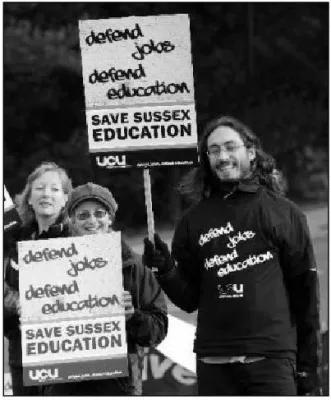
The academics’ union UCU at the University of Sussex cancelled industrial action planned for late June after university bosses declared they were “hopeful” they could avoid any compulsory redundancies.

It soon emerged however that compulsory redundancies had been transformed into ‘voluntary’ ones and the number of job losses remained at over 100, with a similarly severe impact on many courses and workloads expected.

One student mocked the management statement: “We are pleased to announce that the 100 have jumped, and were not pushed. The knives to their backs were unrelated.” A lecturer also commented that “I, among many, have been made ‘voluntarily’ redundant, after being selected for compulsory redundancy. The University seems to have got rid of everyone it wanted by forcing us to accept a ‘voluntary’ settlement.”

The other unions at Sussex, Unite and Unison, representing support staff such as porters, cleaners, IT and workshop technicians, did not even enter in dispute with the University. But like UCU, both Unite and Unison aimed at reducing compulsory redundancies and improving voluntary redundancy packages.

Whilst committee members continued the consultation process, some of the rank and file members argued that the starting point of the unions was wrong, and they should be opposing cuts altogether. None of the three campus unions had rejected university bosses’ line that savings needed to come from staff costs - despite ongoing multi-million pound building projects, and the Vice-Chancellor behind the cuts granting himself a 43% pay increase to £227,000 a year.

“Our area rep came to a special Unite meeting, arguing to give them two more weeks consultation with management,” said Tony, a Unite member and IT worker. “If there was no significant movement during this time, the area rep said she would bring the ballot papers to the next meeting. It shouldn’t be too much of a surprise that she didn’t even turn up to the next meeting, let alone bring ballot papers!”Image removed.

Frustrated with their union’s unwillingness to fight, a group of workers set up the Support Staff Forum (SSF), involving workers from all three campus unions, non-unionised workers as well as several students. Paul, a worker involved in the group, said “one of the good things we have been doing is making both us in the SSF and the wider campus community aware of the cuts and changes in working conditions in the different sectors, as although we all work on the same campus each department can be quite insular.” The SSF also had some success in building solidarity among education workers, such as by encouraging non-UCU members to honour UCU picket lines.

Despite several strike days, widespread support and solidarity, and a vibrant student campaign leading to a week-long occupation in which many hundreds of students and education workers took part, the UCU’s suspension of industrial action marks the end of the dispute. As one would-be striker commented, “Though UCU exec worked tirelessly to achieve the best outcome possible, I feel that once they accepted the need for cuts, they could only negotiate a defeat. Higher Education bosses are using the budget crisis to push through long-term restructuring that will destroy education as we know it. So instead of focusing only on compulsory redundancies, we should have stopped them wrecking our university by opposing all staff reduction. However it looks like UCU nationally are more interested in being involved in restructuring than in stopping it.”

UCU held a ballot for an academic boycott against Sussex, demanding an Avoidance of Redundancy committee which Sussex bosses had rejected out of hand. Earlier in the year at Leeds University UCU had called off industrial action against 700 redundancies after reaching a “groundbreaking” settlement that included setting up an all-union redundancy avoidance committee and postponing any compulsory redundancies until completion of a review in January 2011. However, it later emerged that 400 staff had volunteered for redundancy. With large cuts to higher education budgets, UCU estimates that 22,500 redundancies are in the pipeline in higher education, on top of 34,000 job losses in further education.

  • cuts
  • strikes
  • trade unions
  • education
  • higher education
  • University and College Union (UCU)
  • UNISON – the Public Service Union
  • Unite the Union
  • Sussex University

Guides

Your rights at work

Why do we organise? Capitalism is shit, oppression is shit - but what can we at SolFed do about it?

Why do we organise?

This is our flag - it tells you what we stand for

this-is-our-flag

Direct Action #2 (2024)

Direct Action #2 (2024)

Anarcho-syndicalism in Britain – a little history (2015)

Anarcho-syndicalism in Britain – a little history (2015)

Office worker’s health and safety - your rights and how to use them (2015)

Office worker’s health and safety - your rights and how to use them (2015)

Anarchism and Anarcho-syndicalism (Rudolf Rocker, 2014)

Anarchism and Anarcho-syndicalism (Rudolf Rocker, 2014)

Fighting for ourselves - anarcho-syndicalism and the class struggle (2012)

Fighting for ourselves - anarcho-syndicalism and the class struggle (2012)

Theory & Practice 1 - Workmates - direct action workplace organising on the London underground (2011)

Theory & Practice 1 - Workmates - direct action workplace organising on the London underground (2011)

The Economics of freedom (2003)

The Economics of freedom (2003)

A history of anarcho-syndicalism (SelfEd Collective, 24 unit series, 2001)

A history of anarcho-syndicalism (SelfEd Collective, 24 unit series, 2001)

Out of the frying pan, a critical look at works councils (1998)

Out of the frying pan, a critical look at works councils (1998)

Health and safety at work - an anarcho-syndicalist approach (1997)

Health and safety at work - an anarcho-syndicalist approach (1997)

Theory & Practice 2 - Anarcho-syndicalism in Puerto Real (1994)

Theory & Practice 2 - Anarcho-syndicalism in Puerto Real (1994)
RSS feed