Home
Solidarity Federation
IWA
User account menu
  • Contact
  • Log in
  • Home
    • Intro
    • Workplace organiser training
    • Industrial strategy
    • Community strategy
    • Constitution
  • SolFed
    • Brighton
    • Bristol
    • Edinburgh
    • Liverpool
    • Manchester
    • North London
    • Wales
    • Yorkshire
  • Industries & sectors
    • Claimants and unpaid
    • Education
    • Health and social care
    • Hospitality
  • Events & reports
  • Publications
    • Guides
      • Stuff your boss (doesn't want you to know)
      • Stuff your sexist boss (doesn't want you to know) (2018)
      • Stuff your landlord (doesn't want you to know) (2016)
      • Is your cleaning job killing you? A guide to cleaners health and safety (2017)
      • Office worker’s health and safety - your rights and how to use them (2015)
      • A migrant's guide to Manchester (2016) [en es]
      • A migrant's guide to London (2014) [en es pl]
      • Strike - a guide to walking out (2014)
    • Pamphlets and books
      • Anarcho-syndicalism in Britain – a little history (2015)
        • 1. 19th century to 1914 - The First International, growth of industrial unionism and the Great Unrest
        • 2. 1914–1945 - State suppression and the Bolshevik turn – how Lenin’s seeming success drew militants to the Comintern
        • 3. 1945–1994 - The Anarchist Federation of Britain, Syndicalist Workers’ Federation and Direct Action Movement
        • 4. Today’s movement - A short look at the strategy and thinking of the modern Solidarity Federation
      • Office worker’s health and safety - your rights and how to use them (2015)
      • Anarchism and Anarcho-syndicalism (Rudolf Rocker, 2014)
        • Introduction
        • 1. Ideology of Anarchism
        • 2. History of anarchist philosphy, from Lao-Tse to Kropotkin
        • 3. The origins of anarcho-syndicalism
        • 4. Socialism and anarcho-syndicalism in France
        • 5. The role of the trade unions: anarcho-syndicalist view
        • 6. The struggle in Germany and Spain
        • 7. The political struggle: anarcho-syndicalist view
        • 8. Anarcho-syndicalism since the First World War
      • Fighting for ourselves - anarcho-syndicalism and the class struggle (2012)
        • Introduction
        • 1. The mainstream workers' movement
        • 2. Radical currents in the workers' movement
        • 3. Anarcho-syndicalism in the 20th century
        • 4. Capitalism and the class struggle since World War II
        • 5. Anarcho-syndicalism in the 21st century
        • Endnotes
      • Workmates - direct action workplace organising on the London underground (2011)
      • The Economics of freedom (2003)
      • A history of anarcho-syndicalism (2001)
      • Out of the frying pan, a critical look at works councils (1998)
      • Health and safety at work - an anarcho-syndicalist approach (1997)
      • Anarcho-syndicalism in Puerto Real (1994)
    • Leaflets and flyers
      • Solidarity Federation Education Union (SFEU)
      • Solidarity Federation Hospitality Workers Union (SFHWU)
      • Why do we organise?
      • This is our flag - it tells you what we stand for
      • What is anarcho-syndicalism anyway?
      • Anarchism and Syndicalism (short version)
      • Anarchism and Syndicalism
      • Towards a better union
      • Protest is not enough
      • Building beyond elections
      • We should run our workplaces
      • We should run our communities
      • We should run our movements
    • Newsletters
      • Brighton Solidarity
        • Brighton Solidarity #3
      • Education Worker
        • Education Worker #10 Victimisation (2013)
        • Education Worker #9 (2012)
        • Education Worker #8 Academy Special (2012)
      • Wildcat!
        • Wildcat! #13 (Jan 2013)
        • Wildcat! (Winter 2012)
        • Wildcat! #6 (Summer 2011)
        • Wildcat! #5 (Spring 2011)
        • Wildcat! #4 (Dec 2010)
        • Wildcat! #3 (Oct-Nov 2010)
        • Wildcat! #2 (Jul-Aug 2010)
        • Wildcat! Football for the fans NOT for fat cats! (Jul 2010)
        • Wildcat! #1 (May-June 2010)
      • May Day Bulletin (Newcastle SolFed, 2014)
    • Direct Action
      • Direct Action #2 (2024)
      • Direct Action #1 (2023)
      • Direct action #47 (Summer 2009)
    • Catalyst
      • Catalyst #29 (Feb 2012)
      • Catalyst #28 (Oct 2011)
      • Catalyst #27 (Jun 2011)
      • Catalyst #26 (Mar 2011)
      • Catalyst #25 (Dec 2010)
      • Catalyst #24 (Summer 2010)
    • SelfEd
      • A history of anarcho-syndicalism
        • Block 1
          • Unit 1: The Origins of Capitalism
          • Unit 2: Britain: The Radical Period 1750-1840
          • Unit 3: The First International
          • Unit 4: France 1870-1918 Early revolutionary unions
          • Unit 5: Revolutionary Syndicalism in Britain, 1870-1910
          • Unit 6: Revolutionary Syndicalism in Britain and Ireland, 1910-17
        • Block 2
          • Unit 7: Mexico 1870-1920: Colonialism and Revolution
          • Unit 8: USA 1886-1930 - The Wobblies
          • Unit 9: Anarcho-syndicalism in Argentina 1870-1939
          • Unit 10: Sweden 1889-1939
          • Unit 11: Russia I: 1850-1917
          • Unit 12 Russia II: 1917-30
        • Block 3
          • Unit 13: Going Global - International Organisation, 1872-1922
          • Unit 14: Anarcho-syndicalism in Britain, 1914-30
          • Unit 15 Spain, 1868-1936: Build-up to Revolution
          • Unit 16 Spain: Culture, education, women and sexuality
          • Unit 17: Spain 1936-39: Revolution and Civil War
          • Unit 18: Spain - The Collectives
        • Block 4
          • Unit 19: Britain, 1930-1950 - The Era of Reform
          • Unit 20: Britain, 1950-1990 - Decline of Social Democracy
          • Unit 21: anarcho-syndicalism 1939-99
          • Unit 22: Roots of modern anarcho-syndicalism: freedom, oppression & rebellion
          • Unit 23: Roots of modern anarcho-syndicalism: morality, culture & tactics
          • Unit 24: The spirit of anarcho-syndicalism
    • Letters
  • IWA
By sifa, 23 October, 2010

Know your rights: Working Time Directive

The Working Time Directive limits the hours you work to an average of 48 over a 17-week period. However, many employers make workers sign an ‘opt-out’ that means they can be expected to work more than 48 hours a week.

What most bosses don’t tell you is that if you’ve signed this opt out, you can tell your employer that you want to opt back in. All you need to do is put it in writing. It will take effect in 7 days time unless a different period is specified in the original opt-out, up to a maximum of three months.

The employer has no right to sack you or take any disciplinary action for exercising this, or any other rights. If they do, going to an Employment Tribunal might force them to pay modest compensation.
Tags

  • Know your rights
  • employment rights
By Joseph Kay, 23 October, 2010

Service not included

Following our piece on tips in the last issue, The Independent launched a campaign on the same issue. They didn’t credit either us or the trades unions, which have been campaigning on the issue much longer.

This newspaper campaign seems to have had some effect, however. “Government insiders” now claim they will address the issue in the autumn. More significantly, a prominent “Old” Labour figure has admitted delivering restaurant workers into the hands of their exploiters when drafting minimum wage legislation in 1997.

Ian McCartney, ex-trades union official and token ex-prole in the government, admitted that he sold out workers to ensure the agreement of bosses to the minimum wage. While this ex-waiter banned the use of cash tips to top up the minimum wage, he agreed to a legal loophole allowing catering bosses to use “service charges” for the same purpose.

Tags

  • casualisation
  • bars, catering, hotels and restaurants
  • pay and conditions
  • employment rights
By sifa, 23 October, 2010

Catering bosses tip rip-off

Workers in some of the UK’s most prominent restaurant chains, including Pizza Express, Carluccio’s and Café Rouge, are being ripped off by unscrupulous bosses who use staff tips to subsidise low pay.

The catering sector, already notorious for low pay, poor conditions and long hours, is cynically involved in even worse exploitation of its workforce by using credit card tips to top up wages as low as £2 an hour to make the minimum wage.

Another trick used is to charge staff an “administration fee” on tips added to card transactions. The cost of using the card (between 1% and 2% of the bill) should be met by the restaurant, but the bosses pass that cost on to their workers, who are largely foreign, young and inexperienced. They can easily be threatened with the sack if they tell customers that the bosses keep credit card tips.

Tags

  • bars, catering, hotels and restaurants
By sifa, 23 October, 2010

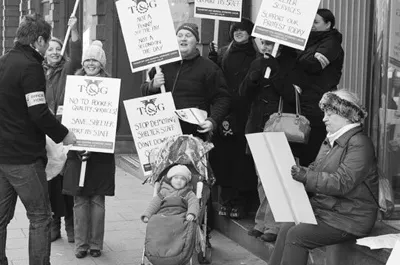
Shelter in a Storm

Workers at Shelter, who provide advice and support to the homeless and badly housed, are fighting to defend their pay and conditions, as well as the core value of the organisation itself.

Shelter’s senior management have responded favourably to New Labour’s policy of tendering public services to the lowest bidder. Management are seeking to implement proposals that would see staff work extra hours for no extra pay, downgrade jobs, remove pay increments and see compulsory redundancies.

While telling dedicated, experienced workers they were not value for money, the charity’s head offices were refurbished at a cost of £750,000, new managers have been employed and senior management gave themselves a pay increase.

Tags

  • charity and NGO
  • resistance
By Joseph Kay, 23 October, 2010

Cleaning up on the tube

London tube cleaners have won crucial pay increases from cleaning companies, with their £5.50 an hour poverty wages being brought up to £7.45.

Cleaners on Metronet contracts were granted the ‘ London living wage’ in July through a wider initiative whilst those working for ISS (contracted by Tubelines) won a staggered pay rise in pre-strike negotiations in August.

With the 48hour RMT strike in June/July and the planned three day strike in August forcing the hand of ISS, the cleaners have demonstrated their strength and gained from it. However, their fight is far from over with the strike committee continuing to meet in pursuit of unmet demands - more holidays, better sick pay, a decent pension and an end to the scandal of ‘third party sackings’.

Tags

  • National Union of Rail, Maritime and Transport Workers (RMT)
  • tube
  • cleaning and facilities
  • pay and conditions
  • transport, couriers and drivers
By sifa, 23 October, 2010

Agency Exploitation

The unions hailed the agreement on equal pay for agency workers “as a victory for union campaigning”. They must be joking. The agreement excludes sick pay and pensions and only guarantees the same pay as permanent staff after twelve week

Tags

  • casualisation
By bill, 23 October, 2010

Strike, occupy, sabotage! - leaflet for anti-cuts march

The text of the leaflet produced by the South London local being distributed on the London anti-cuts march on Saturday 23rd October 2010.

The working class across Europe is facing the worst attacks on our standard of living, jobs and services for decades. We have been forced to pay for capitalism’s crisis since it began; redundancies, pay cuts, benefit cuts, increasing workloads for those who kept their jobs... the private and public sector alike.

As the scale of the cut-backs begins to sink in, there are signs of a growing
movement against the cuts, with hundreds attending public meetings across the country. Many, disenchanted with the anti-war marches and the lethargy of the unions, are arguing for more direct methods in this struggle.

Tags

  • resistance
By Joseph Kay, 22 October, 2010

Know Your Rights: trade union membership

You are protected against being fired or refused a job because of trade union membership or activities, including activities in the past. Your employer is not allowed to treat you any differently if you are a member of a trade union. This means that they must not pass you over for promotion or training opportunities, or treat you differently from non-union members in any way. The same right also applies in the unlikely event of discrimination in favour of union members.

In addition, you have the right to be accompanied by a union official in a disciplinary hearing. You can also have someone accompany you in a grievance hearing if the grievance relates to your terms and conditions of employment.

Tags

  • Know your rights
  • trade unions
  • employment rights
By Joseph Kay, 22 October, 2010

Day of action against Starbucks

On 5th July this year, members of Solidarity Federation joined a day of action against Starbucks, after the coffee chain fired a CNT member in Spain and an Industrial Workers of the World organiser in Grand Rapids, USA. The action was called by the International Workers Association, (of which SolFed and CNT are affiliates) and the IWW.

Tags

  • bars, catering, hotels and restaurants
  • CNT-AIT (Spain)
  • revolutionary unions
  • retail
  • international
By no1, 22 October, 2010

Workplace deaths continue

Workplace deaths across the south west of the country are increasing, according to the Health & Safety Executive, a fact which it finds to be “disappointing”. From March 2007 to March 2008, deaths on the job rose by 16%, with a total of 28 fatalities. Despite injuries in the workplace scaling 240,000, the authorities managed a mere 70 prosecutions across the region; a rather low clearance rate, some might say. Some 38% of injuries were due to “slips, trips and falls” in construction, agriculture and manufacturing.

If you are unfortunate enough to be one of these many casualties and living in the north Somerset area then even more bad luck awaits you, because you’ll have to wait longer for an ambulance than anywhere else in the entire country. Unsurprisingly, these delays have a knock-on effect as paramedics have to stay with the patient until an ambulance turns up, which leads to crews being further delayed at Weston General Hospital for anything up to 45 minutes.

Tags

  • health and safety

Pagination

  • First page
  • Previous page
  • …
  • Page 146
  • Page 147
  • Page 148
  • Page 149
  • Page 150
  • Page 151
  • Page 152
  • Page 153
  • Page 154
  • …
  • Next page
  • Last page

Guides

Your rights at work

Why do we organise? Capitalism is shit, oppression is shit - but what can we at SolFed do about it?

Why do we organise?

This is our flag - it tells you what we stand for

this-is-our-flag

Stuff your boss (doesn't want you to know)

Stuff your boss (doesn't want you to know)

Direct Action #2 (2024)

Direct Action #2 (2024)

Stuff your sexist boss (doesn't want you to know) (2018)

Stuff your sexist boss (doesn't want you to know) (2018)

Is your cleaning job killing you? A guide to cleaners health and safety (2017)

Stuff your landlord (doesn't want you to know) (2016)

Stuff your landlord (doesn't want you to know) (2016)

A migrant's guide to Manchester (2016)

A migrant's guide to Manchester (2016)

Anarcho-syndicalism in Britain – a little history (2015)

Anarcho-syndicalism in Britain – a little history (2015)

Office worker’s health and safety - your rights and how to use them (2015)

Office worker’s health and safety - your rights and how to use them (2015)

A migrant's guide to London (2014)

A migrant's guide to London (2014)

Anarchism and Anarcho-syndicalism (Rudolf Rocker, 2014)

Anarchism and Anarcho-syndicalism (Rudolf Rocker, 2014)

Strike - a guide to walking out (2014)

Strike - a guide to walking out (2014)

Fighting for ourselves - anarcho-syndicalism and the class struggle (2012)

Fighting for ourselves - anarcho-syndicalism and the class struggle (2012)

Theory & Practice 1 - Workmates - direct action workplace organising on the London underground (2011)

Theory & Practice 1 - Workmates - direct action workplace organising on the London underground (2011)

The Economics of freedom (2003)

The Economics of freedom (2003)

A history of anarcho-syndicalism (SelfEd Collective, 24 unit series, 2001)

A history of anarcho-syndicalism (SelfEd Collective, 24 unit series, 2001)

Out of the frying pan, a critical look at works councils (1998)

Out of the frying pan, a critical look at works councils (1998)

Health and safety at work - an anarcho-syndicalist approach (1997)

Health and safety at work - an anarcho-syndicalist approach (1997)

Theory & Practice 2 - Anarcho-syndicalism in Puerto Real (1994)

Theory & Practice 2 - Anarcho-syndicalism in Puerto Real (1994)
RSS feed