A new report into health inequality by the UCL Institute of Health Equality clearly shows that the health gap between the rich and poor is growing. The report highlights the fact that life expectancy has stalled for the first time in a hundred years, with life expectancy actually falling among the poorest 10% of women. The report also found that those living in the most deprived areas of Britain can now expect to spend more of their lives in poor health.
Britain’s household debt mountain has reached a new peak, with UK homes now owing an average of £15,385 to credit card firms, banks and other lenders, according to the TUC.
The study found that household debt rose sharply in 2018 as years of austerity and wage stagnation forced households to increase their borrowing.
The TUC said in its annual report on the nation’s finances that the amounts owed by British households rose to a combined £428bn in the third quarter of 2018. Each household owed £886 more than it did 12 months previously, it said. The figures do not include outstanding mortgage debts but do include student loans.
The level of unsecured debt as a share of household income is now 30.4%, the highest level it has ever been at. It is well above the £286bn peak in 2008 before the financial crisis, the TUC said. That figure also included student loans, but tuition fees then were £3,000 a year compared with up to £9,250 now.
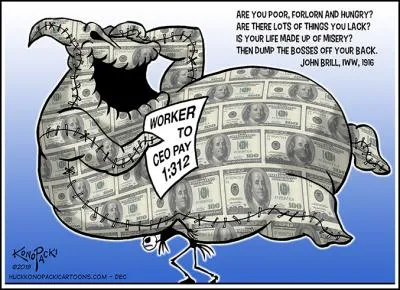
Calculations by the High Pay Centre thinktank and the professional HR body the Chartered Institute of Personnel and Development (CIPD) show top executives are earning 133 times more than the average worker, at a rate of around £1,020 per hour or £3.9m annually. That’s up 11% compared to a year earlier.
It means CEOs working average 12-hour days would only have to clock in for 29 hours in 2019 to earn the median £29,574 of British staff.
Predictably union leaders have rushed to condemn the news. The GMB’s general secretary, Tim Roache, said: “It’s sickening. Three days into the year and fat cat bosses have already made what average workers will earn all year.” Frances O’Grady, the general secretary of the Trades Union Congress, also slammed “greedy executives” she said were “taking more than they’ve earned…..Too much wealth is being hoarded at the top,” she said, adding that reforms were needed to bring executive pay “back down to earth”.
A recent government report into poverty paints a depressing picture of inequality in Britain.
The Acheson Report on Health Inequality, set up by New Labour, found that working class people die younger, and suffer more from lung cancer, coronary heart disease, strokes, and suicides than the rich. They also suffer more house vandalism, and their children are less well-fed, despite the fact that their mothers often go without. Children are less likely to have any form of pre-school education, and have less access to child care. Not surprisingly, after this start in life, they do less well at school. The list goes on…

 For our fifteenth reading group we will be reading What About The Rapists by Dysophia. From the blurb: