Home
Solidarity Federation
IWA
User account menu
  • Contact
  • Log in
  • Home
    • Intro
    • Workplace organiser training
    • Industrial strategy
    • Community strategy
    • Constitution
  • SolFed
    • Brighton
    • Bristol
    • Edinburgh
    • Liverpool
    • Manchester
    • North London
    • Wales
    • Yorkshire
  • Industries & sectors
    • Claimants and unpaid
    • Education
    • Health and social care
    • Hospitality
  • Events & reports
  • Publications
    • Guides
      • Stuff your boss (doesn't want you to know)
      • Stuff your sexist boss (doesn't want you to know) (2018)
      • Stuff your landlord (doesn't want you to know) (2016)
      • Is your cleaning job killing you? A guide to cleaners health and safety (2017)
      • Office worker’s health and safety - your rights and how to use them (2015)
      • A migrant's guide to Manchester (2016) [en es]
      • A migrant's guide to London (2014) [en es pl]
      • Strike - a guide to walking out (2014)
    • Pamphlets and books
      • Anarcho-syndicalism in Britain – a little history (2015)
        • 1. 19th century to 1914 - The First International, growth of industrial unionism and the Great Unrest
        • 2. 1914–1945 - State suppression and the Bolshevik turn – how Lenin’s seeming success drew militants to the Comintern
        • 3. 1945–1994 - The Anarchist Federation of Britain, Syndicalist Workers’ Federation and Direct Action Movement
        • 4. Today’s movement - A short look at the strategy and thinking of the modern Solidarity Federation
      • Office worker’s health and safety - your rights and how to use them (2015)
      • Anarchism and Anarcho-syndicalism (Rudolf Rocker, 2014)
        • Introduction
        • 1. Ideology of Anarchism
        • 2. History of anarchist philosphy, from Lao-Tse to Kropotkin
        • 3. The origins of anarcho-syndicalism
        • 4. Socialism and anarcho-syndicalism in France
        • 5. The role of the trade unions: anarcho-syndicalist view
        • 6. The struggle in Germany and Spain
        • 7. The political struggle: anarcho-syndicalist view
        • 8. Anarcho-syndicalism since the First World War
      • Fighting for ourselves - anarcho-syndicalism and the class struggle (2012)
        • Introduction
        • 1. The mainstream workers' movement
        • 2. Radical currents in the workers' movement
        • 3. Anarcho-syndicalism in the 20th century
        • 4. Capitalism and the class struggle since World War II
        • 5. Anarcho-syndicalism in the 21st century
        • Endnotes
      • Workmates - direct action workplace organising on the London underground (2011)
      • The Economics of freedom (2003)
      • A history of anarcho-syndicalism (2001)
      • Out of the frying pan, a critical look at works councils (1998)
      • Health and safety at work - an anarcho-syndicalist approach (1997)
      • Anarcho-syndicalism in Puerto Real (1994)
    • Leaflets and flyers
      • Solidarity Federation Education Union (SFEU)
      • Solidarity Federation Hospitality Workers Union (SFHWU)
      • Why do we organise?
      • This is our flag - it tells you what we stand for
      • What is anarcho-syndicalism anyway?
      • Anarchism and Syndicalism (short version)
      • Anarchism and Syndicalism
      • Towards a better union
      • Protest is not enough
      • Building beyond elections
      • We should run our workplaces
      • We should run our communities
      • We should run our movements
    • Newsletters
      • Brighton Solidarity
        • Brighton Solidarity #3
      • Education Worker
        • Education Worker #10 Victimisation (2013)
        • Education Worker #9 (2012)
        • Education Worker #8 Academy Special (2012)
      • Wildcat!
        • Wildcat! #13 (Jan 2013)
        • Wildcat! (Winter 2012)
        • Wildcat! #6 (Summer 2011)
        • Wildcat! #5 (Spring 2011)
        • Wildcat! #4 (Dec 2010)
        • Wildcat! #3 (Oct-Nov 2010)
        • Wildcat! #2 (Jul-Aug 2010)
        • Wildcat! Football for the fans NOT for fat cats! (Jul 2010)
        • Wildcat! #1 (May-June 2010)
      • May Day Bulletin (Newcastle SolFed, 2014)
    • Direct Action
      • Direct Action #2 (2024)
      • Direct Action #1 (2023)
      • Direct action #48 (Autumn 2009)
      • Direct action #47 (Summer 2009)
    • Catalyst
      • Catalyst #29 (Feb 2012)
      • Catalyst #28 (Oct 2011)
      • Catalyst #27 (Jun 2011)
      • Catalyst #26 (Mar 2011)
      • Catalyst #25 (Dec 2010)
      • Catalyst #24 (Summer 2010)
    • SelfEd
      • A history of anarcho-syndicalism
        • Block 1
          • Unit 1: The Origins of Capitalism
          • Unit 2: Britain: The Radical Period 1750-1840
          • Unit 3: The First International
          • Unit 4: France 1870-1918 Early revolutionary unions
          • Unit 5: Revolutionary Syndicalism in Britain, 1870-1910
          • Unit 6: Revolutionary Syndicalism in Britain and Ireland, 1910-17
        • Block 2
          • Unit 7: Mexico 1870-1920: Colonialism and Revolution
          • Unit 8: USA 1886-1930 - The Wobblies
          • Unit 9: Anarcho-syndicalism in Argentina 1870-1939
          • Unit 10: Sweden 1889-1939
          • Unit 11: Russia I: 1850-1917
          • Unit 12 Russia II: 1917-30
        • Block 3
          • Unit 13: Going Global - International Organisation, 1872-1922
          • Unit 14: Anarcho-syndicalism in Britain, 1914-30
          • Unit 15 Spain, 1868-1936: Build-up to Revolution
          • Unit 16 Spain: Culture, education, women and sexuality
          • Unit 17: Spain 1936-39: Revolution and Civil War
          • Unit 18: Spain - The Collectives
        • Block 4
          • Unit 19: Britain, 1930-1950 - The Era of Reform
          • Unit 20: Britain, 1950-1990 - Decline of Social Democracy
          • Unit 21: anarcho-syndicalism 1939-99
          • Unit 22: Roots of modern anarcho-syndicalism: freedom, oppression & rebellion
          • Unit 23: Roots of modern anarcho-syndicalism: morality, culture & tactics
          • Unit 24: The spirit of anarcho-syndicalism
    • Letters
  • IWA
By Joseph Kay, 15 October, 2009

Why did we risk it all? Because we won't go down without a fight

While the recent media spin is suggesting that we’re ‘on our way out of recession’, the reality on the ground is that workers are still facing attacks across sectors in the forms of job cuts and community provisions. Education has been one of the sectors worst hit in this period, with £65m slashed from higher-education (HE) budgets, schools closing left, right and centre, and jobs to go at approximately 100 of the 150 HE institutions in the UK . The situation is as bleak as ever.

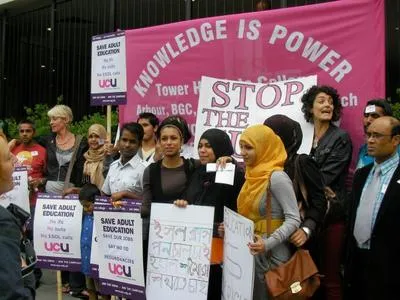
In August, around 250 members of teaching staff at Tower Hamlets College (THC), East London went on indefinite strike over threats of compulsory redundancies, and cuts in provision of ESOL (English for Speakers of Other Languages) courses. Catalyst spoke to Rachel, a member of the striking staff, about the background of the dispute, the issues at hand, and the feelings after the strike came to an end in late September.

Tags

  • interviews
  • strikes
  • education
  • North London
  • Tower Hamlets
By Joseph Kay, 15 October, 2009

Mail strike's roots in unfinished business

Workers at Royal Mail have voted overwhelmingly in favour of strike action over management plans for job cuts. 76% of workers who responded to the ballot voted in favour of industrial action. The roots of the dispute go back to the settlement that ended the 2007 national postal strike.

At the time it was announced as a victory, but in fact the CWU union agreed to management plans to cut jobs. The ‘victory’ was that the CWU and Royal Mail management would negotiate the details of the cuts at a local level. Now postal workers are unhappy with the results of those negotiations. One trigger is the Royal Mail’s refusal to “Pay for Change.” In unilaterally imposing such changes by so-called ‘executive action’, Royal Mail have reopened the dispute.

Tags

  • strikes
  • privatisation
  • Royal Mail
By Joseph Kay, 15 October, 2009

When equality means cuts

In 1997, councils across Britain came to an agreement with unions to undertake ‘Single Status’ job evaluations to end the discrepancies between manual and white collar jobs. Parallel to this, claims made about the historic pay discrepancies between traditionally male and traditionally female jobs were won at various Employment Tribunals. Historically, workers in female dominated jobs (such as those working around childcare) have been paid significantly less than those in jobs usually seen as ‘men’s work’, such as refuse collection.

Since the Equal Pay Act in 1970 these pay discrepancies had been open to legal challenge, but Single Status was supposed to be an across the board solution that would see every job within the councils evaluated and regarded equally based on the content of the job. In theory, this was of course a good thing.

Tags

  • equal pay
  • cuts
  • local government
  • public services
  • Edinburgh
  • Brighton
By Joseph Kay, 15 October, 2009

Freedom for the Belgrade 6!

Six anarchists from the ASI, Solidarity Federation’s Serbian sister organisation are currently imprisoned by the Serbian state.  Tadej Kurep, Ivan Vulovic, Sanja Dojkic, Ratibor Trivunac, Ivan Savic and Nikola Mitrovic are accused of  attacking the Greek embassy in Belgrade remain imprisoned, with (at time of press) no charges yet levelled at them.

The six have been targeted by authorities because of their politics and visibility, and face the ludicrous prospect of international terrorism charges - on the basis that as the embassy is sovereign territory, the attack had crossed an international border. The attack itself caused negligible damage, and has even been claimed by another group.  If international terrorism charges are brought, the Six face over 10 years in prison.

Tags

  • anarcho-syndicalism
  • anarcho-syndicalism today
  • Belgrade 6
  • state
  • repression
By Joseph Kay, 15 October, 2009

Anarcho-syndicalism at work

There are political and economic assumptions in the way the existing, social democratic unions organise. They think workers and management have common interests, and that it is in their best interests to form partnerships. For example, to win the support of bosses in catering for the National Minimum Wage, in 1997 Labour allowed them to include workers’ tips in calculating it, in spite of the NMW being a key election manifesto point.

Workers’ interests are considered to be those of the Labour Party or the union bureaucracy. Representation, where politicians, union officials, or lay representatives deal with management works to resolve problems without harming the latter’s interests. Business is seen as the goose which lays the golden egg, but we think that wealth is created not by business but by workers. In contract cleaning, for example, cleaners create the wealth but are sidelined by both unions and management.

Tags

  • anarcho-syndicalism
  • resistance
By Joseph Kay, 27 September, 2009

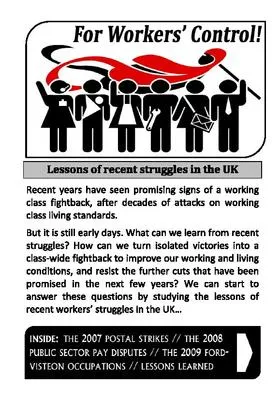
For Workers Control - Lessons of recent struggles in the UK

8-page leaflet looking at what we can learn from the 2007 postal strike, the 2008 public sector strike and the 2009 Visteon occupation.

The leaflet was produced for a demo against the Labour Party Conference on Sunday 27th September. It is based on several previously published articles and we try to draw the lessons of recent relevant struggles in the UK.

For Workers’ Control

Lessons of recent struggles in the UK

Recent years have seen promising signs of a working class fightback, after decades of attacks on working class living standards.

But it is still early days. What can we learn from recent struggles? How can we turn isolated victories into a class-wide fightback to improve our working and living conditions, and resist the further cuts that have been promised in the next few years? We can start to answer these questions by studying the lessons of recent workers’ struggles in the UK…


Attachment Size
for-workers-control.pdf (792.85 KB) 792.85 KB

Tags

  • analysis
  • leaflets and flyers
  • Communication Workers Union (CWU)
  • strikes
  • trade unions
  • UNISON – the Public Service Union
  • Royal Mail
  • Visteon
By sifa, 24 September, 2009
s

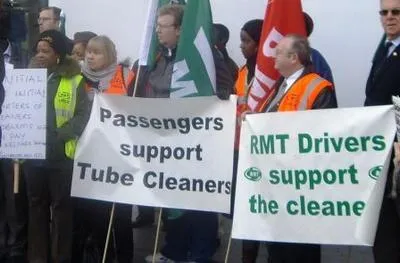
Supporting striking tube cleaners

South London Solidarity Federation Supports the Tube Cleaners. An article about the Tube cleaners Strike and action reports. July 4th, 2008 taken from LibCom.org

Tube cleaners’ union RMT has demanded an end to “appalling intimidation“ of members involved in a 48-hour strike for a living wage on, one on July 1st-3rd. Tube cleaners also engaged in a 24-hour strike on June 25th-26th.

The union is gathering evidence that cleaners have been bullied, harassed and threatened with the sack and with illegal punitive deductions from their wages if they take strike action.

“Reports coming in from picket lines over the last 36 hours indicate that the employers are so desperate that they are resorting to gangster-style intimidation and using the worst sort of fear tactics to stop more people joining the strike, “ RMT general secretary Bob Crow said today.

Tags

  • cleaning and facilities
  • resistance
  • South London
  • National Union of Rail, Maritime and Transport Workers (RMT)

Direct action #48 (Autumn 2009)

da48in this issue 
4-5 editorial: Savage Cuts in Spending - Realities and Possibilities
6-7 Hugging Bankers - the rehabilitation of thieves and their narrow self-interest
8-9 Tilting at Windmils - the Vestas workers’ occupation, climate change and class struggle 
10 Scabs Are Rubbish - Leeds bin workers on strike against pay cuts

Attachment Size
Direct action #48 (Autumn 2009).pdf (7.34 MB) 7.34 MB

Tags

  • library
  • publications
  • Direct Action
By Joseph Kay, 1 August, 2009

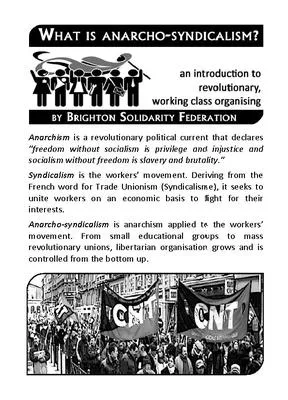
What is anarcho-syndicalism?

This is a leaflet we produced in August 2009, explaining some basics of anarcho-syndicalism.

If you want a copy, please get in touch with us, or download the attached pdf file.

What is anarcho-syndicalism?

Anarchism is a revolutionary political current that declares “freedom without socialism is privilege and injustice and socialism without freedom is slavery and brutality.”

Syndicalism is the workers’ movement. Deriving from the French word for Trade Unionism (Syndicalisme), it seeks to unite workers on an economic basis to fight for their interests.

Anarcho-syndicalism is anarchism applied to the workers’ movement. From small educational groups to mass revolutionary unions, libertarian organisation grows and is controlled from the bottom up.

Attachment Size
what-is-anarcho-syndicalism-leaflet.pdf (708.95 KB) 708.95 KB

Tags

  • leaflets and flyers
  • anarcho-syndicalism today

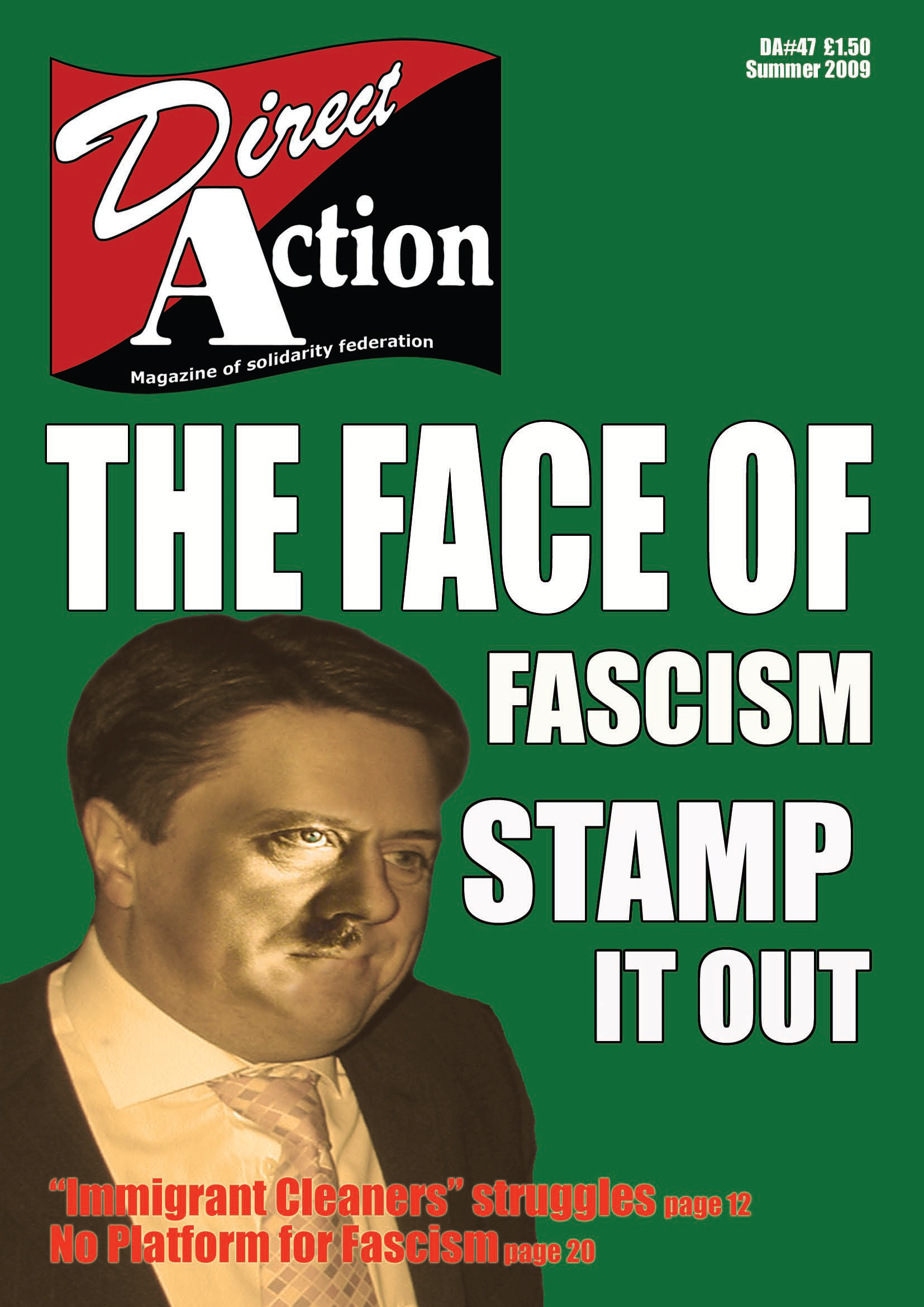
Direct action #47 (Summer 2009)

da-sf-iwa #47

contents

Inside this issue:

  • 4-5: editorial: Why Anarcho-Syndicalism Remains Relevant Today
  • 6-7: A Contradiction at the Heart of Chaos - regulation of global financial markets to solve boom and bust is a non-starter
  • 8-9: Occupy and Defy - the Visteon workers’ struggle and their union
  • 10-11: Lewisham Occupation - a community fighting to save its primary school
  • 11: Fujitsu Attack on Pensions
  • 12-15: Dirty Deeds Done Dirt Cheap - immigrant cleaners’: the “hard-to-organise” are self-organising
  • 16: Breaking Isolation - domestic abuse and workplace support
  • 17: The Big Green Con - seeing through the sham of “green” capitalism
  • 18-19: our history: The Great Dock Strike of 1889 - for the anarchist movement, a significant event that turned abstract talk into what ultimately became anarcho-syndicalism
  • 20-22: No Platform for Fascism - the BNP, despite “ordinary people” voting for it, is a fascist party and must continue to be confronted as such
  • 22-23: have your say: Anarchism & Crime/ Crime / the Miami Five / Left Luggage/ English National Resistance
  • 24: A Rebellious Tradition - is there cause for optimism amid greed, corruption & inequality?
  • 25-26: international: the CNT vs. Ryanair/ General Strike for the Amazon/ Killing for Profit
  • 26-29: reviews: Paul Mason - Live Working or Die Fighting and Meltdown/ Kate Sharpley Library - A Grand Cause; The Federación Anarquista Uruguaya and Salvador Puig Antich & the MIL
  • 30-33: closer look: Seeing Sense in the Age of Stupid - alienation, power and the case for social transformation
  • 34-35: DA resources: Solidarity Federation booklets, contacts, information and friends & neighbours
Attachment Size
Direct action #47 (Summer 2009).pdf (3.16 MB) 3.16 MB

Tags

  • library
  • publications
  • Direct Action

Pagination

  • First page
  • Previous page
  • …
  • Page 159
  • Page 160
  • Page 161
  • Page 162
  • Page 163
  • Page 164
  • Page 165
  • Page 166
  • Page 167
  • …
  • Next page
  • Last page

Guides

Your rights at work

Why do we organise? Capitalism is shit, oppression is shit - but what can we at SolFed do about it?

Why do we organise?

This is our flag - it tells you what we stand for

this-is-our-flag

Stuff your boss (doesn't want you to know)

Stuff your boss (doesn't want you to know)

Direct Action #2 (2024)

Direct Action #2 (2024)

Stuff your sexist boss (doesn't want you to know) (2018)

Stuff your sexist boss (doesn't want you to know) (2018)

Is your cleaning job killing you? A guide to cleaners health and safety (2017)

Stuff your landlord (doesn't want you to know) (2016)

Stuff your landlord (doesn't want you to know) (2016)

A migrant's guide to Manchester (2016)

A migrant's guide to Manchester (2016)

Anarcho-syndicalism in Britain – a little history (2015)

Anarcho-syndicalism in Britain – a little history (2015)

Office worker’s health and safety - your rights and how to use them (2015)

Office worker’s health and safety - your rights and how to use them (2015)

A migrant's guide to London (2014)

A migrant's guide to London (2014)

Anarchism and Anarcho-syndicalism (Rudolf Rocker, 2014)

Anarchism and Anarcho-syndicalism (Rudolf Rocker, 2014)

Strike - a guide to walking out (2014)

Strike - a guide to walking out (2014)

Fighting for ourselves - anarcho-syndicalism and the class struggle (2012)

Fighting for ourselves - anarcho-syndicalism and the class struggle (2012)

Theory & Practice 1 - Workmates - direct action workplace organising on the London underground (2011)

Theory & Practice 1 - Workmates - direct action workplace organising on the London underground (2011)

The Economics of freedom (2003)

The Economics of freedom (2003)

A history of anarcho-syndicalism (SelfEd Collective, 24 unit series, 2001)

A history of anarcho-syndicalism (SelfEd Collective, 24 unit series, 2001)

Out of the frying pan, a critical look at works councils (1998)

Out of the frying pan, a critical look at works councils (1998)

Health and safety at work - an anarcho-syndicalist approach (1997)

Health and safety at work - an anarcho-syndicalist approach (1997)

Theory & Practice 2 - Anarcho-syndicalism in Puerto Real (1994)

Theory & Practice 2 - Anarcho-syndicalism in Puerto Real (1994)
RSS feed