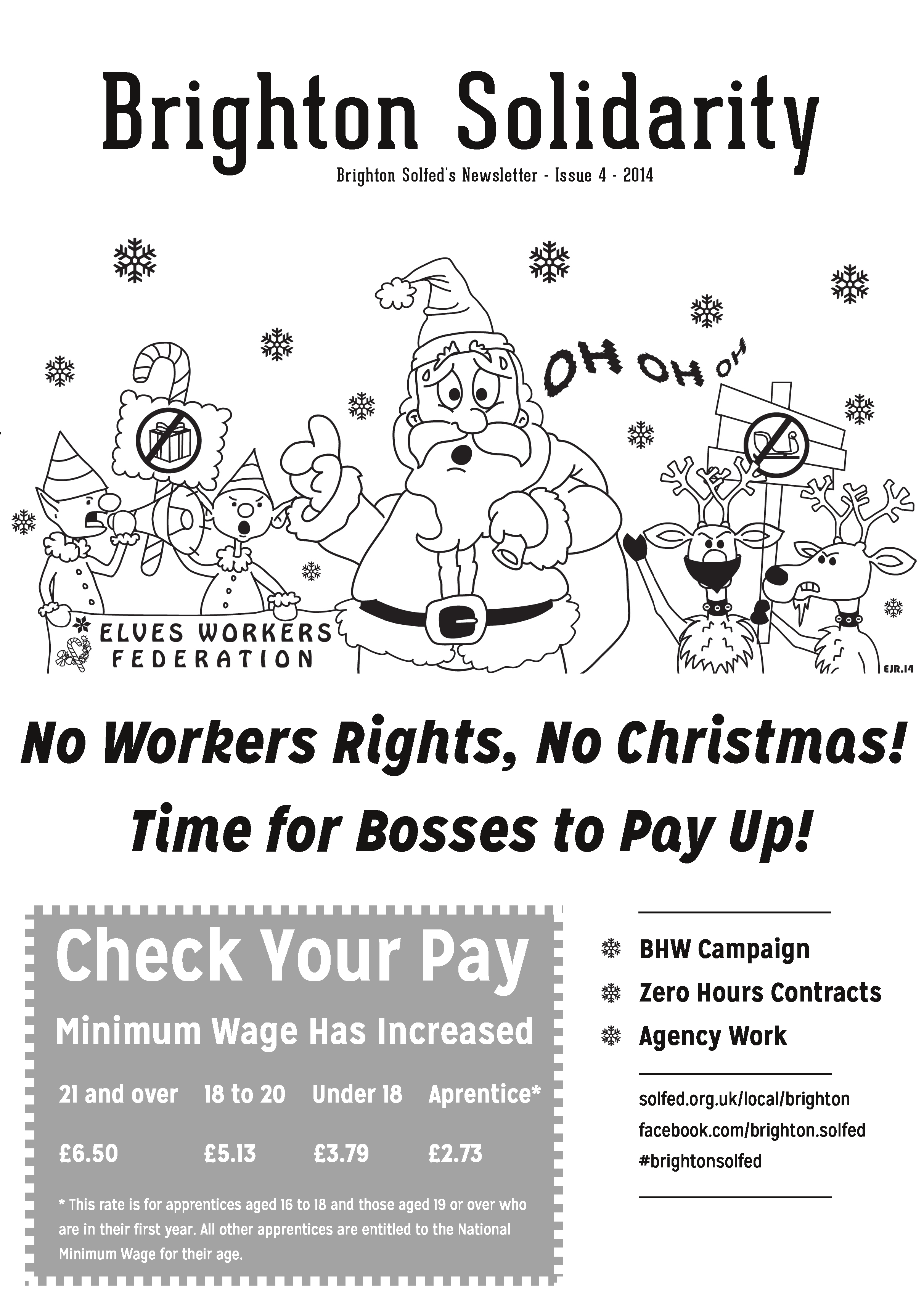
- No Workers Rights, No Christmas! Time for Bosses to Pay Up!
- Employment Rights: National Minimum Wage
- Carry on Picketing!
- The Facts on Zero-Hours Contracts: More power for bosses, fewer rights for workers
- Agency work: An Immigrant Workers Experience
- Brighton SolFed
No Workers Rights, No Christmas! Time for Bosses to Pay Up!
Check Your Pay
Minimum Wage Has Increased
- 21 and over £6.50
- 18 to 20 £5.13
- Under 18 £3.79
- Apprentice* £2.73
 * This rate is for apprentices aged 16 to 18 and those aged 19 or over who are in their first year. All other apprentices are entitled to the National Minimum Wage for their age.
solfed.org.uk/local/brighton facebook.com/brighton.solfed #brightonsolfed
Employment Rights: National Minimum Wage
Paid annual leave, calculated according to hours worked, there is a holiday entitlement calculator, useful for workers on casual or irregular hours at: https://www.gov.uk/calculate-your-holiday-entitlement
Minimum rest breaks, which is 20 minutes after 6 hours worked
Not having to work for more than 48 hours on average per week, unless your contract states otherwise
Protection against unlawful deductions from wages
Protection from unlawful discrimination
Carry on Picketing!
In summer 2014, Brighton Hospitality Workers (BHW) took on one of the most uncompromising bosses we have faced. The owner (who shall henceforth be referred to as ‘V’) of a well-known local café had hired a worker with an agreement to pay her £6ph but when it came to payday, he only coughed up what amounted to £5ph and refused to pay her holiday pay. After V refused to pay her the remainder, the worker approached BHW, who agreed to support her in getting back her owed wages.
During the initial meeting with V, BHW delivered a letter outlining reasons for the conflict and the demands of the worker. The worker herself was too scared to face V. V was verbally and physically abusive, and refused to accept the letter (we left it on the premises anyway).
And so it was that BHW held the first of several pickets. Over the course of two months, BHW and our many supporters held eight pickets. During these pickets, V tried to bully and intimidate picketers by threatening legal action and calling the cops several times, V’s friend tried to dislodge the picket by driving his car onto the pavement and using it to push picketers out of the way (we refused to budge), and other friends of V’s even tried to follow a couple of picketers home after pickets.
But BHW and their supporters refused to be intimidated by the bullying boss and carried on picketing. The atmosphere on the pickets was high-spirited, jovial, and this was further encouraged every time V demonstrated his extremely stupid boss-thoughts (as can be seen in this short documentary). After several pickets, V gave in and offered the workers a satisfactory deal. Even after paying up, V was being difficult and threatened the workers and Brighton SolFed with legal action. It was obvious he knew he lost and was desperately trying to save face, so we just told him to fuck off.
Empowerment and emotional transformations
Over the course of the conflict, we witnessed some interesting emotional transformations in all that were involved. At the beginning of the conflict, the worker was too scared to meet with V to discuss her demands or attend a picket. V displayed thuggish behaviour, he was smug and threatening, acted very macho. The Turkish community members that were in the vicinity – mostly bosses of various small businesses themselves – were hostile towards SolFed. They argued that no one should harm another’s business as it was their (the boss’) livelihood.
However, by the end of the conflict, the worker had attended several pickets and confronted V and his friends. V himself became more meek and quiet, and he looked more haggard and defeated as time went on. The community members changed their original viewpoint too; they eventually accepted that picketing was a justified way to get back owed wages. Some other bosses even tried to convince V to pay up.
These emotional transformations were reflected in the behaviour of all involved. As the worker went from being scared to drawing support from those around her and becoming empowered enough to stand up to V, V became quieter and less confrontational. The community members went from confronting picketers, to quietly observing the situation, to openly arguing with V. The regular picketers became more and more boisterous as time went on, and showed no signs of ever giving up picketing.
Other points
While we were taking direct action, two workers also explored the ‘legal options’ by talking to the Citizens Advice Bureau (CAB). It turned out that there was little that CAB could do to help - the workers soon realised that the law was not on their side.
During the pickets, members of the public were also shocked that bosses could get away with illegal actions. They were even more shocked that the police were called during the pickets and the boss admitted he paid less than minimum wage, yet the police did not do anything and ignored this illegal activity. Several times members of the public spontaneously joined our pickets and helped distribute leaflets.
The Facts on Zero-Hours Contracts: More power for bosses, fewer rights for workers
It is now common practice for employers who want to hire workers on a ‘casual’ or ‘flexible’ basis to issue a zero-hours contract. In basic terms, it is a contract of employment which creates an ‘agreement’ between employer and worker, where the employer has no obligation to provide work and where the worker agrees to be available for work if and when required. This is known as an ‘on-call’ arrangement, where the worker can be called at short notice to cover a few hours, a shift or more.
Although the term ‘zero-hours’ is not defined in employment legislation, it is understood that a worker is not obliged to accept any of the hours offered, just as an employer is not obliged to offer any hours. However, there are clearly problems with this arrangement as workers are under pressure to accept the hours they are offered or face not being offered any more in the future. Zero-hours contracts allow employers to favour some workers over others without breaching employment law. It is also increasingly common for employers to issue zero- hours contracts to workers who are expected to work regular and long hours, often 35 or more per week. At the other extreme, workers rely on several zero-hours contracts as neither one guarantee enough pay to be financially secure.
Zero-hours contracts are a way for employers to hire staff with maximal ‘flexibility’ while observing minimal employment rights. However, if you have signed a zero-hours contract you have ‘worker’ status and are guaranteed employment rights no matter what your contract says.
The majority of employers are not obliged to pay sick or maternity pay to workers on zero-hours contracts, and most contracts do not stipulate a minimum notice period for termination of contract. You can also be expected to work bank holidays without being paid extra.
It is likely that your employer has not made you aware of at least some of your employment rights under zero-hours, and we suggest that you check your contract thoroughly before signing. Talk to your colleagues on zero-hours and if you believe your contracts are unlawful or need checking then Brighton Solidarity Federation will be happy to meet, give advice or support you to make demands from management.
Got an issue or want to join Solfed? Get in contact: brighton@solfed.org.uk or 07790607310
 Agency work: An Immigrant Workers Experience
Using an employment agency is quite common for people looking for a job. That was my case. I arrived in Brighton from Spain a few months ago, my aim was working here for a bit and learn the language. Quite soon, I found a job through an agency in the hospitality sector, a sector which -here as well as elsewhere- relies on unskilled workers in order to exploit them.
If you work through an agency, your company has no responsibility towards you - for them, you are just a cheap and easily replaceable worker who can be mistreated. If they are unhappy with you, they don't even need to lay you off, they have just tell the agency that they don´t want to see you back.
Your training is a mere formality, usually there is just a questionnaire about health and hygiene which you have to quickly fill in. After that, you are told the time and the address of your workplace. You manage to arrive - of course, the transport must be provided by yourself - and you enter your new workplace helplessly, hoping that somebody will explain to you what you should do. However, you will be required to work the same as everybody else, and you better satisfy them if you want that they call you again.
Of course, you will have a flexible schedule. If you have luck, you will know your timetable five days in advance but you can be called to start to work “as soon as possible” too. This means that you can not make plans which you can't cancel at the last minute, and that you have to be waiting for the phone all the time, waiting for a call from the agency and wondering if this week you will have some free time or if you will get enough hours to pay your rent. In addition, you don´t know where you will work. Personally, I had six different workplaces in three months.
But no matter what are you doing in that moment, no matter if you have worked too many hours or just a few, you better not reject too many job offers because you won´t be their favourite any more.
As regards the agencies, there are too many and each one has their own manner. In general you will find a friendly environment: they tell you that you are an excellent worker, that they will call you a lot, that there will be too much work for you and a lot of promises which sometimes are kept and sometimes not. Nevertheless, they will ask you not to look for an other job, you are theirs.
That friendly environment -which they promote with cookies, funny photos and being in the mood for a laugh- could make you commit the common mistake of feeling grateful towards them, “at the end of the day they give me work, they are cool and they are my mates”.
The crude reality is that agencies are companies which earn a lot of money from our work. In addition, if they can, they will steal more from you than the law allows, forgetting to pay our holidays or using another kind of trick.
Don´t let yourself be fooled! The agencies are a swindle allowed by the government and their function is to provide the companies with a precarious, cheap and docile workforce. The agencies devalue our work and become rich at our expense.
If you have to work through an agency be vigilant! Get information about your rights and organise with your workmates.
 Brighton SolFed
 is a local anarcho-syndicalist union based on the idea that through solidarity and direct action, ordinary people have the power to improve our lives.
Our aim is to promote solidarity in our workplaces and outside of them, encouraging workers to organise independently of bosses, bureaucrats and political parties to fight for our own interests.
Our ultimate goal is a stateless, classless society based on the principle "from each according to their ability, to each according to their need". We see such a society emerging out of working class struggles to assert our needs in the here and now.
Our activity therefore aims to build struggles which both benefit us all now and bring us closer to the society we want to create.
We are not a state-registered trade union or political party. Nor are we a service provider – we can’t solve your problems for you.
What we are is fellow workers who are sick of being screwed around ourselves and want to do something about it by helping each other. If that's how you feel too - join us! We are stronger when we stand together and organise.
Current Networks:
 Brighton Hospitality Workers has been winning campaigns against wage theft around Brighton.Hospitality being a big earner for the city but not for the worker, with other common problems such as bullying and under training.
 The Health & Social Care Network is Brighton Solfed's newest initiative. Aiming to bring together all those who work in both areas to stand up for each other.
This is solidarity, not charity - An injury to one is an injury to all!
brighton@solfed.org.uk solfed.org.uk/local/brighton facebook.com/brighton.solfed #brightonsolfed