Home
Solidarity Federation
Section of the International Workers Association
CAPTCHA
Solve this simple math problem and enter the result. E.g. for 1+3, enter 4.
This question is for testing whether or not you are a human visitor and to prevent automated spam submissions.
User account menu
  • Contact
  • Log in
CAPTCHA
Solve this simple math problem and enter the result. E.g. for 1+3, enter 4.
This question is for testing whether or not you are a human visitor and to prevent automated spam submissions.
  • Home
    • About SolFed
    • Workplace organiser training
    • Industrial strategy
    • Community strategy
    • Constitution
  • SolFed
    • Brighton
    • Bristol
    • Edinburgh
    • Liverpool
    • Manchester
    • North London
    • Wales
    • Yorkshire
  • Industries and sectors
    • Claimants and unpaid
    • Education
    • Health and social care
    • Hospitality
  • Events & reports
  • Publications
    • Guides
      • Stuff your boss (doesn't want you to know)
      • Stuff your sexist boss (doesn't want you to know) (2018)
      • Stuff your landlord (doesn't want you to know) (2016)
      • Is your cleaning job killing you? A guide to cleaners health and safety (2017)
      • Office worker’s health and safety - your rights and how to use them (2015)
      • A migrant's guide to Manchester (2016) [en es]
      • A migrant's guide to London (2014) [en es pl]
      • Strike - a guide to walking out (2014)
    • Pamphlets and books
      • Anarcho-syndicalism in Britain – a little history (2015)
      • Office worker’s health and safety - your rights and how to use them (2015)
      • Anarchism and Anarcho-syndicalism (Rudolf Rocker, 2014)
      • Fighting for ourselves - anarcho-syndicalism and the class struggle (2012)
      • Workmates - direct action workplace organising on the London underground (2011)
      • The Economics of freedom (2003)
      • A history of anarcho-syndicalism (2001)
      • Health and safety at work - an anarcho-syndicalist approach (1997)
      • Out of the frying pan, a critical look at works councils (1998)
      • Anarcho-syndicalism in Puerto Real (1994)
    • Leaflets and flyers
      • Solidarity Federation Education Union (SFEU)
      • Solidarity Federation Hospitality Workers Union (SFHWU)
      • What is wage theft?
      • Why do we organise?
      • This is our flag - it tells you what we stand for
      • What is anarcho-syndicalism anyway?
      • Anarchism and Syndicalism (short version)
      • Anarchism and Syndicalism
      • Towards a better union
      • Protest is not enough
      • Building beyond elections
      • We should run our workplaces
      • We should run our communities
      • We should run our movements
    • Posters and stickers
    • Newsletters
      • Brighton Solidarity
        • Brighton Solidarity #3 (2015)
        • Brighton Solidarity #2 (2015)
        • Brighton Solidarity #4 (Winter 2014)
        • Brighton Solidarity #3 (Summer 2014)
        • Direct Action Solidarity #2 (Spring 2014)
        • Direct Action Solidarity #1 (Jan 2012)
        • Brighton Solidarity - spending review special (Oct 2010)
        • Brighton Solidarity - emergency budget special (Jun 2010)
        • Brighton Agitator #1 (Mar 2010)
        • Brighton Solidarity (Winter 2007)
      • Communication Worker
        • Communication Worker #8 (Jul 2001)
        • Communication Worker #7 (Jan 2001)
        • Communication Worker #6
        • Communication Worker #5
        • Communication Worker bulletin
      • Education Worker
        • Education Worker #10 (Apr 2013)
        • Education Worker #9 (Oct 2012)
        • Education Worker #8 (Mar 2012)
        • Education Worker #7 (Mar 2011)
        • Education Worker #6 (Jan 2011)
        • Education Worker #5 (Oct 2009)
        • Education Worker #4 (May 2009)
        • Education Worker #3 (Sep 2008)
        • Education Worker #2 (Jan 2008)
        • Education Worker #1 (2007)
        • Education Worker #9 (Summer 2002)
        • Education Worker #8 - special higher education issue (2002)
      • The Leveller
        • The Leveller #19 (May-Jul 2017)
        • The Leveller #18 (Aug 2016)
        • The Leveller #17 (Mar 2015)
        • The Leveller #17 (Dec 2014)
        • The Leveller #16 (Nov 2014)
        • The Leveller #15 (May 2014)
        • The Leveller #14 (Mar 2014)
        • The Leveller #13 (May 2013)
        • The Leveller #12 (Jun-Jul 2012)
        • The Leveller #11 (May 2012)
        • The Leveller #10 (Apr 2012)
        • The Leveller #9 (Mar 2012)
        • The Leveller #6 (May-Jul 2011)
      • Liverpool Anarchist
        • Liverpool Anarchist #21 (Apr 2022)
        • Liverpool Anarchist #20 (Mar 2022)
        • Liverpool Anarchist #19 (Feb 2022)
        • Liverpool Anarchist #18 (Dec 2021)
        • Liverpool Anarchist #17 (Nov 2021)
        • Liverpool Anarchist #16 (Oct 2021)
        • Liverpool Anarchist #15 (Sep 2021)
        • Liverpool Anarchist #14 (Aug 2021)
        • Liverpool Anarchist #13 (Jul 2021)
        • Liverpool Anarchist #12 (Jun 2021)
        • Liverpool Anarchist #11 (Apr 2021)
        • Liverpool Anarchist #10 (Dec 2020)
        • Liverpool Anarchist #9 (Oct 2020)
        • Liverpool Anarchist #8 (Aug 2020)
        • Liverpool Anarchist #7 (Jul 2020)
        • Liverpool Anarchist #6 (Mar 2020)
        • Liverpool Anarchist #5 (Feb 2020)
        • Liverpool Anarchist #4 (Jan 2020)
        • Liverpool Anarchist #3 (Dec 2019)
        • Liverpool Anarchist #2 (Nov 2019)
        • Liverpool Anarchist #1 (Oct 2019)
      • May Day Bulletin (Newcastle, 2014)
      • Public Service Workers Network bulletin
        • Public Service Workers Network #8 (Winter 1995)
        • Public Service Workers Network #6 (Spring 1995)
        • Public Service Workers Network #5 (Oct-Nov 1994)
        • Public Service Workers Network #4 (Jun-Jul 1994)
        • Public Service Workers Network #3 (Autumn 1993)
      • Spanner in the Works (West Yorkshire, April 2013)
      • Wildcat!
        • Wildcat! #13 (Jan 2013)
        • Wildcat! (Winter 2012)
        • Wildcat! #6 (Summer 2011)
        • Wildcat! #5 (Spring 2011)
        • Wildcat! #4 (Dec 2010)
        • Wildcat! #3 (Oct-Nov 2010)
        • Wildcat! #2 (Jul-Aug 2010)
        • Wildcat! Football for the fans NOT for fat cats! (Jul 2010)
        • Wildcat! #1 (May-June 2010)
    • Direct Action
      • Direct Action - Solidarity Federation
        • Direct Action #2
        • Direct Action #1
        • Direct Action #48 (Autumn 2009)
        • Direct Action #47 (Summer 2009)
        • Direct Action #46 (Spring 2009)
        • Direct Action #45 (Winter 2008)
        • Direct Action #44 (Autumn 2008)
        • Direct Action #43 (Summer 2008)
        • Direct Action #42 (Spring 2008)
        • Direct Action #41 (Winter 2007)
        • Direct Action #40 (Autumn 2007)
        • Direct Action #39 (Summer 2007)
        • Direct Action #38 (Spring 2007)
        • Direct Action #37 (Autumn-Winter 2006)
        • Direct Action #36 (Spring-Summer 2006)
        • Direct Action #35 (Summer 2005)
        • Direct Action #34 (Spring 2005)
        • Direct Action #33 (Winter 2004)
        • Direct Action #32 (Autumn 2004)
        • Direct Action #31 (Summer 2004)
        • Direct Action #30 (Spring 2004)
        • Direct Action #29 (Winter 2003)
        • Direct Action #28 (Autumn 2003)
        • Direct Action #27 (Summer 2003)
        • Direct Action #26 (Spring 2003)
        • Direct Action #25 (Winter 2002)
        • Direct Action #24 (Autumn 2002)
        • Direct Action #23 (Summer 2002)
        • Direct Action #22 (Spring 2002)
        • Direct Action #21 (Winter 2001)
        • Direct Action #20 (Autumn 2001)
        • Direct Action #19 (Summer 2001)
        • Direct Action #18 (Spring 2001)
        • Direct Action #17 (Winter 2000)
        • Direct Action #16 (Autumn 2000)
        • Direct Action #15 (Summer 2000)
        • Direct Action #14 (Spring 2000)
        • Direct Action #13 (Winter 1999)
        • Direct Action #12 (Autumn 1999)
        • Direct Action #11 (Summer 1999)
        • Direct Action #10 (Spring 1999)
        • Direct Action #9 (Winter 1998)
        • Direct Action #8 (Autumn 1998)
        • Direct Action #7 (Summer 1998)
        • Direct Action #6 (Spring 1998)
        • Direct Action #5 (Winter 1997)
        • Direct Action #4 (Autumn 1997)
        • Direct Action #3 (Summer 1997)
        • Direct Action #2 (Spring 1997)
        • Direct Action #1 (Autumn 1996)
        • Direct Action #2 (Winter 1994)
        • Direct Action #1 (Summer 1994)
    • Catalyst
      • Catalyst - Solidarity Federation
        • Catalyst #31 (Oct 2013)
        • Catalyst #29 (Feb 2012)
        • Catalyst #28 (Oct 2011)
        • Catalyst #27 (Jun 2011)
        • Catalyst #26 (Mar 2011)
        • Catalyst #25 (Dec 2010)
        • Catalyst #24 (Summer 2010)
        • Catalyst #23 (Spring 2010)
        • Catalyst #22 (Winter 2009)
        • Catalyst #21 (Summer 2009)
        • Catalyst #20 (Sping 2009)
        • Catalyst #19 (Nov 2008)
        • Catalyst #18 (Sep 2008)
        • Catalyst #17 (July 2008)
        • Catalyst #16 (Spring 2007)
        • Catalyst #15 (Autumn 2006)
        • Catalyst #14 (Spring 2006)
        • Catalyst #13 (Summer 2005)
        • Catalyst #12 (Apr 2005)
        • Catalyst #11 (Sep 2004)
        • Catalyst #10 (May 2004)
        • Catalyst #9 (Spring 2004)
        • Catalyst #8 (Autumn 2003)
        • Catalyst #7 (May 2003)
        • Catalyst #6 (Dec 2002)
        • Catalyst #5 (Dec 2001)
        • Catalyst #4 (May 2001)
        • Catalyst #3 (Feb 2001)
        • Catalyst #2 (Sep 2000)
        • Catalyst #1 (May 2000)
    • SelfEd
      • A history of anarcho-syndicalism
    • Reference
      • Student Radicals - an incomplete history of protest at the University of Sussex 1971-1975 (Ed Goddard, 2011)
      • Anarcho-syndicalism in the 20th Century (Vadim Damier, 2009)
      • Tom Brown's Syndicalism (1990)
      • Trade unionism or syndicalism? (Tom Brown, 1943)
      • The General Strike - vol 1 no 1 (Sam Mainwaring, 15 Feb 1904)
  • IWA

Liverpool Anarchist #21 (Apr 2022)

Book traversal links for Liverpool Anarchist

  • Liverpool Anarchist
  • Up
  • Liverpool Anarchist #20 (Mar 2022)

Liverpool Anarchist #21 (Apr 2022)

On March 17th, P&O Ferries sacked 800 workers without notice over a zoom call. The next day around 300 people gathered outside the Port of Liverpool (in Seaforth, Sefton). This was a huge show of support, given the location is difficult to reach and the short notice. However, the opportunity was wasted, mainly being used to listen to speeches. Despite a sense of camaraderie, with traffic into the port continuing as normal it was hard not to feel like the only thing we were demonstrating was our impotence.

In contrast, on the morning of the 23rd, demonstrators took direct action at the port. A small number of people were allowed into the port to demonstrate at the P&O terminal under close supervision, a distraction which allowed the remaining 40 or so people who had gathered to then block the road into the port. The blockade was maintained for about half an hour, with high morale and support from onlookers, before police moved in to push protestors off the road. This unofficially organised action caused long delays and a tail-back of lorries far down the road.

On the 26th, there was a march, around 250 strong, from the Seafarer’s Centre to the port (followed by yet more speeches). On April 2nd at Pier Head, a joint rally with the People’s Assembly only managed to attract around 50 people. On the 6th, around 60 people marched along Princess Way (a dual carriageway leading to the Port), only to be followed by, you guessed it, speeches! That last march at least led to lorries having to queue to get into the port, despite this the drivers showed their support with beeps and raised fists.
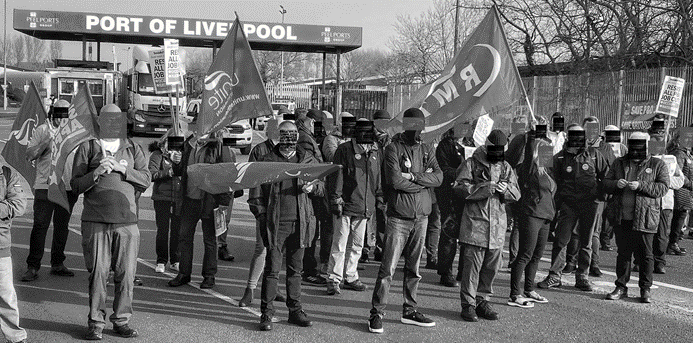
rmtThese protests have been organised by the RMT and Nautilus trade unions, and they have mainly been attended by trade unionists and socialists. Fortunately, anger has been directed against employers and not foreign workers. There have been many high profile speakers such as mayors, MPs and national trade union leaders. Despite all this, the Liverpool to Dublin line resumed service from as early as March 19th, and it’s hard not to feel that, locally, the campaign is losing momentum. As far as we see it, there are two, conflicting, strategies to secure victory. In broad terms, the first approach is associated with the trade union leadership, while the latter tends to come from the rank-and-file.

The first relies on seeking support from the Tory government, Labour opposition and the mass media. This support is hoped to equate to economic and legal pressure on P&O to rehire the workers, as well as repealing anti-trade union laws, making fire-and-rehire illegal and even nationalisation.

However, it seems likely that P&O knowingly made legally dubious decisions, aware that there might be consequences, and deeming it economically worthwhile (perhaps since, if it had all gone to plan, the workers movement would have been caught off-guard and unable to act). It’s hard to view support from the Tories with anything but cynicism, especially since they knew about the mass dismissals beforehand and did nothing. However, the Labour Party is no better. In Coventry, their local council have shown the true colours of all holders of state-power, hiring scabs and misleading the public to crush a bin strike. Media coverage about P&O has been sympathetic, but how long can weekly demonstrations make for good news articles? And if they seem ineffective how long will people keep attending?

The second strategy is that of a persistent campaign of direct action. Without agency staff informing crews that they were going to be replaced (and then refusing to work), the Hull crew occupying their ship, and road blockades in Dover, it’s possible that this could have all blown over without a fuss (afterall, mass dismissals are part and parcel of capitalism). Since the first week following the dismissals, this approach has quietened down, with the exception of sympathetic action from overseas workers. But secondary picketing, road blockades, sit-ins, a concerted consumer boycott, and sympathetic strike action (most of which are illegal) could breathe life into the campaign, and make these protests seem worthwhile.

10.04.22

“The State was never and never can be anything other than the political apparatus of force of the propertied classes to ensure the economic exploitation of the broad masses of the working people.”
Milly Witkop


Flannels out of fashion

flannelsSometimes it can feel like our world is progressing (slowly) in a positive direction. And there are times when you despair, like when real animal fur comes back into fashion, after years of it being unacceptable and supermodels pledging never to wear it again (spoiler: they usually do). For many years, Merseyside Animal Rights have been protesting against the sale of fur in Liverpool shops, including Cricket on Mathew Street and currently Flannels in Liverpool One. As part of the national Stop Fur At Flannels campaign, on March 12th, 9 of us recently paid them a visit to let them know what we think of them and, with chalk and banners, draw attention to what they are doing. We gave out a lot of informative leaflets to (overwhelmingly supportive) Saturday shoppers, many of whom were under the impression that the sale of real fur has already been made illegal in the UK (fur farming was banned in 2000 but imports are still allowed).

The staff are used to our visits and guard the door, often locking it between customers. Sadly, there was a constant stream of them going in and out of the shop, mostly refusing to engage with us, although a few took our leaflets and may rethink their support of the shop if they take the time to read them. If they then let Flannels know they are considering going elsewhere in future, this can put more pressure on the shop than we ever could.

Liverpool One security kept an eye on us but didn’t really interfere. Sometimes we are actually glad of a heavy-handed show of police, as it draws more attention from passers-by, who want to know what on earth is going on, gifting us added opportunities to tell them! We left after 2 hours but will return soon, especially as Flannels are building a massive new store in Clayton Square, the grand opening of which we shall certainly be ‘attending’!
You can contact us at merseysideanimalrights@lists.riseup.net or @MARcampaigns on Facebook.


Who Are the Working Class?
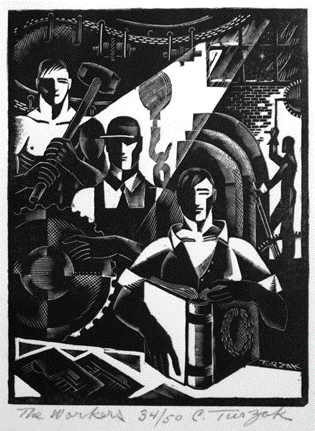
working classTalking about “the working class” conjures up various images of brawny dockers and factory workers, of people in flat caps with thick accents, no doubt white and male, with reactionary views and traditional values. While this is nothing but caricature, there are real differences in wealth, trade, skill, privilege, and culture that can be divided into sociological classes. When we talk about class, however, we refer to a fundamental distinction between those who own and control capital, and those who work for them to create their profits.

‘Capital’ includes all the land, materials, buildings, vehicles, machinery, technology, software and data that are used to extract, produce, transport, and distribute goods and services to generate a profit. The people who own all this might be called capitalists, investors, shareholders, and landlords. Others who don’t necessarily own, but partly control and share in the profits of capital might be called employers, managers, directors, agencies, and bureaucrats. This is the capitalist class (or the ruling class, since they also rule over society by means of the state).

The working class can be defined, in contrast, as those who neither own nor control capital, who do not employ workers or live off the profit that others create. Most of us must work for a wage in order to survive. This does not just mean manual labour, but all kinds of work, from retail to programming, hospitality to academia. We sell our labour-power (ability to work) and create commodities (things and services with exchange value). We create more value than what we are given as a wage, and the surplus value, which we call profit, is either reinvested in the business or goes into the pockets of the capitalist class. This is the meaning of the exploitation of labour.

But not all of us can work. The capitalist economy must maintain a pool of unemployed people which generates competition between workers, pushing down wages and conditions. Since unemployment usually involves poverty and degradation, it serves as a disincentive against refusing to work, disobeying management, or any other activity (such as industrial action) that might result in being sacked. Unemployed and retired workers, lacking ownership and control of capital, are part of the working class. Others are dependent on those who do work, such as children and stay-at- home parents. Household work such as raising children, cooking, cleaning, and caring, is typically unpaid, and has historically been the burden of women.

How many times must we hear about the racist and sexist working class, as if it were one homogenous mass, a hive-mind, – as if no ethnic minorities or women were workers? Indeed, the working class is as diverse as society itself. No doubt, many workers are bigoted, and this not only offends human dignity, it also divides and weakens the working class, leaving us more easily controlled and exploited. As well as containing both inclusive and prejudiced elements, there are also a wide variety of views held in the working class: from socialism to conservatism, liberalism to anarchism.

There is no definite line between the two classes, it is an abstract distinction (though based on material realities) that describes a conflict of forces in capitalist society, not a tool of individual categorisation or judgement. Modern capitalism has seen ever more divisions of power in the workplace, where your supervisor may be doing much the same work as you, only with a little more authority, privilege, and a few extra pennies in their paycheck. The part of the working class with more skilled and “respected” professions will likely have a greater degree of control over their own work, higher wages, and greater job-satisfaction. They may have a stake in maintaining their position, which often means taking the side of the capitalist class and defending the government-imposed order. This could be referred to as the middle class, and while this is an important distinction, ultimately these workers are still exploited (albeit to a lesser degree) like the rest of the working class.

The contradiction between the capitalist and working class is that the former seek to extract ever more profit from the latter by keeping wages low, cracking the whip to raise productivity, and cutting expenses by worsening our conditions and environment. In opposition, we seek to work less, gain higher wages, and improve our living and working environment. These differing interests lead to a constant class struggle, expressed informally through absenteeism and favouritism, but also explicitly through strikes and mass dismissals. We have no illusions that the working class is necessarily powerful or inherently revolutionary, but since we produce all wealth we have the potential to transform our present situation and ultimately society itself. Class struggle will only end when the working class expropriates all capital, takes control over our own workplaces and neighbourhoods, abolishes the state, and starts to voluntarily create and share everything we need and desire to live fulfilling lives in freedom and equality.


Anarchist Bookfair

bookfairOn Saturday the 14th of May the fourth Liverpool Anarchist Bookfair will be taking place. It will be at the Black-e (next to the Chinatown Gate) from 11 till 5. Expect vegan food, talks & stalls from anarchist and activist groups, and a large selection of subversive literature for sale. Includes subjects as wide as animal rights, environmentalism, feminism and the workers’ movement. If you have been reading this newsletter, and meaning to get involved in a group or read more about anarchist theory, it’s a great opportunity to do so.


another worldThe Liverpool Anarchist is edited by individual members of the Solidarity Federation, an anarcho-syndicalist union. We aim to publish monthly and welcome all contributions in accord with our basic ideas. We advocate working class direct action to improve our lives here and now while building a revolutionary movement to do away with capitalism, the state, and all other hierarchies.
Send in feedback, comments, and submissions to: liverpoolanarchist@tuta.io
You can find us online at: liverpoolanarchist.wordpress.com And the Solidarity Federation at: liverpoolsf.org

    Attachment Size
    liverpool-anarchist-21.pdf (3.84 MB) 3.84 MB

    Tags

    • library
    • publications
    • newsletters
    • Liverpool Anarchist
    • Liverpool

    Guides

    Your rights at work

    About SolFed

    About SolFed

    Do you sometimes feel your union isn’t listening to you? (Solidarity Federation Education Union - SFEU)

    SFEU-flyer-2024-front

    What is wage theft?

    What is wage theft

    This is our flag - it tells you what we stand for

    this-is-our-flag

    Solidarity Federation Hospitality Workers Union (SFHWU)

    sfhwu leaflet front

    Stuff your boss (doesn't want you to know)

    Stuff your boss (doesn't want you to know)

    Why do we organise? Capitalism is shit, oppression is shit - but what can we at SolFed do about it?

    Why do we organise?

    Stuff your sexist boss (doesn't want you to know) (2018)

    Stuff your sexist boss (doesn't want you to know) (2018)

    Cost of living - Organise and fight back with the Solidarity Federation

    Cost of living - Organise and fight back with the Solidarity Federation

    Don't cross picket lines! Solidarity is the most powerful force in the world

    Don't cross picket lines

    Direct Action #2 (2024)

    Direct Action #2 (2024)

    Don't just moan - Organise!

    Don't just moan - Organise!

    Is your cleaning job killing you? A guide to cleaners health and safety (2017)

    Stuff your landlord (doesn't want you to know) (2016)

    Stuff your landlord (doesn't want you to know) (2016)

    Fed up with your landlord? Organise and fight back!

    Fed up with your landlord? Organise and fight back!

    A migrant's guide to Manchester (2016)

    A migrant's guide to Manchester (2016)

    SolFed supports trans liberation - transphobia is a workplace and housing issue

    SolFed supports Trans Liberation - transphobia is a workplace and housing issue

    Office worker’s health and safety - your rights and how to use them (2015)

    Office worker’s health and safety - your rights and how to use them (2015)

    Solidarity Federation - Where we stand

    Solidarity Federation - Where we stand

    Anarcho-syndicalism in Britain – a little history (2015)

    Anarcho-syndicalism in Britain – a little history (2015)

    Strike - a guide to walking out (2014)

    Strike - a guide to walking out (2014)

    Anarchism and Anarcho-syndicalism (Rudolf Rocker, 2014)

    Anarchism and Anarcho-syndicalism (Rudolf Rocker, 2014)

    There's power in a union

    theres-power-in-a-union

    A migrant's guide to London (2014)

    A migrant's guide to London (2014)

    Fighting for ourselves - anarcho-syndicalism and the class struggle (2012)

    Fighting for ourselves - anarcho-syndicalism and the class struggle (2012)

    Theory & Practice 1 - Workmates - direct action workplace organising on the London underground (2011)

    Theory & Practice 1 - Workmates - direct action workplace organising on the London underground (2011)

    The Economics of freedom (2003)

    The Economics of freedom (2003)

    A history of anarcho-syndicalism (SelfEd Collective, 24 unit series, 2001)

    A history of anarcho-syndicalism (SelfEd Collective, 24 unit series, 2001)

    Out of the frying pan, a critical look at works councils (1998)

    Out of the frying pan, a critical look at works councils (1998)

    Health and safety at work - an anarcho-syndicalist approach (1997)

    Health and safety at work - an anarcho-syndicalist approach (1997)

    Theory & Practice 2 - Anarcho-syndicalism in Puerto Real (1994)

    Theory & Practice 2 - Anarcho-syndicalism in Puerto Real (1994)

    RSS feed

    The Solidarity Federation is an anarcho-syndicalist union, a means for people seeking to improve our lives to organise in our workplaces and communities. SolFed brings together people in all occupations regardless of industry, sector or trade – whether we’re employed or not.

    SolFed seeks the abolition of capitalism and the institutions of power that are associated with it, such as the state. Our goal is to create a society centred on needs rather than profit, based upon the principle ‘from each according to ability, to each according to need’.

    We believe in the principle of direct action – that means doing something for ourselves and not expecting leaders or representatives to act on our behalf.

    SolFed members organise ourselves in a federation of local unions; in education we are in the Solidarity Federation Education Union (SFEU) and our members in hospitality are in the Solidarity Federation Hospitality Workers Union (SFHWU)

    Join us!