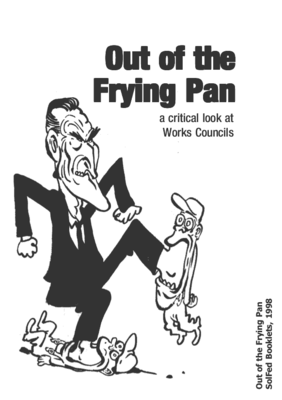
Works Councils are coming to Britain. But what are Works Councils, and what will they mean for working people and trade unions? Are the TUC unions right to welcome the changes in labour relations which Works Councils will bring?
Works Councils, far from empowering people, act as a tool by which management can control and pacify people at work. The truth behind Works Councils is exposed here through the views of workers in France, who have witnessed their failure at first hand.
The message is clear; there is nothing to be gained and much to lose from the introduction of a Works Council system in Britain.
Out of the Frying Pan is a critical analysis of Works Councils and a look ahead at a real future for organising and fighting back in your workplace.
Preface
The British Context - The new realism
Works Councils Basics - Bad for workplace organisation | Good for business | One-way partnership | Self-preservation
Case Study - France - How do CNT members in France view Works Councils? | Why do unions participate in Works Councils? | Does participation bring protection for active union members and ensure more freedom of action? | Does Participation increase our credibility and initiate resistance? | Is involvement in Works Councils possible for purely tactical reasons? | What does the future hold?
A Fundamental Alternative - A different kind of union | How revolutionary unionism works | We want real social change
Who's SolFed? - Getting down the local | Direct Action | Networks | Global Solidarity | Aims of the SolFed | Publications
This pamphlet is based on a course organised by North & East London Solidarity Federation called "Organising for Health and Safety" back in 1997. Part 1 introduces the idea of health, safety and welfare standards at work, and places them in the context of capitalism. Part 2 suggests ways of finding out about and taking up health and safety issues. Part 3 details some common problems and definitions, and Part 4 provides a case study from the Norwich and Norfolk Solidarity Federation, and introduces the idea of union support surgeries. Part 5 compares and contrasts modern trade unionism with anarcho-syndicalism as advocated by the Solidarity Federation, and argues for social revolution. Finally, there are appendices on tactics, basic rights and information of practical use.