Home
Solidarity Federation
IWA
User account menu
  • Contact
  • Log in
  • Home
    • Intro
    • Workplace organiser training
    • Industrial strategy
    • Community strategy
    • Constitution
  • SolFed
    • Brighton
    • Bristol
    • Edinburgh
    • Liverpool
    • Manchester
    • North London
    • Wales
    • Yorkshire
  • Industries & sectors
    • Claimants and unpaid
    • Education
    • Health and social care
    • Hospitality
  • Events & reports
  • Publications
    • Guides
      • Stuff your boss (doesn't want you to know)
      • Stuff your sexist boss (doesn't want you to know) (2018)
      • Stuff your landlord (doesn't want you to know) (2016)
      • Is your cleaning job killing you? A guide to cleaners health and safety (2017)
      • Office worker’s health and safety - your rights and how to use them (2015)
      • A migrant's guide to Manchester (2016) [en es]
      • A migrant's guide to London (2014) [en es pl]
      • Strike - a guide to walking out (2014)
    • Pamphlets and books
      • Anarcho-syndicalism in Britain – a little history (2015)
        • 1. 19th century to 1914 - The First International, growth of industrial unionism and the Great Unrest
        • 2. 1914–1945 - State suppression and the Bolshevik turn – how Lenin’s seeming success drew militants to the Comintern
        • 3. 1945–1994 - The Anarchist Federation of Britain, Syndicalist Workers’ Federation and Direct Action Movement
        • 4. Today’s movement - A short look at the strategy and thinking of the modern Solidarity Federation
      • Office worker’s health and safety - your rights and how to use them (2015)
      • Anarchism and Anarcho-syndicalism (Rudolf Rocker, 2014)
        • Introduction
        • 1. Ideology of Anarchism
        • 2. History of anarchist philosphy, from Lao-Tse to Kropotkin
        • 3. The origins of anarcho-syndicalism
        • 4. Socialism and anarcho-syndicalism in France
        • 5. The role of the trade unions: anarcho-syndicalist view
        • 6. The struggle in Germany and Spain
        • 7. The political struggle: anarcho-syndicalist view
        • 8. Anarcho-syndicalism since the First World War
      • Fighting for ourselves - anarcho-syndicalism and the class struggle (2012)
        • Introduction
        • 1. The mainstream workers' movement
        • 2. Radical currents in the workers' movement
        • 3. Anarcho-syndicalism in the 20th century
        • 4. Capitalism and the class struggle since World War II
        • 5. Anarcho-syndicalism in the 21st century
        • Endnotes
      • Workmates - direct action workplace organising on the London underground (2011)
      • The Economics of freedom (2003)
      • A history of anarcho-syndicalism (2001)
      • Out of the frying pan, a critical look at works councils (1998)
      • Health and safety at work - an anarcho-syndicalist approach (1997)
      • Anarcho-syndicalism in Puerto Real (1994)
    • Leaflets and flyers
      • Solidarity Federation Education Union (SFEU)
      • Solidarity Federation Hospitality Workers Union (SFHWU)
      • Why do we organise?
      • This is our flag - it tells you what we stand for
      • What is anarcho-syndicalism anyway?
      • Anarchism and Syndicalism (short version)
      • Anarchism and Syndicalism
      • Towards a better union
      • Protest is not enough
      • Building beyond elections
      • We should run our workplaces
      • We should run our communities
      • We should run our movements
    • Newsletters
      • Brighton Solidarity
        • Brighton Solidarity #3
      • Education Worker
        • Education Worker #10 Victimisation (2013)
        • Education Worker #9 (2012)
        • Education Worker #8 Academy Special (2012)
      • Wildcat!
        • Wildcat! #13 (Jan 2013)
        • Wildcat! (Winter 2012)
        • Wildcat! #6 (Summer 2011)
        • Wildcat! #5 (Spring 2011)
        • Wildcat! #4 (Dec 2010)
        • Wildcat! #3 (Oct-Nov 2010)
        • Wildcat! #2 (Jul-Aug 2010)
        • Wildcat! Football for the fans NOT for fat cats! (Jul 2010)
        • Wildcat! #1 (May-June 2010)
      • May Day Bulletin (Newcastle SolFed, 2014)
    • Direct Action
      • Direct Action #2 (2024)
      • Direct Action #1 (2023)
      • Direct action #47 (Summer 2009)
    • Catalyst
      • Catalyst #29 (Feb 2012)
      • Catalyst #28 (Oct 2011)
      • Catalyst #27 (Jun 2011)
      • Catalyst #26 (Mar 2011)
      • Catalyst #25 (Dec 2010)
      • Catalyst #24 (Summer 2010)
    • SelfEd
      • A history of anarcho-syndicalism
        • Block 1
          • Unit 1: The Origins of Capitalism
          • Unit 2: Britain: The Radical Period 1750-1840
          • Unit 3: The First International
          • Unit 4: France 1870-1918 Early revolutionary unions
          • Unit 5: Revolutionary Syndicalism in Britain, 1870-1910
          • Unit 6: Revolutionary Syndicalism in Britain and Ireland, 1910-17
        • Block 2
          • Unit 7: Mexico 1870-1920: Colonialism and Revolution
          • Unit 8: USA 1886-1930 - The Wobblies
          • Unit 9: Anarcho-syndicalism in Argentina 1870-1939
          • Unit 10: Sweden 1889-1939
          • Unit 11: Russia I: 1850-1917
          • Unit 12 Russia II: 1917-30
        • Block 3
          • Unit 13: Going Global - International Organisation, 1872-1922
          • Unit 14: Anarcho-syndicalism in Britain, 1914-30
          • Unit 15 Spain, 1868-1936: Build-up to Revolution
          • Unit 16 Spain: Culture, education, women and sexuality
          • Unit 17: Spain 1936-39: Revolution and Civil War
          • Unit 18: Spain - The Collectives
        • Block 4
          • Unit 19: Britain, 1930-1950 - The Era of Reform
          • Unit 20: Britain, 1950-1990 - Decline of Social Democracy
          • Unit 21: anarcho-syndicalism 1939-99
          • Unit 22: Roots of modern anarcho-syndicalism: freedom, oppression & rebellion
          • Unit 23: Roots of modern anarcho-syndicalism: morality, culture & tactics
          • Unit 24: The spirit of anarcho-syndicalism
    • Letters
  • IWA

The 'Spanish Revolution' hits Brighton

By Joseph Kay, 23 May, 2011

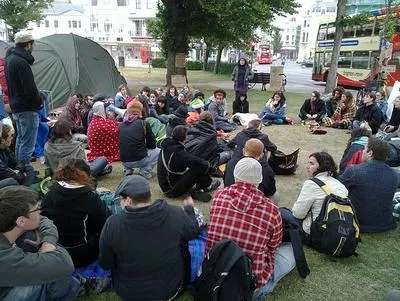
The occupations and demonstrations that have rocked Spain in opposition to austerity, unemployment and party politics have reached Brighton. At least 30 people, mostly from Spain, were occupying part of the Old Steine in Brighton city centre tonight in solidarity with the movement in Spain. An assembly run on directly democratic lines, with a megaphone being passed around participants, discussed tactics and goals of the camp, with decisions made to stage further protests and put on a programme of workshops. The assembly also reiterated its independence from all political ideologies and parties. Below is some information on the English protest law we've compiled (this was a big topic of debate tonight) in English and español. A statement on the movement by our Spanish sister-section the CNT is available here.

Information about the law and protest in England
The European Convention of Human Rights, via the Human Rights Act (1998) guarantees the rights to freedom of expression (Art. 10) and freedom of association and assembly (Art. 11). This means all other laws (including those below) have to comply with these rights, subject to limits “necessary in a democratic society”. But in practice, the police will use several laws against protest. These are the most common laws they use: it is not comprehensive. For more information see http://greenandblackcross.org/legal/keyadvice

The Public Order Act (1986)
Section 12 (processions) and Section 14 (assemblies) allow the police to impose conditions (duration, route, location) on demonstrations “to prevent serious public disorder, serious criminal damage or serious disruption to the life of the community”. Breaking these restrictions can lead to arrest. Section 5 allows arrest for behaviour likely to cause “harassment, alarm or distress”.

Breach of the peace
The police have the power to arrest people 'to prevent a breach of the peace', what this means is at their discretion!

Private property
Some 'public space' (like Churchill Square) is private property. The owners (or their agents: security/management) can use reasonable force to remove you, and the police will normally assist. It is only a crime (aggravated trespass) if you trespass with “the intention of disrupting, or intimidating those taking part in, lawful activity”.

Stop and search
When you are stopped or searched under any search powers, you DO NOT have to give the police your name and address.

Remember: the police can always find a law to use if they want to stop a protest. But it's up to protesters to decide whether to ignore the police or comply. It is often a question of numbers: if there are lots of protesters it is easier to protest freely. If there are few, it is harder to ignore police instructions.

Información sobre la Ley y la Protesta en Inglaterra
La Convención Europea de los Derechos Humanos, mediante la Ley de los Derechos Humanos (1998), garantiza los derechos de Libertad de Expresión (Pro. 10) y de Libertad de Asociación y Reunión (Pro. 11). Eso significa que todas las demás leyes (ver debajo) tienen que cumplir con estos derechos que están sujetos a los límites “necesarios en una sociedad democrática”. Pero en la práctica, la policía puede utilizar algunas leyes contra los manifestaciones. Estas son las leyes que utilizan con mayor frecuencia (no es una lista completa). Para más información (en inglés) ver http://greenandblackcross.org/legal/keyadvice


La Ley de Orden Publico (The Public Order Act 1986)
La Sección 12 (desfiles) y la Sección 14 (asambleas) permiten a la policía imponer condiciones (duración, recorrido, localización) a las manifestaciones “para evitar a graves desórdenes públicos, grandes daños delictivos, o grandes perturbaciones a la vida de la comunidad”. Los actos contra estas limitaciones pueden motivar la detención. Sección 5: Se permite detener por “comportamiento que pueda provocar acoso, alarma o angustia”.

"Violación de la paz" (breach of the peace)
La policía tiene el poder para detener gente "para evitar una violación de la paz". ¡Lo que significa que pueden detener a discrección!

La propiedad privada
Algunos "espacios publicos" (como la Churchill Square) son propiedad privada. Los propietarios (o sus agentes: tanto los guardias de seguridad como la gerencia) pueden utilizar una "fuerza razonable" para sacarte, y la policía normalmente los ayudará. Sólo es delito (si entras sin autorización en propiedad ajena es más grave - aggravated trespass) si entras sin autorización con 'la intención de perturbar o intimidar a los participantes en una actividad legal'.

Detención y registro (stop and search)
Si eres detenido o registrado bajo las medidas de registrao, NO TIENES por qué dar a la policía ni tu nombre ni tu dirección.

Recordar: la policia siempre puede encontrar una ley si desean impedir una manifestación. Pero es elección de los manifestantes el decidir hacer caso omiso de la policía o cumplir con su voluntad. Muchas veces, es cuestión de número: si hay muchos manifestantes, es más facil manifestarse con libertad. Si hay pocos, es más dificil de ignorar las instrucciónes de la policia.

  • demonstrations
  • job cuts
  • mass meetings
  • occupations
  • political parties
  • español

Guides

Your rights at work

Why do we organise? Capitalism is shit, oppression is shit - but what can we at SolFed do about it?

Why do we organise?

This is our flag - it tells you what we stand for

this-is-our-flag

Direct Action #2 (2024)

Direct Action #2 (2024)

Anarcho-syndicalism in Britain – a little history (2015)

Anarcho-syndicalism in Britain – a little history (2015)

Office worker’s health and safety - your rights and how to use them (2015)

Office worker’s health and safety - your rights and how to use them (2015)

Anarchism and Anarcho-syndicalism (Rudolf Rocker, 2014)

Anarchism and Anarcho-syndicalism (Rudolf Rocker, 2014)

Fighting for ourselves - anarcho-syndicalism and the class struggle (2012)

Fighting for ourselves - anarcho-syndicalism and the class struggle (2012)

Theory & Practice 1 - Workmates - direct action workplace organising on the London underground (2011)

Theory & Practice 1 - Workmates - direct action workplace organising on the London underground (2011)

The Economics of freedom (2003)

The Economics of freedom (2003)

A history of anarcho-syndicalism (SelfEd Collective, 24 unit series, 2001)

A history of anarcho-syndicalism (SelfEd Collective, 24 unit series, 2001)

Out of the frying pan, a critical look at works councils (1998)

Out of the frying pan, a critical look at works councils (1998)

Health and safety at work - an anarcho-syndicalist approach (1997)

Health and safety at work - an anarcho-syndicalist approach (1997)

Theory & Practice 2 - Anarcho-syndicalism in Puerto Real (1994)

Theory & Practice 2 - Anarcho-syndicalism in Puerto Real (1994)
RSS feed