Home
Solidarity Federation
Section of the International Workers Association
CAPTCHA
Solve this simple math problem and enter the result. E.g. for 1+3, enter 4.
This question is for testing whether or not you are a human visitor and to prevent automated spam submissions.
User account menu
  • Contact
  • Log in
CAPTCHA
Solve this simple math problem and enter the result. E.g. for 1+3, enter 4.
This question is for testing whether or not you are a human visitor and to prevent automated spam submissions.
  • Home
    • About SolFed
    • Workplace organiser training
    • Industrial strategy
    • Community strategy
    • Constitution
  • SolFed
    • Brighton
    • Bristol
    • Edinburgh
    • Liverpool
    • Manchester
    • North London
    • Wales
    • Yorkshire
  • Industries and sectors
    • Claimants and unpaid
    • Education
    • Health and social care
    • Hospitality
  • Events & reports
  • Publications
    • Guides
      • Stuff your boss (doesn't want you to know)
      • Stuff your sexist boss (doesn't want you to know) (2018)
      • Stuff your landlord (doesn't want you to know) (2016)
      • Is your cleaning job killing you? A guide to cleaners health and safety (2017)
      • Office worker’s health and safety - your rights and how to use them (2015)
      • A migrant's guide to Manchester (2016) [en es]
      • A migrant's guide to London (2014) [en es pl]
      • Strike - a guide to walking out (2014)
    • Pamphlets and books
      • Anarcho-syndicalism in Britain – a little history (2015)
      • Office worker’s health and safety - your rights and how to use them (2015)
      • Anarchism and Anarcho-syndicalism (Rudolf Rocker, 2014)
      • Fighting for ourselves - anarcho-syndicalism and the class struggle (2012)
      • Workmates - direct action workplace organising on the London underground (2011)
      • The Economics of freedom (2003)
      • A history of anarcho-syndicalism (2001)
      • Health and safety at work - an anarcho-syndicalist approach (1997)
      • Out of the frying pan, a critical look at works councils (1998)
      • Anarcho-syndicalism in Puerto Real (1994)
    • Leaflets and flyers
      • Solidarity Federation Education Union (SFEU)
      • Solidarity Federation Hospitality Workers Union (SFHWU)
      • What is wage theft?
      • Why do we organise?
      • This is our flag - it tells you what we stand for
      • What is anarcho-syndicalism anyway?
      • Anarchism and Syndicalism (short version)
      • Anarchism and Syndicalism
      • Towards a better union
      • Protest is not enough
      • Building beyond elections
      • We should run our workplaces
      • We should run our communities
      • We should run our movements
    • Posters and stickers
    • Newsletters
      • Brighton Solidarity
        • Brighton Solidarity #3 (2015)
        • Brighton Solidarity #2 (2015)
        • Brighton Solidarity #4 (Winter 2014)
        • Brighton Solidarity #3 (Summer 2014)
        • Direct Action Solidarity #2 (Spring 2014)
        • Direct Action Solidarity #1 (Jan 2012)
        • Brighton Solidarity - spending review special (Oct 2010)
        • Brighton Solidarity - emergency budget special (Jun 2010)
        • Brighton Agitator #1 (Mar 2010)
        • Brighton Solidarity (Winter 2007)
      • Communication Worker
        • Communication Worker #8 (Jul 2001)
        • Communication Worker #7 (Jan 2001)
        • Communication Worker #6
        • Communication Worker #5
        • Communication Worker bulletin
      • Education Worker
        • Education Worker #10 (Apr 2013)
        • Education Worker #9 (Oct 2012)
        • Education Worker #8 (Mar 2012)
        • Education Worker #7 (Mar 2011)
        • Education Worker #6 (Jan 2011)
        • Education Worker #5 (Oct 2009)
        • Education Worker #4 (May 2009)
        • Education Worker #3 (Sep 2008)
        • Education Worker #2 (Jan 2008)
        • Education Worker #1 (2007)
        • Education Worker #9 (Summer 2002)
        • Education Worker #8 - special higher education issue (2002)
      • The Leveller
        • The Leveller #19 (May-Jul 2017)
        • The Leveller #18 (Aug 2016)
        • The Leveller #17 (Mar 2015)
        • The Leveller #17 (Dec 2014)
        • The Leveller #16 (Nov 2014)
        • The Leveller #15 (May 2014)
        • The Leveller #14 (Mar 2014)
        • The Leveller #13 (May 2013)
        • The Leveller #12 (Jun-Jul 2012)
        • The Leveller #11 (May 2012)
        • The Leveller #10 (Apr 2012)
        • The Leveller #9 (Mar 2012)
        • The Leveller #6 (May-Jul 2011)
      • Liverpool Anarchist
        • Liverpool Anarchist #21 (Apr 2022)
        • Liverpool Anarchist #20 (Mar 2022)
        • Liverpool Anarchist #19 (Feb 2022)
        • Liverpool Anarchist #18 (Dec 2021)
        • Liverpool Anarchist #17 (Nov 2021)
        • Liverpool Anarchist #16 (Oct 2021)
        • Liverpool Anarchist #15 (Sep 2021)
        • Liverpool Anarchist #14 (Aug 2021)
        • Liverpool Anarchist #13 (Jul 2021)
        • Liverpool Anarchist #12 (Jun 2021)
        • Liverpool Anarchist #11 (Apr 2021)
        • Liverpool Anarchist #10 (Dec 2020)
        • Liverpool Anarchist #9 (Oct 2020)
        • Liverpool Anarchist #8 (Aug 2020)
        • Liverpool Anarchist #7 (Jul 2020)
        • Liverpool Anarchist #6 (Mar 2020)
        • Liverpool Anarchist #5 (Feb 2020)
        • Liverpool Anarchist #4 (Jan 2020)
        • Liverpool Anarchist #3 (Dec 2019)
        • Liverpool Anarchist #2 (Nov 2019)
        • Liverpool Anarchist #1 (Oct 2019)
      • May Day Bulletin (Newcastle, 2014)
      • Public Service Workers Network bulletin
        • Public Service Workers Network #8 (Winter 1995)
        • Public Service Workers Network #6 (Spring 1995)
        • Public Service Workers Network #5 (Oct-Nov 1994)
        • Public Service Workers Network #4 (Jun-Jul 1994)
        • Public Service Workers Network #3 (Autumn 1993)
      • Spanner in the Works (West Yorkshire, April 2013)
      • Wildcat!
        • Wildcat! #13 (Jan 2013)
        • Wildcat! (Winter 2012)
        • Wildcat! #6 (Summer 2011)
        • Wildcat! #5 (Spring 2011)
        • Wildcat! #4 (Dec 2010)
        • Wildcat! #3 (Oct-Nov 2010)
        • Wildcat! #2 (Jul-Aug 2010)
        • Wildcat! Football for the fans NOT for fat cats! (Jul 2010)
        • Wildcat! #1 (May-June 2010)
    • Direct Action
      • Direct Action - Solidarity Federation
        • Direct Action #2
        • Direct Action #1
        • Direct Action #48 (Autumn 2009)
        • Direct Action #47 (Summer 2009)
        • Direct Action #46 (Spring 2009)
        • Direct Action #45 (Winter 2008)
        • Direct Action #44 (Autumn 2008)
        • Direct Action #43 (Summer 2008)
        • Direct Action #42 (Spring 2008)
        • Direct Action #41 (Winter 2007)
        • Direct Action #40 (Autumn 2007)
        • Direct Action #39 (Summer 2007)
        • Direct Action #38 (Spring 2007)
        • Direct Action #37 (Autumn-Winter 2006)
        • Direct Action #36 (Spring-Summer 2006)
        • Direct Action #35 (Summer 2005)
        • Direct Action #34 (Spring 2005)
        • Direct Action #33 (Winter 2004)
        • Direct Action #32 (Autumn 2004)
        • Direct Action #31 (Summer 2004)
        • Direct Action #30 (Spring 2004)
        • Direct Action #29 (Winter 2003)
        • Direct Action #28 (Autumn 2003)
        • Direct Action #27 (Summer 2003)
        • Direct Action #26 (Spring 2003)
        • Direct Action #25 (Winter 2002)
        • Direct Action #24 (Autumn 2002)
        • Direct Action #23 (Summer 2002)
        • Direct Action #22 (Spring 2002)
        • Direct Action #21 (Winter 2001)
        • Direct Action #20 (Autumn 2001)
        • Direct Action #19 (Summer 2001)
        • Direct Action #18 (Spring 2001)
        • Direct Action #17 (Winter 2000)
        • Direct Action #16 (Autumn 2000)
        • Direct Action #15 (Summer 2000)
        • Direct Action #14 (Spring 2000)
        • Direct Action #13 (Winter 1999)
        • Direct Action #12 (Autumn 1999)
        • Direct Action #11 (Summer 1999)
        • Direct Action #10 (Spring 1999)
        • Direct Action #9 (Winter 1998)
        • Direct Action #8 (Autumn 1998)
        • Direct Action #7 (Summer 1998)
        • Direct Action #6 (Spring 1998)
        • Direct Action #5 (Winter 1997)
        • Direct Action #4 (Autumn 1997)
        • Direct Action #3 (Summer 1997)
        • Direct Action #2 (Spring 1997)
        • Direct Action #1 (Autumn 1996)
        • Direct Action #2 (Winter 1994)
        • Direct Action #1 (Summer 1994)
    • Catalyst
      • Catalyst - Solidarity Federation
        • Catalyst #31 (Oct 2013)
        • Catalyst #29 (Feb 2012)
        • Catalyst #28 (Oct 2011)
        • Catalyst #27 (Jun 2011)
        • Catalyst #26 (Mar 2011)
        • Catalyst #25 (Dec 2010)
        • Catalyst #24 (Summer 2010)
        • Catalyst #23 (Spring 2010)
        • Catalyst #22 (Winter 2009)
        • Catalyst #21 (Summer 2009)
        • Catalyst #20 (Sping 2009)
        • Catalyst #19 (Nov 2008)
        • Catalyst #18 (Sep 2008)
        • Catalyst #17 (July 2008)
        • Catalyst #16 (Spring 2007)
        • Catalyst #15 (Autumn 2006)
        • Catalyst #14 (Spring 2006)
        • Catalyst #13 (Summer 2005)
        • Catalyst #12 (Apr 2005)
        • Catalyst #11 (Sep 2004)
        • Catalyst #10 (May 2004)
        • Catalyst #9 (Spring 2004)
        • Catalyst #8 (Autumn 2003)
        • Catalyst #7 (May 2003)
        • Catalyst #6 (Dec 2002)
        • Catalyst #5 (Dec 2001)
        • Catalyst #4 (May 2001)
        • Catalyst #3 (Feb 2001)
        • Catalyst #2 (Sep 2000)
        • Catalyst #1 (May 2000)
    • SelfEd
      • A history of anarcho-syndicalism
    • Reference
      • Student Radicals - an incomplete history of protest at the University of Sussex 1971-1975 (Ed Goddard, 2011)
      • Anarcho-syndicalism in the 20th Century (Vadim Damier, 2009)
      • Tom Brown's Syndicalism (1990)
      • Trade unionism or syndicalism? (Tom Brown, 1943)
      • The General Strike - vol 1 no 1 (Sam Mainwaring, 15 Feb 1904)
  • IWA

Bristol is a divided city. Which side are you on?

By Baggie, 29 March, 2021

bsf
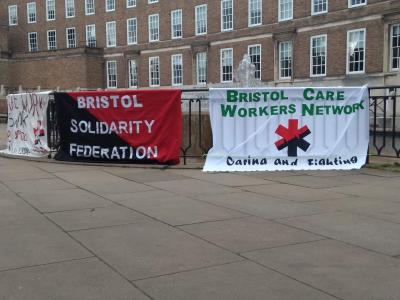
Bristol Solidarity Federation & Bristol Care Workers Network banners

Bristol is great, right? This city was named the “best place to live” in the UK by the Sunday Times in 2017, the best place for under 26s by The Independent in 2019, and Bristol districts like Easton and Old Market regularly win national accolades as the best/trendiest/coolest place in the UK to set up home.

The city exudes a progressive, green and tolerant vibe; 62% of Bristolians voted remain in the Brexit referendum, and all four of Bristol's parliamentary constituencies are held by the labour party, as is the city’s elected mayoral office. Bristol boasts Fairtrade City status and was named Green Capital of Europe in 2015. Newcomers to Bristol tend to see the city as a liberal paradise.

It isn’t. The city’s woke self-image is a sad irony in what is one of the most unequal and starkly divided places in the UK. Some of the UK’s most deprived wards are in Bristol, and yet these “deprivation hotspots” exist a few streets away from some of Britain’s wealthiest neighbourhoods. A 2015 survey by Bristol City Council found that 16% of the city’s population (69,000 people including 10,500 older people and nearly 18,000 children) live in these hotspots.

These numbers are increasing, despite (or, more likely, because of) the savage gentrification of the inner city. The most deprived parts of the city are Lawrence Hill, Whitchurch, Hartcliffe and Filwood.

Lawrence Hill is a two minute walk from Old Market, which was ranked second in a list of the UK’s “coolest places to live” by the Conservative-supporting Sunday Times newspaper in 2018. 

Neighbouring Easton, a literal stone’s throw from Lawrence Hill station, is perhaps the most fiercely contested district in the city’s social struggles. Stapleton Road in Easton was dubbed “Britain’s worst street” by race-baiting hack journalists at the Sunday People in 2011. Neighbouring St Mark’s Road was crowned the “Best Street in the UK and Ireland” in the 2020 Urbanism awards. The two streets not only share a postcode but actually have an intersection with each other. You can stand at the bottom of the steps outside Ladbrokes, with the Black Swan on your right and Jeevan’s Sweets to your left, with one foot on the country’s most desired street and one foot on its’ most reviled. This is a uniquely Bristolian experience.

The Easton area (winner of the dubious accolade of Time Out’s “coolest neighbourhood in Bristol” in 2019) has seen the UK’s biggest increase in property prices in the last 10 years, with average house prices up by 120% since 2010, according to The Guardian. This is gentrification, pure and simple, and it is this relentless inflation of the cost of living in Bristol that has created a city in which the nation’s poorest sleep on the doorsteps of the nation’s most privileged. The award-winning restaurants on St Mark’s Road and the tent sleepers in Eastville Park are symptoms of the same social sickness. 

As well as its’ economic divide, Bristol is rigidly segregated by ethnicity and race. 22% of people in Bristol identify with an ethnicity other than White British, significantly higher than the national average of 14%. Yet although Bristol is famous for diversity, a 2017 report by the Runnymede trust ranked Bristol the 7th worst out of 348 regions in England and Wales for racial inequality, with a particularly stark disadvantage in employment and education. If you’re a white newcomer to Bristol, and you’ve found yourself wondering why your new social circle is so monochrome in such a multicultural city, there’s your answer. Bristol’s jobs and schools, the institutions of social mobility in capitalist society, are rigged against people of colour.

Visitors and new arrivals to the city often comment on the city’s lack of inclusion and atmosphere of segregation. In 2017, business owners in Broadmead shopping centre hosted a stunningly tone-deaf “Jamaica Day” as an advertising gimmick. The stunt was branded as “disgusting and disappointing” by the Jamaican High Commission’s representative in Bristol, due to it’s appropriation and “reductionist” stereotyping of Jamaican culture. The event was remarkable for the apparent lack of involvement from Bristol’s prominent Jamaican community. St Paul’s, the historic heart of Caribbean Bristol, sits just the other side of the motorway from Broadmead. This is another example of a divided city; a place where one community can lampoon and exoticise the other, apparently ignorant of the other’s existence less than a mile away. It’s hard to imagine this happening anywhere else but Bristol.

Arguably the biggest black mark against Bristol’s reputation for tolerance is the city’s police force. Police officers from Avon and Somerset Constabulary made national headlines in 2018 after they tasered their own race relations officer for “looking like a suspect”. In 2017 an independent report described Avon and Somerset Constabulary as “institutionally racist” after a frankly harrowing series of failures by ASC led to the murder of a disabled refugee by a white neighbour. In December 2020, six police officers were filmed restraining and using CS spray on a black mother on a Bristol bus, in front of her young child. The incident began as a dispute over the change for the woman’s fare.

These incidents are shocking, but it’s the statistics that paint the bleakest picture of life for people of colour in a city policed by racist thugs. 160 complaints of police racism were lodged against Avon and Somerset Constabulary between 2014 and 2019, with police upholding a mere 1% of these claims.  In 2016, The Bristol Cable reported that the racial bias in police stop and searches was actually increasing rather than decreasing, and a 2018 article by the Bristol Post, hardly a progressive source, reported that black people were 7 times more likely than white people to be stopped and searched by ASC officers; a figure comparable with those of the Metropolitan Police in London. Speaking to Freedom News, activists from Bristol Copwatch described Avon and Somerset Police as acting like slave patrols. Bristol’s racialised class war is being fought with tasers and pepper spray as well as with rent increases and housing sell-offs.

Part of Bristol’s utopian sense of itself comes from the apparent strength of the city’s green movement. In 2015, Bristol was given a European Green Capital award. On their website, the woke PR firm Greenhouse describe Bristol as having a “strong identity” of “sustainability”, praising the city’s “long term commitments to climate change and [becoming a] low carbon, happy city.” VisitBristol.com cites Bristol as the UK’s first “cycling city”, and Bristol was described as “the vegan capital of the world” by the website Vegan Food and Living in 2019.

Sadly, Green Bristol’s borders end at the limits of the city centre. In 2018, residents in Avonmouth, West Bristol became so frustrated by the stench, industrial dust and plagues of flies that infest the community that they threatened a tax strike. Avonmouth, a suburb and industrial area on the far western edge of Bristol, has been dubbed the “waste capital of the south west” by local journalists, due to the multiple waste processing plants in the district. 175,000 tonnes of waste are incinerated annually at the Avonmouth Suez plant alone.

The energy from Avonmouth’s rubbish burners has been described as “green” and “sustainable” by the council and the companies responsible, and makes up a significant part of the city council’s plans for a carbon neutral Bristol by 2030. The claim that burning rubbish is in any way “clean” energy has been hotly disputed by campaigners and branded an “absolute lie” by independent researchers. Avonmouth is only a fifteen minute drive from City Hall, but it feels like another world. This is yet another symptom of a divided city; a city offering vegan burgers to the few and burning garbage to the rest.

The city’s eco credentials are further marred by its dysfunctional public transport system. The shoddiness of Bristol’s privatised bus service is a frequent in-joke among locals. But, like everything, Bristol’s public transport problem is fundamentally a class issue. A 2020 study by the Design and Manufacturing Futures Lab cited “transport poverty” as a key factor in the social and economic deprivation that is felt so painfully in areas like Hartcliffe and Avonmouth. These are districts that lack local amenities and services, and where many residents are too poor to own a car, meaning that access to things like health centres and schools is restricted. The remote geography and the lack of public transport keeps these areas cut off and isolated from the affluent, leafy city centre, starving the residents of access to the culture and community that the city supposedly offers.  

The takeaway here is that Bristol is indeed a great place to live, provided that you’re rich and white. The city’s reputation as a left-wing bubble is skin-deep; Bristol’s mayor and representatives have shown little interest in tackling the stark social issues described above, preferring to rest on their laurels than address the gaping inequalities that seethe beneath the surface of this hipster mini-London.  

Bristol’s radical left also has some difficult questions to ask itself. Are we guilty of the same complacency? Are we just another part of the city's progressive veneer? Why are we more comfortable spray-painting around Stokes Croft than fighting food poverty in Filwood? In such a divided city, on which side of the line do we really stand?

We are not asking this to detract from the considerable achievements of our comrades in recent years, or to absolve ourselves from responsibility for the same failings, but to challenge all of us in Bristol to scratch the surface and see the real struggles underneath.

This city is not a paradise, it’s a battleground. Which side are we on?

    • health and social care
    • Bristol
    • Bristol Care Workers Network

    Guides

    Your rights at work

    About SolFed

    About SolFed

    Do you sometimes feel your union isn’t listening to you? (Solidarity Federation Education Union - SFEU)

    SFEU-flyer-2024-front

    What is wage theft?

    What is wage theft

    This is our flag - it tells you what we stand for

    this-is-our-flag

    Solidarity Federation Hospitality Workers Union (SFHWU)

    sfhwu leaflet front

    Stuff your boss (doesn't want you to know)

    Stuff your boss (doesn't want you to know)

    Why do we organise? Capitalism is shit, oppression is shit - but what can we at SolFed do about it?

    Why do we organise?

    Stuff your sexist boss (doesn't want you to know) (2018)

    Stuff your sexist boss (doesn't want you to know) (2018)

    Cost of living - Organise and fight back with the Solidarity Federation

    Cost of living - Organise and fight back with the Solidarity Federation

    Don't cross picket lines! Solidarity is the most powerful force in the world

    Don't cross picket lines

    Direct Action #2 (2024)

    Direct Action #2 (2024)

    Don't just moan - Organise!

    Don't just moan - Organise!

    Is your cleaning job killing you? A guide to cleaners health and safety (2017)

    Stuff your landlord (doesn't want you to know) (2016)

    Stuff your landlord (doesn't want you to know) (2016)

    Fed up with your landlord? Organise and fight back!

    Fed up with your landlord? Organise and fight back!

    A migrant's guide to Manchester (2016)

    A migrant's guide to Manchester (2016)

    SolFed supports trans liberation - transphobia is a workplace and housing issue

    SolFed supports Trans Liberation - transphobia is a workplace and housing issue

    Office worker’s health and safety - your rights and how to use them (2015)

    Office worker’s health and safety - your rights and how to use them (2015)

    Solidarity Federation - Where we stand

    Solidarity Federation - Where we stand

    Anarcho-syndicalism in Britain – a little history (2015)

    Anarcho-syndicalism in Britain – a little history (2015)

    Strike - a guide to walking out (2014)

    Strike - a guide to walking out (2014)

    Anarchism and Anarcho-syndicalism (Rudolf Rocker, 2014)

    Anarchism and Anarcho-syndicalism (Rudolf Rocker, 2014)

    There's power in a union

    theres-power-in-a-union

    A migrant's guide to London (2014)

    A migrant's guide to London (2014)

    Fighting for ourselves - anarcho-syndicalism and the class struggle (2012)

    Fighting for ourselves - anarcho-syndicalism and the class struggle (2012)

    Theory & Practice 1 - Workmates - direct action workplace organising on the London underground (2011)

    Theory & Practice 1 - Workmates - direct action workplace organising on the London underground (2011)

    The Economics of freedom (2003)

    The Economics of freedom (2003)

    A history of anarcho-syndicalism (SelfEd Collective, 24 unit series, 2001)

    A history of anarcho-syndicalism (SelfEd Collective, 24 unit series, 2001)

    Out of the frying pan, a critical look at works councils (1998)

    Out of the frying pan, a critical look at works councils (1998)

    Health and safety at work - an anarcho-syndicalist approach (1997)

    Health and safety at work - an anarcho-syndicalist approach (1997)

    Theory & Practice 2 - Anarcho-syndicalism in Puerto Real (1994)

    Theory & Practice 2 - Anarcho-syndicalism in Puerto Real (1994)

    RSS feed

    The Solidarity Federation is an anarcho-syndicalist union, a means for people seeking to improve our lives to organise in our workplaces and communities. SolFed brings together people in all occupations regardless of industry, sector or trade – whether we’re employed or not.

    SolFed seeks the abolition of capitalism and the institutions of power that are associated with it, such as the state. Our goal is to create a society centred on needs rather than profit, based upon the principle ‘from each according to ability, to each according to need’.

    We believe in the principle of direct action – that means doing something for ourselves and not expecting leaders or representatives to act on our behalf.

    SolFed members organise ourselves in a federation of local unions; in education we are in the Solidarity Federation Education Union (SFEU) and our members in hospitality are in the Solidarity Federation Hospitality Workers Union (SFHWU)

    Join us!