Home
Solidarity Federation
IWA
User account menu
  • Contact
  • Log in
  • Home
    • Intro
    • Workplace organiser training
    • Industrial strategy
    • Community strategy
    • Constitution
  • SolFed
    • Brighton
    • Bristol
    • Edinburgh
    • Liverpool
    • Manchester
    • North London
    • Wales
    • Yorkshire
  • Industries & sectors
    • Claimants and unpaid
    • Education
    • Health and social care
    • Hospitality
  • Events & reports
  • Publications
    • Guides
      • Stuff your boss (doesn't want you to know)
      • Stuff your sexist boss (doesn't want you to know) (2018)
      • Stuff your landlord (doesn't want you to know) (2016)
      • Is your cleaning job killing you? A guide to cleaners health and safety (2017)
      • Office worker’s health and safety - your rights and how to use them (2015)
      • A migrant's guide to Manchester (2016) [en es]
      • A migrant's guide to London (2014) [en es pl]
      • Strike - a guide to walking out (2014)
    • Pamphlets and books
      • Anarcho-syndicalism in Britain – a little history (2015)
        • 1. 19th century to 1914 - The First International, growth of industrial unionism and the Great Unrest
        • 2. 1914–1945 - State suppression and the Bolshevik turn – how Lenin’s seeming success drew militants to the Comintern
        • 3. 1945–1994 - The Anarchist Federation of Britain, Syndicalist Workers’ Federation and Direct Action Movement
        • 4. Today’s movement - A short look at the strategy and thinking of the modern Solidarity Federation
      • Office worker’s health and safety - your rights and how to use them (2015)
      • Anarchism and Anarcho-syndicalism (Rudolf Rocker, 2014)
        • Introduction
        • 1. Ideology of Anarchism
        • 2. History of anarchist philosphy, from Lao-Tse to Kropotkin
        • 3. The origins of anarcho-syndicalism
        • 4. Socialism and anarcho-syndicalism in France
        • 5. The role of the trade unions: anarcho-syndicalist view
        • 6. The struggle in Germany and Spain
        • 7. The political struggle: anarcho-syndicalist view
        • 8. Anarcho-syndicalism since the First World War
      • Fighting for ourselves - anarcho-syndicalism and the class struggle (2012)
        • Introduction
        • 1. The mainstream workers' movement
        • 2. Radical currents in the workers' movement
        • 3. Anarcho-syndicalism in the 20th century
        • 4. Capitalism and the class struggle since World War II
        • 5. Anarcho-syndicalism in the 21st century
        • Endnotes
      • Workmates - direct action workplace organising on the London underground (2011)
      • The Economics of freedom (2003)
      • A history of anarcho-syndicalism (2001)
      • Out of the frying pan, a critical look at works councils (1998)
      • Health and safety at work - an anarcho-syndicalist approach (1997)
      • Anarcho-syndicalism in Puerto Real (1994)
    • Leaflets and flyers
      • Solidarity Federation Education Union (SFEU)
      • Solidarity Federation Hospitality Workers Union (SFHWU)
      • Why do we organise?
      • This is our flag - it tells you what we stand for
      • What is anarcho-syndicalism anyway?
      • Anarchism and Syndicalism (short version)
      • Anarchism and Syndicalism
      • Towards a better union
      • Protest is not enough
      • Building beyond elections
      • We should run our workplaces
      • We should run our communities
      • We should run our movements
    • Newsletters
      • Brighton Solidarity
        • Brighton Solidarity #3
      • Education Worker
        • Education Worker #10 Victimisation (2013)
        • Education Worker #9 (2012)
        • Education Worker #8 Academy Special (2012)
      • Wildcat!
        • Wildcat! #13 (Jan 2013)
        • Wildcat! (Winter 2012)
        • Wildcat! #6 (Summer 2011)
        • Wildcat! #5 (Spring 2011)
        • Wildcat! #4 (Dec 2010)
        • Wildcat! #3 (Oct-Nov 2010)
        • Wildcat! #2 (Jul-Aug 2010)
        • Wildcat! Football for the fans NOT for fat cats! (Jul 2010)
        • Wildcat! #1 (May-June 2010)
      • May Day Bulletin (Newcastle SolFed, 2014)
    • Direct Action
      • Direct Action #2 (2024)
      • Direct Action #1 (2023)
      • Direct action #47 (Summer 2009)
    • Catalyst
      • Catalyst #29 (Feb 2012)
      • Catalyst #28 (Oct 2011)
      • Catalyst #27 (Jun 2011)
      • Catalyst #26 (Mar 2011)
      • Catalyst #25 (Dec 2010)
      • Catalyst #24 (Summer 2010)
    • SelfEd
      • A history of anarcho-syndicalism
        • Block 1
          • Unit 1: The Origins of Capitalism
          • Unit 2: Britain: The Radical Period 1750-1840
          • Unit 3: The First International
          • Unit 4: France 1870-1918 Early revolutionary unions
          • Unit 5: Revolutionary Syndicalism in Britain, 1870-1910
          • Unit 6: Revolutionary Syndicalism in Britain and Ireland, 1910-17
        • Block 2
          • Unit 7: Mexico 1870-1920: Colonialism and Revolution
          • Unit 8: USA 1886-1930 - The Wobblies
          • Unit 9: Anarcho-syndicalism in Argentina 1870-1939
          • Unit 10: Sweden 1889-1939
          • Unit 11: Russia I: 1850-1917
          • Unit 12 Russia II: 1917-30
        • Block 3
          • Unit 13: Going Global - International Organisation, 1872-1922
          • Unit 14: Anarcho-syndicalism in Britain, 1914-30
          • Unit 15 Spain, 1868-1936: Build-up to Revolution
          • Unit 16 Spain: Culture, education, women and sexuality
          • Unit 17: Spain 1936-39: Revolution and Civil War
          • Unit 18: Spain - The Collectives
        • Block 4
          • Unit 19: Britain, 1930-1950 - The Era of Reform
          • Unit 20: Britain, 1950-1990 - Decline of Social Democracy
          • Unit 21: anarcho-syndicalism 1939-99
          • Unit 22: Roots of modern anarcho-syndicalism: freedom, oppression & rebellion
          • Unit 23: Roots of modern anarcho-syndicalism: morality, culture & tactics
          • Unit 24: The spirit of anarcho-syndicalism
    • Letters
  • IWA

Interview with a French striker

By Joseph Kay, 27 December, 2010

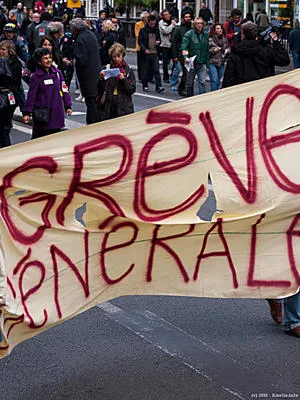
2010 saw huge social unrest sweep France in response to proposed pension reforms which would have upped the retirement age, amongst other cuts. Jean-Marie Cosson, a striking teacher from the town of Saint-Nazaire talks about the revolt at one of the last bastions of the worker’s movement, where the entrance of the lyceéns (young students) into the movement was given an ovation by ‘their fathers in blue collars.’

What’s the situation  at Saint-Nazaire?
J-M Cosson: It’s still delicate. On the 7th of October, before the lyceéns had even started to consider participating in the movement, some hooded guys went into a lyceé and smashed some windows. Bizarre… The end of a demo in October, which had got 20,000 people together (Saint-Nazaire has a population of 70,000), didn’t go well. The gendarmes (paramilitary police) fired tear gas at the lyceéns, even though their representatives had negotiated with the regular police to avoid things turning bad. This time justice didn’t wait for many years like it did for (former President) Chirac. Three guys went straight to trial. Two got two-month mandatory sentences.

How does the movement organise itself between public and private sector workers and the lyceéns?
The general assemblies are held per sector, and the co-ordination is done systematically. For example, on the 13th of October the lyceéns blocked their establishments in the morning. Then, the guys from the shipyards organised a meet-up for a general assembly. The workers from Airbus, from the refinery at Donges, the train drivers and the teachers arrived. Followed by hundreds of lyceéns who were given an ovation by their fathers in blue collars. These are the intense moments, where solidarity is rediscovered. Lyceéns, teachers, train drivers, refinery strikers, we’re all joined up.

What are the debates in the general assemblies?
During the general assembly at Donges refinery, where 350 workers were present, the indefinite strike was debated, with the understanding that they weren’t going to vote again to strike every 24 hours. They decided to blockade the refinery until the 18th of October. In the education sector, some voted for an indefinite strike. Others didn’t support the idea of a strike for its own sake, to stay at home and be content to fill up the state’s coffers by allowing it to withhold wages. So it was decided to have actions every day: we wanted to attack the sites of economic production, to hit the wallet. Above all, we wanted to avoid finding ourselves opposed to one another, public against private. It’s been 40 years that they’ve been teaching us to be individualists.

Where’ve the blockades been? How have you been trying to extend the movement?
The Donges refinery is blocked. The guys help the twenty employees of the petrol depot nearby to maintain the strike pickets and to prevent the police from occupying it. In the small businesses it’s delicate. The guys daren’t …

Did this convergence of strikes and sectors start up quickly?
The unions called us into the streets many times in quick succession. We told ourselves that if we didn’t take the matter in hand, the movement would croak. Fed up with marching! Especially since some unions stopped saying the words “general strike”.

What’s the role of the union federations in the movement at Saint-Nazaire?
Little wars between branches always exist. So do contradictions between what the national leadership say and what goes on at a local level. We ask ourselves sometimes why they don’t get behind the movement more firmly. (…) The movement has federated itself between generations and between the different sectors. We don’t demand to know each other’s union affiliation. We don’t give a fuck! I’m in SNES (FE teacher’s union): that gives me access to some information, but we don’t show off our badges.

What have you made of the media’s treatment of the movement?
At the moment I often have an urge to turn off my television, because I get so wound up by the bulletins! What they say about the lyceéns is unsupportable: always to hear this talk of ‘manipulation’, as if they were incapable of thinking on their own. When the kids are told that they become self-managed entrepreneurs at 16, that’s not going to make anyone happy.


This interview was originally conducted by by Ivan de Roy, for BASTA! and published in Jusqu’ici (‘hitherto’ or ‘til now’), a journal of the French anti-austerity movement. It was translated by our friends at www.liensjournal.wordpress.com
  • cuts
  • general strikes
  • pensions

Guides

Your rights at work

Why do we organise? Capitalism is shit, oppression is shit - but what can we at SolFed do about it?

Why do we organise?

This is our flag - it tells you what we stand for

this-is-our-flag

Direct Action #2 (2024)

Direct Action #2 (2024)

Anarcho-syndicalism in Britain – a little history (2015)

Anarcho-syndicalism in Britain – a little history (2015)

Office worker’s health and safety - your rights and how to use them (2015)

Office worker’s health and safety - your rights and how to use them (2015)

Anarchism and Anarcho-syndicalism (Rudolf Rocker, 2014)

Anarchism and Anarcho-syndicalism (Rudolf Rocker, 2014)

Fighting for ourselves - anarcho-syndicalism and the class struggle (2012)

Fighting for ourselves - anarcho-syndicalism and the class struggle (2012)

Theory & Practice 1 - Workmates - direct action workplace organising on the London underground (2011)

Theory & Practice 1 - Workmates - direct action workplace organising on the London underground (2011)

The Economics of freedom (2003)

The Economics of freedom (2003)

A history of anarcho-syndicalism (SelfEd Collective, 24 unit series, 2001)

A history of anarcho-syndicalism (SelfEd Collective, 24 unit series, 2001)

Out of the frying pan, a critical look at works councils (1998)

Out of the frying pan, a critical look at works councils (1998)

Health and safety at work - an anarcho-syndicalist approach (1997)

Health and safety at work - an anarcho-syndicalist approach (1997)

Theory & Practice 2 - Anarcho-syndicalism in Puerto Real (1994)

Theory & Practice 2 - Anarcho-syndicalism in Puerto Real (1994)
RSS feed