Home
Solidarity Federation
IWA
User account menu
  • Contact
  • Log in
  • Home
    • Intro
    • Workplace organiser training
    • Industrial strategy
    • Community strategy
    • Constitution
  • SolFed
    • Brighton
    • Bristol
    • Edinburgh
    • Liverpool
    • Manchester
    • North London
    • Wales
    • Yorkshire
  • Industries & sectors
    • Claimants and unpaid
    • Education
    • Health and social care
    • Hospitality
  • Events & reports
  • Publications
    • Guides
      • Stuff your boss (doesn't want you to know)
      • Stuff your sexist boss (doesn't want you to know) (2018)
      • Stuff your landlord (doesn't want you to know) (2016)
      • Is your cleaning job killing you? A guide to cleaners health and safety (2017)
      • Office worker’s health and safety - your rights and how to use them (2015)
      • A migrant's guide to Manchester (2016) [en es]
      • A migrant's guide to London (2014) [en es pl]
      • Strike - a guide to walking out (2014)
    • Pamphlets and books
      • Anarcho-syndicalism in Britain – a little history (2015)
        • 1. 19th century to 1914 - The First International, growth of industrial unionism and the Great Unrest
        • 2. 1914–1945 - State suppression and the Bolshevik turn – how Lenin’s seeming success drew militants to the Comintern
        • 3. 1945–1994 - The Anarchist Federation of Britain, Syndicalist Workers’ Federation and Direct Action Movement
        • 4. Today’s movement - A short look at the strategy and thinking of the modern Solidarity Federation
      • Office worker’s health and safety - your rights and how to use them (2015)
      • Anarchism and Anarcho-syndicalism (Rudolf Rocker, 2014)
        • Introduction
        • 1. Ideology of Anarchism
        • 2. History of anarchist philosphy, from Lao-Tse to Kropotkin
        • 3. The origins of anarcho-syndicalism
        • 4. Socialism and anarcho-syndicalism in France
        • 5. The role of the trade unions: anarcho-syndicalist view
        • 6. The struggle in Germany and Spain
        • 7. The political struggle: anarcho-syndicalist view
        • 8. Anarcho-syndicalism since the First World War
      • Fighting for ourselves - anarcho-syndicalism and the class struggle (2012)
        • Introduction
        • 1. The mainstream workers' movement
        • 2. Radical currents in the workers' movement
        • 3. Anarcho-syndicalism in the 20th century
        • 4. Capitalism and the class struggle since World War II
        • 5. Anarcho-syndicalism in the 21st century
        • Endnotes
      • Workmates - direct action workplace organising on the London underground (2011)
      • The Economics of freedom (2003)
      • A history of anarcho-syndicalism (2001)
      • Out of the frying pan, a critical look at works councils (1998)
      • Health and safety at work - an anarcho-syndicalist approach (1997)
      • Anarcho-syndicalism in Puerto Real (1994)
    • Leaflets and flyers
      • Solidarity Federation Education Union (SFEU)
      • Solidarity Federation Hospitality Workers Union (SFHWU)
      • Why do we organise?
      • This is our flag - it tells you what we stand for
      • What is anarcho-syndicalism anyway?
      • Anarchism and Syndicalism (short version)
      • Anarchism and Syndicalism
      • Towards a better union
      • Protest is not enough
      • Building beyond elections
      • We should run our workplaces
      • We should run our communities
      • We should run our movements
    • Newsletters
      • Brighton Solidarity
        • Brighton Solidarity #3
      • Education Worker
        • Education Worker #10 Victimisation (2013)
        • Education Worker #9 (2012)
        • Education Worker #8 Academy Special (2012)
      • Wildcat!
        • Wildcat! #13 (Jan 2013)
        • Wildcat! (Winter 2012)
        • Wildcat! #6 (Summer 2011)
        • Wildcat! #5 (Spring 2011)
        • Wildcat! #4 (Dec 2010)
        • Wildcat! #3 (Oct-Nov 2010)
        • Wildcat! #2 (Jul-Aug 2010)
        • Wildcat! Football for the fans NOT for fat cats! (Jul 2010)
        • Wildcat! #1 (May-June 2010)
      • May Day Bulletin (Newcastle SolFed, 2014)
    • Direct Action
      • Direct Action #2 (2024)
      • Direct Action #1 (2023)
      • Direct action #47 (Summer 2009)
    • Catalyst
      • Catalyst #29 (Feb 2012)
      • Catalyst #28 (Oct 2011)
      • Catalyst #27 (Jun 2011)
      • Catalyst #26 (Mar 2011)
      • Catalyst #25 (Dec 2010)
      • Catalyst #24 (Summer 2010)
    • SelfEd
      • A history of anarcho-syndicalism
        • Block 1
          • Unit 1: The Origins of Capitalism
          • Unit 2: Britain: The Radical Period 1750-1840
          • Unit 3: The First International
          • Unit 4: France 1870-1918 Early revolutionary unions
          • Unit 5: Revolutionary Syndicalism in Britain, 1870-1910
          • Unit 6: Revolutionary Syndicalism in Britain and Ireland, 1910-17
        • Block 2
          • Unit 7: Mexico 1870-1920: Colonialism and Revolution
          • Unit 8: USA 1886-1930 - The Wobblies
          • Unit 9: Anarcho-syndicalism in Argentina 1870-1939
          • Unit 10: Sweden 1889-1939
          • Unit 11: Russia I: 1850-1917
          • Unit 12 Russia II: 1917-30
        • Block 3
          • Unit 13: Going Global - International Organisation, 1872-1922
          • Unit 14: Anarcho-syndicalism in Britain, 1914-30
          • Unit 15 Spain, 1868-1936: Build-up to Revolution
          • Unit 16 Spain: Culture, education, women and sexuality
          • Unit 17: Spain 1936-39: Revolution and Civil War
          • Unit 18: Spain - The Collectives
        • Block 4
          • Unit 19: Britain, 1930-1950 - The Era of Reform
          • Unit 20: Britain, 1950-1990 - Decline of Social Democracy
          • Unit 21: anarcho-syndicalism 1939-99
          • Unit 22: Roots of modern anarcho-syndicalism: freedom, oppression & rebellion
          • Unit 23: Roots of modern anarcho-syndicalism: morality, culture & tactics
          • Unit 24: The spirit of anarcho-syndicalism
    • Letters
  • IWA

Breadcrumb

  1. Home
  2. industries, occupations and sectors
  3. hospitality

cleaning and facilities

By sifa, 23 October, 2010

Cleaning up on the tube

London tube cleaners have won crucial pay increases from cleaning companies, with their £5.50 an hour poverty wages being brought up to £7.45.

Cleaners on Metronet contracts were granted the ‘ London living wage’ in July through a wider initiative whilst those working for ISS (contracted by Tubelines) won a staggered pay rise in pre-strike negotiations in August.

With the 48hour RMT strike in June/July and the planned three day strike in August forcing the hand of ISS, the cleaners have demonstrated their strength and gained from it. However, their fight is far from over with the strike committee continuing to meet in pursuit of unmet demands - more holidays, better sick pay, a decent pension and an end to the scandal of ‘third party sackings’.
Tags

  • tube
  • cleaning and facilities
  • Unite the Union
By Joseph Kay, 23 October, 2010

Cleaning up on the tube

London tube cleaners have won crucial pay increases from cleaning companies, with their £5.50 an hour poverty wages being brought up to £7.45.

Cleaners on Metronet contracts were granted the ‘ London living wage’ in July through a wider initiative whilst those working for ISS (contracted by Tubelines) won a staggered pay rise in pre-strike negotiations in August.

With the 48hour RMT strike in June/July and the planned three day strike in August forcing the hand of ISS, the cleaners have demonstrated their strength and gained from it. However, their fight is far from over with the strike committee continuing to meet in pursuit of unmet demands - more holidays, better sick pay, a decent pension and an end to the scandal of ‘third party sackings’.

Tags

  • National Union of Rail, Maritime and Transport Workers (RMT)
  • tube
  • cleaning and facilities
  • pay and conditions
  • transport, couriers and drivers
By Joseph Kay, 22 October, 2010

Dirty dealings at the LSE

At the London School of Economics the cleaning contract is held by ISS, a multinational with lots of privatised cleaning contracts, including the London Underground. The cleaners are mainly Latin American with poor English and a fear of joining a union or speaking out about their lousy pay and conditions.

As a result of a campaign by Justice for Cleaners, the LSE has adopted the London Living Wage which is higher than the National Minimum Wage. However, it was phased in over three years of the new cleaning contract.

Worse, the workers are paying for it. They are currently paid £6 per hour but staffing has been cut and they have to work harder. This has affected standards of cleaning - management blame the new contract for mice in the Library.

Tags

  • casualisation
  • education
  • higher education
  • cleaning and facilities
  • immigration
By no1, 22 October, 2010

Amey do the dirty

Last September Amey plc suspended 5 Colombian cleaners at the National Physical Laboratory for publicising the excessive workload the company had put on fewer staff, as well as subcontracting work to agency staff without proper training in health and safety – vital where some labs should not be entered by cleaners while dangerous experiments were in progress - to NPL staff. They were sacked for “gross misconduct” at the end of November.

When Amey took over the cleaning contract at NPL in December 2006 the largely Latin American workforce were seeking union recognition - a right afforded to all other workers at the NPL. Amey responded to what they saw as excessive pay rates and staffing levels by summoning the cleaners to a “training session” - the doors were bolted and 7 workers were arrested by police and immigration officials. They were sacked, and 3 were deported. None was replaced. The workforce was eventually reduced from 36 to just 10.

Tags

  • Amey
  • National Union of Rail, Maritime and Transport Workers (RMT)
  • cleaning and facilities
By no1, 22 October, 2010

Taken to the cleaners

Cleaners on the London Underground chalked up an impressive victory in January when Clara Osagiede, a Cleaners Grade union secretary with the RMT (Rail, Maritime and Transport Union), had her sacking decision overturned in a disciplinary hearing with ISS, the owners of the cleaning contract on the Tube.

Mary Boakye, another union rep whose hearing followed that of Clara, had her dismissal delayed by 24 hours due to a raucous mobilisation in solidarity with the two women on the ISS front steps. The cleaning contractor’s choice to target them – who were both active in a successful strike for a London living wage (£7.45/hour) for tube cleaners –demonstrates its opposition to ongoing efforts by cleaners to improve their conditions in a contract which still doesn’t offer sickness pay, despite the death of one cleaner on the job last year.

Tags

  • National Union of Rail, Maritime and Transport Workers (RMT)
  • cleaning and facilities
By bill, 18 October, 2010

Solidarity with cleaners again

NLSF once again joined other militants to demonstrate outside London & Regional Properties, owners of company Berns Salonger, notoroious bosses of cleaners in Sweeden fighting for their dignity.

This followed on from a very successful mass demonstration on Friday 13th August. However the demo was less well attended, and a slight organisational hitch meant the leaflets for distrobution arrived late. None-the-less, international solidarity was shown to the workers in Sweeden, and may their fight continue onwards to success.

The Cleaners Defence Committee is a network of cleaners, workers and militants who have supported migrant workers in their struggles in London for fair treatment and a living wage.

Tags

  • events and reports
  • cleaning and facilities
By no1, 26 September, 2010

Dirty deeds done dirt cheap - Immigrant cleaners: the “hard-to-organise” are self-organising

Workers in contract cleaning face low wages, a lack of basic employment rights, bullying management and victimisation for union activities. However, especially among Latin Americans, self-organisation has sustained struggles against the un-scrupulous multinational companies who employ them, and against the immigration controls which are used to sack un-wanted workers and victimise union acti-vists. Those struggles highlight the inadequacy of the “organising model” of trades unionism promoted by the likes of Unite!

Tags

  • Amey
  • Lancaster (cleaning)
  • Justice4Cleaners
  • Latin American Workers Association
  • trade unions
  • Mitie
  • cleaning and facilities
  • Unite the Union
  • Schroders
  • Willis
  • immigration
  • repression
By no1, 20 September, 2010

Strike in the city

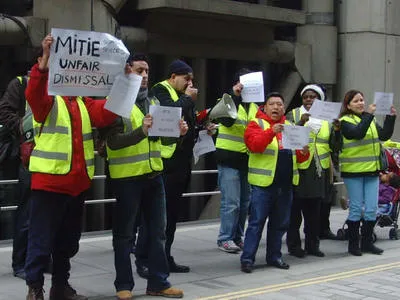
Latin American cleaners on Friday 3rd April held the latest in a series of weekly demonstrations outside their former workplace in the insurance firm Willis in the City of London against the sacking of five of their colleagues by the Mitie cleaning contractor. The four men and one woman were dismissed following an email conversation with management, in which the cleaners registered their unhappiness at a sudden change in shift patterns, done without consultation.

Tags

  • North London
  • Mitie
  • cleaning and facilities
  • Willis
By bill, 14 September, 2010

Demo in solidarity with cleaners

Members of North London SF demonstrated alongside other militants outside the head offices of London & Regional Properties, owners of Berns Salonger, a company that treats the cleaners it employs with intolerable conditions.

Tags

  • events and reports
  • North London
  • cleaning and facilities
By no1, 6 September, 2010

Sweep ISS out of SOAS

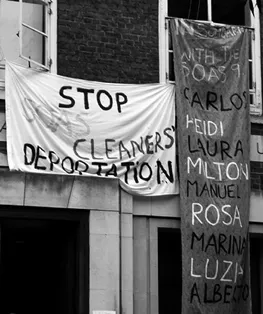
On June 12th, cleaners working for ISS at the School of Oriental & African Studies (SOAS) in London were called to a meeting by management. The cleaners were “processed” by immigration officials who detained nine of them as “illegal immigrants”. It was perhaps no coincidence that a picket of SOAS’ governing body demanding the reinstatement of victimised SOAS UNISON Branch Chair José Stalin Bermudez, who had been prominent in organising cleaners, had been called for that morning.

Those detained were denied union representation, but a campaign was quickly organised by SOAS campus unions and students, migrant worker activists and anti-deportation campaigners. SOAS management was held responsible for ISS “ambushing” their cleaners as punishment for winning union recognition and the London Living Wage.

Tags

  • education
  • North London
  • cleaning and facilities
  • privatisation
  • SOAS
  • immigration
  • repression

Pagination

  • First page
  • Previous page
  • Page 1
  • Page 2
  • Page 3
  • Page 4
  • Next page
  • Last page
cleaning and facilities

Guides

Your rights at work

Why do we organise? Capitalism is shit, oppression is shit - but what can we at SolFed do about it?

Why do we organise?

This is our flag - it tells you what we stand for

this-is-our-flag

Direct Action #2 (2024)

Direct Action #2 (2024)

Anarcho-syndicalism in Britain – a little history (2015)

Anarcho-syndicalism in Britain – a little history (2015)

Office worker’s health and safety - your rights and how to use them (2015)

Office worker’s health and safety - your rights and how to use them (2015)

Anarchism and Anarcho-syndicalism (Rudolf Rocker, 2014)

Anarchism and Anarcho-syndicalism (Rudolf Rocker, 2014)

Fighting for ourselves - anarcho-syndicalism and the class struggle (2012)

Fighting for ourselves - anarcho-syndicalism and the class struggle (2012)

Theory & Practice 1 - Workmates - direct action workplace organising on the London underground (2011)

Theory & Practice 1 - Workmates - direct action workplace organising on the London underground (2011)

The Economics of freedom (2003)

The Economics of freedom (2003)

A history of anarcho-syndicalism (SelfEd Collective, 24 unit series, 2001)

A history of anarcho-syndicalism (SelfEd Collective, 24 unit series, 2001)

Out of the frying pan, a critical look at works councils (1998)

Out of the frying pan, a critical look at works councils (1998)

Health and safety at work - an anarcho-syndicalist approach (1997)

Health and safety at work - an anarcho-syndicalist approach (1997)

Theory & Practice 2 - Anarcho-syndicalism in Puerto Real (1994)

Theory & Practice 2 - Anarcho-syndicalism in Puerto Real (1994)
RSS feed