Home
Solidarity Federation
IWA
User account menu
  • Contact
  • Log in
  • Home
    • Intro
    • Workplace organiser training
    • Industrial strategy
    • Community strategy
    • Constitution
  • SolFed
    • Brighton
    • Bristol
    • Edinburgh
    • Liverpool
    • Manchester
    • North London
    • Wales
    • Yorkshire
  • Industries & sectors
    • Claimants and unpaid
    • Education
    • Health and social care
    • Hospitality
  • Events & reports
  • Publications
    • Guides
      • Stuff your boss (doesn't want you to know)
      • Stuff your sexist boss (doesn't want you to know) (2018)
      • Stuff your landlord (doesn't want you to know) (2016)
      • Is your cleaning job killing you? A guide to cleaners health and safety (2017)
      • Office worker’s health and safety - your rights and how to use them (2015)
      • A migrant's guide to Manchester (2016) [en es]
      • A migrant's guide to London (2014) [en es pl]
      • Strike - a guide to walking out (2014)
    • Pamphlets and books
      • Anarcho-syndicalism in Britain – a little history (2015)
        • 1. 19th century to 1914 - The First International, growth of industrial unionism and the Great Unrest
        • 2. 1914–1945 - State suppression and the Bolshevik turn – how Lenin’s seeming success drew militants to the Comintern
        • 3. 1945–1994 - The Anarchist Federation of Britain, Syndicalist Workers’ Federation and Direct Action Movement
        • 4. Today’s movement - A short look at the strategy and thinking of the modern Solidarity Federation
      • Office worker’s health and safety - your rights and how to use them (2015)
      • Anarchism and Anarcho-syndicalism (Rudolf Rocker, 2014)
        • Introduction
        • 1. Ideology of Anarchism
        • 2. History of anarchist philosphy, from Lao-Tse to Kropotkin
        • 3. The origins of anarcho-syndicalism
        • 4. Socialism and anarcho-syndicalism in France
        • 5. The role of the trade unions: anarcho-syndicalist view
        • 6. The struggle in Germany and Spain
        • 7. The political struggle: anarcho-syndicalist view
        • 8. Anarcho-syndicalism since the First World War
      • Fighting for ourselves - anarcho-syndicalism and the class struggle (2012)
        • Introduction
        • 1. The mainstream workers' movement
        • 2. Radical currents in the workers' movement
        • 3. Anarcho-syndicalism in the 20th century
        • 4. Capitalism and the class struggle since World War II
        • 5. Anarcho-syndicalism in the 21st century
        • Endnotes
      • Workmates - direct action workplace organising on the London underground (2011)
      • The Economics of freedom (2003)
      • A history of anarcho-syndicalism (2001)
      • Out of the frying pan, a critical look at works councils (1998)
      • Health and safety at work - an anarcho-syndicalist approach (1997)
      • Anarcho-syndicalism in Puerto Real (1994)
    • Leaflets and flyers
      • Solidarity Federation Education Union (SFEU)
      • Solidarity Federation Hospitality Workers Union (SFHWU)
      • Why do we organise?
      • This is our flag - it tells you what we stand for
      • What is anarcho-syndicalism anyway?
      • Anarchism and Syndicalism (short version)
      • Anarchism and Syndicalism
      • Towards a better union
      • Protest is not enough
      • Building beyond elections
      • We should run our workplaces
      • We should run our communities
      • We should run our movements
    • Newsletters
      • Brighton Solidarity
        • Brighton Solidarity #3
      • Education Worker
        • Education Worker #10 Victimisation (2013)
        • Education Worker #9 (2012)
        • Education Worker #8 Academy Special (2012)
      • Wildcat!
        • Wildcat! #13 (Jan 2013)
        • Wildcat! (Winter 2012)
        • Wildcat! #6 (Summer 2011)
        • Wildcat! #5 (Spring 2011)
        • Wildcat! #4 (Dec 2010)
        • Wildcat! #3 (Oct-Nov 2010)
        • Wildcat! #2 (Jul-Aug 2010)
        • Wildcat! Football for the fans NOT for fat cats! (Jul 2010)
        • Wildcat! #1 (May-June 2010)
      • May Day Bulletin (Newcastle SolFed, 2014)
    • Direct Action
      • Direct Action #2 (2024)
      • Direct Action #1 (2023)
      • Direct action #47 (Summer 2009)
    • Catalyst
      • Catalyst #29 (Feb 2012)
      • Catalyst #28 (Oct 2011)
      • Catalyst #27 (Jun 2011)
      • Catalyst #26 (Mar 2011)
      • Catalyst #25 (Dec 2010)
      • Catalyst #24 (Summer 2010)
    • SelfEd
      • A history of anarcho-syndicalism
        • Block 1
          • Unit 1: The Origins of Capitalism
          • Unit 2: Britain: The Radical Period 1750-1840
          • Unit 3: The First International
          • Unit 4: France 1870-1918 Early revolutionary unions
          • Unit 5: Revolutionary Syndicalism in Britain, 1870-1910
          • Unit 6: Revolutionary Syndicalism in Britain and Ireland, 1910-17
        • Block 2
          • Unit 7: Mexico 1870-1920: Colonialism and Revolution
          • Unit 8: USA 1886-1930 - The Wobblies
          • Unit 9: Anarcho-syndicalism in Argentina 1870-1939
          • Unit 10: Sweden 1889-1939
          • Unit 11: Russia I: 1850-1917
          • Unit 12 Russia II: 1917-30
        • Block 3
          • Unit 13: Going Global - International Organisation, 1872-1922
          • Unit 14: Anarcho-syndicalism in Britain, 1914-30
          • Unit 15 Spain, 1868-1936: Build-up to Revolution
          • Unit 16 Spain: Culture, education, women and sexuality
          • Unit 17: Spain 1936-39: Revolution and Civil War
          • Unit 18: Spain - The Collectives
        • Block 4
          • Unit 19: Britain, 1930-1950 - The Era of Reform
          • Unit 20: Britain, 1950-1990 - Decline of Social Democracy
          • Unit 21: anarcho-syndicalism 1939-99
          • Unit 22: Roots of modern anarcho-syndicalism: freedom, oppression & rebellion
          • Unit 23: Roots of modern anarcho-syndicalism: morality, culture & tactics
          • Unit 24: The spirit of anarcho-syndicalism
    • Letters
  • IWA

CNT-AIT: Reviving the spirit of the people

By no1, 27 July, 2011
cnt

Below is a statement by our Spanish sister section on the occasion of the 75th anniversary of the beginning of the Spanish Revolution (Spanish original)

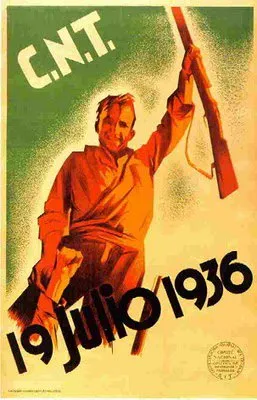
This 19th of July is the 75 anniversary of the 1936 Spanish Revolution. 75 years since that Summer when the workers took to the streets, not just to defend themselves from the coup d’etat started by the fascists, but also to fight for their future, where they saw a different society based on equality, solidarity and mutual support. Despite the time elapsed between then and now we can point out two similarities and one fundamental difference.

Today, as then, the government remains a puppet of the interests of the powerful. In July ‘36, the Republican Government refused to give weapons to the workers for self-defense, although aware of the gravity of the coup; showing that its fear of regular armed people was bigger than its fear of fascists. Today the socialists, like ridiculous apprentices of Machiavelli, give in to the blackmail of financial power, and legislate to exploit and further impoverish the workers. Then as now, Governments are not listening to those people they represent so unworthily.

In summer of ‘36 unemployment rates were very high, many companies were closed, wages were miserable and many people starved, something we are going to see again. Capitalism, joined to its natural appendices, the Army (to control the body) and the Church (to control the mind), saw in the workers’ organisation a clear menace to their interests, so Army and Church were used to massacre them. Today the capitalists are not called fascists, they are “the market”, and although the disappointed and quiet working class is not a threat, they push to cut salaries and rights, or eliminate the most basic public services to guarantee their future benefits. Their armies are shareholders and their pulpits the media (dis)information. Speculating on stocks they condemn to death or poverty millions of people across the World or ruin entire countries. Now as then, indifferent to suffering and needs, they spread exploitation and insecurity in order to maintain their privileges.

In the other hand, the primary difference from those times is the conciousness of the working class. Despite many years of repression and hardship, the workers of 1936 were organized. Labour unions were full of members and also full of dreams. Male and female workers did not join the Unions only for economic benefits, but also demanded another way of life, a different economy, another kind of relationship with each other. Getting out of poverty, not only materially, but also spiritually. In fact they suceeded. In the midst of a war against a professional army, the workers not only confronted those forces, they also realised their aspirations through the collectivisation of the means of production that took place after that 19th of July; this remains to this day a unique example in World History.

Today, the CNT is not just fighting against capital and the State, but also against the passivity of the workers. The working class of the 21st century struggles between fear and disorientation, unable to make sense of association, unable to see further than the day in hand. Individualism, as the tool of power, still rules. Many workers admire their exploitative bosses, justify their aggression and dream of imitating them to escape their misery.

Breaking up this situation is the most important job for the CNT militants. Making our union a place where workers learn solidarity and mutual support as the first step to building an alternative to this unfair and non-sensical society. A place to connect the spirit of those who fought on the 19th July with those today that are having the same problems with the same enemies. To show anarcho-syndicalism as a way to improve not only their lives but also their personal and collective ethics. To find this new world that we carry in our hearts.

Despite all the means of control, again society fills up the streets and squares; therefore, today as in the past, we continue our work without giving an inch on the theory or practice, confident that perseverance and loyal and honest work will raise the awareness of the working class and will help the spirit of the people to be reborn.


Permanent Confederal Committee Secretariat - CNT

  • Spanish Revolution
  • anarcho-syndicalism today
  • CNT-AIT (Spain)
  • statements
  • international

Guides

Your rights at work

Why do we organise? Capitalism is shit, oppression is shit - but what can we at SolFed do about it?

Why do we organise?

This is our flag - it tells you what we stand for

this-is-our-flag

Direct Action #2 (2024)

Direct Action #2 (2024)

Anarcho-syndicalism in Britain – a little history (2015)

Anarcho-syndicalism in Britain – a little history (2015)

Office worker’s health and safety - your rights and how to use them (2015)

Office worker’s health and safety - your rights and how to use them (2015)

Anarchism and Anarcho-syndicalism (Rudolf Rocker, 2014)

Anarchism and Anarcho-syndicalism (Rudolf Rocker, 2014)

Fighting for ourselves - anarcho-syndicalism and the class struggle (2012)

Fighting for ourselves - anarcho-syndicalism and the class struggle (2012)

Theory & Practice 1 - Workmates - direct action workplace organising on the London underground (2011)

Theory & Practice 1 - Workmates - direct action workplace organising on the London underground (2011)

The Economics of freedom (2003)

The Economics of freedom (2003)

A history of anarcho-syndicalism (SelfEd Collective, 24 unit series, 2001)

A history of anarcho-syndicalism (SelfEd Collective, 24 unit series, 2001)

Out of the frying pan, a critical look at works councils (1998)

Out of the frying pan, a critical look at works councils (1998)

Health and safety at work - an anarcho-syndicalist approach (1997)

Health and safety at work - an anarcho-syndicalist approach (1997)

Theory & Practice 2 - Anarcho-syndicalism in Puerto Real (1994)

Theory & Practice 2 - Anarcho-syndicalism in Puerto Real (1994)
RSS feed