Home
Solidarity Federation
IWA
User account menu
  • Contact
  • Log in
  • Home
    • Intro
    • Workplace organiser training
    • Industrial strategy
    • Community strategy
    • Constitution
  • SolFed
    • Brighton
    • Bristol
    • Edinburgh
    • Liverpool
    • Manchester
    • North London
    • Wales
    • Yorkshire
  • Industries & sectors
    • Claimants and unpaid
    • Education
    • Health and social care
    • Hospitality
  • Events & reports
  • Publications
    • Guides
      • Stuff your boss (doesn't want you to know)
      • Stuff your sexist boss (doesn't want you to know) (2018)
      • Stuff your landlord (doesn't want you to know) (2016)
      • Is your cleaning job killing you? A guide to cleaners health and safety (2017)
      • Office worker’s health and safety - your rights and how to use them (2015)
      • A migrant's guide to Manchester (2016) [en es]
      • A migrant's guide to London (2014) [en es pl]
      • Strike - a guide to walking out (2014)
    • Pamphlets and books
      • Anarcho-syndicalism in Britain – a little history (2015)
        • 1. 19th century to 1914 - The First International, growth of industrial unionism and the Great Unrest
        • 2. 1914–1945 - State suppression and the Bolshevik turn – how Lenin’s seeming success drew militants to the Comintern
        • 3. 1945–1994 - The Anarchist Federation of Britain, Syndicalist Workers’ Federation and Direct Action Movement
        • 4. Today’s movement - A short look at the strategy and thinking of the modern Solidarity Federation
      • Office worker’s health and safety - your rights and how to use them (2015)
      • Anarchism and Anarcho-syndicalism (Rudolf Rocker, 2014)
        • Introduction
        • 1. Ideology of Anarchism
        • 2. History of anarchist philosphy, from Lao-Tse to Kropotkin
        • 3. The origins of anarcho-syndicalism
        • 4. Socialism and anarcho-syndicalism in France
        • 5. The role of the trade unions: anarcho-syndicalist view
        • 6. The struggle in Germany and Spain
        • 7. The political struggle: anarcho-syndicalist view
        • 8. Anarcho-syndicalism since the First World War
      • Fighting for ourselves - anarcho-syndicalism and the class struggle (2012)
        • Introduction
        • 1. The mainstream workers' movement
        • 2. Radical currents in the workers' movement
        • 3. Anarcho-syndicalism in the 20th century
        • 4. Capitalism and the class struggle since World War II
        • 5. Anarcho-syndicalism in the 21st century
        • Endnotes
      • Workmates - direct action workplace organising on the London underground (2011)
      • The Economics of freedom (2003)
      • A history of anarcho-syndicalism (2001)
      • Out of the frying pan, a critical look at works councils (1998)
      • Health and safety at work - an anarcho-syndicalist approach (1997)
      • Anarcho-syndicalism in Puerto Real (1994)
    • Leaflets and flyers
      • Solidarity Federation Education Union (SFEU)
      • Solidarity Federation Hospitality Workers Union (SFHWU)
      • Why do we organise?
      • This is our flag - it tells you what we stand for
      • What is anarcho-syndicalism anyway?
      • Anarchism and Syndicalism (short version)
      • Anarchism and Syndicalism
      • Towards a better union
      • Protest is not enough
      • Building beyond elections
      • We should run our workplaces
      • We should run our communities
      • We should run our movements
    • Newsletters
      • Brighton Solidarity
        • Brighton Solidarity #3
      • Education Worker
        • Education Worker #10 Victimisation (2013)
        • Education Worker #9 (2012)
        • Education Worker #8 Academy Special (2012)
      • Wildcat!
        • Wildcat! #13 (Jan 2013)
        • Wildcat! (Winter 2012)
        • Wildcat! #6 (Summer 2011)
        • Wildcat! #5 (Spring 2011)
        • Wildcat! #4 (Dec 2010)
        • Wildcat! #3 (Oct-Nov 2010)
        • Wildcat! #2 (Jul-Aug 2010)
        • Wildcat! Football for the fans NOT for fat cats! (Jul 2010)
        • Wildcat! #1 (May-June 2010)
      • May Day Bulletin (Newcastle SolFed, 2014)
    • Direct Action
      • Direct Action #2 (2024)
      • Direct Action #1 (2023)
      • Direct action #47 (Summer 2009)
    • Catalyst
      • Catalyst #29 (Feb 2012)
      • Catalyst #28 (Oct 2011)
      • Catalyst #27 (Jun 2011)
      • Catalyst #26 (Mar 2011)
      • Catalyst #25 (Dec 2010)
      • Catalyst #24 (Summer 2010)
    • SelfEd
      • A history of anarcho-syndicalism
        • Block 1
          • Unit 1: The Origins of Capitalism
          • Unit 2: Britain: The Radical Period 1750-1840
          • Unit 3: The First International
          • Unit 4: France 1870-1918 Early revolutionary unions
          • Unit 5: Revolutionary Syndicalism in Britain, 1870-1910
          • Unit 6: Revolutionary Syndicalism in Britain and Ireland, 1910-17
        • Block 2
          • Unit 7: Mexico 1870-1920: Colonialism and Revolution
          • Unit 8: USA 1886-1930 - The Wobblies
          • Unit 9: Anarcho-syndicalism in Argentina 1870-1939
          • Unit 10: Sweden 1889-1939
          • Unit 11: Russia I: 1850-1917
          • Unit 12 Russia II: 1917-30
        • Block 3
          • Unit 13: Going Global - International Organisation, 1872-1922
          • Unit 14: Anarcho-syndicalism in Britain, 1914-30
          • Unit 15 Spain, 1868-1936: Build-up to Revolution
          • Unit 16 Spain: Culture, education, women and sexuality
          • Unit 17: Spain 1936-39: Revolution and Civil War
          • Unit 18: Spain - The Collectives
        • Block 4
          • Unit 19: Britain, 1930-1950 - The Era of Reform
          • Unit 20: Britain, 1950-1990 - Decline of Social Democracy
          • Unit 21: anarcho-syndicalism 1939-99
          • Unit 22: Roots of modern anarcho-syndicalism: freedom, oppression & rebellion
          • Unit 23: Roots of modern anarcho-syndicalism: morality, culture & tactics
          • Unit 24: The spirit of anarcho-syndicalism
    • Letters
  • IWA

More bad news from the World Bank

By Tony, 5 January, 2019

Following on from our recent post on the World Bank and climate change comes more bad news from the Bank. In the World Bank’s flagship 2019 World Development Report, entitled the Changing Nature of Work, the  Bank argues for wide-ranging deregulation of labour; deemed necessary to prepare countries for the changing nature of work. The report sets out a nice cosy capitalist future under which firms will be relieved of the burden of contributing to social security, have the flexibility to pay wages as low as they think fit and have the power to fire people at will.

Needless to say, the World Bank report has nothing to say about the worldwide decline in worker’s share of national income. Nor does it bother to look into the undermining of working conditions through deliberate corporate strategies such as outsourcing and bogus “self-employed” classification. Instead, the report goes on to support companies like Uber by agreeing that their workers were not employees but were “emerging as a separate labour category”.

In arguing for ever greater deregulation, the report points out that regulation  “protects the few who hold formal jobs while leaving out most workers”. Therefore, in an admiral show of egalitarianism, the report proposes to trash all working conditions to ensure everyone gets to be equal! The report goes on to point out that, in the age of automation, “Burdensome regulations also make it more expensive for firms to rearrange their workforce to accommodate changing technologies.”

This free market claptrap has no relation to realities. The idea that ever greater deregulation of the labour market will somehow miraculously result in a high-tech economy, populated by a highly skilled, highly paid workforce is a joke.   As can be seen from our own beloved economy, where ever greater casualisation has resulted in firms holding back from high-tech investment, due to there being few savings to be made when the cost of labour is so cheap. This has resulted in Britain becoming locked into a low-wage, low-skill, low-productivity economy, in which wages are state subsidised and workers make up for a lack of earnings power by taking on ever greater debt.

Since the publication of the draft report,  there have been growing condemnation of the World Bank. For example, Oxfam argued the report's emphasis on social protection put the costs of supporting workers and poor households on the government, letting employers off the hook. Going on to state “The World Development Report casts serious doubts over the commitment of the World Bank to reducing the gap between rich and poor,”

What is more shocking however is not that the World Bank is supporting big business, but rather why organisations such as Oxfam and the  International Labour Organisation are shocked by the fact. The Bank was set up by western capitalism immediately after the second world war to act in its interest. And the World Bank has certainly delivered.  Since its inception, the Bank has been used as a tool for fighting the cold war, a means of maintaining western capitalism’s power over of the developing world and a way of imposing free-market policies on countries in return for bailouts.

The very first World Bank loan was made to post-war France on the strict understanding that public spending was to be slashed and loan repayments made the priority; with the loan only made on the condition that communist supporters were removed from the French Government.

After the introduction of the Marshall Plan in the immediate post-war period, the bank turned much of its loving attention to the developing world. Where it immediately started charging developing countries far higher interest rates for loans than commercial banks. Leading to calls for the bank to be reformed with some countries even arguing for the developing world to set up their own bank that would prioritise their interest.

Undeterred the Bank began to target loans on projects designed to increase the developing worlds ability to export raw materials, at the same time refusing to support projects designed to satisfy domestic demand. All of which was aimed at increasing the developing world's dependency on western goods. Just to make doubly sure, the World Bank began to give loans on the condition that countries purchased goods and services from the developed world in return. As a result during the first seventeen years of the World Bank, more than 93% of the money lent came back each year to the industrialized countries in the form of purchases.

By the 1980s, the World Bank, and its partners in crime the IMF were being used to impose free-market dogma in the form of structural reform programmes. Under structural reform programmes, in return for loans, countries were forced to slash public spending, deregulate labour, cut salaries, pensions and welfare, stop food, rent and fuel subsidies, introduce widescale privatisation and smash organised labour.  A World Bank playbook that was to be used in the former Soviet Union countries in the form of “economic shock therapy” and also by the increasingly sainted EU in Greece during the Eurozone crisis.

And the World Bank free market playbook is still very much in play today. While writing this post news come from the Solidarity Federation’s sister organisation in Poland, the ZSP, that the World Bank is currently advising the Polish government on how to go about privatising state owned housing. 

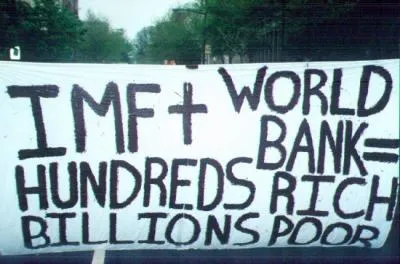
The reality is that the World Bank, behind all the platitudes about reducing poverty and equality, is a capitalist institution whose priority is to support the interest of capitalism. As such it has to be opposed  just like the capitalist system that created it.


  • World Bank

Guides

Your rights at work

Why do we organise? Capitalism is shit, oppression is shit - but what can we at SolFed do about it?

Why do we organise?

This is our flag - it tells you what we stand for

this-is-our-flag

Direct Action #2 (2024)

Direct Action #2 (2024)

Anarcho-syndicalism in Britain – a little history (2015)

Anarcho-syndicalism in Britain – a little history (2015)

Office worker’s health and safety - your rights and how to use them (2015)

Office worker’s health and safety - your rights and how to use them (2015)

Anarchism and Anarcho-syndicalism (Rudolf Rocker, 2014)

Anarchism and Anarcho-syndicalism (Rudolf Rocker, 2014)

Fighting for ourselves - anarcho-syndicalism and the class struggle (2012)

Fighting for ourselves - anarcho-syndicalism and the class struggle (2012)

Theory & Practice 1 - Workmates - direct action workplace organising on the London underground (2011)

Theory & Practice 1 - Workmates - direct action workplace organising on the London underground (2011)

The Economics of freedom (2003)

The Economics of freedom (2003)

A history of anarcho-syndicalism (SelfEd Collective, 24 unit series, 2001)

A history of anarcho-syndicalism (SelfEd Collective, 24 unit series, 2001)

Out of the frying pan, a critical look at works councils (1998)

Out of the frying pan, a critical look at works councils (1998)

Health and safety at work - an anarcho-syndicalist approach (1997)

Health and safety at work - an anarcho-syndicalist approach (1997)

Theory & Practice 2 - Anarcho-syndicalism in Puerto Real (1994)

Theory & Practice 2 - Anarcho-syndicalism in Puerto Real (1994)
RSS feed