Home
Solidarity Federation
IWA
User account menu
  • Contact
  • Log in
  • Home
    • Intro
    • Workplace organiser training
    • Industrial strategy
    • Community strategy
    • Constitution
  • SolFed
    • Brighton
    • Bristol
    • Edinburgh
    • Liverpool
    • Manchester
    • North London
    • Wales
    • Yorkshire
  • Industries & sectors
    • Claimants and unpaid
    • Education
    • Health and social care
    • Hospitality
  • Events & reports
  • Publications
    • Guides
      • Stuff your boss (doesn't want you to know)
      • Stuff your sexist boss (doesn't want you to know) (2018)
      • Stuff your landlord (doesn't want you to know) (2016)
      • Is your cleaning job killing you? A guide to cleaners health and safety (2017)
      • Office worker’s health and safety - your rights and how to use them (2015)
      • A migrant's guide to Manchester (2016) [en es]
      • A migrant's guide to London (2014) [en es pl]
      • Strike - a guide to walking out (2014)
    • Pamphlets and books
      • Anarcho-syndicalism in Britain – a little history (2015)
        • 1. 19th century to 1914 - The First International, growth of industrial unionism and the Great Unrest
        • 2. 1914–1945 - State suppression and the Bolshevik turn – how Lenin’s seeming success drew militants to the Comintern
        • 3. 1945–1994 - The Anarchist Federation of Britain, Syndicalist Workers’ Federation and Direct Action Movement
        • 4. Today’s movement - A short look at the strategy and thinking of the modern Solidarity Federation
      • Office worker’s health and safety - your rights and how to use them (2015)
      • Anarchism and Anarcho-syndicalism (Rudolf Rocker, 2014)
        • Introduction
        • 1. Ideology of Anarchism
        • 2. History of anarchist philosphy, from Lao-Tse to Kropotkin
        • 3. The origins of anarcho-syndicalism
        • 4. Socialism and anarcho-syndicalism in France
        • 5. The role of the trade unions: anarcho-syndicalist view
        • 6. The struggle in Germany and Spain
        • 7. The political struggle: anarcho-syndicalist view
        • 8. Anarcho-syndicalism since the First World War
      • Fighting for ourselves - anarcho-syndicalism and the class struggle (2012)
        • Introduction
        • 1. The mainstream workers' movement
        • 2. Radical currents in the workers' movement
        • 3. Anarcho-syndicalism in the 20th century
        • 4. Capitalism and the class struggle since World War II
        • 5. Anarcho-syndicalism in the 21st century
        • Endnotes
      • Workmates - direct action workplace organising on the London underground (2011)
      • The Economics of freedom (2003)
      • A history of anarcho-syndicalism (2001)
      • Out of the frying pan, a critical look at works councils (1998)
      • Health and safety at work - an anarcho-syndicalist approach (1997)
      • Anarcho-syndicalism in Puerto Real (1994)
    • Leaflets and flyers
      • Solidarity Federation Education Union (SFEU)
      • Solidarity Federation Hospitality Workers Union (SFHWU)
      • Why do we organise?
      • This is our flag - it tells you what we stand for
      • What is anarcho-syndicalism anyway?
      • Anarchism and Syndicalism (short version)
      • Anarchism and Syndicalism
      • Towards a better union
      • Protest is not enough
      • Building beyond elections
      • We should run our workplaces
      • We should run our communities
      • We should run our movements
    • Newsletters
      • Brighton Solidarity
        • Brighton Solidarity #3
      • Education Worker
        • Education Worker #10 Victimisation (2013)
        • Education Worker #9 (2012)
        • Education Worker #8 Academy Special (2012)
      • Wildcat!
        • Wildcat! #13 (Jan 2013)
        • Wildcat! (Winter 2012)
        • Wildcat! #6 (Summer 2011)
        • Wildcat! #5 (Spring 2011)
        • Wildcat! #4 (Dec 2010)
        • Wildcat! #3 (Oct-Nov 2010)
        • Wildcat! #2 (Jul-Aug 2010)
        • Wildcat! Football for the fans NOT for fat cats! (Jul 2010)
        • Wildcat! #1 (May-June 2010)
      • May Day Bulletin (Newcastle SolFed, 2014)
    • Direct Action
      • Direct Action #2 (2024)
      • Direct Action - Syndicalist Workers Federation
      • Direct Action #1 (2023)
      • Direct action #47 (Summer 2009)
    • Catalyst
      • Catalyst #29 (Feb 2012)
      • Catalyst #28 (Oct 2011)
      • Catalyst #27 (Jun 2011)
      • Catalyst #26 (Mar 2011)
      • Catalyst #25 (Dec 2010)
      • Catalyst #24 (Summer 2010)
    • SelfEd
      • A history of anarcho-syndicalism
        • Block 1
          • Unit 1: The Origins of Capitalism
          • Unit 2: Britain: The Radical Period 1750-1840
          • Unit 3: The First International
          • Unit 4: France 1870-1918 Early revolutionary unions
          • Unit 5: Revolutionary Syndicalism in Britain, 1870-1910
          • Unit 6: Revolutionary Syndicalism in Britain and Ireland, 1910-17
        • Block 2
          • Unit 7: Mexico 1870-1920: Colonialism and Revolution
          • Unit 8: USA 1886-1930 - The Wobblies
          • Unit 9: Anarcho-syndicalism in Argentina 1870-1939
          • Unit 10: Sweden 1889-1939
          • Unit 11: Russia I: 1850-1917
          • Unit 12 Russia II: 1917-30
        • Block 3
          • Unit 13: Going Global - International Organisation, 1872-1922
          • Unit 14: Anarcho-syndicalism in Britain, 1914-30
          • Unit 15 Spain, 1868-1936: Build-up to Revolution
          • Unit 16 Spain: Culture, education, women and sexuality
          • Unit 17: Spain 1936-39: Revolution and Civil War
          • Unit 18: Spain - The Collectives
        • Block 4
          • Unit 19: Britain, 1930-1950 - The Era of Reform
          • Unit 20: Britain, 1950-1990 - Decline of Social Democracy
          • Unit 21: anarcho-syndicalism 1939-99
          • Unit 22: Roots of modern anarcho-syndicalism: freedom, oppression & rebellion
          • Unit 23: Roots of modern anarcho-syndicalism: morality, culture & tactics
          • Unit 24: The spirit of anarcho-syndicalism
    • Letters
  • IWA

Education workers

By drumlit, 18 May, 2019

ewWorking conditions in educational institutions are becoming more and more difficult. This is often linked to managers making cuts, establishing austerity measures, or asking all workers to do more for less.  We currently organise as a network of workers at University of Brighton, and have links to other educational institutions.

We aim to organise to improve these conditions on a day-to-day basis, trying to fight winnable disputes for caretakers, cleaners and hourly-paid lecturers alike. To resist the ways that these institutions are attacking the working conditions of all staff means working together, not establishing boundaries between academic and non-academic staff.

Practical modes of organising in the first place might include getting together with fellow workers to discuss what specific problems there are. Do you have the correct equipment? Is there a problem with overtime? Has there been extra responsibility added to your role without recognition of this? Getting together and talking about these things can help you to work out what a common target might be. For instance, office workers could consider whether their working environment meets health and safety conditions; hourly paid and fractional lecturers can insist on collective rather than individual meetings to discuss teaching allocation, and so on.

The university is trying to exploit its most vulnerable and precarious staff. The first step in stopping them doing this is small efforts of solidarity. If you’re interested in helping to organise, there are some resources and further information below. We also meet up once a month to discuss our situations at work and how we can best support one another with these. If you'd like to start coming along, fill out the contact form below to get in touch with us.

Office workers

The office environment is often unhealthy and sometimes unsafe, especially if you don’t know what legal rights you have.

This pamphlet, collated by Bristol Soldarity Federation, offers a simple, easy to understand rundown of your rights, from general laws to specifics around the office environment.

A handy jargon buster is included along with helpful tips for dealing with common problems like RSI, eye strain and stress.

And the final section is possibly the most important of all — looking at how we can organise collectively to make our work permanently safer and healthier.

Struggling? You aren’t alone.

Cleaners

Cleaners have a vital role in society, yet their job is poorly paid and routinely dismissed as a job carried out mainly by women to earn a bit of extra cash. Cleaning is also not generally seen as a particularly physically hard or dangerous job. Most people see cleaning as involving a bit of dusting, mopping and hoovering.

Written by a cleaner, this pamphlet draws on research from across the world to show the reality of cleaning and the impact the job has on the health and wellbeing of cleaners. The pamphlet not only examines the more obvious aspects of the job that affect cleaners’ health, such as the physical demands of the job and the effects of cleaning chemicals, but also takes into account the detrimental impact of factors such as low pay, ever-increasing workloads, low status, sexual harassment and family commitments on the everyday lives of cleaners. In doing so, the pamphlet exposes the true cost being paid by cleaners and their families for job that is central to the wellbeing of society as a whole.

As such, this pamphlet is not only essential reading for cleaners but for all those interested in seeing greater justice for one of the most exploited and marginalised groups of workers.

The stuff your sexist boss doesn't want you to know

Sexism is a constant presence in many workplaces where it can take many forms. From lower pay, to expectations of unpaid work, to sexual harassment by bosses, other workers or customers, sexism means women and workers seen as women are treated unequally on the basis of sex or gender. Our new pamphlet looks at the reality of sexism in the workplace and what we can do about it.

As anarcho-syndicalists we favour direct, collective strategies that build and maintain a culture of resistance in the workplace. While it’s not always possible to directly confront sexism at work, there is still much that can be done to make work more bearable and undermine sexist behaviour. Coping strategies can allow workers to deal with things on a personal level while tactics of resistance can help you to actively fight against unequal treatment, objectification, harassment and structural disadvantage. In this way workers can organise and fightback, building a culture of solidarity and support at work, which ultimately means you and others experiencing sexism are less isolated and more likely to win.

Lecturers

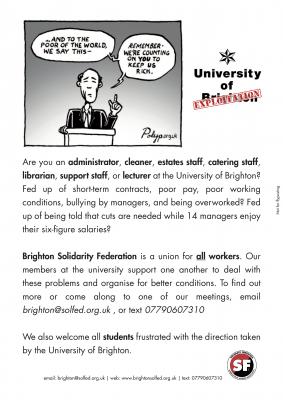
Hourly paid and fractional work is common at Brighton, as is being told your teaching at the last minute, being given no resources to support you with teaching entire modules, being underpaid, not being paid over the summer - the list goes on. Whilst the situation can be difficult, lecturers can take small but significant actions to improve it, such as accompanying one another to meetings, insisting on collective meetings, sharing information about administrative processes for claiming and organising with other workers at the university for better conditions. This document has information that will hopefully be useful for helping lecturers to navigate hourly paid and fractional work.


Loading...

  • education
  • higher education

Guides

Your rights at work

Why do we organise? Capitalism is shit, oppression is shit - but what can we at SolFed do about it?

Why do we organise?

This is our flag - it tells you what we stand for

this-is-our-flag

Direct Action #2 (2024)

Direct Action #2 (2024)

Anarcho-syndicalism in Britain – a little history (2015)

Anarcho-syndicalism in Britain – a little history (2015)

Office worker’s health and safety - your rights and how to use them (2015)

Office worker’s health and safety - your rights and how to use them (2015)

Anarchism and Anarcho-syndicalism (Rudolf Rocker, 2014)

Anarchism and Anarcho-syndicalism (Rudolf Rocker, 2014)

Fighting for ourselves - anarcho-syndicalism and the class struggle (2012)

Fighting for ourselves - anarcho-syndicalism and the class struggle (2012)

Theory & Practice 1 - Workmates - direct action workplace organising on the London underground (2011)

Theory & Practice 1 - Workmates - direct action workplace organising on the London underground (2011)

The Economics of freedom (2003)

The Economics of freedom (2003)

A history of anarcho-syndicalism (SelfEd Collective, 24 unit series, 2001)

A history of anarcho-syndicalism (SelfEd Collective, 24 unit series, 2001)

Out of the frying pan, a critical look at works councils (1998)

Out of the frying pan, a critical look at works councils (1998)

Health and safety at work - an anarcho-syndicalist approach (1997)

Health and safety at work - an anarcho-syndicalist approach (1997)

Theory & Practice 2 - Anarcho-syndicalism in Puerto Real (1994)

Theory & Practice 2 - Anarcho-syndicalism in Puerto Real (1994)
RSS feed