- New Leaders Same Old Problems
- Education Not Marketisation
- Inequality in the UK
- Black Women in History
- Wellness Schemes At Work Don't Work
- About Direct Action and Solidarity Federation
New Leaders Same Old Problems
So now we have another set of clowns running the circus. Those who bothered to vote went for Labour, hoping for something better. People realised the Tories are selfish, corrupt, sleazy, and only out to make money for themselves and their wealthy friends.
Meanwhile in Scotland the SNP is having its own troubles and look to lose the dominance they have established over Scottish politics.
This looks like good news for the Labour party. They are ahead in the polls and seemingly pushing at an open door. Yet the cautious approach adopted by Kier Starmer has angered those on the left especially those who were giddy when Jeremy Corbyn was unexpectedly made leader.
Many have declared that they couldn't bring themselves to vote for this re-brand of "New Labour." On election day though, a good proportion followed their learned behaviour and dutifully put their cross next to the Labour candidate even though they disagree with every policy of the party, including Labour’s support for the State of Israel which is engaging in genocide.
In their minds there is still the old illusion; supporters believe any Labour government is preferable to the Tories and once in power they can be persuaded to move leftwards and adopt more progressive policies. This is a farce.
Many British people are cynical and see all politics and politicians as corrupt and frauds. This is not to say they are adopting a revolutionary view but a resigned acceptance to parliamentary democracy. Some stayed away but others voted against the Tories believing this will change things.
So what can we expect? Well, much of the same. For the poor, disadvantaged and oppressed not much will change. The mantra will be the same as now: ‘we would like to do certain things but there is no money.’ Of course, that is a lie. There is enough money, but political decisions are made on who and what to spend it on.
Even though a majority now want to take the water and energy industries into "public" ownership, (nationalisation) as well as the railways, and certainly nearly everyone wants more public investment and less private enterprise in the NHS, the Labour Party, ever wary of being labelled extremist, shy away from this.
Should we be surprised though? The record of previous Labour governments shows that they always adopt a cautious approach when in power.
The first two pre-second world war administrations went out of their way to appear ‘sensible’ and ‘capable’ of managing capitalism. Even the much-lauded Atlee government of 1945, elected on a landslide, failed to carry through everything they could have.
In 1942 a report was written by Liberal MP William Beveridge which proposed nationalising much of the economy and healthcare. The Beveridge Report was incredibly popular and both Tory and Labour made promises for the expansion of welfare and the creation of a nationalised health service. Labour was seen as more committed to reform and the Tories were associated with unemployment and the depression.
Atlee’s Labour oversaw the implementation of the NHS that was to care for all from the ‘cradle to grave’ (to paraphrase Churchill). But even this achievement was marred by the introduction of charges for dental and optical treatment to pay for the expanding defence budget and the development of a British nuclear deterrent.
They nationalised sectors of the economy, but this was in failing industries that the owners were glad to get rid of especially given the generous compensation they were offered. The nationalised industries previously had years of under-investment and the money paid in compensation would have been better used to improve the infrastructure of the industries. The new managers were appointed not by the workers but on a ‘jobs for the boys’ philosophy.
When it came to the most profitable industry, iron and steel, the nationalisation was delayed and then done in such a half-hearted way it was easy to re-privatise by the next Tory government.
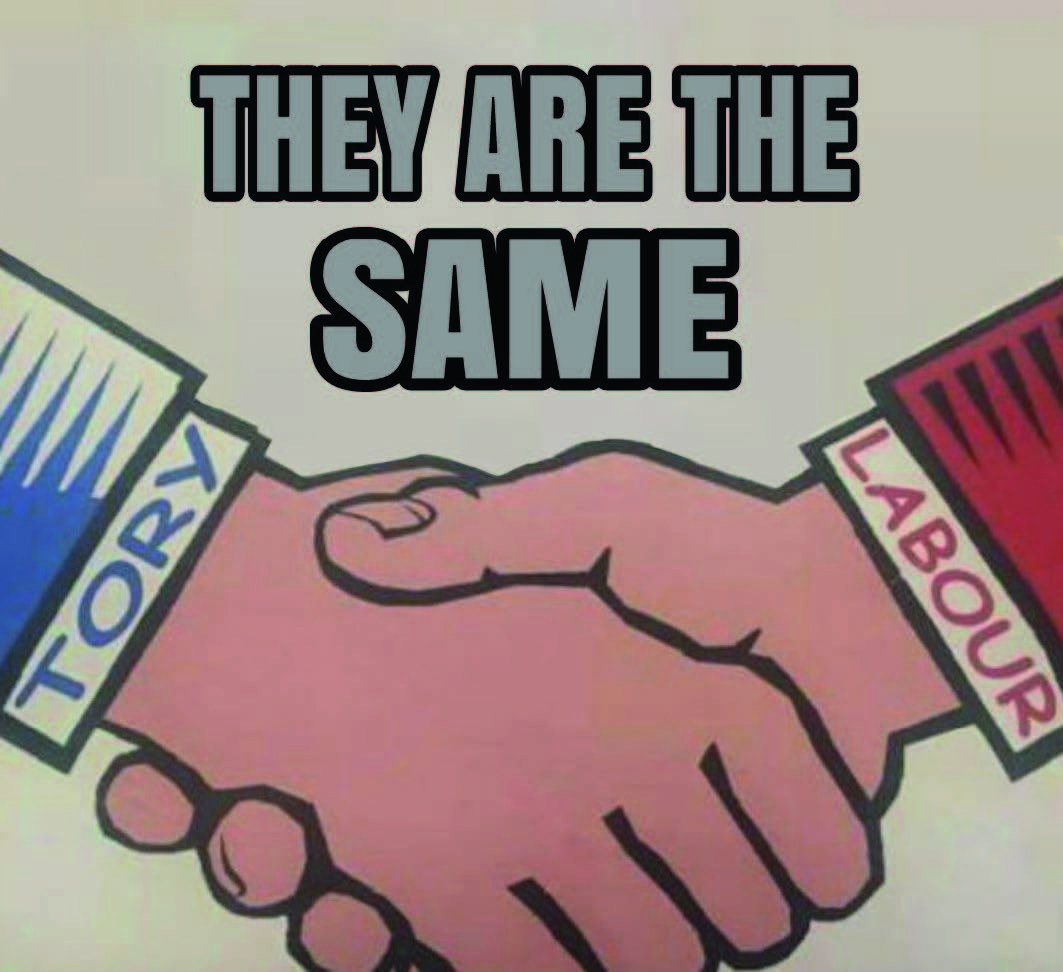 Labour are the new caretakers for capitalism. Nothing fundamental will change, we'll still be exploited and poor. Unemployment and homelessness will continue. Wages and living conditions will be the same, the environment will continue to be polluted. The rich will continue to get richer and the whole rotten system will continue. Unless we organise and fight for ourselves, to build a working class movement independent and opposed to all political parties and reformist unions. A movement based on class struggle, solidarity and direct action, to improve conditions now, but with the ultimate aim of getting rid of capitalism and class society for a better world where we run things for the needs of everyone.
Anarchist syndicalism is such a movement. Join us and build real resistance to the boss class.
Education Not Marketisation
 Many higher education institutions face financial collapse, but what has brought about this perfect storm and what can be done about it?
Headlines often focus on ‘over-reliance on international students’, but it is more complex. Why do universities try so hard to recruit international students? Because international fees are not regulated and universities can charge what they can get away with, meaning Cambridge can charge a Chinese student more than Cardiff Met. So, are they just being greedy? Not really – they are trying to cover the short-fall arising from domestic student fees barely rising in a decade.
In 2012, universities could charge an undergraduate student £9,000 per year; twelve years later, it has only risen to £9,250, while universities’ costs have gone through the roof. We are all familiar with the cost of living crisis, but imagine how much worse it would be without a pay rise in twelve years!
So is the answer to raise tuition fees? Of course not – the answer is to challenge the marketisation of higher education. This, and this alone, is the cause of the problem. In a stroke of neo-liberal “genius”, the then established £3,000 per year tuition fee hit true capitalist territory in 2012, and universities could charge between £6,000 and £9,000 a year. A typical university was expected to charge £6,000, and only exceptional institutions would charge £9,000. The government believed market forces would sort it all out; the ‘good’ universities would survive, and the sub-par ones would wither away or merge.
To make matters worse, 2015 saw the market forces strategy at play again, with the lifting of the cap on student numbers. Rather than each university being capped regarding numbers of students they could recruit, any university could now recruit as many students as it wanted. This was great for Russell Group universities and other prestigious institutions, but less good for smaller, regional universities and ex-polytechnics. If you could get into Bristol Uni, why go to the University of the West of England (ex-Bristol Poly)?
So the older (pre-1992) universities hoovered up as many students as they could by lowering their entry standards. The knock-on effect was the post-1992 universities lowering their own entry standards even further to stand a chance of attracting enough students and their much-needed fees.
Many universities are now reporting levels of student mental health concerns at an all-time high. The pressure to get a degree, and the willingness of universities to offer places, means that many students are really struggling with degree-level study, as well as debt.
There is no positive spin on the marketisation of higher education; all that happens is rich institutions get richer and the poor get poorer, while student choice and mental health suffer.
Market forces have no place in our education. While the economy may be too messed up to expect an immediate abolition of student fees, a realistic step forward would be to reinstate the cap on student numbers, which would at least distribute student fee income more fairly. Despite what the Russell Group of universities may say, this idea is not unheard of – during Covid, it looked like it could happen.
What we see now are the all too familiar effects of market forces – increasing concentration of wealth in ever fewer hands and a declining standard of service available to all but those with the deepest pockets. Looking no further than housing or the railways or the water companies, to name but a few, should leave little doubt as to where marketisation of education, if unchecked, is headed.
 The Solidarity Federation Education Union sees the education system, including the HE sector, as a resource that must be as widely accessible as possible. Market forces, however, are about re-distributing society’s wealth into the hands of those at the top. In other words, education for the majority is becoming increasingly substandard, while the richest can always pay for the best.
SFEU is not motivated by the self-interest of capitalist structures like the Russell Group. Instead, all our collective energy is directed at fighting for the interests of those engaged in education, whether as workers, no matter what job, or as consumers.
Do you sometimes feel your union isn’t listening to you?
Do you sometimes wonder whose interests they’re representing?
The chances are your union suffers from as much bureaucracy as the very institution you are fighting against!
If you are sick of the top-down approach to protect your interests consider joining the SOLIDARITY FEDERATION EDUCATION UNION
Your union. Your voice.
You can find out more at www.solfed.org.uk/sfeu or contact us at sfeu@riseup.net
Inequality in the UK
 The UK is the second most unequal society of all the rich nations after the USA. This ever-widening gap between the super-rich and the rest of us has been occurring since the election of Maragret Thatcher in 1979. This has led to the rich getting ever richer to the point that the UK's 171 billionaires now hold as much wealth as over 40 million of the rest of us. In 2020, the Office for National Statistics calculated that the richest 10% of households hold 43% of all wealth. The poorest 50%, by contrast, own just 9%, while the bottom 10% own just 0.02% of the total wealth. Today, the five richest families in the UK are wealthier than the bottom 20 percent of the entire population combined.
Such massive wealth inequality has a profound effect on society. It causes huge damage to the economy, shortens people's lives, makes people unhealthy and unhappy, leads to poorer health and education systems and increases the amount of violence and crime in society. While inequality generally makes society a far less happy place to live and declining public services impacts on us all, apart from the very rich, inequality has a devastating effect on the lives of the less well off. Just to give a few examples, a study by the Health Foundation found that a 60-year-old woman in the poorest areas of England has a level of ‘diagnosed illness’ equivalent to that of a 76-year-old woman in the wealthiest areas, while a 60-year-old man in the poorest areas of England will on average have a level of “diagnosed illness” equivalent to that of a 70-year-old man in the wealthiest areas. A woman living in the poorest areas has a life expectancy five years shorter than a woman in the wealthiest areas, while men living in the poorest areas can expect to die nine years earlier than men in the wealthiest areas.
Inequality then, blights the lives of us all and fundamentally shapes the society we live in and causes untold harm to those less well off. Given the harm inequality does to the vast majority of us, it does beg the question as to just why the UK economy is so unequal. Of course, inequality is endemic to capitalism: where there is capitalism there is inequality.
But that does not explain why the UK is such an unequal society compared to other rich countries. The answer to this puzzle lies in the nature of the UK economy.
The profound economic changes introduced by Thatcher changed the nature of British capitalism, driving out manufacturing and reasonably well-paid jobs, to the benefit of the financial sector. Over time, this has led to the UK economy being largely dominated by speculators and a rentier class, who contribute little to the economy in real terms, but are able to use their dominant position within the economy to extract an ever-larger share of the wealth created by society as a whole. In effect the UK economy has been turned into a cash cow for the rich.
This explains the conundrum of how it is that as a society we get ever more rich, and yet public services seem to get ever worse. The reality is that even though as a nation our overall wealth is increasing, an ever-larger percentage of that increased wealth is ending up in the hands of the rich. The super rich are hoovering up all the money, leaving the rest of us to struggle to make ends meet and having to finance collapsing public services out of ever dwindling incomes. As wages decline in real terms the government has to keep increasing taxes in an attempt to fund public services, resulting in the absurd position of the tax burden being at the highest in 70 years while at the same time public services are falling apart.
One solution would be to redistribute society's wealth downwards. It is estimated that a one off 1% wealth tax on households with more than £1m would generate an extra £260 billion in revenue. Enough to end, at least for the time being, the crisis in the health service and social care. But even this fairly modest proposal has been rejected by all the major parties, including the Labour Party, who have made it clear that they “have no plans to introduce a wealth tax”. The Labour leadership has also made it perfectly clear that they have no intention of redistributing wealth through taxes in any meaningful way.
In January, the then shadow chancellor, Rachel Reeves stated they had no intention of reinstating the cap that limited the bonus paid out to bankers to twice their salary. The cap was abolished by the disastrous, shortlived Truss government. Reeves stated she had “no intention” of bringing back the cap, saying she wanted to be the “champion of a thriving financial services industry”. Maintaining a “thriving” financial services industry, it would appear, requires bankers receiving obscene levels in a society where many depend on food banks. This announcement should come as no surprise given the Labour leadership has already withdrawn its commitment to raise the top rate of income tax to 45p. The cowardice of the Labour leadership, in the face of hostility by the rich and their allies in the media, can be put into perspective by the fact that even the Thatcher government kept the top rate of tax at 60p or above for the first 10 years of being in government.
Understandably many will continue to support the Labour Party in the hope that once elected into government they will become more radical. However, rather than being dependent on the whims of politicians, workers should organise themselves and take action. It is no coincidence that the most dramatic reduction in inequality in the history of the UK came about in the immediate decades after the second world war, during a period of trade union militancy. Militant workers were able to force through change to the extent that by the 1970s the UK was one of the most equal countries in the world. After the defeat of trade union militancy in the 1980s and early 1990s inequality once again began to grow, to the point that billionaire wealth has rocketed by over 1000% since 1990.
Inequality has turned the UK into an ever more brutal place to live, with levels of poverty that should be a source of shame to governments in a country that is still one of the richest in the world. Things will only change when people get organised and force change. Ultimately, the scourge of inequality will only end when capitalism, a system driven by greed and narrow self-interest, is replaced by a humane society, a society in which each and every individual can live fulfilling lives free from the evil and injustice of an unequal world.
Black Women in History
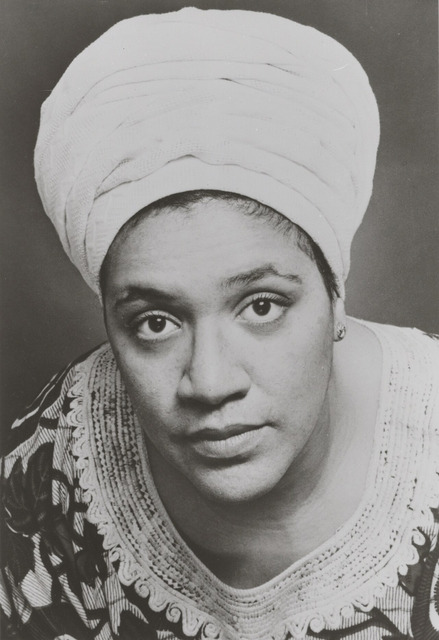 Audre Lorde (1934-1992) was an acclaimed writer and poet known for her radical honesty and fight against racism and sexism. Self-described as a "Black, lesbian, mother, warrior, poet," Lorde wrote often about the intersections of her identities. After earning both a BA from Hunter College and a masters from Columbia University, Lorde spent the 1960s working as a librarian in New York. In the 1970s she worked as a poet-in-residence at Tougaloo College in Mississippi and began publishing poetry collections. The works were informed by the intersections of race, class, and gender, and became increasingly more political. Some of her most famous works are "The Master's Tools Won't Dismantle The Master's House" and "Martha."
Lorde passed away in 1992; her first full biography, Warrior Poet, was published by Alexis De Veaux in 2006. There's many women like her who we're not taught about in school. We don't get to know about black working class history, or any working class history for that matter. We remain ignorant, while women like Audre Lorde are fighting for justice, freedom and equality. Their struggle is YOUR struggle; it's a class issue and breaking down divisions like sexism, racism and homophobia etc makes us strong and able enough to protect each other from discrimination and bigotry. Fighting back at this cruel economic system that exploits all of us, involves challenging all attitudes and ideas that oppress different groups within our class.
If we want improvements, it means fighting for ourselves without politicians, leaders and union officials, by taking direct action by those concerned.
DA would like to receive more articles on the subject of the contribution of people of colour to political history, and why there are so few in our movement today
Wellness Schemes At Work Don't Work
Great news! Employers worldwide spent around $60billion in 2021 on “wellness” programs - and here you were thinking your employer didn't give a crap about you. The even better news is that the money spent on “wellness" by employers is projected to grow to the sum of $94billion by 2026. The extent that companies will go to improve the health of their workforce knows no bounds, with companies splashing out billions in schemes such as helping to stop workers smoking, offering diet plans, introducing yoga and exercise sessions, installing bicycle-powered desks (the mind boggles), providing counselling, taking employees on outdoor adventures and much more. Your bosses are truly wonderful people.
The only fly in the ointment of this utopian world of work is that “wellness” programs do not work & can even make things worse - as a number of studies have shown. A new study by Oxford University found that almost all “wellness” interventions had no statistically significant impact on worker wellbeing or job satisfaction. They notably failed to reduce stress, make employees feel supported or improve workplace relationships. In some cases, wellbeing interventions seemed to make matters worse. For example, the study found that mindfulness training actually had a negative impact on workers overall mental health. No doubt many readers will be utterly shocked to learn that peddling away at the desk while trying to deal with ever rising workloads does not actually improve your health. Who would have thought it?
The reality is that wellness programs are little more than PR exercises aimed at convincing workers, customers, and the wider public that employers really do care. Worse, they are insulting, given that the employers seem to think that workers are so thick that sending them off for a weekend of thrilling “outdoor adventure" and “fun” will blind them to the fact that workloads are increasing while their pay, in real terms, is falling. In truth the very same employers who are falling over themselves to promote wellness schemes, as a way of improving workplace health, are the very same people who are making people ill by driving down working conditions in the name of ever greater profit.
The extent to which declining working conditions are affecting workers' health is truly shocking. A recent study at Stanford University found that the most common workplace sources of stress included shift work, long working hours, job insecurity, conflicts between work and life, low job control, high work demands and lack of support. The report found that in the USA, 120,000 deaths a year could be attributable to these factors and estimated that between 5% and 8% of healthcare is down to how employers treat their workforce.
The answer to ill health arising from poor working conditions is not the degrading farce of management driven wellness programs but workers getting together and challenging the power of the employer. As a trade union the Solidarity Federation runs a number of workplace training courses, including a course aimed at women, and one tailored for LGBTQ+ people who wish to organise in their workplaces.
About Direct Action
 This freesheet is produced by Solidarity Federation, and aims to be a regular publication. Named after our old journal, we're starting small with the hope of expanding and improving in future issues.
We hope to use this publication to spread anarcho-syndicalist ideas and contribute to contemporary theory and practice of revolutionary unionism.
We are actively seeking written contributions, as well as original art, photography and illustrations, so if you would like to contribute please email us at: DAeditors@protonmail.com
SOLIDARITY FEDERATION
The Solidarity Federation is an anarcho-syndicalist union, committed to the abolition of capitalism, the state and class society. We are the British section of the International Workers Association, with locals across the country. For more information, visit solfed.org.uk