Home
Solidarity Federation
IWA
User account menu
  • Contact
  • Log in
  • Home
    • Intro
    • Workplace organiser training
    • Industrial strategy
    • Community strategy
    • Constitution
  • SolFed
    • Brighton
    • Bristol
    • Edinburgh
    • Liverpool
    • Manchester
    • North London
    • Wales
    • Yorkshire
  • Industries & sectors
    • Claimants and unpaid
    • Education
    • Health and social care
    • Hospitality
  • Events & reports
  • Publications
    • Guides
      • Stuff your boss (doesn't want you to know)
      • Stuff your sexist boss (doesn't want you to know) (2018)
      • Stuff your landlord (doesn't want you to know) (2016)
      • Is your cleaning job killing you? A guide to cleaners health and safety (2017)
      • Office worker’s health and safety - your rights and how to use them (2015)
      • A migrant's guide to Manchester (2016) [en es]
      • A migrant's guide to London (2014) [en es pl]
      • Strike - a guide to walking out (2014)
    • Pamphlets and books
      • Anarcho-syndicalism in Britain – a little history (2015)
        • 1. 19th century to 1914 - The First International, growth of industrial unionism and the Great Unrest
        • 2. 1914–1945 - State suppression and the Bolshevik turn – how Lenin’s seeming success drew militants to the Comintern
        • 3. 1945–1994 - The Anarchist Federation of Britain, Syndicalist Workers’ Federation and Direct Action Movement
        • 4. Today’s movement - A short look at the strategy and thinking of the modern Solidarity Federation
      • Office worker’s health and safety - your rights and how to use them (2015)
      • Anarchism and Anarcho-syndicalism (Rudolf Rocker, 2014)
        • Introduction
        • 1. Ideology of Anarchism
        • 2. History of anarchist philosphy, from Lao-Tse to Kropotkin
        • 3. The origins of anarcho-syndicalism
        • 4. Socialism and anarcho-syndicalism in France
        • 5. The role of the trade unions: anarcho-syndicalist view
        • 6. The struggle in Germany and Spain
        • 7. The political struggle: anarcho-syndicalist view
        • 8. Anarcho-syndicalism since the First World War
      • Fighting for ourselves - anarcho-syndicalism and the class struggle (2012)
        • Introduction
        • 1. The mainstream workers' movement
        • 2. Radical currents in the workers' movement
        • 3. Anarcho-syndicalism in the 20th century
        • 4. Capitalism and the class struggle since World War II
        • 5. Anarcho-syndicalism in the 21st century
        • Endnotes
      • Workmates - direct action workplace organising on the London underground (2011)
      • The Economics of freedom (2003)
      • A history of anarcho-syndicalism (2001)
      • Out of the frying pan, a critical look at works councils (1998)
      • Health and safety at work - an anarcho-syndicalist approach (1997)
      • Anarcho-syndicalism in Puerto Real (1994)
    • Leaflets and flyers
      • Solidarity Federation Education Union (SFEU)
      • Solidarity Federation Hospitality Workers Union (SFHWU)
      • Why do we organise?
      • This is our flag - it tells you what we stand for
      • What is anarcho-syndicalism anyway?
      • Anarchism and Syndicalism (short version)
      • Anarchism and Syndicalism
      • Towards a better union
      • Protest is not enough
      • Building beyond elections
      • We should run our workplaces
      • We should run our communities
      • We should run our movements
    • Newsletters
      • Brighton Solidarity
        • Brighton Solidarity #3
      • Education Worker
        • Education Worker #10 Victimisation (2013)
        • Education Worker #9 (2012)
        • Education Worker #8 Academy Special (2012)
      • Wildcat!
        • Wildcat! #13 (Jan 2013)
        • Wildcat! (Winter 2012)
        • Wildcat! #6 (Summer 2011)
        • Wildcat! #5 (Spring 2011)
        • Wildcat! #4 (Dec 2010)
        • Wildcat! #3 (Oct-Nov 2010)
        • Wildcat! #2 (Jul-Aug 2010)
        • Wildcat! Football for the fans NOT for fat cats! (Jul 2010)
        • Wildcat! #1 (May-June 2010)
      • May Day Bulletin (Newcastle SolFed, 2014)
    • Direct Action
      • Direct Action #2 (2024)
      • Direct Action #1 (2023)
      • Direct action #47 (Summer 2009)
    • Catalyst
      • Catalyst #29 (Feb 2012)
      • Catalyst #28 (Oct 2011)
      • Catalyst #27 (Jun 2011)
      • Catalyst #26 (Mar 2011)
      • Catalyst #25 (Dec 2010)
      • Catalyst #24 (Summer 2010)
    • SelfEd
      • A history of anarcho-syndicalism
        • Block 1
          • Unit 1: The Origins of Capitalism
          • Unit 2: Britain: The Radical Period 1750-1840
          • Unit 3: The First International
          • Unit 4: France 1870-1918 Early revolutionary unions
          • Unit 5: Revolutionary Syndicalism in Britain, 1870-1910
          • Unit 6: Revolutionary Syndicalism in Britain and Ireland, 1910-17
        • Block 2
          • Unit 7: Mexico 1870-1920: Colonialism and Revolution
          • Unit 8: USA 1886-1930 - The Wobblies
          • Unit 9: Anarcho-syndicalism in Argentina 1870-1939
          • Unit 10: Sweden 1889-1939
          • Unit 11: Russia I: 1850-1917
          • Unit 12 Russia II: 1917-30
        • Block 3
          • Unit 13: Going Global - International Organisation, 1872-1922
          • Unit 14: Anarcho-syndicalism in Britain, 1914-30
          • Unit 15 Spain, 1868-1936: Build-up to Revolution
          • Unit 16 Spain: Culture, education, women and sexuality
          • Unit 17: Spain 1936-39: Revolution and Civil War
          • Unit 18: Spain - The Collectives
        • Block 4
          • Unit 19: Britain, 1930-1950 - The Era of Reform
          • Unit 20: Britain, 1950-1990 - Decline of Social Democracy
          • Unit 21: anarcho-syndicalism 1939-99
          • Unit 22: Roots of modern anarcho-syndicalism: freedom, oppression & rebellion
          • Unit 23: Roots of modern anarcho-syndicalism: morality, culture & tactics
          • Unit 24: The spirit of anarcho-syndicalism
    • Letters
  • IWA

Anarchism and Syndicalism (short version)

Book traversal links for North London - flyers and materials

  • North London - flyers and materials
  • Up
  • Anarchism and Syndicalism

Anarchism and Syndicalism (short)ANARCHISM

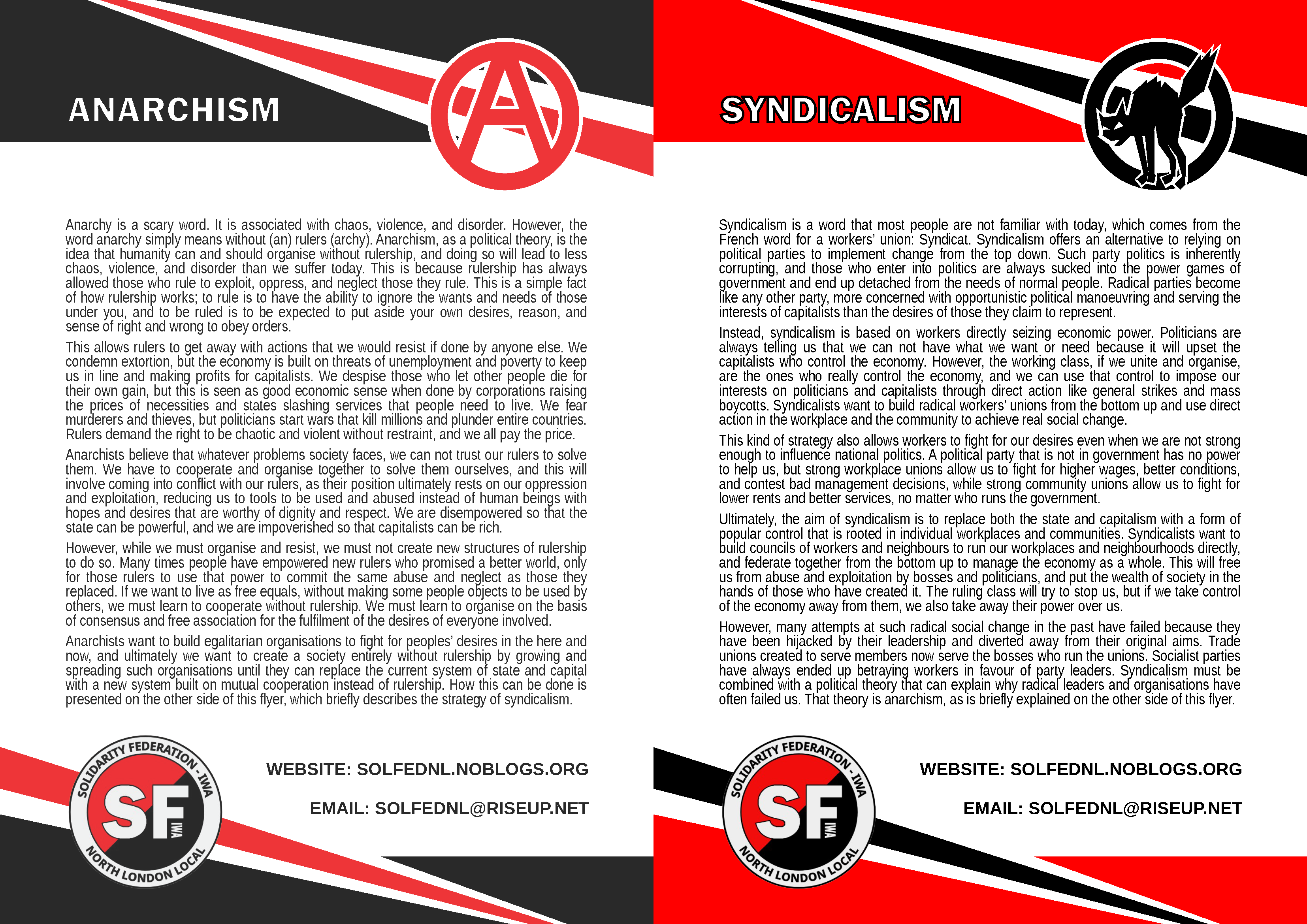
Anarchy is a scary word. It is associated with chaos, violence, and disorder. However, the word anarchy simply means without (an) rulers (archy). Anarchism, as a political theory, is the idea that humanity can and should organise without rulership, and doing so will lead to less chaos, violence, and disorder than we suffer today. This is because rulership has always allowed those who rule to exploit, oppress, and neglect those they rule. This is a simple fact of how rulership works; to rule is to have the ability to ignore the wants and needs of those under you, and to be ruled is to be expected to put aside your own desires, reason, and sense of right and wrong to obey orders.

This allows rulers to get away with actions that we would resist if done by anyone else. We condemn extortion, but the economy is built on threats of unemployment and poverty to keep us in line and making profits for capitalists. We despise those who let other people die for their own gain, but this is seen as good economic sense when done by corporations raising the prices of necessities and states slashing services that people need to live. We fear murderers and thieves, but politicians start wars that kill millions and plunder entire countries. Rulers demand the right to be chaotic and violent without restraint, and we all pay the price.

Anarchists believe that whatever problems society faces, we can not trust our rulers to solve them. We have to cooperate and organise together to solve them ourselves, and this will involve coming into conflict with our rulers, as their position ultimately rests on our oppression and exploitation, reducing us to tools to be used and abused instead of human beings with hopes and desires that are worthy of dignity and respect. We are disempowered so that the state can be powerful, and we are impoverished so that capitalists can be rich.

However, while we must organise and resist, we must not create new structures of rulership to do so. Many times people have empowered new rulers who promised a better world, only for those rulers to use that power to commit the same abuse and neglect as those they replaced. If we want to live as free equals, without making some people objects to be used by others, we must learn to cooperate without rulership. We must learn to organise on the basis of consensus and free association for the fulfilment of the desires of everyone involved.

Anarchists want to build egalitarian organisations to fight for peoples’ desires in the here and now, and ultimately we want to create a society entirely without rulership by growing and spreading such organisations until they can replace the current system of state and capital with a new system built on mutual cooperation instead of rulership. How this can be done is presented on the other side of this flyer, which briefly describes the strategy of syndicalism.

SYNDICALISM

Syndicalism is a word that most people are not familiar with today, which comes from the French word for a workers’ union: Syndicat. Syndicalism offers an alternative to relying on political parties to implement change from the top down. Such party politics is inherently corrupting, and those who enter into politics are always sucked into the power games of government and end up detached from the needs of normal people. Radical parties become like any other party, more concerned with opportunistic political manoeuvring and serving the interests of capitalists than the desires of those they claim to represent.

Instead, syndicalism is based on workers directly seizing economic power. Politicians are always telling us that we can not have what we want or need because it will upset the capitalists who control the economy. However, the working class, if we unite and organise, are the ones who really control the economy, and we can use that control to impose our interests on politicians and capitalists through direct action like general strikes and mass boycotts. Syndicalists want to build radical workers’ unions from the bottom up and use direct action in the workplace and the community to achieve real social change.

This kind of strategy also allows workers to fight for our desires even when we are not strong enough to influence national politics. A political party that is not in government has no power to help us, but strong workplace unions allow us to fight for higher wages, better conditions, and contest bad management decisions, while strong community unions allow us to fight for lower rents and better services, no matter who runs the government.

Ultimately, the aim of syndicalism is to replace both the state and capitalism with a form of popular control that is rooted in individual workplaces and communities. Syndicalists want to build councils of workers and neighbours to run our workplaces and neighbourhoods directly, and federate together from the bottom up to manage the economy as a whole. This will free us from abuse and exploitation by bosses and politicians, and put the wealth of society in the hands of those who have created it. The ruling class will try to stop us, but if we take control of the economy away from them, we also take away their power over us.

However, many attempts at such radical social change in the past have failed because they have been hijacked by their leadership and diverted away from their original aims. Trade unions created to serve members now serve the bosses who run the unions. Socialist parties have always ended up betraying workers in favour of party leaders. Syndicalism must be combined with a political theory that can explain why radical leaders and organisations have often failed us. That theory is anarchism, as is briefly explained on the other side of this flyer.

Attachment Size
anarchism-and-syndicalism-london-short-colour-a5.pdf (83.26 KB) 83.26 KB
anarchism-and-syndicalism-london-short-bw-a5.pdf (79.58 KB) 79.58 KB

Tags

  • library
  • publications
  • leaflets and flyers
  • North London
  • anarcho-syndicalism
  • anarchism
  • revolutionary syndicalism

Guides

Your rights at work

Why do we organise? Capitalism is shit, oppression is shit - but what can we at SolFed do about it?

Why do we organise?

This is our flag - it tells you what we stand for

this-is-our-flag

Direct Action #2 (2024)

Direct Action #2 (2024)

Anarcho-syndicalism in Britain – a little history (2015)

Anarcho-syndicalism in Britain – a little history (2015)

Office worker’s health and safety - your rights and how to use them (2015)

Office worker’s health and safety - your rights and how to use them (2015)

Anarchism and Anarcho-syndicalism (Rudolf Rocker, 2014)

Anarchism and Anarcho-syndicalism (Rudolf Rocker, 2014)

Fighting for ourselves - anarcho-syndicalism and the class struggle (2012)

Fighting for ourselves - anarcho-syndicalism and the class struggle (2012)

Theory & Practice 1 - Workmates - direct action workplace organising on the London underground (2011)

Theory & Practice 1 - Workmates - direct action workplace organising on the London underground (2011)

The Economics of freedom (2003)

The Economics of freedom (2003)

A history of anarcho-syndicalism (SelfEd Collective, 24 unit series, 2001)

A history of anarcho-syndicalism (SelfEd Collective, 24 unit series, 2001)

Out of the frying pan, a critical look at works councils (1998)

Out of the frying pan, a critical look at works councils (1998)

Health and safety at work - an anarcho-syndicalist approach (1997)

Health and safety at work - an anarcho-syndicalist approach (1997)

Theory & Practice 2 - Anarcho-syndicalism in Puerto Real (1994)

Theory & Practice 2 - Anarcho-syndicalism in Puerto Real (1994)
RSS feed