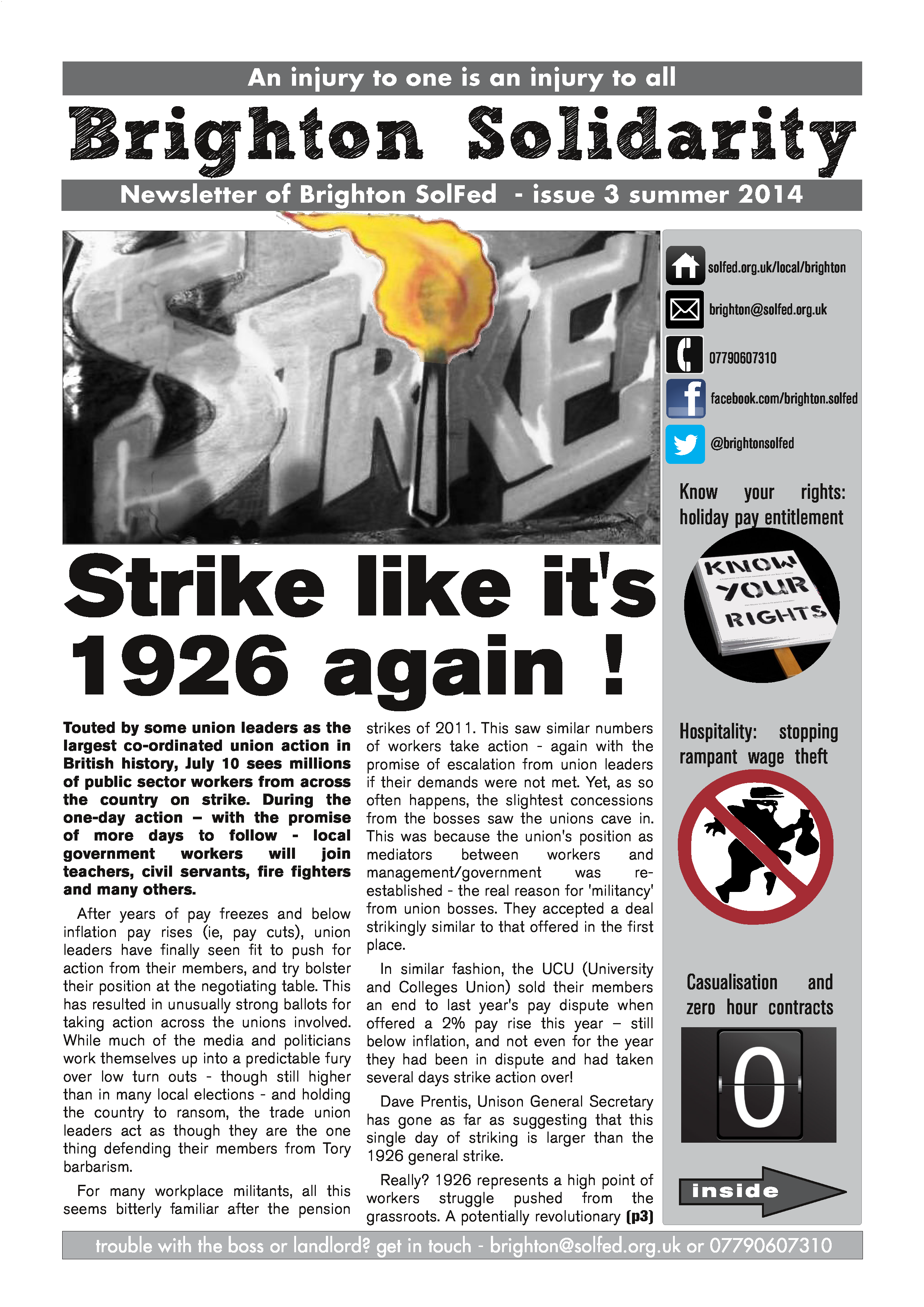
- Strike like it's 1926 again!
- When bosses who don't want to foot the bill: Restaurant worker stops wage theft
- Just the usual management bullshit
- About us
- Know your rights at work: Holidays and Holiday Pay
- The fight against casualisation: Zero hours, zero respect?
- Who are the Brighton Hospitality Workers?
An injury to one is an injury to all
solfed.org.uk/local/brighton brighton@solfed.org.uk
07790607310 facebook.com/brighton.solfed @brightonsolfed
inside
- Know your rights: holiday pay entitlement
- Hospitality: stopping rampant wage theft
- Casualisation and zero hour contracts
Strike like it's 1926 again!
 Touted by some union leaders as the largest co-ordinated union action in British history, July 10 sees millions of public sector workers from across the country on strike. During the one-day action – with the promise of more days to follow - local government workers will join teachers, civil servants, fire fighters and many others.
After years of pay freezes and below inflation pay rises (ie, pay cuts), union leaders have finally seen fit to push for action from their members, and try bolster their position at the negotiating table. This has resulted in unusually strong ballots for taking action across the unions involved. While much of the media and politicians work themselves up into a predictable fury over low turn outs - though still higher than in many local elections - and holding the country to ransom, the trade union leaders act as though they are the one thing defending their members from Tory barbarism.
For many workplace militants, all this seems bitterly familiar after the pension strikes of 2011. This saw similar numbers of workers take action - again with the promise of escalation from union leaders if their demands were not met. Yet, as so often happens, the slightest concessions from the bosses saw the unions cave in. This was because the union's position as mediators between workers and management/ government was re-established - the real reason for 'militancy' from union bosses. They accepted a deal strikingly similar to that offered in the first place.
In similar fashion, the UCU (University and Colleges Union) sold their members an end to last year's pay dispute when offered a 2% pay rise this year – still below inflation, and not even for the year they had been in dispute and had taken several days strike action over!
Dave Prentis, Unison General Secretary has gone as far as suggesting that this single day of striking is larger than the 1926 general strike.
Really? 1926 represents a high point of workers struggle pushed from the grassroots. A potentially revolutionary moment, it genuinely threatened to bring the country to a standstill. A far cry from the usual token one day affair.
But there is one parallel that Prentis might have accidentally stumbled upon. In 1926, after several days of powerful strike action and running battles with scabs, the working class had begun to show who really had power in society. This terrified the TUC (Trade Union Congress), who sold their members down the river by ordering them back to work, leaving those most under attack to fight and lose alone. Perhaps it was this that Prentis had in mind.
Of course, events like this are vital as a starting point. Millions of people are taking direct action by withdrawing their labour to fight back against a government and ruling class intent of grinding us further into poverty. But it’s only that – a start. Workers have to be willing to fight for themselves if they want to reverse years of falling living standards. We can't just rely on the trade union bureaucracy, who have sold us out time and time again. Only if we force the issue and deny bosses the ability to attack us do we stand a chance. Neither can we allow union leaders to leave us defenceless and give in with the slightest concession (or promise of a Labour Party victory).
We need to be willing to take sustained action that make it so the government is unable to ignore our demands and power.
In Brighton, we saw bin men stand up for themselves and show the way it’s done. When threatened with huge pay cuts, they took action immediately and refused to go back to work. Not for them a token day of action and a futile wait for negotiations to happen. Within just over a week, they had beaten back the council. This is how we need to do it – waiting for a bureaucrat to negotiate us a better deal just won’t cut it.
We shouldn't underestimate the importance of what public sector workers are doing on July 10. But equally we shouldn't forget the millions of largely non-unionised workers in the private sector who are struggling with low wages and insecurity.
Here in Brighton and Hove the newly organised Brighton Hospitality Workers have been taking on the bosses in a notoriously precarious sector. By taking direct control of their disputes local workers have already won back over £6000 in stolen wages and denied holiday entitlement.
This is direct action - a sustained, principled stand that doesn't allow union bureaucrats, politicians or anybody else to hijack our struggles.
When bosses who don't want to foot the bill: Restaurant worker stops wage theft
 In June 2014 Brighton Hospitality Workers was approached by a former worker at a Spanish restaurant with issues including below minimum wage pay, no paid holiday entitlement and nonreceipt of wage slips. The migrant worker, who had worked at the restaurant for nearly 3 years, told us that in 2013 he complained about his low pay and subsequently had his hours cut from 50 to 26 per week. When in May 2014 he told the boss he was going to consult about the pay issue he was laid off.
 Together with the worker we drafted a demand letter for unpaid wages and holiday entitlement for the last year, which exceeded £2000. Two BHW comrades then accompanied the worker in delivering the letter to the boss, including a deadline for payment before a campaign of direct action would begin. The boss was obviously concerned about the demand, and threat of action, and responded within two days to arrange for the worker to revisit the restaurant. An initial payment of £1500 was immediately offered, which the worker accepted.
He was also told to expect his missing wage slips and P45 as soon as possible. The worker then questioned the payout, which was below the original demand, and went back the next day. A further £500 was offered and this was accepted. The boss was nervous throughout and said that he’d studied the financial calculations included in the demand letter and couldn’t argue with them. He told the worker, who has since joined other BHW actions, not to have anything to with SolFed, who he described as ‘troublemakers’. Strangely enough, the worker disagrees!
We expect the boss to think twice in future before stealing workers’ wages and treating them without dignity and respect – his attention to our demand letter suggests this.
Brighton Hospitality Workers was formed by SolFed in October 2013 in response to members and their colleagues working in the industry who were tired of being ripped off and were willing to organise collectively. This is the fifth successive conflict won and money reclaimed by workers taking direct action now exceeds £6000.
Just the usual management bullshit
 You couldn't make it up. In 2001 American Express were going through some 'restructuring', making some of their workers redundant. In a fit of generosity managers decided to give each member of staff they laid off a book to help them through. It was called Who moved my cheese? An amazing way to deal with change in your work and in your life.
The blurb says, "This profound book from bestselling author, Spence Johnson, will show you how to anticipate change, adapt to change quickly, enjoy change and be ready to change quickly again and again."
So, if only we weren't so stuck in our ways, we could enjoy our livelihoods being at the whim of bosses and the 'market'.
Who knew?
About us
 Brighton SolFed (Solidarity Federation) is a local union initiative based on the idea that through solidarity and direct action, ordinary people have the power to improve
our lives.
Our members are workers, students and others looking to build a libertarian working class movement. Our aim is to promote solidarity in our workplaces and outside them, encouraging workers to organise independently of bosses, bureaucrats and political parties to fight for our own interests as a class. Our ultimate goal is a stateless, classless society based on the principle "from each according to ability, to each according to need" – libertarian communism.
We see such a society based on our needs being created out of working class struggles to assert our needs in the here and now. Our activity is therefore aimed at promoting, assisting and developing such class struggles, which both benefit us all now and bring us closer to the society we want to create.
We believe in direct action solidarity. That could mean pickets or occupations, or organising with our co-workers. We also believe in collective action - that we are stronger when we stand together. Discuss your problem with us and we’ll make suggestions how we can help - but the decision which course of action to take always rests with you.
We do this in our free time and we’ll help you out for free... so why would we do this? We are not a service provider – we can’t provide professional legal advice, and we can’t solve your problems for you. We are not a state-registered trade union or political party. What we are is fellow workers who are sick of being screwed around ourselves and want to do something about it. What we can do is share experience, information, and support in methods which have proven effective previously. This is solidarity, not charity - An injury to one is an injury to all!
Know your rights at work: Holidays and Holiday Pay
 All workers are legally entitled to paid holiday, unless they are self-employed, and this is known as ‘statutory entitlement’. This is regardless of whether it is stated in your contract or if your contract says differently – this is the law and it overrides any differences in a contract or verbal agreement you have with your employer. It is worth noting that employers have the right to include bank holidays as part of your statutory entitlement, but workers have no right to be paid for taking bank holidays as leave without an agreement with their employer.
Full-time workers who work 5 days per week are entitled to 5.6 weeks or 28 days paid holiday per year: 5 (days worked per week)
5.6 weeks’ (statutory entitlement per year) = 28. Part-time workers or workers who work irregular or casual hours are entitled to the equivalent of 5.6 weeks per year, according to the days or hours they work. For example, if you work 3 full days per week you are entitled to 16.8 days paid holiday per year: 3 (days worked per week)
5.6 (weeks’ statutory entitlement per year) = 16.8. If you work irregular or casual hours it is better to add up the number of hours you have worked at the end of each month and enter this figure into a holiday entitlement calculator. The following website address has a link to a calculator: https://www.gov.uk/calculate-your-holiday-entitlement
Employers are required to have a process both for calculating workers’ statutory entitlement and for supporting workers to take their paid leave. This should be included in your contract and the amount of paid leave you have earned should be included in printed paysl ips. On starting a job, you are entitled to one twel fth of your statutory entitlement in your first month in the job, or you can carry this over to two twelfths in your second month, three twelfths in your third month, etc. Importantly, you also have a right to be paid for any holiday entitlement you haven’t taken or were prevented from taking, either at the end of the leave year (which is normally either December 31st or March 31st) or at the end of employment. Further to this, employers are liable to pay you for leave you have not taken or were prevented from taking for up to a year in arrears.
In our experience, non-payment of holiday entitlement regularly forms a significant part of unpaid wages claims, and we have had successful claims for unpaid holiday entitlement going back a year, usually after employment had ended. It is important to keep a record of the hours you work each month, and always hold your employer to account for how much paid leave you are entitled to and when you can take this – many employers don’t want you to know this information and will deliberately prevent you from taking paid leave. Share this information with your workmates!
Getting messed around by a boss or landlord? Want to do something about it? Get in touch! Call us on 077 9060 7310.
The fight against casualisation: Zero hours, zero respect?
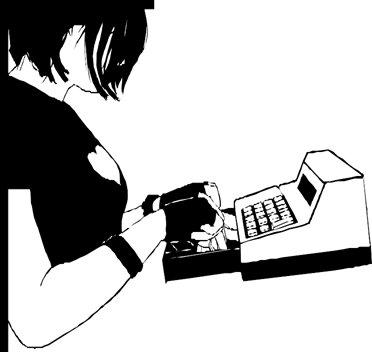 Zero hour contracts are a favourite with bosses who like their workers to be vulnerable. Yet while leftist politicians keep prattling about reforming zero hour contracts, local workers are fighting back, supported by SolFed's hospitality workers campaign.
In May, a former cashier at a high-profile Brighton grocer won back £1,250 in owed wages and unpaid holiday entitlement as a result of a Brighton Hospitality Workers (BHW) campaign. The worker, who was on a zero-hours contract, was sacked without notice following a three week period when the bosses refused to give her any hours. She was also owed holiday pay for leave she was prevented from taking.
Talking about her own experience, the former cashier describes her working conditions before being sacked. She says that, with her verbal zero hour contract, she had to work "sometimes 10 hours per day for a week; sometimes with no day off. Once I had been working 15 days in a row". All this in spite of having been assured, when she was hired, that she would work 8 hours per day and 6 days in a week.
"At the beginning, I asked for a written contract but nobody gave it to me. And I didn´t insist anymore", recalls the worker. When she came back from a one-week holidays, she was told not to come back "until we need you again" - a call that never came. "I asked myself, how would I survive in a country that is not mine", she says. "On the other hand, I felt very supported by the rest of the cashiers. They all saw that this was a very unfair situation. They were also scared about being treated the same way, and also fel t empathy, I suppose."
Then, she decided to fight back.
First, she went to get legal advice. She was told that with a zero hour contract "there was nothing that could be done". Despite feeling powerless after that, she explains that "deep down I knew that still something could be done!" Then she contacted SolFed and i t was in the first meeting when she heard the word "picket" for the first time. "I felt really relief", she recalls: "I realised that it could be another ways of action. When I saw how many things could be done, I said: lets go for it!"
SolFed´s demands were issued in a letter citing working time regulations and with a financial breakdown of money owed, including a demand for average pay for the three weeks of denied work. The grocery's owners attempted to retain control throughout the conflict by trying to isolate and intimidate the former worker, cancelling meetings at the last moment, withdrawing offers and threatening to sack staff. However, the cashier and her supporters stood firm.
Matters came to a head when the worker, supported by a SolFed member, demanded a meeting in the bosses' office. At the same time 16 BHW supporters armed with leaflets got ready outside the shop for a potential picket to inform customers about the exploi tative condi tions inside. "I was worried that other workers might face negative consequences", she says. "But I think the bosses were scared. They realized that they have such a lot of things to hide that they didn´t want to go on with the conflict." Clearly anxious at the threat of direct action and the bad publicity this would create, payment was immediately made in full - before the picket got going.
The worker is now convinced that misogyny and xenophobia had a lot to do with her case. "They saw that I could'n speak good English and they thought they could treat me however they wanted", she says. BHW is staying in touch with the cashiers to keep an eye on developments at the store, which has earned a reputation for bullying management, unlawful contracts and a lack of dignity and respect for workers.
 The former cashier says that this experience has shown her that there is actually a way for workers to make themselves be respected and fight for their rights. "I feel very proud of standing up for what I deserve. Had I gone down the legal route I wouldn´t have achieved anything - that's why I'm grateful for the support from Brighton Hospitality Workers."
Who are the Brighton Hospitality Workers?
 BHW is a campaign against casualisation in the local hospitality sector initiated by Brighton SolFed in October 2013. Whether it's bullying, outstanding pay, or sexism, we offer practical support to hospitality workers wanting to stand up to their bosses and organise. As more workers get involved and take action, we ultimately would like the campaign to develop into a local anarcho-syndicalist union. Casualised working conditions are a daily reality in Brighton's hospitality industry. In response we’re raising our profile with stalls on Saturday afternoons and flyposting across the city. We're successfully concluding our sixth conflict, with money reclaimed by workers now exceeding a total of £6000.