Home
Solidarity Federation
Section of the International Workers Association
CAPTCHA
Solve this simple math problem and enter the result. E.g. for 1+3, enter 4.
This question is for testing whether or not you are a human visitor and to prevent automated spam submissions.
User account menu
  • Contact
  • Log in
CAPTCHA
Solve this simple math problem and enter the result. E.g. for 1+3, enter 4.
This question is for testing whether or not you are a human visitor and to prevent automated spam submissions.
  • Home
    • About SolFed
    • Workplace organiser training
    • Industrial strategy
    • Community strategy
    • Constitution
  • SolFed
    • Brighton
    • Bristol
    • Edinburgh
    • Liverpool
    • Manchester
    • North London
    • Wales
    • Yorkshire
  • Industries and sectors
    • Claimants and unpaid
    • Education
    • Health and social care
    • Hospitality
  • Events & reports
  • Publications
    • Guides
      • Stuff your boss (doesn't want you to know)
      • Stuff your sexist boss (doesn't want you to know) (2018)
      • Stuff your landlord (doesn't want you to know) (2016)
      • Is your cleaning job killing you? A guide to cleaners health and safety (2017)
      • Office worker’s health and safety - your rights and how to use them (2015)
      • A migrant's guide to Manchester (2016) [en es]
      • A migrant's guide to London (2014) [en es pl]
      • Strike - a guide to walking out (2014)
    • Pamphlets and books
      • Anarcho-syndicalism in Britain – a little history (2015)
      • Office worker’s health and safety - your rights and how to use them (2015)
      • Anarchism and Anarcho-syndicalism (Rudolf Rocker, 2014)
      • Fighting for ourselves - anarcho-syndicalism and the class struggle (2012)
      • Workmates - direct action workplace organising on the London underground (2011)
      • The Economics of freedom (2003)
      • A history of anarcho-syndicalism (2001)
      • Health and safety at work - an anarcho-syndicalist approach (1997)
      • Out of the frying pan, a critical look at works councils (1998)
      • Anarcho-syndicalism in Puerto Real (1994)
    • Leaflets and flyers
      • Solidarity Federation Education Union (SFEU)
      • Solidarity Federation Hospitality Workers Union (SFHWU)
      • What is wage theft?
      • Why do we organise?
      • This is our flag - it tells you what we stand for
      • What is anarcho-syndicalism anyway?
      • Anarchism and Syndicalism (short version)
      • Anarchism and Syndicalism
      • Towards a better union
      • Protest is not enough
      • Building beyond elections
      • We should run our workplaces
      • We should run our communities
      • We should run our movements
    • Posters and stickers
    • Newsletters
      • Brighton Solidarity
        • Brighton Solidarity #3 (2015)
        • Brighton Solidarity #2 (2015)
        • Brighton Solidarity #4 (Winter 2014)
        • Brighton Solidarity #3 (Summer 2014)
        • Direct Action Solidarity #2 (Spring 2014)
        • Direct Action Solidarity #1 (Jan 2012)
        • Brighton Solidarity - spending review special (Oct 2010)
        • Brighton Solidarity - emergency budget special (Jun 2010)
        • Brighton Agitator #1 (Mar 2010)
        • Brighton Solidarity (Winter 2007)
      • Communication Worker
        • Communication Worker #8 (Jul 2001)
        • Communication Worker #7 (Jan 2001)
        • Communication Worker #6
        • Communication Worker #5
        • Communication Worker bulletin
      • Education Worker
        • Education Worker #10 (Apr 2013)
        • Education Worker #9 (Oct 2012)
        • Education Worker #8 (Mar 2012)
        • Education Worker #7 (Mar 2011)
        • Education Worker #6 (Jan 2011)
        • Education Worker #5 (Oct 2009)
        • Education Worker #4 (May 2009)
        • Education Worker #3 (Sep 2008)
        • Education Worker #2 (Jan 2008)
        • Education Worker #1 (2007)
        • Education Worker #9 (Summer 2002)
        • Education Worker #8 - special higher education issue (2002)
      • The Leveller
        • The Leveller #19 (May-Jul 2017)
        • The Leveller #18 (Aug 2016)
        • The Leveller #17 (Mar 2015)
        • The Leveller #17 (Dec 2014)
        • The Leveller #16 (Nov 2014)
        • The Leveller #15 (May 2014)
        • The Leveller #14 (Mar 2014)
        • The Leveller #13 (May 2013)
        • The Leveller #12 (Jun-Jul 2012)
        • The Leveller #11 (May 2012)
        • The Leveller #10 (Apr 2012)
        • The Leveller #9 (Mar 2012)
        • The Leveller #6 (May-Jul 2011)
      • Liverpool Anarchist
        • Liverpool Anarchist #21 (Apr 2022)
        • Liverpool Anarchist #20 (Mar 2022)
        • Liverpool Anarchist #19 (Feb 2022)
        • Liverpool Anarchist #18 (Dec 2021)
        • Liverpool Anarchist #17 (Nov 2021)
        • Liverpool Anarchist #16 (Oct 2021)
        • Liverpool Anarchist #15 (Sep 2021)
        • Liverpool Anarchist #14 (Aug 2021)
        • Liverpool Anarchist #13 (Jul 2021)
        • Liverpool Anarchist #12 (Jun 2021)
        • Liverpool Anarchist #11 (Apr 2021)
        • Liverpool Anarchist #10 (Dec 2020)
        • Liverpool Anarchist #9 (Oct 2020)
        • Liverpool Anarchist #8 (Aug 2020)
        • Liverpool Anarchist #7 (Jul 2020)
        • Liverpool Anarchist #6 (Mar 2020)
        • Liverpool Anarchist #5 (Feb 2020)
        • Liverpool Anarchist #4 (Jan 2020)
        • Liverpool Anarchist #3 (Dec 2019)
        • Liverpool Anarchist #2 (Nov 2019)
        • Liverpool Anarchist #1 (Oct 2019)
      • May Day Bulletin (Newcastle, 2014)
      • Public Service Workers Network bulletin
        • Public Service Workers Network #8 (Winter 1995)
        • Public Service Workers Network #6 (Spring 1995)
        • Public Service Workers Network #5 (Oct-Nov 1994)
        • Public Service Workers Network #4 (Jun-Jul 1994)
        • Public Service Workers Network #3 (Autumn 1993)
      • Spanner in the Works (West Yorkshire, April 2013)
      • Wildcat!
        • Wildcat! #13 (Jan 2013)
        • Wildcat! (Winter 2012)
        • Wildcat! #6 (Summer 2011)
        • Wildcat! #5 (Spring 2011)
        • Wildcat! #4 (Dec 2010)
        • Wildcat! #3 (Oct-Nov 2010)
        • Wildcat! #2 (Jul-Aug 2010)
        • Wildcat! Football for the fans NOT for fat cats! (Jul 2010)
        • Wildcat! #1 (May-June 2010)
    • Direct Action
      • Direct Action - Solidarity Federation
        • Direct Action #2
        • Direct Action #1
        • Direct Action #48 (Autumn 2009)
        • Direct Action #47 (Summer 2009)
        • Direct Action #46 (Spring 2009)
        • Direct Action #45 (Winter 2008)
        • Direct Action #44 (Autumn 2008)
        • Direct Action #43 (Summer 2008)
        • Direct Action #42 (Spring 2008)
        • Direct Action #41 (Winter 2007)
        • Direct Action #40 (Autumn 2007)
        • Direct Action #39 (Summer 2007)
        • Direct Action #38 (Spring 2007)
        • Direct Action #37 (Autumn-Winter 2006)
        • Direct Action #36 (Spring-Summer 2006)
        • Direct Action #35 (Summer 2005)
        • Direct Action #34 (Spring 2005)
        • Direct Action #33 (Winter 2004)
        • Direct Action #32 (Autumn 2004)
        • Direct Action #31 (Summer 2004)
        • Direct Action #30 (Spring 2004)
        • Direct Action #29 (Winter 2003)
        • Direct Action #28 (Autumn 2003)
        • Direct Action #27 (Summer 2003)
        • Direct Action #26 (Spring 2003)
        • Direct Action #25 (Winter 2002)
        • Direct Action #24 (Autumn 2002)
        • Direct Action #23 (Summer 2002)
        • Direct Action #22 (Spring 2002)
        • Direct Action #21 (Winter 2001)
        • Direct Action #20 (Autumn 2001)
        • Direct Action #19 (Summer 2001)
        • Direct Action #18 (Spring 2001)
        • Direct Action #17 (Winter 2000)
        • Direct Action #16 (Autumn 2000)
        • Direct Action #15 (Summer 2000)
        • Direct Action #14 (Spring 2000)
        • Direct Action #13 (Winter 1999)
        • Direct Action #12 (Autumn 1999)
        • Direct Action #11 (Summer 1999)
        • Direct Action #10 (Spring 1999)
        • Direct Action #9 (Winter 1998)
        • Direct Action #8 (Autumn 1998)
        • Direct Action #7 (Summer 1998)
        • Direct Action #6 (Spring 1998)
        • Direct Action #5 (Winter 1997)
        • Direct Action #4 (Autumn 1997)
        • Direct Action #3 (Summer 1997)
        • Direct Action #2 (Spring 1997)
        • Direct Action #1 (Autumn 1996)
        • Direct Action #2 (Winter 1994)
        • Direct Action #1 (Summer 1994)
    • Catalyst
      • Catalyst - Solidarity Federation
        • Catalyst #31 (Oct 2013)
        • Catalyst #29 (Feb 2012)
        • Catalyst #28 (Oct 2011)
        • Catalyst #27 (Jun 2011)
        • Catalyst #26 (Mar 2011)
        • Catalyst #25 (Dec 2010)
        • Catalyst #24 (Summer 2010)
        • Catalyst #23 (Spring 2010)
        • Catalyst #22 (Winter 2009)
        • Catalyst #21 (Summer 2009)
        • Catalyst #20 (Sping 2009)
        • Catalyst #19 (Nov 2008)
        • Catalyst #18 (Sep 2008)
        • Catalyst #17 (July 2008)
        • Catalyst #16 (Spring 2007)
        • Catalyst #15 (Autumn 2006)
        • Catalyst #14 (Spring 2006)
        • Catalyst #13 (Summer 2005)
        • Catalyst #12 (Apr 2005)
        • Catalyst #11 (Sep 2004)
        • Catalyst #10 (May 2004)
        • Catalyst #9 (Spring 2004)
        • Catalyst #8 (Autumn 2003)
        • Catalyst #7 (May 2003)
        • Catalyst #6 (Dec 2002)
        • Catalyst #5 (Dec 2001)
        • Catalyst #4 (May 2001)
        • Catalyst #3 (Feb 2001)
        • Catalyst #2 (Sep 2000)
        • Catalyst #1 (May 2000)
    • SelfEd
      • A history of anarcho-syndicalism
    • Reference
      • Student Radicals - an incomplete history of protest at the University of Sussex 1971-1975 (Ed Goddard, 2011)
      • Anarcho-syndicalism in the 20th Century (Vadim Damier, 2009)
      • Tom Brown's Syndicalism (1990)
      • Trade unionism or syndicalism? (Tom Brown, 1943)
      • The General Strike - vol 1 no 1 (Sam Mainwaring, 15 Feb 1904)
  • IWA

Why did we risk it all? Because we won't go down without a fight

By Joseph Kay, 15 October, 2009
c

While the recent media spin is suggesting that we’re ‘on our way out of recession’, the reality on the ground is that workers are still facing attacks across sectors in the forms of job cuts and community provisions. Education has been one of the sectors worst hit in this period, with £65m slashed from higher-education (HE) budgets, schools closing left, right and centre, and jobs to go at approximately 100 of the 150 HE institutions in the UK . The situation is as bleak as ever.

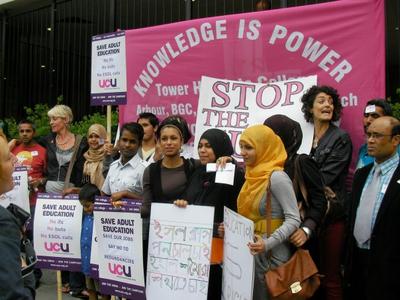
In August, around 250 members of teaching staff at Tower Hamlets College (THC), East London went on indefinite strike over threats of compulsory redundancies, and cuts in provision of ESOL (English for Speakers of Other Languages) courses. Catalyst spoke to Rachel, a member of the striking staff, about the background of the dispute, the issues at hand, and the feelings after the strike came to an end in late September.

We began by discussing the background to the strike, going back to June of this year, – “There was new management, a new principal, new senior managers … and in June they issued a document ‘Securing the Future’.” The nature of this document turned out to be a plan for “very brutal cuts in provision and jobs, and on June 5 there was a 30 day notice for consultation”, with the projection in June being that “40-60 jobs in THC would be cut, while approximately 50% of ESOL course places would also be lost, and some in A-level teaching.”
Prior to the attack on jobs and provision, Rachel said that she had experienced “good working conditions with a strong union … we were comfortable”. But that all changed, and with a suddenness typical of many disputes, the plans to cut jobs and ESOL provision were an aggressive assault on the workers and students. Management were strategic in their timing – “proposing to do it all at once, and at the end of term so it was hard to do anything about it… coming up to exams, most of teaching finished for the summer” – indeed the choice of timing had put the workers in a more difficult position to fight back, but they had no choice.
          
Campaign against cuts
“A campaign started against the cuts, they were talking about 60 people being made redundant but they offered voluntary redundancy and a lot of people took that – which was unfortunate but meant fewer compulsory redundancies”. The campaign began right away, and on 27th June in Bethnal Green, a demonstration of workers, students, and supporters marched to Altab Ali Park in Whitechapel.  In addition, staff and students were writing letters in anger at the proposed job and course cuts, but it was clear that direct action would be the only way of fighting back if the workers were to have any hope of defending themselves.

In early July, the attempts to formalise the redundancies had become more concrete. Rachel told us of a “letter sent by courier at night” which targeted 19 people at that stage for compulsory redundancy, which had made a ballot for indefinite strike action all the more vital. In the meantime, over the summer weeks, some people accepted voluntary redundancies, and some appeals had continued between July and August.

Strike ballot
The teaching staff, who were members of the University and Colleges Union (UCU), decided to step-up the fight-back. “We balloted for strike action in late-June and we had a series of one-day strikes toward the end of term”. While feeling that in and of themselves they were ineffective in combating the cuts, Rachel says this was a useful process; “it was a way for people from the different sites to meet and discuss things… we then had an unofficial union action – we refused to take part in a staff development event that we had been required to do- this brought people together”. The same day, staff voted for indefinite strike in September.

The strike was due to start on 27th, August, before students began to enrol for the new academic year – “were we going to be able to carry it out from first day of term?...we had a union meeting first day of term” and they affirmed the strike from then on. Rachel described some of the debates and internal dynamics involved – “some people thought we shouldn’t do it during enrolment because of students, since the college has competition from other 6th forms, but we decided to do it anyway”.

Student support
From the beginning of the campaign students were on-board with the staff action – “students did show support…at Poplar [another THC site] students respected the picket line and on the adult sites they mostly didn’t cross the picket line. We took great pains to make sure they could understand. The students knew us and they knew what it was about.”

The initial demands of the strike at that point were solely around the issue of compulsory redundancies. “We were down to 13 compulsory redundancies because others had won appeals or taken voluntary redundancy under pressure. Other things were dropped… saving some of the jobs did save some course provision.”

The strike
During the strike Rachel says feelings of solidarity were high - “morale was fantastic… there were so many on picket-lines and doing other things and people feeling good… busking, collecting, daily meetings, not much problem with scabs”. The busking and collecting helped the strikers to support themselves financially during the month they were out.

“We got strike pay from national union (UCU), but we don’t quite know how much for full-time staff. There were 250 people on strike; we were able to collect a lot of money, about £20-25k, through colleges and workplaces, especially FE colleges, and places like local fire station. There was a hardship fund and any striker can say ‘I need this much money’ on the basis of trust and solidarity.”

Mixed results
“In the end officially there were no compulsory redundancies, but in a few cases I saw them as compulsory because certain people were selected through a scoring process, put through a meat-grinder, going over summer, in the end offered redeployment/demotion or voluntary redundancy.” Basically some had been forced into taking ‘voluntary’ redundancies.

“Six teachers got their jobs back… seven people I believe took voluntary redundancy. Nothing else was included in negotiations about what happens next.” Rachel was very honest about the shortcomings, but she does feel that the gains that had been made, which were mostly in confidence terms, are worth building on. Despite the feeling that they could have achieved more, she says, “we are strong going back, heading to more of a shop-steward model. If we keep that going where we can meet and continue the feeling of strength.
“I think people thought we couldn’t stay out too much longer. If we carried on we’d be divided. I think people want to feel good about it and we did accomplish a lot. It could have been much worse without our action.”

So was it a ‘victory’?
In the immediate aftermath of the vote, Rachel had written on the class struggle website libcom.org that “this deal was sold through with the most outrageous manipulation of the mass meeting where discussion was suppressed before and during the meeting as far as possible, with members being shouted down by union officials.

“In the short time there was for debate, many people spoke against accepting the deal but in the end there were 24 votes against, many abstentions and the clear majority voting to accept and go back to work. (though the meeting was of course smaller than our usual weekly meetings).”

Having had a few days to reflect on the outcome by the time we spoke, Rachel was acknowledging that there were positive elements in the outcome. While compulsory redundancies were defeated, and this would also mean some ESOL provision would be saved (though not nearly as much as the 1,000 places under threat), Rachel and many of her fellow strikers are not getting carried away in the euphoria expressed by some on the left and higher up in the UCU.

“It was quite a bittersweet thing. A lot of people don’t wanna talk about it as a victory – we could have done more heading back to work , but we feel great about what we did… I think at Poplar you’ve got an SWP branch, they were the ones that kind of ended it when it ended. They wanted that result and got it in the mass vote – ‘This is  a great victory lets go down to the Brighton Labour party conference.’ But cracks have started to appear very quickly in those celebrations.

“People feel it’s a mixed bag. It’s not just me – 24 of us voted against going back. I didn’t think we could stay much longer, but the vote wasn’t done in the spirit that other meetings had been done.”

The action by teaching staff has had a ripple-effect in terms of other staff – “the Unison people were promised no compulsory redundancies because we were on strike.” So despite the mixed feeling concerning the outcome, the are definite positives that should not be under-emphasised.

Rachel made clear that while she felt the THC workers could have held out for more, it was only through taking their action against the bosses that they were able to make the gains they did. A feeling among many of the THC staff that were on strike is that they learned the value of fighting back and standing side-by-side in solidarity with each other – had they allowed these attacks to go unchallenged, they’d certainly have been in a considerably worse position. While there are many lesson to be learned from the strike, Rachel felt that many of her colleagues gained a sense of confidence in what they could achieve when they took collective action, and in times when indefinite strikes are almost unheard of, the THC workers have set an example for workers everywhere.

The fight-back in education is on, and there have been glimmers of hope. From THC to the victorious parent-led occupation at Lewisham Bridge Primary School (see page 3) winning an education for their children, examples are being set for workplaces and communities under attack: the only way we can defend our interests is to fight for them. One of the lessons learned has been that it was not the union that ‘won’ this ‘victory’ for the Tower Hamlets strikers; it was the collective action and solidarity of the workers themselves.

In a support leaflet for the strike, the London Education Workers’ Group said, “The Tower Hamlets strikers have set a fantastic example for the rest of us in education to follow. Through their direct action and solidarity they have shown [principal] Michael Farley and all those seeking to make cuts in education that we will not go down without a fight.”

Rachel has been very honest about the shortcomings after the strike, but the most important thing coming out was the sense of confidence and solidarity they felt going back to work, and no-one can take that away from the Tower Hamlets College workers.
Catalyst thanks Rachel for taking the time out to chat about her experiences.

    • interviews
    • strikes
    • education
    • North London
    • Tower Hamlets
    • Catalyst posts

    Guides

    Your rights at work

    About SolFed

    About SolFed

    Do you sometimes feel your union isn’t listening to you? (Solidarity Federation Education Union - SFEU)

    SFEU-flyer-2024-front

    What is wage theft?

    What is wage theft

    This is our flag - it tells you what we stand for

    this-is-our-flag

    Solidarity Federation Hospitality Workers Union (SFHWU)

    sfhwu leaflet front

    Stuff your boss (doesn't want you to know)

    Stuff your boss (doesn't want you to know)

    Why do we organise? Capitalism is shit, oppression is shit - but what can we at SolFed do about it?

    Why do we organise?

    Stuff your sexist boss (doesn't want you to know) (2018)

    Stuff your sexist boss (doesn't want you to know) (2018)

    Cost of living - Organise and fight back with the Solidarity Federation

    Cost of living - Organise and fight back with the Solidarity Federation

    Don't cross picket lines! Solidarity is the most powerful force in the world

    Don't cross picket lines

    Direct Action #2 (2024)

    Direct Action #2 (2024)

    Don't just moan - Organise!

    Don't just moan - Organise!

    Is your cleaning job killing you? A guide to cleaners health and safety (2017)

    Stuff your landlord (doesn't want you to know) (2016)

    Stuff your landlord (doesn't want you to know) (2016)

    Fed up with your landlord? Organise and fight back!

    Fed up with your landlord? Organise and fight back!

    A migrant's guide to Manchester (2016)

    A migrant's guide to Manchester (2016)

    SolFed supports trans liberation - transphobia is a workplace and housing issue

    SolFed supports Trans Liberation - transphobia is a workplace and housing issue

    Office worker’s health and safety - your rights and how to use them (2015)

    Office worker’s health and safety - your rights and how to use them (2015)

    Solidarity Federation - Where we stand

    Solidarity Federation - Where we stand

    Anarcho-syndicalism in Britain – a little history (2015)

    Anarcho-syndicalism in Britain – a little history (2015)

    Strike - a guide to walking out (2014)

    Strike - a guide to walking out (2014)

    Anarchism and Anarcho-syndicalism (Rudolf Rocker, 2014)

    Anarchism and Anarcho-syndicalism (Rudolf Rocker, 2014)

    There's power in a union

    theres-power-in-a-union

    A migrant's guide to London (2014)

    A migrant's guide to London (2014)

    Fighting for ourselves - anarcho-syndicalism and the class struggle (2012)

    Fighting for ourselves - anarcho-syndicalism and the class struggle (2012)

    Theory & Practice 1 - Workmates - direct action workplace organising on the London underground (2011)

    Theory & Practice 1 - Workmates - direct action workplace organising on the London underground (2011)

    The Economics of freedom (2003)

    The Economics of freedom (2003)

    A history of anarcho-syndicalism (SelfEd Collective, 24 unit series, 2001)

    A history of anarcho-syndicalism (SelfEd Collective, 24 unit series, 2001)

    Out of the frying pan, a critical look at works councils (1998)

    Out of the frying pan, a critical look at works councils (1998)

    Health and safety at work - an anarcho-syndicalist approach (1997)

    Health and safety at work - an anarcho-syndicalist approach (1997)

    Theory & Practice 2 - Anarcho-syndicalism in Puerto Real (1994)

    Theory & Practice 2 - Anarcho-syndicalism in Puerto Real (1994)

    RSS feed

    The Solidarity Federation is an anarcho-syndicalist union, a means for people seeking to improve our lives to organise in our workplaces and communities. SolFed brings together people in all occupations regardless of industry, sector or trade – whether we’re employed or not.

    SolFed seeks the abolition of capitalism and the institutions of power that are associated with it, such as the state. Our goal is to create a society centred on needs rather than profit, based upon the principle ‘from each according to ability, to each according to need’.

    We believe in the principle of direct action – that means doing something for ourselves and not expecting leaders or representatives to act on our behalf.

    SolFed members organise ourselves in a federation of local unions; in education we are in the Solidarity Federation Education Union (SFEU) and our members in hospitality are in the Solidarity Federation Hospitality Workers Union (SFHWU)

    Join us!