Home
Solidarity Federation
IWA
User account menu
  • Contact
  • Log in
  • Home
    • Intro
    • Workplace organiser training
    • Industrial strategy
    • Community strategy
    • Constitution
  • SolFed
    • Brighton
    • Bristol
    • Edinburgh
    • Liverpool
    • Manchester
    • North London
    • Wales
    • Yorkshire
  • Industries & sectors
    • Claimants and unpaid
    • Education
    • Health and social care
    • Hospitality
  • Events & reports
  • Publications
    • Guides
      • Stuff your boss (doesn't want you to know)
      • Stuff your sexist boss (doesn't want you to know) (2018)
      • Stuff your landlord (doesn't want you to know) (2016)
      • Is your cleaning job killing you? A guide to cleaners health and safety (2017)
      • Office worker’s health and safety - your rights and how to use them (2015)
      • A migrant's guide to Manchester (2016) [en es]
      • A migrant's guide to London (2014) [en es pl]
      • Strike - a guide to walking out (2014)
    • Pamphlets and books
      • Anarcho-syndicalism in Britain – a little history (2015)
        • 1. 19th century to 1914 - The First International, growth of industrial unionism and the Great Unrest
        • 2. 1914–1945 - State suppression and the Bolshevik turn – how Lenin’s seeming success drew militants to the Comintern
        • 3. 1945–1994 - The Anarchist Federation of Britain, Syndicalist Workers’ Federation and Direct Action Movement
        • 4. Today’s movement - A short look at the strategy and thinking of the modern Solidarity Federation
      • Office worker’s health and safety - your rights and how to use them (2015)
      • Anarchism and Anarcho-syndicalism (Rudolf Rocker, 2014)
        • Introduction
        • 1. Ideology of Anarchism
        • 2. History of anarchist philosphy, from Lao-Tse to Kropotkin
        • 3. The origins of anarcho-syndicalism
        • 4. Socialism and anarcho-syndicalism in France
        • 5. The role of the trade unions: anarcho-syndicalist view
        • 6. The struggle in Germany and Spain
        • 7. The political struggle: anarcho-syndicalist view
        • 8. Anarcho-syndicalism since the First World War
      • Fighting for ourselves - anarcho-syndicalism and the class struggle (2012)
        • Introduction
        • 1. The mainstream workers' movement
        • 2. Radical currents in the workers' movement
        • 3. Anarcho-syndicalism in the 20th century
        • 4. Capitalism and the class struggle since World War II
        • 5. Anarcho-syndicalism in the 21st century
        • Endnotes
      • Workmates - direct action workplace organising on the London underground (2011)
      • The Economics of freedom (2003)
      • A history of anarcho-syndicalism (2001)
      • Out of the frying pan, a critical look at works councils (1998)
      • Health and safety at work - an anarcho-syndicalist approach (1997)
      • Anarcho-syndicalism in Puerto Real (1994)
    • Leaflets and flyers
      • Solidarity Federation Education Union (SFEU)
      • Solidarity Federation Hospitality Workers Union (SFHWU)
      • Why do we organise?
      • This is our flag - it tells you what we stand for
      • What is anarcho-syndicalism anyway?
      • Anarchism and Syndicalism (short version)
      • Anarchism and Syndicalism
      • Towards a better union
      • Protest is not enough
      • Building beyond elections
      • We should run our workplaces
      • We should run our communities
      • We should run our movements
    • Newsletters
      • Brighton Solidarity
        • Brighton Solidarity #3
      • Education Worker
        • Education Worker #10 Victimisation (2013)
        • Education Worker #9 (2012)
        • Education Worker #8 Academy Special (2012)
      • Wildcat!
        • Wildcat! #13 (Jan 2013)
        • Wildcat! (Winter 2012)
        • Wildcat! #6 (Summer 2011)
        • Wildcat! #5 (Spring 2011)
        • Wildcat! #4 (Dec 2010)
        • Wildcat! #3 (Oct-Nov 2010)
        • Wildcat! #2 (Jul-Aug 2010)
        • Wildcat! Football for the fans NOT for fat cats! (Jul 2010)
        • Wildcat! #1 (May-June 2010)
      • May Day Bulletin (Newcastle SolFed, 2014)
    • Direct Action
      • Direct Action #2 (2024)
      • Direct Action #1 (2023)
      • Direct action #47 (Summer 2009)
    • Catalyst
      • Catalyst #29 (Feb 2012)
      • Catalyst #28 (Oct 2011)
      • Catalyst #27 (Jun 2011)
      • Catalyst #26 (Mar 2011)
      • Catalyst #25 (Dec 2010)
      • Catalyst #24 (Summer 2010)
    • SelfEd
      • A history of anarcho-syndicalism
        • Block 1
          • Unit 1: The Origins of Capitalism
          • Unit 2: Britain: The Radical Period 1750-1840
          • Unit 3: The First International
          • Unit 4: France 1870-1918 Early revolutionary unions
          • Unit 5: Revolutionary Syndicalism in Britain, 1870-1910
          • Unit 6: Revolutionary Syndicalism in Britain and Ireland, 1910-17
        • Block 2
          • Unit 7: Mexico 1870-1920: Colonialism and Revolution
          • Unit 8: USA 1886-1930 - The Wobblies
          • Unit 9: Anarcho-syndicalism in Argentina 1870-1939
          • Unit 10: Sweden 1889-1939
          • Unit 11: Russia I: 1850-1917
          • Unit 12 Russia II: 1917-30
        • Block 3
          • Unit 13: Going Global - International Organisation, 1872-1922
          • Unit 14: Anarcho-syndicalism in Britain, 1914-30
          • Unit 15 Spain, 1868-1936: Build-up to Revolution
          • Unit 16 Spain: Culture, education, women and sexuality
          • Unit 17: Spain 1936-39: Revolution and Civil War
          • Unit 18: Spain - The Collectives
        • Block 4
          • Unit 19: Britain, 1930-1950 - The Era of Reform
          • Unit 20: Britain, 1950-1990 - Decline of Social Democracy
          • Unit 21: anarcho-syndicalism 1939-99
          • Unit 22: Roots of modern anarcho-syndicalism: freedom, oppression & rebellion
          • Unit 23: Roots of modern anarcho-syndicalism: morality, culture & tactics
          • Unit 24: The spirit of anarcho-syndicalism
    • Letters
  • IWA

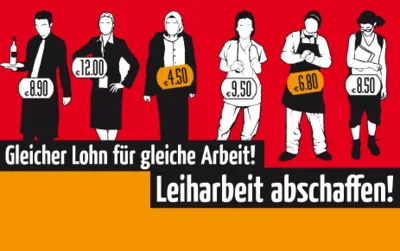
Abolish temporary work! Campaign from FAU-IWA

By no1, 3 January, 2011
f

Statement by German anarcho-syndicalist group FAU on the situation of temporary employment in Germany and recent developments between unions and employers' organisations.

Since social-democrat and green politicians broke down all restrictions on temporary employment in 2003, the number of people paid by temporary work agencies in Germany increased from 300.000 to 900.000 in 2010. Many of them have been forced by legal employment agencies to offer themselves to these "slave-traders". Temporary workers earn 30% less than their colleagues. Collective labour agreements, as those which have been negotiated by the Christian unions umbrella association for temporary work and personnel-service-agencies CGZP (Tarifgemeinschaft Christlicher Gewerkschaften für Zeitarbeit und Personalserviceagenturen) are crucially responsible for that. Now, the federal German labour court (BAG) rendered CGZP's labour agreements ineffective. No labour contract signed by the CGZP unions is valid any longer.

Legitimate Claim on “Equal Pay”

Each contract signed between CGZP unions and employer's organizations, such as AMP (Arbeitgeberverband Mittelständischer Personaldienstleister) or BDV (Bundesverband Deutscher Dienstleistungsunternehmen e.V.), are generally ineffective now. All temporary workers, who have been paid by CGZP contracts so far, have a legitimate claim to receive the money lost by these contracts over the last three years. They can also legitimately claim for all bonuses and extra pays which have been paid to their colleges as there is a German labour law which prohibits different treatments of worker's in the same company.

Lower courts in Berlin and Berlin-Brandenburg have already neutralized CGZP contracts. CGZP's appeal on a point of law that followed has now been turned away by Germany's federal court. In an official press release, the court justifies its decision by arguing that labour contracts can only be negotiated by a union which has the legitimate ability to do so. Due to several criteria, the CGZP has not.

200,000-300,000 Temporary Workers hope for back pay

When ineffective CGZP labour contracts have been used, each temporary worker needs to be back paid for the time he worked under these conditions. He needs not be treated different from other workers. According to German labour law on the transfer of personnel (AÜG) §10 (4), workers can now demand repayment from the temporary work agency they work for. The sum is adjusted on comparable employees working for the company which lent the temporary worker.

As each CGZP contract has been rendered ineffective, each limitation period is ineffective too. Conclusively workers can demand repayment for the last three years. Temporary workers should immediately check their contracts for links to CGZP labour agreements and lodge an action if necessary.

Bad Tricks

Since January 01, 2010 there exist other fake-unions like the CGZP. The CGM, DHV and GÖD did also sign labour agreements for temporary work. If these agreements are affected by the court's actual decision remains unknown so far. Their contracts remain probably untouched by the decision.

CGZP and DGB

The Christian union negotiated labour agreements with 1600 companies which are members of the employer's organizations AMP and BVD and with some smaller organizations. 200.000 to 300.000 workers work under their condition. In 2008, there have been 1.383 CGZP's union members, while there have been 800.000 temporary workers at all. 500.000 temporary workers are not affected by CGZP labour agreements but by deals negotiated between Germany's big union umbrella association DGB and the slave-trading employer's organizations iGZ (Interessenverband Deutscher Zeitarbeitsunternehmen) and BZA (Bundesverband Zeitarbeit). The DGB unions labour agreements are slightly better than those of CGZP: some cent more. But there are only a few temporary workers inside DGB anyway.

Minimum Wage – the Solution?

The federal German labour court's decision on CGZP labour agreements does not affect members of the DGB. This year, the union renewed its labour agreements guaranteeing dumping wages. So there is no reason for the DGB unions and its bureaucrats to applaud the actual judicial decision. After the renewing of its labour agreements, DGB cannot put pressure on the temporary work industry for “equal pay” and “equal treatment”. Their labour agreements are valid for the rest of time. Now DGB claims minimum wages for temporary workers, trying to compensate their own mistakes. But legally enacted minimum wages for temporary workers will always undercut wages and conditions of regularly employed workers. This is the opposite of equal pay. It is just another name for mass discrimination.

The FAU unions say: commercial "slave-trading" is a crime and temporary work needs to be abolished now.
For more information see (German): www.leiharbeit-abschaffen.de

  • Germany
  • casualisation
  • FAU-IAA
  • employment agencies
  • international

Guides

Your rights at work

Why do we organise? Capitalism is shit, oppression is shit - but what can we at SolFed do about it?

Why do we organise?

This is our flag - it tells you what we stand for

this-is-our-flag

Direct Action #2 (2024)

Direct Action #2 (2024)

Anarcho-syndicalism in Britain – a little history (2015)

Anarcho-syndicalism in Britain – a little history (2015)

Office worker’s health and safety - your rights and how to use them (2015)

Office worker’s health and safety - your rights and how to use them (2015)

Anarchism and Anarcho-syndicalism (Rudolf Rocker, 2014)

Anarchism and Anarcho-syndicalism (Rudolf Rocker, 2014)

Fighting for ourselves - anarcho-syndicalism and the class struggle (2012)

Fighting for ourselves - anarcho-syndicalism and the class struggle (2012)

Theory & Practice 1 - Workmates - direct action workplace organising on the London underground (2011)

Theory & Practice 1 - Workmates - direct action workplace organising on the London underground (2011)

The Economics of freedom (2003)

The Economics of freedom (2003)

A history of anarcho-syndicalism (SelfEd Collective, 24 unit series, 2001)

A history of anarcho-syndicalism (SelfEd Collective, 24 unit series, 2001)

Out of the frying pan, a critical look at works councils (1998)

Out of the frying pan, a critical look at works councils (1998)

Health and safety at work - an anarcho-syndicalist approach (1997)

Health and safety at work - an anarcho-syndicalist approach (1997)

Theory & Practice 2 - Anarcho-syndicalism in Puerto Real (1994)

Theory & Practice 2 - Anarcho-syndicalism in Puerto Real (1994)
RSS feed