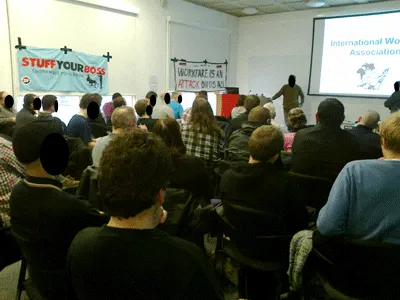
On January 5th 2013, South London SF hosted a conference to celebrate the 90th Anniversary of the International Workers Association (IWA), to which SF is affiliated. The programme was lively and aimed not only at the history of the IWA but also at the current activities of the sections. As well as participants from across the UK, comrades came from France (CNT-F GAP), Slovakia (Priama Akcia) and Germany (FAU).
Despite the late notice and shortening of the programme due to unforeseen circumstances and illness of the main organizer, the conference was a success. There were four main talks, interspersed with breaks. The talks were well received and there were over one hundred attendees at various points in the day. You can find the IWA-AIT conference programme on the SolFed website. What follows are the notes taken from all the presentations.
IWA - 90 years of ideas & practice - SolFed
The conference began with a talk on ninety years of the IWA’s ideas and practice, from T, a long-established militant and an IWA affiliate for nearly 40 years. He traced the origins of anarcho-syndicalism and the IWA back to the split in the First International between Marxian scientific socialism and anarchists’ concentration on struggle. The rejection of the state as a method of liberation was placed in the context of the butchery of the Paris Commune.
T went on to trace the progress of ideas through subsequent international groupings after the anarchists were expelled from the First International and it was closed down by the Marxists. For example, the St. Imier International, founded in 1872, was able to help uprisings in Spain and Italy and to rebuild in France. The growth of syndicalism in the late 19th century, in contrast to the reformism of the Second International, led to the ideas of the social general strike and direct action. Despite the prevalence of pacifist ideas and a naivety regarding revolutionary take-over, this was an important period in the development of revolutionary syndicalism and anarcho-syndicalism.
T also covered the discussions among syndicalist unions around the Third International, where several participated until its true role as a pawn of Moscow became clear. This led directly to the IWA being formed in 1922 under the initiative of the FAUD of Germany.
After the momentous events of the thirties, the IWA found itself a pale shadow in its first post war congress in 1945, with only the SAC of Sweden functioning as a union. In the fifties, the SAC left and the IWA was further weakened by arguments amongst the exiles of the Spanish CNT. By 1975, it was almost dead with only 5-6 groups, two of which were exiles. The death of Franco and the end of the post-war long capitalist boom added impetus and by 1979, FAU, USI and NSF had all re-emerged. The fall of the Berlin wall led to new groups in Eastern Europe, and new technology has added a further boost to communication.

FORA history & current activities
The second talk was given by Guillermo Zunzunegui on the FORA of Argentina. The translators made great efforts to keep up with Guillermo’s impassioned history of the Argentine workers movement and his own personal connections to it in what was widely considered the highlight of the day.
The workers movement in Argentina began in the 1880s, sparked largely by migrant workers and some exiles from the First International. FORA, the oldest IWA section, was founded in 1901 from a meeting of more than fifty Workers’ Resistance Societies which had grown out of the strikes that had been taking place. At the time, as with all workers organisations, it was composed of anarchists and socialists. Tensions between them lasted until a big strike where socialists formed the UGT.
In 1906, syndicalists in France adopted the Charter of Amiens, which proposed a separation of economic syndicalism and political action, not necessarily electoral. The FORA rejected this, seeing it as the beginning of the exclusion of the anarchists from the workers movement. They continue to this day to reject the idea of a union, such as the CNT, and a specific political organisation of anarchists, such as the FAI. As FORA had always been anarchist, there was no need for anarchists to pull out.
The organisation’s Fifth Congress in 1905 called for the widest possible education in the philosophy of anarchist communism. In 1915, FORA split – the adherents of the IX Congress went for the Charter of Amiens approach and the V Congress stuck to anarchist communism. FORA (IX) joined another union to negotiate with the government, something that FORA (V) rejected. In 1923, FORA was made illegal after the violent strikes of 1919 and the Rebellion of Patagonia. The Rebellion involved rural labourers against English sheep farmers and lasted two years, with over 1500 workers killed.
From the thirties to 1983, Argentina suffered under successive dictatorships. Any militants could expect reprisals. In the 1960s, Peronists banned every union except CGT, forcing FORA underground.
The dictatorship in the 1970s disappeared a generation of young militants, some for reasons as trivial as campaigning for lower bus fares for students. This was against a background of urban guerrillas and US fear of communism. The dictatorship didn’t just kill its people; it also stole and bankrupted the country, and so embarked on the Falklands War to whip up nationalism to cover up its failings. The only organisations to oppose the War were FORA and the Madres de la Plaza de Mayo, mothers of the disappeared who gathered to shame the authorities.
After democracy in 1983, the country continued to suffer economically. There was a sharp fall in 1989 and the new Peronist government privatised everything they could. This sowed the seeds for the revolts that came after 2001, leading to new tactics adapted to the conditions people found themselves in. For example, the unemployed, sometimes three generations in one go, began to block roads. In 2001, the economy collapsed as money was spirited out of the country. The middle classes were ruined as well and poor areas began to see a dual-power dynamic as the state abandoned them. The people’s response was to occupy factories and run public assemblies in neighbourhoods.
Anarchists were denounced by Marxists everywhere, but small groups started to go the old FORA local and finally understood the message the old men had been telling them. There are now, once more Workers Resistance Societies all over the country, though FORA is still illegal in Patagonia.
A trial and error quest to find own approach in a post-Stalinist society – Priama akcia
The third talk came from members of Priama Akcia (PA) in Slovakia, about how they developed as a small IWA section in a country with no anarchist tradition. PA was founded in 2000 and has evolved from a group influenced by counter-culture and the DIY ethic to one that plays a small part in workers struggles and tries to influence them.
PA particularly focused on some of the problems of language in a country which was told it had “socialism”. Understandably, words like proletariat and communism need to be explained rather than used freely. (It must be said we in SF would agree with this and try to write our material for all to read).
The role of law in the work of PA was explained. While it is important to know the law, our rights and what the employers can and can’t do, we shouldn’t limit ourselves to law, because the the most important tool in the struggle to achieve our demands is direct action. Therefore, from the first moment it is explained to the workers who have problems in their workplace and approach the organization, that PA is not a legal counselling service and that their active participation in eventual campaigns is crucial.
PA also shared their experiences and ideas regarding the problems of isolated members, which is a problem many organisations face. Ideas on principles used when attempting to form local groups, that would last and thrive, were mentioned briefly.
The functioning of “open meetings” was mentioned as well. They are a place to discuss workplace or community related problems, current activities or campaigns. Often half the attendants are non-members. PA stressed the need for reliable and responsible comrades, having suffered from bad experiences coming from the DIY subculture. To this end they take a thorough approach to recruitment involving much participation before membership.
PA also focused on the aims of the organization - helping its own members in the workplace, as well as expressing solidarity with other struggling workers. They are currently supporting a teachers’ strike in which a member has participated (her school was the first to continue striking after the mainstream union called off an indefinite strike following three days of action). As a small section they stress that international solidarity can have a great impact.
Solidarity Federation, past and present
The last talk was from an ex-DAM and current SF member about the origins of the Solidarity Federation, particularly in the experiences drawn from the struggles of the 80s, both large and small. If the talk was to be summed up in one sentence, it would be “have confidence in our ideas”.
Another member of SF explained the main ideas behind the Workfare scheme and the SF campaign against the scheme. It was pointed out that Workfare is an attack on the working class as a whole, lowering living and working standards and helping restructure the nature of work.
Following a lively campaign and after SF called a week of action in July 2012 against Holland & Barrett’s participation in the scheme, the company decided to withdraw. This success didn’t stop activities and as the campaign is long-term, other companies will be targeted in 2013, the current target is Poundland.
The next 10 years
A recurrent theme of the day was that of Anarcho-syndicalist revival and the ties that bind us to a more combative past; the ideas and actions of the early anarchists and syndicalists, the old men of FORA who kept the tradition alive, the DAM comrades who remain active. Our history is created by past and present actions and we should learn from them, so that we can celebrate the 100th Anniversary of the IWA as an even stronger force.
Written by the SF conference working group and Priama akcia speakers.