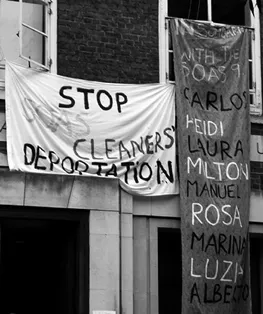
Members of North London SF demonstrated alongside other militants outside the head offices of London & Regional Properties, owners of Berns Salonger, a company that treats the cleaners it employs with intolerable conditions.
Across the world, other sections of the International Workers Association have been fighting state attempts to repress workers organisation.
In Serbia, in a dramatic turn, six Serbian activists, known as the Belgrade Six (for more details, see Catalyst #22 - available at http:// www.solfed.org.uk/docs/catalyst), were released on bail on the first day of their trial on February 17th.
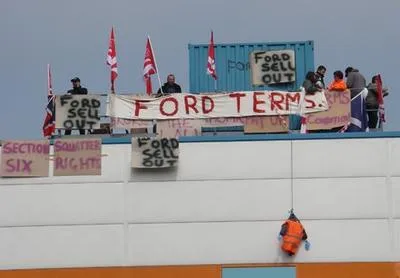
Workers at car parts manufacturer Visteon in Belfast, Enfield and Basildon occupied their factories on Wednesday 1st April, after they were given six minutes’ notice of closure and told to leave immediately. 565 jobs have been lost at Visteon plants across the UK. Left with no alternative, the workers staged a spontaneous sit-in, first in Belfast then spreading to the other two plants.
Many of the workers had worked at the Enfield factory, originally owned by Ford who set up Visteon and transferred the factory operations to it in 2000, for many years. Ford had agreed that the workers transferred to Visteon would receive the same conditions as other Ford workers, but the bankruptcy of Visteon UK left them with the legal minimum redundancy payments and pension compensation. Workers demanded that the Ford redundancy and pension terms they had been promised be honoured.
On June 12th, cleaners working for ISS at the School of Oriental & African Studies (SOAS) in London were called to a meeting by management. The cleaners were “processed” by immigration officials who detained nine of them as “illegal immigrants”. It was perhaps no coincidence that a picket of SOAS’ governing body demanding the reinstatement of victimised SOAS UNISON Branch Chair José Stalin Bermudez, who had been prominent in organising cleaners, had been called for that morning.
Those detained were denied union representation, but a campaign was quickly organised by SOAS campus unions and students, migrant worker activists and anti-deportation campaigners. SOAS management was held responsible for ISS “ambushing” their cleaners as punishment for winning union recognition and the London Living Wage.
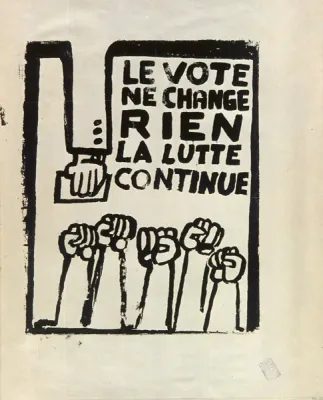
It’s election season again. It’s a time of photo-ops and promises, manifestos and controversies. But behind the endless announcements, allegations and denials, is anything really at stake? After 13 years of Labour government, many people want a change. The economy on which Gordon Brown staked his reputation as Chancellor has nosedived on his watch as Prime Minister.
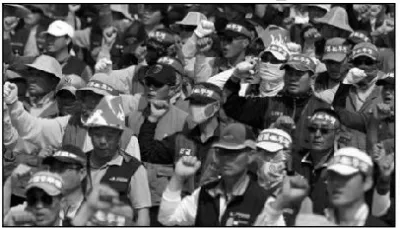
China is experiencing a rising wave of industrial unrest, as workers increasingly turn to collective action to fight against their exploitation.
Rapid industrialisation over the past few decades has created massive internal migration from the countryside to the cities on an unprecedented scale, dwarfing Britain’s industrial revolution two centuries ago. Now, this new urban working class has begun to flex its muscles, disrupting production in order to assert their demands.
The high-profile suicides at Foxconn, who make iPhones for Apple, were merely the tip of the iceberg. There, angry workers rioted over sweatshop conditions, chanting “capitalists kill people” and brandishing pictures of the CEO of Foxconn, Terry Gou. The company quickly offered improved wages and conditions in an attempt to quell the storm. However these headline-grabbing measures were quickly eaten up by reductions in overtime and speed-ups on production lines.
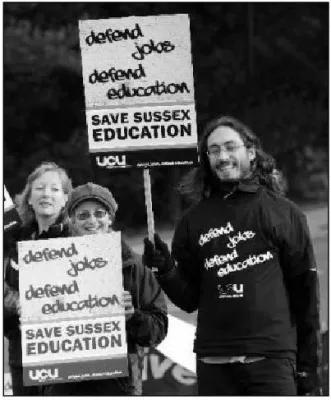
The academics’ union UCU at the University of Sussex cancelled industrial action planned for late June after university bosses declared they were “hopeful” they could avoid any compulsory redundancies.
It soon emerged however that compulsory redundancies had been transformed into ‘voluntary’ ones and the number of job losses remained at over 100, with a similarly severe impact on many courses and workloads expected.
One student mocked the management statement: “We are pleased to announce that the 100 have jumped, and were not pushed. The knives to their backs were unrelated.” A lecturer also commented that “I, among many, have been made ‘voluntarily’ redundant, after being selected for compulsory redundancy. The University seems to have got rid of everyone it wanted by forcing us to accept a ‘voluntary’ settlement.”
A new Education Bill is set to massively extend Labour’s controversial Academies programme.
The Education Secretary Michael Gove has now added Ofsted-graded “outstanding” schools to the hit-list. His plans promise even more Academies; over 150 schools have already applied for Academy status, with hundreds more enquiring for further information or registering an interest. The Academies scheme allows non-state bodies, including religious groups, businesses and voluntary groups to take control of schools in exchange for a nominal amount of funding for new facilities.
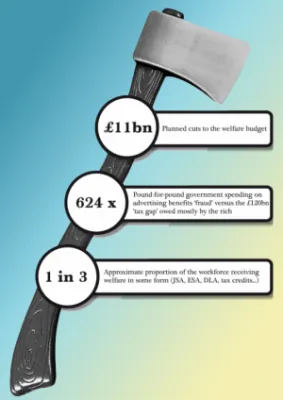
The government’s answer to the problem of unemployment during the biggest economic crisis since the 1930s is not to create any new jobs, but to launch a massive attack on our living standards.
In the emergency budget, one group of people who will be hit the hardest is welfare claimants.
Benefits are not just for the unemployed. They supplement low pay and give those with disabilities or caring responsibilities a means by which to survive, as well as providing income to those who cannot find unemployment. With around 2.5 million people claiming Job Seekers Allowance (JSA), 2.9 million receiving Disability Living Allowance (DLA), around 5 million reeceiving working tax credits and further claimants on other tax credit schemes and Employment and Support Allowance (ESA), more than one-in-three of Britain’s 30 million strong workforce are receiving some form of state welfare.