The revolutionary syndicalism of the early 20th century was not born in the heads of theoreticians. It was the practice of the workers’ movement which sought its own doctrine [1] – above all, the practice of direct action.
The First World War was a serious test for the internationalist and anti-militarist position proclaimed by the syndicalists. Some of them (Alexander Berkman, Antonio Bernardo, V. García, A. Shapiro, Bill Shatov) together with E. Malatesta and Emma Goldman signed a manifesto against the war, denouncing it as a war of aggression by both sides.
The global revolutionary wave which started in 1917 in Russia gradually enveloped other countries. Anarchists and syndicalists took an active part in events and were frequently found in the front ranks of revolutionary actions.
The general enthusiasm and mass self-organization of the workers imparted a new impulse to the libertarian workers’ movement.
The International Association of Workers was reconstituted at a moment when the global revolutionary wave had already begun to subside. Many of its sections were soon subjected to harsh repression and were crushed. In Italy after the regime of Mussolini took power, the activity of local branches of the USI was paralyzed already by April 1924.
Going underground, the labour federation re-organized and was able to lead a number of significant strikes (miners in Valdarno and on Elba), marble workers in Carrara, and metalworkers).
In spite of heavy defeats in a majority of countries, the repressions of dictators, and the politics of communists aimed at subverting the anarcho-syndicalist movement, the period of the 1920’s and 1930’s was a time of lively ideological-theoretical discussions among anarchists and anarcho-syndicalists. The participants in these discussions not only put forth a penetrating analysis of contemporary capitalist society, but also described the contours of a social alternative with great insight.
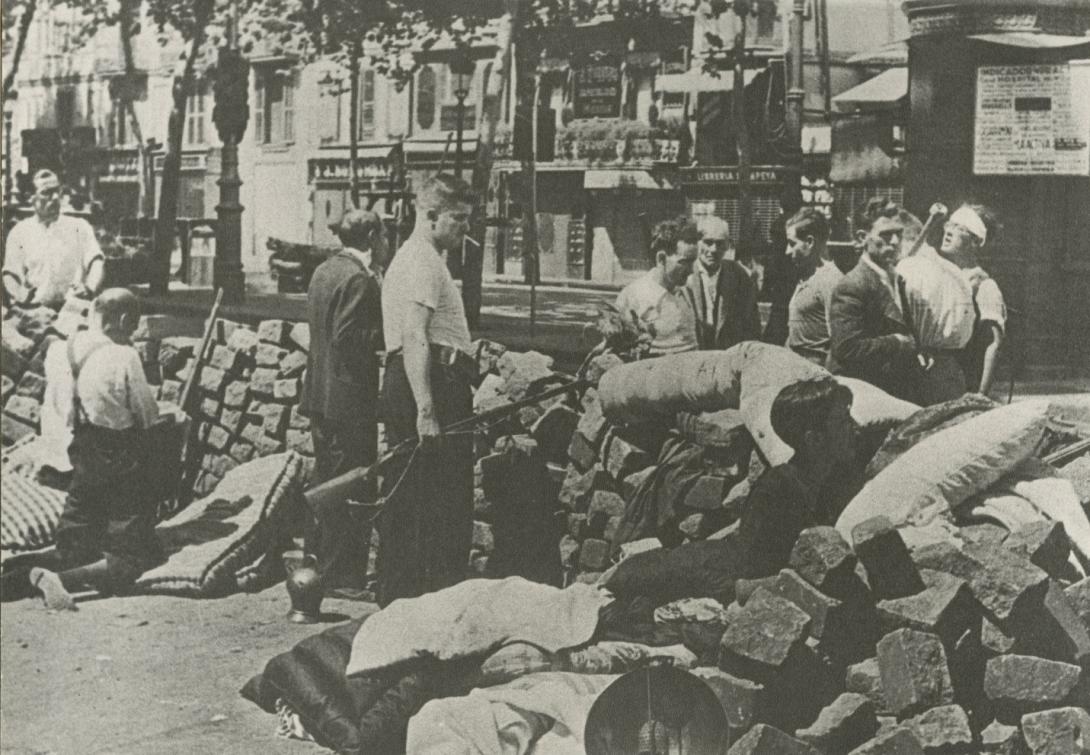
In July 1936, in response to a military-fascist mutiny of right-wing generals against the Spanish Republic, in Barcelona – the capital of the region of Catalonia and the largest industrial centre of the country – a general strike flared up and grew into a worker revolt. The core elements of this uprising were armed members and supporters of the CNT.
Theoretically the relationship of the Spanish anarcho-syndicalists to the question of power was determined long before July 1936. The Spanish anarchist (libertarian) movement from its very beginning in the 1870’s preached the simultaneous annihilation of Capitalism and the State by means of social revolution, and the transition to a stateless system – a federation of free communes and workers’ unions. A plan of action in a situation of social revolution had been outlined by the end of 1933, just before a planned uprising against a right-wing government which had just acceded to power.