This dispute arose after the Ardbride strike, and once again was initially publicised by Edinburgh DAM. It also reached a successful conclusion, unlike the one we’d put so much effort into supporting over the previous year.
In September 1987, Tricia Jennings, a worker at Burton’s in Edinburgh, became pregnant and a few days later was rushed to hospital with a threatened miscarriage. She informed her employer about her situation and at first they seemed sympathetic. Tricia spent the next 6 weeks fighting to save her baby, but when she returned to work on 9th November she found she’d been sacked. Everyone else in the ship knew 2 weeks before Tricia did. No reason was given, though subsequently Burton’s tried to claim she was sacked for “absenteeism” or because her work was “below standard”. However, Tricia had had a certificate for the absence and had passed her six month probation.
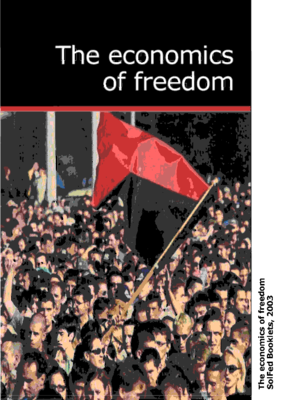
This pamphlet has been written by a group of people in the Solidarity Federation. We are actively involved in taking direct action for a better world. However, we are also interested in what this better world might be like and how it might work. In the current world of US-led terror against terror, corporate cronyism and corruption, and widening global and class inequality, we all want and deserve better.
The Solidarity Federation is the British section of the anarcho-syndicalist global movement. Anarcho-syndicalism is about direct democracy – democracy from the bottom up - no party politicians, corporate managers or union leaders. Direct democracy means decisions are made by all those present. Hence, we cannot be prescriptive about what a future, decent economy might work like. It will be decided by the people there at the time. Hopefully, it will happen soon, and everyone will be involved. However, in the meantime, it is rather a cop-out to simply say, “we'll sort that out later” and then, fall back on abstract principles or vague concepts. So, we thought it would be useful to develop a detailed model (but not a straightjacket) of how it could work. This is the result.
Unit 1: Introduction - The origins of Capitalism Unit 2: Britain - The radical period 1750s-1840s Unit 3: The First International Unit 4: France 1870-1918 - Early revolutionary Unions Unit 5: Revolutionary syndicalism in Britain, 1870-1910 Unit 6: Revolutionary syndicalism in Britain and Ireland, 1910-1917
Unit 7: Mexico 1870-1920 - Colonialism and revolution Unit 8: USA 1886-1930 - The Wobblies Unit 9: Anarcho-syndicalism in Argentina 1870-1939 Unit 10: Sweden - 1889-1939 Unit 11: Russia I - 1850-1917 Unit 12: Russia II - 1917-1930
Unit 13: Going Global - International Organisation, 1872-1922 Unit 14: Anarcho-syndicalism in Britain, 1914-30 Unit 15: Spain, 1868-1936 - Build-up to revolution Unit 16: Spain - Culture, education, women and sexuality Unit 17: Spain 1936-39 - Revolution and civil war Unit 18: Spain - The Collectives
Unit 19: Britain, 1930-1950 - The era of reformism Unit 20: Britain, 1950-1990 - Decline of social democracy Unit 21: Global anarcho-syndicalism 1939-99 Unit 22: Roots of modern anarcho-syndicalism - freedom, oppression, rebellion Unit 23: Roots of modern anarcho-syndicalism - morality, culture, tactics Unit 24: The spirit of anarcho-syndicalism
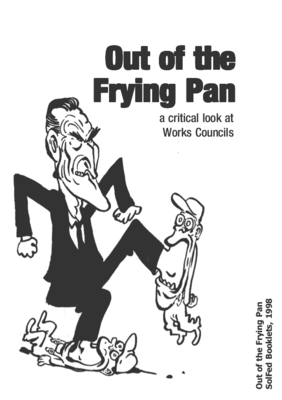
Works Councils are coming to Britain. But what are Works Councils, and what will they mean for working people and trade unions? Are the TUC unions right to welcome the changes in labour relations which Works Councils will bring?
Works Councils, far from empowering people, act as a tool by which management can control and pacify people at work. The truth behind Works Councils is exposed here through the views of workers in France, who have witnessed their failure at first hand.
The message is clear; there is nothing to be gained and much to lose from the introduction of a Works Council system in Britain.
Out of the Frying Pan is a new, critical analysis of Works Councils and a look ahead at a real future for organising and fighting back in your workplace.
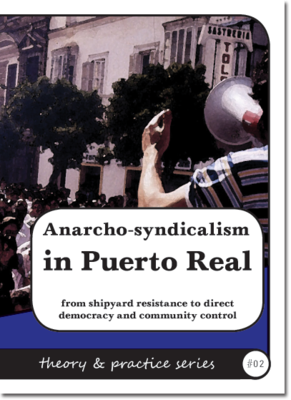
The 1987 struggle against threatened closure in and around the shipyards of Puerto Real, Spain, in both workplace and community witnessed the anarcho-syndicalist union CNT playing both a prominent and decisive role.
The Direct Action Movement's 1991 pamphlet on strategy, setting out a vision of networks of militant workers seeking to create explicitly revolutionary workplace and community based groups capable of initiating collective direct action - revolutionary unions. The DAM became Solidarity Federation in 1994.
Throwing down the gauntlet
The phoney war
Class mobilisation
On the offensive
A call to arms
"One must try to increase as much as possible the theoretical content of all our activities, but without the 'dry and shriveled doctrinalism' which could destroy in part the great constructive action which our comrades are carrying forward in the relentless fight between the haves and the have nots. Our people stand for action on the march. It is while going forward that we overtake. Don't hold them back, even to teach them `the most beautiful theories' ..."
This short pamphlet is not intended to be the definitive information on the Poll Tax as this is impossible as the government is still amending its rules and regulations concerning the implementation of the Poll Tax. [1]
Anarchism is the philosophy of a new social order based on liberty, and unrestricted by man-made laws; the theory that all forms of government rest on violence and are therefore wrong and harmful, as well as unnecessary.
 SelfEd Collective, 24 unit correspondence course, 2001