Home
Solidarity Federation
IWA
User account menu
  • Contact
  • Log in
  • Home
    • Intro
    • Workplace organiser training
    • Industrial strategy
    • Community strategy
    • Constitution
  • SolFed
    • Brighton
    • Bristol
    • Edinburgh
    • Liverpool
    • Manchester
    • North London
    • Wales
    • Yorkshire
  • Industries & sectors
    • Claimants and unpaid
    • Education
    • Health and social care
    • Hospitality
  • Events & reports
  • Publications
    • Guides
      • Stuff your boss (doesn't want you to know)
      • Stuff your sexist boss (doesn't want you to know) (2018)
      • Stuff your landlord (doesn't want you to know) (2016)
      • Is your cleaning job killing you? A guide to cleaners health and safety (2017)
      • Office worker’s health and safety - your rights and how to use them (2015)
      • A migrant's guide to Manchester (2016) [en es]
      • A migrant's guide to London (2014) [en es pl]
      • Strike - a guide to walking out (2014)
    • Pamphlets and books
      • Anarcho-syndicalism in Britain – a little history (2015)
        • 1. 19th century to 1914 - The First International, growth of industrial unionism and the Great Unrest
        • 2. 1914–1945 - State suppression and the Bolshevik turn – how Lenin’s seeming success drew militants to the Comintern
        • 3. 1945–1994 - The Anarchist Federation of Britain, Syndicalist Workers’ Federation and Direct Action Movement
        • 4. Today’s movement - A short look at the strategy and thinking of the modern Solidarity Federation
      • Office worker’s health and safety - your rights and how to use them (2015)
      • Anarchism and Anarcho-syndicalism (Rudolf Rocker, 2014)
        • Introduction
        • 1. Ideology of Anarchism
        • 2. History of anarchist philosphy, from Lao-Tse to Kropotkin
        • 3. The origins of anarcho-syndicalism
        • 4. Socialism and anarcho-syndicalism in France
        • 5. The role of the trade unions: anarcho-syndicalist view
        • 6. The struggle in Germany and Spain
        • 7. The political struggle: anarcho-syndicalist view
        • 8. Anarcho-syndicalism since the First World War
      • Fighting for ourselves - anarcho-syndicalism and the class struggle (2012)
        • Introduction
        • 1. The mainstream workers' movement
        • 2. Radical currents in the workers' movement
        • 3. Anarcho-syndicalism in the 20th century
        • 4. Capitalism and the class struggle since World War II
        • 5. Anarcho-syndicalism in the 21st century
        • Endnotes
      • Workmates - direct action workplace organising on the London underground (2011)
      • The Economics of freedom (2003)
      • A history of anarcho-syndicalism (2001)
      • Out of the frying pan, a critical look at works councils (1998)
      • Health and safety at work - an anarcho-syndicalist approach (1997)
      • Anarcho-syndicalism in Puerto Real (1994)
    • Leaflets and flyers
      • Solidarity Federation Education Union (SFEU)
      • Solidarity Federation Hospitality Workers Union (SFHWU)
      • Why do we organise?
      • This is our flag - it tells you what we stand for
      • What is anarcho-syndicalism anyway?
      • Anarchism and Syndicalism (short version)
      • Anarchism and Syndicalism
      • Towards a better union
      • Protest is not enough
      • Building beyond elections
      • We should run our workplaces
      • We should run our communities
      • We should run our movements
    • Newsletters
      • Brighton Solidarity
        • Brighton Solidarity #3
      • Education Worker
        • Education Worker #10 Victimisation (2013)
        • Education Worker #9 (2012)
        • Education Worker #8 Academy Special (2012)
      • Wildcat!
        • Wildcat! #13 (Jan 2013)
        • Wildcat! (Winter 2012)
        • Wildcat! #6 (Summer 2011)
        • Wildcat! #5 (Spring 2011)
        • Wildcat! #4 (Dec 2010)
        • Wildcat! #3 (Oct-Nov 2010)
        • Wildcat! #2 (Jul-Aug 2010)
        • Wildcat! Football for the fans NOT for fat cats! (Jul 2010)
        • Wildcat! #1 (May-June 2010)
      • May Day Bulletin (Newcastle SolFed, 2014)
    • Direct Action
      • Direct Action #2 (2024)
      • Direct Action #1 (2023)
      • Direct action #47 (Summer 2009)
    • Catalyst
      • Catalyst #29 (Feb 2012)
      • Catalyst #28 (Oct 2011)
      • Catalyst #27 (Jun 2011)
      • Catalyst #26 (Mar 2011)
      • Catalyst #25 (Dec 2010)
      • Catalyst #24 (Summer 2010)
    • SelfEd
      • A history of anarcho-syndicalism
        • Block 1
          • Unit 1: The Origins of Capitalism
          • Unit 2: Britain: The Radical Period 1750-1840
          • Unit 3: The First International
          • Unit 4: France 1870-1918 Early revolutionary unions
          • Unit 5: Revolutionary Syndicalism in Britain, 1870-1910
          • Unit 6: Revolutionary Syndicalism in Britain and Ireland, 1910-17
        • Block 2
          • Unit 7: Mexico 1870-1920: Colonialism and Revolution
          • Unit 8: USA 1886-1930 - The Wobblies
          • Unit 9: Anarcho-syndicalism in Argentina 1870-1939
          • Unit 10: Sweden 1889-1939
          • Unit 11: Russia I: 1850-1917
          • Unit 12 Russia II: 1917-30
        • Block 3
          • Unit 13: Going Global - International Organisation, 1872-1922
          • Unit 14: Anarcho-syndicalism in Britain, 1914-30
          • Unit 15 Spain, 1868-1936: Build-up to Revolution
          • Unit 16 Spain: Culture, education, women and sexuality
          • Unit 17: Spain 1936-39: Revolution and Civil War
          • Unit 18: Spain - The Collectives
        • Block 4
          • Unit 19: Britain, 1930-1950 - The Era of Reform
          • Unit 20: Britain, 1950-1990 - Decline of Social Democracy
          • Unit 21: anarcho-syndicalism 1939-99
          • Unit 22: Roots of modern anarcho-syndicalism: freedom, oppression & rebellion
          • Unit 23: Roots of modern anarcho-syndicalism: morality, culture & tactics
          • Unit 24: The spirit of anarcho-syndicalism
    • Letters
  • IWA

Breadcrumb

  1. Home
  2. industries, occupations and sectors
  3. health and social care

health and safety

By no1, 24 October, 2010

Government-funded deaths

The Centre for Corporate Accountability has revealed that, in the last 20 months, 9 apprentice workers - all under the age of 23 - have been killed on work placements as part of Government-funded courses. It is not known how many apprentices have been injured.

One of the deaths has resulted in a director and company being prosecuted for manslaughter. The trial is due to take place later this year at Exeter Crown Court. Another has resulted in the company pleading guilty to health and safety offences, whilst five of the deaths continue to be under investigation.

At the time, all of the apprentices were undertaking the work-placement part of their course/apprenticeship, and were on vocational courses funded by the government.s Learning and Skills Council, which funds all post-16 training and education for young people.
Tags

  • health and safety
By no1, 24 October, 2010

Formaldehyde kills

It has now been accepted that Formaldehyde, a chemical to which millions of workers are exposed to, causes cancer. The International Agency for Research on Cancer had already concluded that formaldehyde was probably carcinogenic to humans, but new studies have now found hard evidence showing that formaldehyde causes nasopharyngeal cancer in humans.

Formaldehyde is used mainly in the production of resins that are used as adhesives and binders for wood products, pulp, paper, glasswool and rockwool. It is also used extensively in the production of plastics and coatings, in textile finishing, in the manufacture of industrial chemicals, and as a disinfectant and preservative (formalin) used in labs and in morgues for embalming.

Tags

  • health and safety
By no1, 24 October, 2010

Exposed – ‘accidents' at work

As the Health and Safety jargon goes, 99% of accidents are preventable. Here are just a few examples of cases where negligence by employers - who would rather make extra profits than prevent accidents - has been exposed.

Tags

  • health and safety
By no1, 24 October, 2010

Overwork = madness

Tags

  • health and safety
By no1, 24 October, 2010

Deaths at work highest in North West

Figures released by trade unions the TGWU and UCATT show that 104 people died at work in the North West of England in 2003-04, the highest of any region in England, Scotland or Wales. The number of major injuries at work during the same two-year period was 7,218, the second highest of any region. Not one single company director was prosecuted for these deaths or injuries.

In March 1996, when in opposition, Labour gave its support to a law for director liability when Michael Meacher MP said in Parliament, “Responsibility for health and safety must be vested at the highest level of each organisation. Companies should appoint an individual at board level with overall responsibility for health and safety.”

Tags

  • health and safety
By no1, 24 October, 2010

The killing goes on...

Despite the target, set by the government in February 2001, to cut deaths and major injuries in construction by 40 per cent by 2004/05 and by 66 per cent by 2009/10 the murdering of building workers is still going on unchecked.

Tags

  • health and safety
By Joseph Kay, 23 October, 2010

Making a killing

Nearly twice as many people die from fatal injuries at work than are victims of homicide, a new report has revealed. At least 1,300 people died as a result of fatal occupational injuries in 2005-06 in England and Wales, compared with 765 homicide deaths. It was also found that non-fatal workplace injuries requiring hospitalisation were far higher than those needing treatment following a violent crime.

Yet at a time when crime, especially violent crime, takes centre stage and any working class youth who likes wearing a hood is stigmatized as a potential mass murderer, the violent crime and murder taking place in the workplace everyday is never reported. Moreover, while Labour responds to every Daily Mail hang-and-flog-them headline by throwing yet more people into already overcrowded jails the perpetrators of crime in the workplace get off virtually scot-free

Tags

  • health and safety
By no1, 22 October, 2010

Workplace deaths continue

Workplace deaths across the south west of the country are increasing, according to the Health & Safety Executive, a fact which it finds to be “disappointing”. From March 2007 to March 2008, deaths on the job rose by 16%, with a total of 28 fatalities. Despite injuries in the workplace scaling 240,000, the authorities managed a mere 70 prosecutions across the region; a rather low clearance rate, some might say. Some 38% of injuries were due to “slips, trips and falls” in construction, agriculture and manufacturing.

If you are unfortunate enough to be one of these many casualties and living in the north Somerset area then even more bad luck awaits you, because you’ll have to wait longer for an ambulance than anywhere else in the entire country. Unsurprisingly, these delays have a knock-on effect as paramedics have to stay with the patient until an ambulance turns up, which leads to crews being further delayed at Weston General Hospital for anything up to 45 minutes.

Tags

  • health and safety
By no1, 26 September, 2010

Have your say : A Killer at Work

Though asbestos in now banned in Britain, many buildings we live and work in today predate the ban. For example, about 90% of schools still contain asbestos. As a result, thousands of people are dying, and will continue to die, from asbestos related diseases which very often are not manifest until many years, even decades, after exposure.

Asbestos is a fibrous substance found in seams between layers of rock. The fibres are strong, flexible, and will not burn below 1000 ºC. There are different types but these days 95% of all asbestos mined is white asbestos, or Chrysotile.

When processed it is broken down into tiny fibres, which are so strong and pliable they can be spun and woven. There is practically no limit to how small these fibres can get. When asbestos is used, even if only handled, it gives off dust, some of it invisible. These invisible fibres can enter the lungs and are responsible for asbestos related diseases.

Tags

  • letters
  • health and safety
  • asbestos

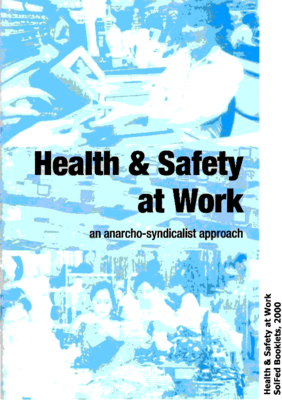
Health and safety at work - an anarcho-syndicalist approach (1997)

Health and safety at work - an anarcho-syndicalist approach (1997)This pamphlet is based on a course organised by North & East London Solidarity Federation called "Organising for Health and Safety" back in 1997.

Tags

  • library
  • publications
  • pamphlets and books
  • health and safety
  • workplace organising

Pagination

  • First page
  • Previous page
  • Page 1
  • Page 2
  • Page 3
health and safety

Guides

Your rights at work

Why do we organise? Capitalism is shit, oppression is shit - but what can we at SolFed do about it?

Why do we organise?

This is our flag - it tells you what we stand for

this-is-our-flag

Direct Action #2 (2024)

Direct Action #2 (2024)

Anarcho-syndicalism in Britain – a little history (2015)

Anarcho-syndicalism in Britain – a little history (2015)

Office worker’s health and safety - your rights and how to use them (2015)

Office worker’s health and safety - your rights and how to use them (2015)

Anarchism and Anarcho-syndicalism (Rudolf Rocker, 2014)

Anarchism and Anarcho-syndicalism (Rudolf Rocker, 2014)

Fighting for ourselves - anarcho-syndicalism and the class struggle (2012)

Fighting for ourselves - anarcho-syndicalism and the class struggle (2012)

Theory & Practice 1 - Workmates - direct action workplace organising on the London underground (2011)

Theory & Practice 1 - Workmates - direct action workplace organising on the London underground (2011)

The Economics of freedom (2003)

The Economics of freedom (2003)

A history of anarcho-syndicalism (SelfEd Collective, 24 unit series, 2001)

A history of anarcho-syndicalism (SelfEd Collective, 24 unit series, 2001)

Out of the frying pan, a critical look at works councils (1998)

Out of the frying pan, a critical look at works councils (1998)

Health and safety at work - an anarcho-syndicalist approach (1997)

Health and safety at work - an anarcho-syndicalist approach (1997)

Theory & Practice 2 - Anarcho-syndicalism in Puerto Real (1994)

Theory & Practice 2 - Anarcho-syndicalism in Puerto Real (1994)
RSS feed