"Those who fight can lose, but those who don't fight have already lost"
Bertolt Brecht
“The pay and terms of conditions of employment for over 1.4 million local government services workers is determined by the National Joint Council (NJC) for Local Government Services.” So reads the local government website and herein lie the constraints that trade unionists have to fight against.
The National Joint Council (NJC, see the 'green book') is for pay and conditions negotiations for local government workers in England, Wales and Northern Ireland. The Scottish Joint Council (SJC, see the 'red book') is for negotiations for local government workers in the thirty-two local authorities/councils across Scotland. Our small union, the Solidarity Federation Education Union (SFEU) is not part of the NJC or SJC but our members are active on the ground and in the workplace fighting for better pay and conditions every day.
The NJC is made up of both unions and employers and facilitates these pay negotiations. The recognised unions in these negotiations are GMB, Unison and Unite. In November 2025 the joint recognised unions submitted their pay claim to the Employers, this claim included:
- An increase of at least £3,000 or 10% (whichever is greater) across all NJC spinal column points (Based on a one-year settlement)
- A minimum pay rate of £15 an hour for the NJC pay spine
- A two-hour reduction in the working week
- An increase of one day annual leave
- The ability of all school support staff to take a day of paid leave during term time
- The abolition of Level 1 Teaching Assistant role and instead all Level 1 role holders be moved onto Level 2
The justification for these claims can be partly summarised with a graph produced by the joint unions:
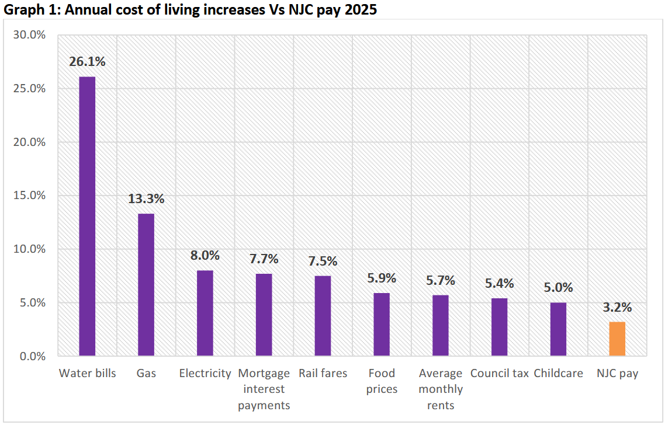
The pay increase offered in 2025 is noticeably lower than the increased cost of all of the listed expenses, expenses that impact the vast majority of workers. This means that that the previous pay increase offers little more than a softened blow, a managed decline in spending power, for most of us.
In March 2026, the unions met with the Employers about the claim. Employers made a full and final offer of a 3.3% pay increase while rejecting all other demands, the offer would come into effect on the 1st April. Employers made their offer within hours of the meeting and refused any and all negotiation.
The unions then took the offer to members, with a vote to reject also being a vote in favour of moving to ballot for industrial action. The members of all three unions voted not to accept the offer, meaning that the unions would move to ballot for industrial action. Employers were invited to engage in further negotiation, which they refused.
The industrial action ballot closed in August, the majority vote in the ballots of all three unions was in favour of strike action. Unfortunately, only Unite reached the legally required 50% vote turnout threshold for the vote to be valid. With two out of three unions unable to strike, and further negotiations refused, the 3.3% pay increase offer was accepted.
This negotiation played out almost identically to the 2025/26 negotiation, though last year Employers refused to even meet with the unions.
With a nearly identical timeline and a nearly identical pay offer, workers can expect little more this year than they experienced last year.
Rather than sit back and hope for a better result next time, active members of the above unions, including our own (SFEU) work for mobilisation in the workplace to counter employer pressures. Rather than rely on ballots and voting, we need to be creative in how we can improve our conditions day by day. Working slowly, asserting what minimum rights we have, health and safety (including work levels) are all aspects we need to take into account. Conversations with workmates in breaks and over meals is a good place to start. Offering solidarity and mutual aid, forming WhatsApp groups to provide support for workers is productive. In disputes we have participated in elsewhere, in Glasgow and Edinburgh, for example, this practical step has proved fruitful: workers start to share ideas, defend their rights and make sure that they are prepared for ongoing and future struggles. This is what SFEU is dedicated to: organisation now, not voting later.
Join us to build this new way of union organising.