Home
Solidarity Federation
IWA
User account menu
  • Contact
  • Log in
  • Home
    • Intro
    • Workplace organiser training
    • Industrial strategy
    • Community strategy
    • Constitution
  • SolFed
    • Brighton
    • Bristol
    • Edinburgh
    • Liverpool
    • Manchester
    • North London
    • Wales
    • Yorkshire
  • Industries & sectors
    • Claimants and unpaid
    • Education
    • Health and social care
    • Hospitality
  • Events & reports
  • Publications
    • Guides
      • Stuff your boss (doesn't want you to know)
      • Stuff your sexist boss (doesn't want you to know) (2018)
      • Stuff your landlord (doesn't want you to know) (2016)
      • Is your cleaning job killing you? A guide to cleaners health and safety (2017)
      • Office worker’s health and safety - your rights and how to use them (2015)
      • A migrant's guide to Manchester (2016) [en es]
      • A migrant's guide to London (2014) [en es pl]
      • Strike - a guide to walking out (2014)
    • Pamphlets and books
      • Anarcho-syndicalism in Britain – a little history (2015)
        • 1. 19th century to 1914 - The First International, growth of industrial unionism and the Great Unrest
        • 2. 1914–1945 - State suppression and the Bolshevik turn – how Lenin’s seeming success drew militants to the Comintern
        • 3. 1945–1994 - The Anarchist Federation of Britain, Syndicalist Workers’ Federation and Direct Action Movement
        • 4. Today’s movement - A short look at the strategy and thinking of the modern Solidarity Federation
      • Office worker’s health and safety - your rights and how to use them (2015)
      • Anarchism and Anarcho-syndicalism (Rudolf Rocker, 2014)
        • Introduction
        • 1. Ideology of Anarchism
        • 2. History of anarchist philosphy, from Lao-Tse to Kropotkin
        • 3. The origins of anarcho-syndicalism
        • 4. Socialism and anarcho-syndicalism in France
        • 5. The role of the trade unions: anarcho-syndicalist view
        • 6. The struggle in Germany and Spain
        • 7. The political struggle: anarcho-syndicalist view
        • 8. Anarcho-syndicalism since the First World War
      • Fighting for ourselves - anarcho-syndicalism and the class struggle (2012)
        • Introduction
        • 1. The mainstream workers' movement
        • 2. Radical currents in the workers' movement
        • 3. Anarcho-syndicalism in the 20th century
        • 4. Capitalism and the class struggle since World War II
        • 5. Anarcho-syndicalism in the 21st century
        • Endnotes
      • Workmates - direct action workplace organising on the London underground (2011)
      • The Economics of freedom (2003)
      • A history of anarcho-syndicalism (2001)
      • Out of the frying pan, a critical look at works councils (1998)
      • Health and safety at work - an anarcho-syndicalist approach (1997)
      • Anarcho-syndicalism in Puerto Real (1994)
    • Leaflets and flyers
      • Solidarity Federation Education Union (SFEU)
      • Solidarity Federation Hospitality Workers Union (SFHWU)
      • Why do we organise?
      • This is our flag - it tells you what we stand for
      • What is anarcho-syndicalism anyway?
      • Anarchism and Syndicalism (short version)
      • Anarchism and Syndicalism
      • Towards a better union
      • Protest is not enough
      • Building beyond elections
      • We should run our workplaces
      • We should run our communities
      • We should run our movements
    • Newsletters
      • Brighton Solidarity
        • Brighton Solidarity #3
      • Education Worker
        • Education Worker #10 Victimisation (2013)
        • Education Worker #9 (2012)
        • Education Worker #8 Academy Special (2012)
      • Wildcat!
        • Wildcat! #13 (Jan 2013)
        • Wildcat! (Winter 2012)
        • Wildcat! #6 (Summer 2011)
        • Wildcat! #5 (Spring 2011)
        • Wildcat! #4 (Dec 2010)
        • Wildcat! #3 (Oct-Nov 2010)
        • Wildcat! #2 (Jul-Aug 2010)
        • Wildcat! Football for the fans NOT for fat cats! (Jul 2010)
        • Wildcat! #1 (May-June 2010)
      • May Day Bulletin (Newcastle SolFed, 2014)
    • Direct Action
      • Direct Action #2 (2024)
      • Direct Action #1 (2023)
      • Direct action #47 (Summer 2009)
    • Catalyst
      • Catalyst #29 (Feb 2012)
      • Catalyst #28 (Oct 2011)
      • Catalyst #27 (Jun 2011)
      • Catalyst #26 (Mar 2011)
      • Catalyst #25 (Dec 2010)
      • Catalyst #24 (Summer 2010)
    • SelfEd
      • A history of anarcho-syndicalism
        • Block 1
          • Unit 1: The Origins of Capitalism
          • Unit 2: Britain: The Radical Period 1750-1840
          • Unit 3: The First International
          • Unit 4: France 1870-1918 Early revolutionary unions
          • Unit 5: Revolutionary Syndicalism in Britain, 1870-1910
          • Unit 6: Revolutionary Syndicalism in Britain and Ireland, 1910-17
        • Block 2
          • Unit 7: Mexico 1870-1920: Colonialism and Revolution
          • Unit 8: USA 1886-1930 - The Wobblies
          • Unit 9: Anarcho-syndicalism in Argentina 1870-1939
          • Unit 10: Sweden 1889-1939
          • Unit 11: Russia I: 1850-1917
          • Unit 12 Russia II: 1917-30
        • Block 3
          • Unit 13: Going Global - International Organisation, 1872-1922
          • Unit 14: Anarcho-syndicalism in Britain, 1914-30
          • Unit 15 Spain, 1868-1936: Build-up to Revolution
          • Unit 16 Spain: Culture, education, women and sexuality
          • Unit 17: Spain 1936-39: Revolution and Civil War
          • Unit 18: Spain - The Collectives
        • Block 4
          • Unit 19: Britain, 1930-1950 - The Era of Reform
          • Unit 20: Britain, 1950-1990 - Decline of Social Democracy
          • Unit 21: anarcho-syndicalism 1939-99
          • Unit 22: Roots of modern anarcho-syndicalism: freedom, oppression & rebellion
          • Unit 23: Roots of modern anarcho-syndicalism: morality, culture & tactics
          • Unit 24: The spirit of anarcho-syndicalism
    • Letters
  • IWA

The Black Friday Wal-Mart Strikes: An Analysis

By Jerome Baxter, 22 November, 2012
s

Friday the 23rd of November will see Wal-Mart, which owns UK chain ASDA and which has an entirely non-union workforce, hit with coordinated strikes and protests.  The date of these strikes is not arbitrary.  It's “Black Friday”, the busiest shopping day of the year in the US. 

This article, written by a American-born SolFedder who's worked retail in the past, seeks to explore the strikes: their roots and their implications for the American working class. 

So what should radicals make of this?  First and foremost, we should support the strikers.  We should make an effort to understand how such strikes were organised, how they've spread, and why, at this particular point, Wal-Mart workers have found the confidence to strike.  Second, however, we should also analyse the potential pitfalls the so-called “viral strikes”.  Where does self-organisation end and trade union mediation begin?  How can we support the former and minimise the latter?

From Buy Nothing Day to Strike Day: Substitutionalism, Class Struggle, and the Crisis.

“Black Friday” is called as such because it's the busiest shopping day of the year in America.  It's the kick-off to the highly profitable holiday shopping season and, if retailers claims are to be believed, the day each year where they go from being 'in the red' to profitably being 'in the black'.

Not surprisingly then, Black Friday has long been a target of activists.  Prior to this year's strikes, this activism culminated in the Buy Nothing Day campaign initiated by the “social activist” magazine Adbusters.  For Buy Nothing Day, Americans are encourage to buy NOTHING as a protest against mass consumption and the consumer society.  Besides the obvious folly of such a campaign—folks are going to purchase Christmas presents one way or another, it makes sense to buy them as cheaply as possible—it's substitutionalist in the worst way.  Lacking anything close to a class analysis, the emphasis is not on workers or the power they have as the operators of the means of production and distribution.  Instead, it's on consumers, and their supposed power to step in to change the world. 

All of this is tied up in liberal and often patronising notions of “exploitation”.  Exploitation is something which happens over “there” in third world sweatshops.  It's our job as western consumers to shame the likes of ASDA and use our consumer power to pressure companies and governments to play nice. The problems we have in the wealthier nations are not those of labour, but of consumption.  If only we consumed less, the world's problem would decrease in turn.

This author doesn't think that it's material wealth which keeps any working class from rebelling, but a lack of confidence in our own power.  In the US, no doubt, the ruling class promotes the idea that as the poster children for global capitalism, Americans have the highest standard of living in the world (and, if not of living, certainly of “freedom”).  But with the ever deepening crisis, such a façade breaks down more and more by the day. 

The reality of outsourcing, temp work, and generally increasing precariousness of employment facing the global working class has undoubtedly hit home.  And, consequently, people are starting to fight back.

Understanding the Players Behind the Strikes

Before continuing, it's worth noting that there can be no doubt that salts from American trade unions have been gaining employment at Wal-Mart for years.  Wal-Mart, despite its incessantly aggressive anti-union stance, would be a massive prize in terms of dues money.  The boost in prominence for the union who 'broke' the chain would be massive. 

For their part, Wal-Mart has suggested that the UFCW (for English readers, think USDAW.  Yeah, that shit.) is behind the coming strikes.  And in 2009 the CEO of Wal-Mart and the the leader of the massive Service Employers International Union issued a joint statement in support of President Obama's healthcare reforms.

In any case, the first strikes which have led us here began when outsourced warehouse workers walked off the job in California.  The workers were associated with Warehouse Workers United.  WWU are, in turn, supported by Change to Win, a large breakaway group from the main American trade union federation, the AFL-CIO.  As part of the strike, the workers began a fifty mile “pilgrimage” where they were supported by community organisations and faith groups.

Following this, outsourced warehouse workers in Indiana walked off the job, struck for three weeks, and won their main demands.  And in an unheard development, the workers went back to work with full back pay. 

This time, the workers were supported by a workers centre associated with the independent trade union UE.  UE is generally considered to be, in American parlance, the “best of the business unions”.  The union is more democratic, more left-wing, and less tied to the Democratic Party.  It's also more likely to engage in direct action and challenge anti-worker laws, and more willing to fight as a minority union, even without recognition.  

Interestingly, in both cases the workers made Wal-Mart and not their direct employer their public target.  Tactics like supply-chain organising and direct action by a non-unionised workforce, long advocated by radicals, made a distinct appearance in these strikes.  None of this is to say that the organisers of these strikes were radicals—I have no evidence one way or the other—or that such struggles won't eventually be recuperated.  But it is to say that there is at least a latent radicalism within the strike wave. 

From the warehouses to the stores, shopworkers then began to strike.  By mid-October 28 stores in 12 states had been hit by strikes.  It's a safe bet to say that various trade unions, groups, and probably even some self-organisation has been behind the scenes in these stoppages.

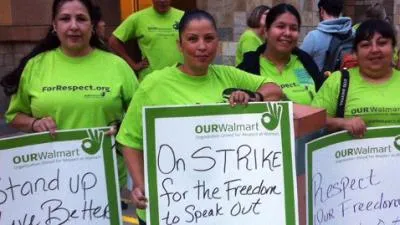
Since the early retailworker strikes in Southern California, a group calling itself OUR Walmart claimed to be supporting the strikers.  Wal-Mart, for their part, have filed for an injuction against the planned Black Friday strikes and demonstrations.  The company alleges that the OUR Walmart is a project of the UFCW and that the protests constitute illegal pickets.

Where Next?

The Black Friday Wal-Mart strike wave could prove to be a watershed moment in US labour history.  It could be a rebirth of American labour, inspiring other service and retail workers to begin organising on the job.  Or it could more of the same: trade unions harvesting the inevitable anger that bubbles up on the shopfloor and using it to prop up themselves as the representatives of labour.

So, as radicals, what can we do?  For one, go to Friday's pickets and protests.  Begin making contacts with the striking workers.  Talk to them about about material issues and don't lecture them about politics.  Instead, offer to support them in ways and with actions that the trade unions won't. 

Deeper political conversations will develop from there. Besides helping to push for more militant actions we can help to inoculate the workers against not only the inevitable backlash they'll face from management, but from the inevitable sell-outs they'll experience if trade unions are allowed to monopolise future actions.

  • Asda
  • analysis
  • strikes
  • USA
  • North London

Guides

Your rights at work

Why do we organise? Capitalism is shit, oppression is shit - but what can we at SolFed do about it?

Why do we organise?

This is our flag - it tells you what we stand for

this-is-our-flag

Direct Action #2 (2024)

Direct Action #2 (2024)

Anarcho-syndicalism in Britain – a little history (2015)

Anarcho-syndicalism in Britain – a little history (2015)

Office worker’s health and safety - your rights and how to use them (2015)

Office worker’s health and safety - your rights and how to use them (2015)

Anarchism and Anarcho-syndicalism (Rudolf Rocker, 2014)

Anarchism and Anarcho-syndicalism (Rudolf Rocker, 2014)

Fighting for ourselves - anarcho-syndicalism and the class struggle (2012)

Fighting for ourselves - anarcho-syndicalism and the class struggle (2012)

Theory & Practice 1 - Workmates - direct action workplace organising on the London underground (2011)

Theory & Practice 1 - Workmates - direct action workplace organising on the London underground (2011)

The Economics of freedom (2003)

The Economics of freedom (2003)

A history of anarcho-syndicalism (SelfEd Collective, 24 unit series, 2001)

A history of anarcho-syndicalism (SelfEd Collective, 24 unit series, 2001)

Out of the frying pan, a critical look at works councils (1998)

Out of the frying pan, a critical look at works councils (1998)

Health and safety at work - an anarcho-syndicalist approach (1997)

Health and safety at work - an anarcho-syndicalist approach (1997)

Theory & Practice 2 - Anarcho-syndicalism in Puerto Real (1994)

Theory & Practice 2 - Anarcho-syndicalism in Puerto Real (1994)
RSS feed