
Home
Solidarity Federation
IWA
User account menu
  • Contact
  • Log in
  • Home
    • Intro
    • Workplace organiser training
    • Industrial strategy
    • Community strategy
    • Constitution
  • SolFed
    • Brighton
    • Bristol
    • Edinburgh
    • Liverpool
    • Manchester
    • North London
    • Wales
    • Yorkshire
  • Industries & sectors
    • Claimants and unpaid
    • Education
    • Health and social care
    • Hospitality
  • Events & reports
  • Publications
    • Guides
      • Stuff your boss (doesn't want you to know)
      • Stuff your sexist boss (doesn't want you to know) (2018)
      • Stuff your landlord (doesn't want you to know) (2016)
      • Is your cleaning job killing you? A guide to cleaners health and safety (2017)
      • Office worker’s health and safety - your rights and how to use them (2015)
      • A migrant's guide to Manchester (2016) [en es]
      • A migrant's guide to London (2014) [en es pl]
      • Strike - a guide to walking out (2014)
    • Pamphlets and books
      • Anarcho-syndicalism in Britain – a little history (2015)
        • 1. 19th century to 1914 - The First International, growth of industrial unionism and the Great Unrest
        • 2. 1914–1945 - State suppression and the Bolshevik turn – how Lenin’s seeming success drew militants to the Comintern
        • 3. 1945–1994 - The Anarchist Federation of Britain, Syndicalist Workers’ Federation and Direct Action Movement
        • 4. Today’s movement - A short look at the strategy and thinking of the modern Solidarity Federation
      • Office worker’s health and safety - your rights and how to use them (2015)
      • Anarchism and Anarcho-syndicalism (Rudolf Rocker, 2014)
        • Introduction
        • 1. Ideology of Anarchism
        • 2. History of anarchist philosphy, from Lao-Tse to Kropotkin
        • 3. The origins of anarcho-syndicalism
        • 4. Socialism and anarcho-syndicalism in France
        • 5. The role of the trade unions: anarcho-syndicalist view
        • 6. The struggle in Germany and Spain
        • 7. The political struggle: anarcho-syndicalist view
        • 8. Anarcho-syndicalism since the First World War
      • Fighting for ourselves - anarcho-syndicalism and the class struggle (2012)
        • Introduction
        • 1. The mainstream workers' movement
        • 2. Radical currents in the workers' movement
        • 3. Anarcho-syndicalism in the 20th century
        • 4. Capitalism and the class struggle since World War II
        • 5. Anarcho-syndicalism in the 21st century
        • Endnotes
      • Workmates - direct action workplace organising on the London underground (2011)
      • The Economics of freedom (2003)
      • A history of anarcho-syndicalism (2001)
      • Out of the frying pan, a critical look at works councils (1998)
      • Health and safety at work - an anarcho-syndicalist approach (1997)
      • Anarcho-syndicalism in Puerto Real (1994)
    • Leaflets and flyers
      • Solidarity Federation Education Union (SFEU)
      • Solidarity Federation Hospitality Workers Union (SFHWU)
      • Why do we organise?
      • This is our flag - it tells you what we stand for
      • What is anarcho-syndicalism anyway?
      • Anarchism and Syndicalism (short version)
      • Anarchism and Syndicalism
      • Towards a better union
      • Protest is not enough
      • Building beyond elections
      • We should run our workplaces
      • We should run our communities
      • We should run our movements
    • Newsletters
      • Brighton Solidarity
        • Brighton Solidarity #3
      • Education Worker
        • Education Worker #10 Victimisation (2013)
        • Education Worker #9 (2012)
        • Education Worker #8 Academy Special (2012)
      • Wildcat!
        • Wildcat! #13 (Jan 2013)
        • Wildcat! (Winter 2012)
        • Wildcat! #6 (Summer 2011)
        • Wildcat! #5 (Spring 2011)
        • Wildcat! #4 (Dec 2010)
        • Wildcat! #3 (Oct-Nov 2010)
        • Wildcat! #2 (Jul-Aug 2010)
        • Wildcat! Football for the fans NOT for fat cats! (Jul 2010)
        • Wildcat! #1 (May-June 2010)
      • May Day Bulletin (Newcastle SolFed, 2014)
    • Direct Action
      • Direct Action #2 (2024)
      • Direct Action #1 (2023)
      • Direct action #47 (Summer 2009)
    • Catalyst
      • Catalyst #29 (Feb 2012)
      • Catalyst #28 (Oct 2011)
      • Catalyst #27 (Jun 2011)
      • Catalyst #26 (Mar 2011)
      • Catalyst #25 (Dec 2010)
      • Catalyst #24 (Summer 2010)
    • SelfEd
      • A history of anarcho-syndicalism
        • Block 1
          • Unit 1: The Origins of Capitalism
          • Unit 2: Britain: The Radical Period 1750-1840
          • Unit 3: The First International
          • Unit 4: France 1870-1918 Early revolutionary unions
          • Unit 5: Revolutionary Syndicalism in Britain, 1870-1910
          • Unit 6: Revolutionary Syndicalism in Britain and Ireland, 1910-17
        • Block 2
          • Unit 7: Mexico 1870-1920: Colonialism and Revolution
          • Unit 8: USA 1886-1930 - The Wobblies
          • Unit 9: Anarcho-syndicalism in Argentina 1870-1939
          • Unit 10: Sweden 1889-1939
          • Unit 11: Russia I: 1850-1917
          • Unit 12 Russia II: 1917-30
        • Block 3
          • Unit 13: Going Global - International Organisation, 1872-1922
          • Unit 14: Anarcho-syndicalism in Britain, 1914-30
          • Unit 15 Spain, 1868-1936: Build-up to Revolution
          • Unit 16 Spain: Culture, education, women and sexuality
          • Unit 17: Spain 1936-39: Revolution and Civil War
          • Unit 18: Spain - The Collectives
        • Block 4
          • Unit 19: Britain, 1930-1950 - The Era of Reform
          • Unit 20: Britain, 1950-1990 - Decline of Social Democracy
          • Unit 21: anarcho-syndicalism 1939-99
          • Unit 22: Roots of modern anarcho-syndicalism: freedom, oppression & rebellion
          • Unit 23: Roots of modern anarcho-syndicalism: morality, culture & tactics
          • Unit 24: The spirit of anarcho-syndicalism
    • Letters
  • IWA

Breadcrumb

  1. Home

analysis

By Jerome Baxter, 22 November, 2012
s

The Black Friday Wal-Mart Strikes: An Analysis

Friday the 23rd of November will see Wal-Mart, which owns UK chain ASDA and which has an entirely non-union workforce, hit with coordinated strikes and protests.  The date of these strikes is not arbitrary.  It's “Black Friday”, the busiest shopping day of the year in the US. 

This article, written by a American-born SolFedder who's worked retail in the past, seeks to explore the strikes: their roots and their implications for the American working class.


Tags

  • Asda
  • analysis
  • strikes
  • USA
  • North London
By Joseph Kay, 20 March, 2011

Winning the argument, or winning the fight?

There’s been a lot of talk in the anti-cuts movement about the importance of ‘winning the argument’. This strategy holds that the best way to go about fighting attacks on wages, living conditions and services is to point out the flaws in the pro-cuts arguments and suggest alternative policies which would avoid the need for cuts.

Some even seem to think that if the argument is won, the government will see the error of its ways, stop the planned cuts and everyone can go home happy.

It isn’t hard to see where this strategy falls down. It certainly isn’t the weakness of the anti-cuts arguments; it’s been convincingly shown that these cuts aren’t ‘necessary’ at all.

No, its mistake is the belief that society is based on rational arguments in the first place. Our society is not a debating chamber, but a power struggle between different groups with competing interests.

Tags

  • analysis
  • cuts
By Joseph Kay, 22 February, 2011

Graduates - no future?

A postgraduate student at Sussex university assesses the future facing graduates.

Paul Mason, BBC Newsnight’s economics editor has suggested of the unrest in Tunisia, Egypt, Greece, France, London and elsewhere that "at the heart if it all is a new sociological type: the graduate with no future".[1] All manner of lefties have been standing in Library Square, entreating us to 'defend education' with petitions, placards and processions. Few of us have taken up the request. What is there to defend? The current education cuts will no doubt make things worse, but it’s not education we need to defend but our conditions of life, both at university and more importantly for the rest of our lives. We need to turn our critical faculties both on our education and on the society it is preparing us for. Do we have a future? Is it worth the sacrifices it demands?

Tags

  • analysis
  • cuts
  • alienation
  • education
  • Sussex University
By Stevil54, 11 February, 2011

Multiculturalism, diversity and equality

Much has been said about David Cameron’s recent speech on the failure of multiculturalism. Predictably the left have condemned what was said and rushed to the defence of the multicultural society.  Trouble is there is a big difference between the realities of living in a society with various cultures and the concept of multiculturalism.   In the years of the New Labour governments multiculturalism was pushed to the fore along with the twin ideas of equality and diversity. Of course this was all part of the New Labour mantra of ‘everyone is middle class’ that really fooled no-one, especially the working class. The idea of class was subsumed under the banner of multiculturalism and diversity. The industry that sprung up to around these ideas giving workshops and training on ‘equality and diversity’ concentrated on race, gender, sexuality, disability, even religion, but class was left off the list.

Tags

  • analysis
  • culture
  • racism
  • left wing parliamentarism
  • right wing parliamentarism
  • immigration
By Joseph Kay, 20 January, 2011

The paradox of reformism - a call for economic blockades

Neoliberal ideology is a crock of shit and everyone left of Labour knows it. Critics have pointed out its flawed assumptions regarding perfect competition, consumer access to information, human nature and a host of other factors that nowhere apply in the real world. They’ve also pointed out that where neoliberal policies have been applied, the results have often been disastrous and rarely matched the promised outcomes of prosperity for the rich and trickle down for the poor. One famous example was the so-called J-curve model for transitioning the former USSR to Western-style capitalism. The ‘J’, a small downswing in transition followed by a long upswing when neoliberal policies worked their magic, turned into something more resembling an ‘L’, plunging millions into worse poverty than before.

And then there’s the cuts.

Tags

  • analysis
  • cuts
  • exploitation
  • workers' movement
  • resistance
By Archiver, 22 December, 2010

Credit Crunches and Capitalist Calamities

Just when you think the credit crunch may be past the worse, along comes another bank, or two, or three, going bust and the financial system is thrown yet again into crisis. And as each crisis hits, governments rush in with our billions, to keep the whole financial sector from collapse.

So much for all that crap preached for years about the need for market discipline under which uneconomic companies are allowed to go to the wall. It would seem that the iron laws of the free market only apply to coal mines. The banks are allowed to play by another set of free market rules, in which the well connected are allowed to make billions from corrupt deals, then when it all starts to fall apart, we pay the price with rising unemployment, falling living standards and repossessions. In the words of the old song, it’s the rich who get the pleasure and the poor who get the blame.

Tags

  • analysis
  • credit crunch
  • crisis
By Joseph Kay, 5 December, 2010

Notes on the violent minority

The Millbank riot and some of the subsequent student protests have been widely condemned in the media as the actions of a 'violent minority'. NUS president Aaron Porter infamously described the riot as ‘despicable’. Property destruction, we were told, undermined the message of the NUS’ peaceful protest. This was the behaviour of ‘anarchists’, outsiders hijacking what would otherwise be respectable political protest in a liberal democracy. But liberals would do well to reflect on their own glass house before casting such rhetorical stones.

Liberalism: doctrine of the violent minority

Liberalism in fact is nothing but the ideology of minority violence par excellence. Margaret Thatcher’s favourite thinker, Adam Smith, was refreshingly frank about this back in the 18th century:

Tags

  • analysis
  • liberalism
  • violence
  • police
By no1, 26 September, 2010

Breeding like Rats: the professional middle classes under new labour

Tags

  • analysis
  • New Labour
  • managerialism
By Joseph Kay, 23 May, 2010

We don’t need a party

After the failure at the polls, much attention from socialists and trade unionists has fallen upon the possibilities of working class political representation. While some talk of ‘reclaiming’ the Labour Party for the workers movement, others feel this party has had it’s day, and a replacement is needed. The Trade Unionist and Socialist Coalition (TUSC) can in many ways be seen as the springboard for the latest such attempt  – coming on the heels of past attempts, such as Arthur Scargil’s Socialist Labour Party.

Labour themselves resorted to ‘class war’ rhetoric in a supposed ‘core vote’ strategy during the election campaign. This is not of course a new idea. The Labour Party was founded in the early 20th century, and subsequently set about supporting imperialist wars and breaking strikes. So why after a century of failure is the idea of a workers’ party stubbornly refusing to die?

Tags

  • analysis
  • anarcho-syndicalism
  • political parties
By Joseph Kay, 27 September, 2009

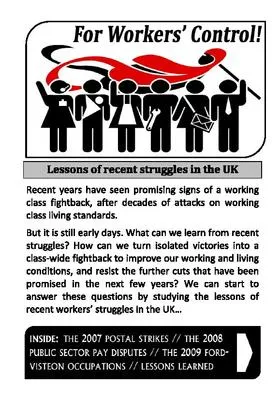
For Workers Control - Lessons of recent struggles in the UK

8-page leaflet looking at what we can learn from the 2007 postal strike, the 2008 public sector strike and the 2009 Visteon occupation.

The leaflet was produced for a demo against the Labour Party Conference on Sunday 27th September. It is based on several previously published articles and we try to draw the lessons of recent relevant struggles in the UK.

For Workers’ Control

Lessons of recent struggles in the UK

Recent years have seen promising signs of a working class fightback, after decades of attacks on working class living standards.

But it is still early days. What can we learn from recent struggles? How can we turn isolated victories into a class-wide fightback to improve our working and living conditions, and resist the further cuts that have been promised in the next few years? We can start to answer these questions by studying the lessons of recent workers’ struggles in the UK…


Attachment Size
for-workers-control.pdf (792.85 KB) 792.85 KB

Tags

  • analysis
  • leaflets and flyers
  • Communication Workers Union (CWU)
  • strikes
  • trade unions
  • UNISON – the Public Service Union
  • Royal Mail
  • Visteon
analysis

Guides

Your rights at work

Why do we organise? Capitalism is shit, oppression is shit - but what can we at SolFed do about it?

Why do we organise?

This is our flag - it tells you what we stand for

this-is-our-flag

Direct Action #2 (2024)

Direct Action #2 (2024)

Anarcho-syndicalism in Britain – a little history (2015)

Anarcho-syndicalism in Britain – a little history (2015)

Office worker’s health and safety - your rights and how to use them (2015)

Office worker’s health and safety - your rights and how to use them (2015)

Anarchism and Anarcho-syndicalism (Rudolf Rocker, 2014)

Anarchism and Anarcho-syndicalism (Rudolf Rocker, 2014)

Fighting for ourselves - anarcho-syndicalism and the class struggle (2012)

Fighting for ourselves - anarcho-syndicalism and the class struggle (2012)

Theory & Practice 1 - Workmates - direct action workplace organising on the London underground (2011)

Theory & Practice 1 - Workmates - direct action workplace organising on the London underground (2011)

The Economics of freedom (2003)

The Economics of freedom (2003)

A history of anarcho-syndicalism (SelfEd Collective, 24 unit series, 2001)

A history of anarcho-syndicalism (SelfEd Collective, 24 unit series, 2001)

Out of the frying pan, a critical look at works councils (1998)

Out of the frying pan, a critical look at works councils (1998)

Health and safety at work - an anarcho-syndicalist approach (1997)

Health and safety at work - an anarcho-syndicalist approach (1997)

Theory & Practice 2 - Anarcho-syndicalism in Puerto Real (1994)

Theory & Practice 2 - Anarcho-syndicalism in Puerto Real (1994)
RSS feed