Home
Solidarity Federation
IWA
User account menu
  • Contact
  • Log in
  • Home
    • Intro
    • Workplace organiser training
    • Industrial strategy
    • Community strategy
    • Constitution
  • SolFed
    • Brighton
    • Bristol
    • Edinburgh
    • Liverpool
    • Manchester
    • North London
    • Wales
    • Yorkshire
  • Industries & sectors
    • Claimants and unpaid
    • Education
    • Health and social care
    • Hospitality
  • Events & reports
  • Publications
    • Guides
      • Stuff your boss (doesn't want you to know)
      • Stuff your sexist boss (doesn't want you to know) (2018)
      • Stuff your landlord (doesn't want you to know) (2016)
      • Is your cleaning job killing you? A guide to cleaners health and safety (2017)
      • Office worker’s health and safety - your rights and how to use them (2015)
      • A migrant's guide to Manchester (2016) [en es]
      • A migrant's guide to London (2014) [en es pl]
      • Strike - a guide to walking out (2014)
    • Pamphlets and books
      • Anarcho-syndicalism in Britain – a little history (2015)
        • 1. 19th century to 1914 - The First International, growth of industrial unionism and the Great Unrest
        • 2. 1914–1945 - State suppression and the Bolshevik turn – how Lenin’s seeming success drew militants to the Comintern
        • 3. 1945–1994 - The Anarchist Federation of Britain, Syndicalist Workers’ Federation and Direct Action Movement
        • 4. Today’s movement - A short look at the strategy and thinking of the modern Solidarity Federation
      • Office worker’s health and safety - your rights and how to use them (2015)
      • Anarchism and Anarcho-syndicalism (Rudolf Rocker, 2014)
        • Introduction
        • 1. Ideology of Anarchism
        • 2. History of anarchist philosphy, from Lao-Tse to Kropotkin
        • 3. The origins of anarcho-syndicalism
        • 4. Socialism and anarcho-syndicalism in France
        • 5. The role of the trade unions: anarcho-syndicalist view
        • 6. The struggle in Germany and Spain
        • 7. The political struggle: anarcho-syndicalist view
        • 8. Anarcho-syndicalism since the First World War
      • Fighting for ourselves - anarcho-syndicalism and the class struggle (2012)
        • Introduction
        • 1. The mainstream workers' movement
        • 2. Radical currents in the workers' movement
        • 3. Anarcho-syndicalism in the 20th century
        • 4. Capitalism and the class struggle since World War II
        • 5. Anarcho-syndicalism in the 21st century
        • Endnotes
      • Workmates - direct action workplace organising on the London underground (2011)
      • The Economics of freedom (2003)
      • A history of anarcho-syndicalism (2001)
      • Out of the frying pan, a critical look at works councils (1998)
      • Health and safety at work - an anarcho-syndicalist approach (1997)
      • Anarcho-syndicalism in Puerto Real (1994)
    • Leaflets and flyers
      • Solidarity Federation Education Union (SFEU)
      • Solidarity Federation Hospitality Workers Union (SFHWU)
      • Why do we organise?
      • This is our flag - it tells you what we stand for
      • What is anarcho-syndicalism anyway?
      • Anarchism and Syndicalism (short version)
      • Anarchism and Syndicalism
      • Towards a better union
      • Protest is not enough
      • Building beyond elections
      • We should run our workplaces
      • We should run our communities
      • We should run our movements
    • Newsletters
      • Brighton Solidarity
        • Brighton Solidarity #3
      • Education Worker
        • Education Worker #10 Victimisation (2013)
        • Education Worker #9 (2012)
        • Education Worker #8 Academy Special (2012)
      • Wildcat!
        • Wildcat! #13 (Jan 2013)
        • Wildcat! (Winter 2012)
        • Wildcat! #6 (Summer 2011)
        • Wildcat! #5 (Spring 2011)
        • Wildcat! #4 (Dec 2010)
        • Wildcat! #3 (Oct-Nov 2010)
        • Wildcat! #2 (Jul-Aug 2010)
        • Wildcat! Football for the fans NOT for fat cats! (Jul 2010)
        • Wildcat! #1 (May-June 2010)
      • May Day Bulletin (Newcastle SolFed, 2014)
    • Direct Action
      • Direct Action #2 (2024)
      • Direct Action #1 (2023)
      • Direct action #47 (Summer 2009)
    • Catalyst
      • Catalyst #29 (Feb 2012)
      • Catalyst #28 (Oct 2011)
      • Catalyst #27 (Jun 2011)
      • Catalyst #26 (Mar 2011)
      • Catalyst #25 (Dec 2010)
      • Catalyst #24 (Summer 2010)
    • SelfEd
      • A history of anarcho-syndicalism
        • Block 1
          • Unit 1: The Origins of Capitalism
          • Unit 2: Britain: The Radical Period 1750-1840
          • Unit 3: The First International
          • Unit 4: France 1870-1918 Early revolutionary unions
          • Unit 5: Revolutionary Syndicalism in Britain, 1870-1910
          • Unit 6: Revolutionary Syndicalism in Britain and Ireland, 1910-17
        • Block 2
          • Unit 7: Mexico 1870-1920: Colonialism and Revolution
          • Unit 8: USA 1886-1930 - The Wobblies
          • Unit 9: Anarcho-syndicalism in Argentina 1870-1939
          • Unit 10: Sweden 1889-1939
          • Unit 11: Russia I: 1850-1917
          • Unit 12 Russia II: 1917-30
        • Block 3
          • Unit 13: Going Global - International Organisation, 1872-1922
          • Unit 14: Anarcho-syndicalism in Britain, 1914-30
          • Unit 15 Spain, 1868-1936: Build-up to Revolution
          • Unit 16 Spain: Culture, education, women and sexuality
          • Unit 17: Spain 1936-39: Revolution and Civil War
          • Unit 18: Spain - The Collectives
        • Block 4
          • Unit 19: Britain, 1930-1950 - The Era of Reform
          • Unit 20: Britain, 1950-1990 - Decline of Social Democracy
          • Unit 21: anarcho-syndicalism 1939-99
          • Unit 22: Roots of modern anarcho-syndicalism: freedom, oppression & rebellion
          • Unit 23: Roots of modern anarcho-syndicalism: morality, culture & tactics
          • Unit 24: The spirit of anarcho-syndicalism
    • Letters
  • IWA

Underemployment, casualisation and the future of work

By Tony, 12 July, 2018
c

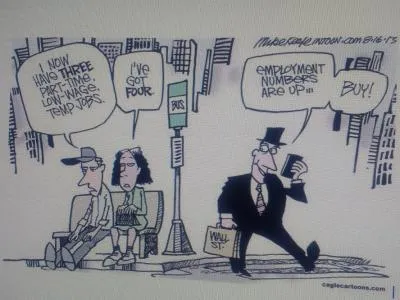
Underemployment is the term used for workers who get fewer hours than they want and need to live on. In the UK there are now at least 1.4 million workers on zero-hours contracts and 865,000 agency workers, many of whom struggle to get enough hours a week to survive on. Added to which, companies are increasingly employing people on a part-time basis, often on contracts of 10 hours or less. This leaves workers dependent on any extra hours management may choose to offer them. According to the Office for National Statistics, just under 10% of the working population or 3.3 million people want more hours; or to put it another way, are part unemployed.  To put this into context there are now twice as many people underemployed as there are unemployed.

The practice of underemployment puts management into a powerful position, enabling them to dictate working conditions and create a workplace culture of fear and permanent insecurity, where workers feel they have to put up with just about anything or risk being sanctioned by not being offered any extra hours available. Studies have shown that, where there is a high level of underemployment, the culture of the workplace is characterised by discrimination, sexual harassment and assault, high levels of stress and mental illness, bullying, arbitrary rules, favouritism and wage theft. It can also make balancing work, childcare, and school a nightmare given the need to take on extra hours often at short notice to make up pay.

“We only find out on the day, or the day before, about how many hours we will work and about our start and finish times. I am a single mother of two children and it is very difficult for me. ”

The reality behind underemployment was revealed in a survey of 450,000 USDAW union members. The survey was largely of workers in retail, warehouse and distribution along with road transport.  The survey revealed that 60% of respondents have contracts for 30 hours or less. Almost two-thirds (64%), of those taking part in the survey, regularly work additional hours above their contracted hours. The survey found that two-thirds would like these extra hours to be guaranteed.  It also found that one in every three of respondents said they would like to work longer hours.

The survey also found an increasing use of agency workers with one in twenty workers (5%) reporting that at least half of the workforce are agency staff. It was also found that many workers have to take on extra jobs to make ends meet with 8% having a second job, with a further 20% looking for a second job. The survey also shows an alarming increase in the use of short-hours contracts - contracts of 10 hours or less - as a means of avoiding the bad publicity now associated with zero hours contracts. The overwhelming majority that took part in the survey stated they wanted more job security and guarantees over hours with 98% stating that they believed that workers should have a right to contracts that reflect their normal hours.

The USDAW survey is alarming as it points to a big growth in underemployment in the traditional sectors of the economy where it has generally been assumed jobs are more secure. It now appears that these sectors are moving towards the conditions found in the “gig” economy, where the majority of employees' hours vary from week to week according to business needs.  

“Agency workers at my workplace are very unhappy with the way they are treated. They come into work; many have spent up to £6 just to get to work; when they arrive, they find that they are sent home after one hour.”

That big-named companies are now using underemployment, as a means to cut cost and increase profits, should not come as too big of a surprise.  This process has been underway in the US retail sector for many years and has become commonly known as “short shifted.” In the US, retail companies have introduced just in time scheduling” and use other “lean” manufacturing practices managing an increasingly part time workforce and cut wage cost to the bone.  

The key to the introduction of these “lean” manufacturing practices has been the use of the latest technologies, which has allowed retailers to track sales patterns and predict labour costs with far greater precision. This has enabled US retailers to cut or increases workers hours in line with fluctuations in business.  For example, if there is bad weather, the scheduling algorithm can indicate that employees should be sent home before their shift ends. Another example is to use detectors embedded in the welcome mat in shops that measure conversion rates — how many people enter the store in relation to how many walk out with bags — and plan work schedules accordingly.

Methods like this, have allowed, even large retail companies employing thousands of workers, to tailor the working hours of individual workers to cut cost. To the extent that companies are able to use sales per hour of individual workers for one week to determine their work schedule for the next. This not only cuts cost, it puts constant pressure on workers to sell more or have their hours cut. This has led to guaranteed full time employment increasingly the preserve of managers and long-term employees with the majority of the workforce on part time contracts with many in constant need of extra hours.

“I’m not considered full-time but during the holiday season I work full-time hours. Only managers can get full-time status officially.”

Not surprisingly these “lean” manufacturing practices has spread beyond retail in the US and are now being used in fast food and full-service restaurants, hotels, entertainment, construction, and information sectors. The USDAW survey would indicate that “lean” manufacturing practices are being imported into the UK economy.  Amazon, for example, regularly sends workers home when not enough work is available and uses the practice, common in US retail, of getting workers to compete with each other for the reward of extra hours.

In the UK, much has been made of the dangers posed by new technology and focus has rightly been on increasing automation and the threat to jobs. However, the danger of technology being used to casualise low-tech “unskilled” jobs, is just as real. This may well have big implications for the future of work in the UK. Already there is evidence that, in the UK, companies are reluctant to invest in labour saving technology due to the price of labour being cheap. With new technologies been used to drive down labour cost, making automation less cost effective, we may well see the workforce increasingly dominated by state subsidised, underemployed workers, whose lives by necessity revolve around the constant to need to work more hours to make up pay. A scenario even more likely, should some form of universal basic income be introduced.

As a union, Solidarity Federation is committed to developing new methods of organising to meet the challenges of a rapidly changing economy. Part of which includes running a workplace organiser training course which is open to everyone. For more information contact training@solfed.org.uk.

  • casualisation

Guides

Your rights at work

Why do we organise? Capitalism is shit, oppression is shit - but what can we at SolFed do about it?

Why do we organise?

This is our flag - it tells you what we stand for

this-is-our-flag

Direct Action #2 (2024)

Direct Action #2 (2024)

Anarcho-syndicalism in Britain – a little history (2015)

Anarcho-syndicalism in Britain – a little history (2015)

Office worker’s health and safety - your rights and how to use them (2015)

Office worker’s health and safety - your rights and how to use them (2015)

Anarchism and Anarcho-syndicalism (Rudolf Rocker, 2014)

Anarchism and Anarcho-syndicalism (Rudolf Rocker, 2014)

Fighting for ourselves - anarcho-syndicalism and the class struggle (2012)

Fighting for ourselves - anarcho-syndicalism and the class struggle (2012)

Theory & Practice 1 - Workmates - direct action workplace organising on the London underground (2011)

Theory & Practice 1 - Workmates - direct action workplace organising on the London underground (2011)

The Economics of freedom (2003)

The Economics of freedom (2003)

A history of anarcho-syndicalism (SelfEd Collective, 24 unit series, 2001)

A history of anarcho-syndicalism (SelfEd Collective, 24 unit series, 2001)

Out of the frying pan, a critical look at works councils (1998)

Out of the frying pan, a critical look at works councils (1998)

Health and safety at work - an anarcho-syndicalist approach (1997)

Health and safety at work - an anarcho-syndicalist approach (1997)

Theory & Practice 2 - Anarcho-syndicalism in Puerto Real (1994)

Theory & Practice 2 - Anarcho-syndicalism in Puerto Real (1994)
RSS feed