Home
Solidarity Federation
IWA
User account menu
  • Contact
  • Log in
  • Home
    • Intro
    • Workplace organiser training
    • Industrial strategy
    • Community strategy
    • Constitution
  • SolFed
    • Brighton
    • Bristol
    • Edinburgh
    • Liverpool
    • Manchester
    • North London
    • Wales
    • Yorkshire
  • Industries & sectors
    • Claimants and unpaid
    • Education
    • Health and social care
    • Hospitality
  • Events & reports
  • Publications
    • Guides
      • Stuff your boss (doesn't want you to know)
      • Stuff your sexist boss (doesn't want you to know) (2018)
      • Stuff your landlord (doesn't want you to know) (2016)
      • Is your cleaning job killing you? A guide to cleaners health and safety (2017)
      • Office worker’s health and safety - your rights and how to use them (2015)
      • A migrant's guide to Manchester (2016) [en es]
      • A migrant's guide to London (2014) [en es pl]
      • Strike - a guide to walking out (2014)
    • Pamphlets and books
      • Anarcho-syndicalism in Britain – a little history (2015)
        • 1. 19th century to 1914 - The First International, growth of industrial unionism and the Great Unrest
        • 2. 1914–1945 - State suppression and the Bolshevik turn – how Lenin’s seeming success drew militants to the Comintern
        • 3. 1945–1994 - The Anarchist Federation of Britain, Syndicalist Workers’ Federation and Direct Action Movement
        • 4. Today’s movement - A short look at the strategy and thinking of the modern Solidarity Federation
      • Office worker’s health and safety - your rights and how to use them (2015)
      • Anarchism and Anarcho-syndicalism (Rudolf Rocker, 2014)
        • Introduction
        • 1. Ideology of Anarchism
        • 2. History of anarchist philosphy, from Lao-Tse to Kropotkin
        • 3. The origins of anarcho-syndicalism
        • 4. Socialism and anarcho-syndicalism in France
        • 5. The role of the trade unions: anarcho-syndicalist view
        • 6. The struggle in Germany and Spain
        • 7. The political struggle: anarcho-syndicalist view
        • 8. Anarcho-syndicalism since the First World War
      • Fighting for ourselves - anarcho-syndicalism and the class struggle (2012)
        • Introduction
        • 1. The mainstream workers' movement
        • 2. Radical currents in the workers' movement
        • 3. Anarcho-syndicalism in the 20th century
        • 4. Capitalism and the class struggle since World War II
        • 5. Anarcho-syndicalism in the 21st century
        • Endnotes
      • Workmates - direct action workplace organising on the London underground (2011)
      • The Economics of freedom (2003)
      • A history of anarcho-syndicalism (2001)
      • Out of the frying pan, a critical look at works councils (1998)
      • Health and safety at work - an anarcho-syndicalist approach (1997)
      • Anarcho-syndicalism in Puerto Real (1994)
    • Leaflets and flyers
      • Solidarity Federation Education Union (SFEU)
      • Solidarity Federation Hospitality Workers Union (SFHWU)
      • Why do we organise?
      • This is our flag - it tells you what we stand for
      • What is anarcho-syndicalism anyway?
      • Anarchism and Syndicalism (short version)
      • Anarchism and Syndicalism
      • Towards a better union
      • Protest is not enough
      • Building beyond elections
      • We should run our workplaces
      • We should run our communities
      • We should run our movements
    • Newsletters
      • Brighton Solidarity
        • Brighton Solidarity #3
      • Education Worker
        • Education Worker #10 Victimisation (2013)
        • Education Worker #9 (2012)
        • Education Worker #8 Academy Special (2012)
      • Wildcat!
        • Wildcat! #13 (Jan 2013)
        • Wildcat! (Winter 2012)
        • Wildcat! #6 (Summer 2011)
        • Wildcat! #5 (Spring 2011)
        • Wildcat! #4 (Dec 2010)
        • Wildcat! #3 (Oct-Nov 2010)
        • Wildcat! #2 (Jul-Aug 2010)
        • Wildcat! Football for the fans NOT for fat cats! (Jul 2010)
        • Wildcat! #1 (May-June 2010)
      • May Day Bulletin (Newcastle SolFed, 2014)
    • Direct Action
      • Direct Action #2 (2024)
      • Direct Action #1 (2023)
      • Direct action #47 (Summer 2009)
    • Catalyst
      • Catalyst #29 (Feb 2012)
      • Catalyst #28 (Oct 2011)
      • Catalyst #27 (Jun 2011)
      • Catalyst #26 (Mar 2011)
      • Catalyst #25 (Dec 2010)
      • Catalyst #24 (Summer 2010)
    • SelfEd
      • A history of anarcho-syndicalism
        • Block 1
          • Unit 1: The Origins of Capitalism
          • Unit 2: Britain: The Radical Period 1750-1840
          • Unit 3: The First International
          • Unit 4: France 1870-1918 Early revolutionary unions
          • Unit 5: Revolutionary Syndicalism in Britain, 1870-1910
          • Unit 6: Revolutionary Syndicalism in Britain and Ireland, 1910-17
        • Block 2
          • Unit 7: Mexico 1870-1920: Colonialism and Revolution
          • Unit 8: USA 1886-1930 - The Wobblies
          • Unit 9: Anarcho-syndicalism in Argentina 1870-1939
          • Unit 10: Sweden 1889-1939
          • Unit 11: Russia I: 1850-1917
          • Unit 12 Russia II: 1917-30
        • Block 3
          • Unit 13: Going Global - International Organisation, 1872-1922
          • Unit 14: Anarcho-syndicalism in Britain, 1914-30
          • Unit 15 Spain, 1868-1936: Build-up to Revolution
          • Unit 16 Spain: Culture, education, women and sexuality
          • Unit 17: Spain 1936-39: Revolution and Civil War
          • Unit 18: Spain - The Collectives
        • Block 4
          • Unit 19: Britain, 1930-1950 - The Era of Reform
          • Unit 20: Britain, 1950-1990 - Decline of Social Democracy
          • Unit 21: anarcho-syndicalism 1939-99
          • Unit 22: Roots of modern anarcho-syndicalism: freedom, oppression & rebellion
          • Unit 23: Roots of modern anarcho-syndicalism: morality, culture & tactics
          • Unit 24: The spirit of anarcho-syndicalism
    • Letters
  • IWA

Breadcrumb

  1. Home
  2. industries, occupations and sectors
  3. claimants and unpaid

unemployment

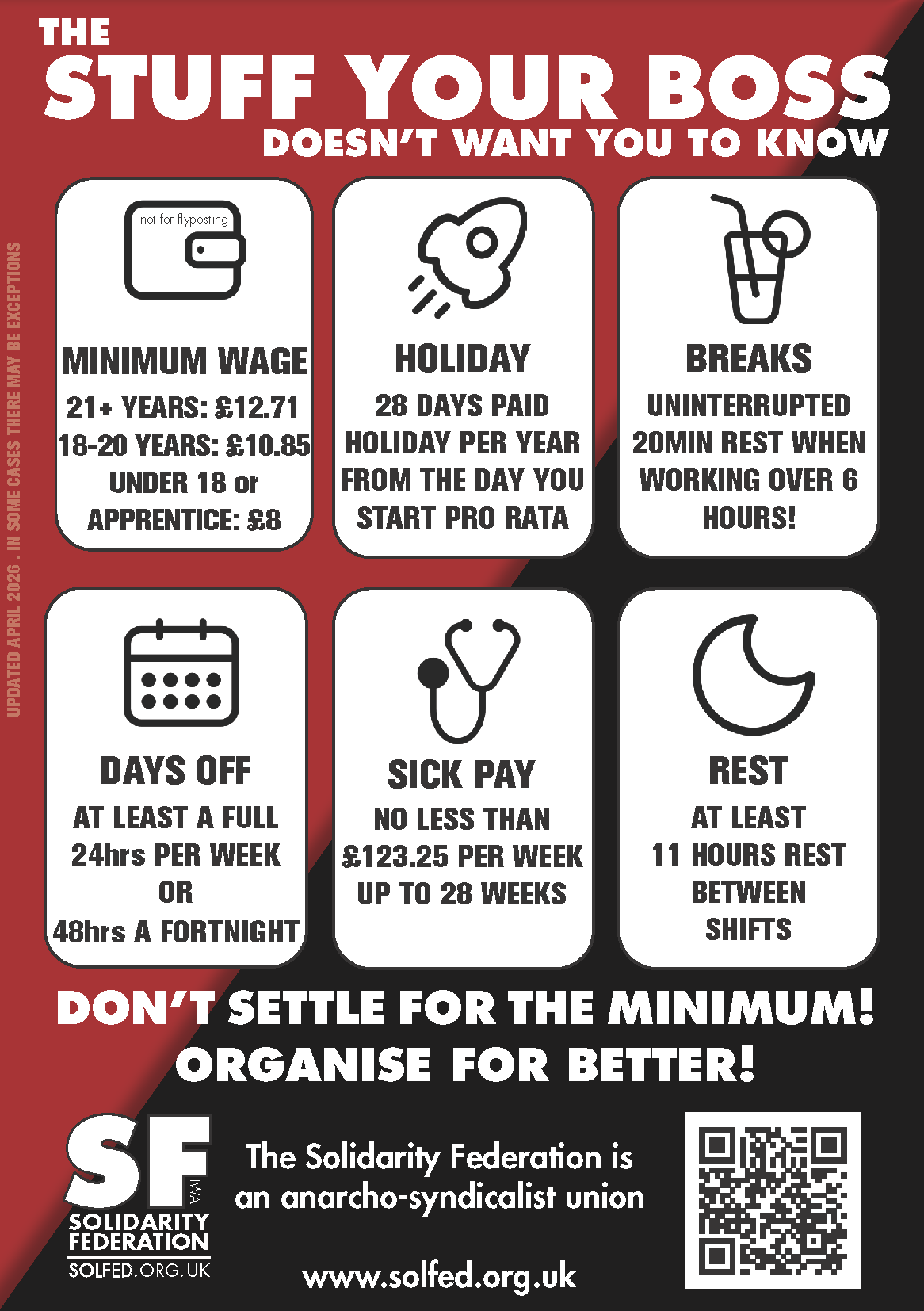
Stuff your boss (doesn't want you to know)

Stuff your boss (doesn't want you to know)Key rights at work

Whether we’re working temporarily or permanently, with an agency, full or part-time, we have certain basic rights ...

Attachment Size
Stuff your boss (doesn't want you to know) sticker 2026.pdf (110.63 KB) 110.63 KB

Tags

  • library
  • publications
  • guides
  • accidents
  • employment agencies
  • breaks
  • casualisation
  • deductions
  • dismissals
  • harassment
  • leave
  • lockouts
  • minimum wage
  • pay and conditions
  • racism
  • sexism
  • sickness
  • unemployment
  • unpaid labour
  • victimisation
  • working hours
  • workplace deaths
  • xenophobia
  • zero hour contracts
By nobrightside, 25 November, 2013
slsf

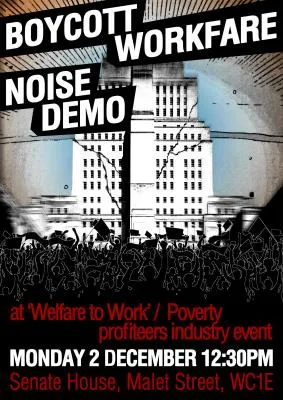
SolFed supports Boycott Workfare's Noise Demo

On 2nd December, those driving forced labour for unemployed people on the government's workfare schemes are getting together for their annual conference at Senate House, Malet Street, London.

ERSA, the trade body for the 'welfare to work' industry, have called their conference "Challenge and change in an evolving landscape". Those attending include Esther McVey (Minister for Employment); Stephen Timms (Shadow Minister for Employment); The Department for Work and Pensions Director of Social Justice; Chairs, Heads and Directors from workfare profiteers A4E, Avanta, Seetec, G4S, Pinnacle People, Groundwork UK, Tomorrow's People; the lead researcher from Ian Duncan Smith's thinktank, the Centre for Social Justice; and the Chief Executive of the Tax Payer's Alliance. All under one roof.

Tags

  • Boycott Workfare
  • unemployment
  • North London
  • workfare
  • protests
  • South London
By Joseph Kay, 24 September, 2012

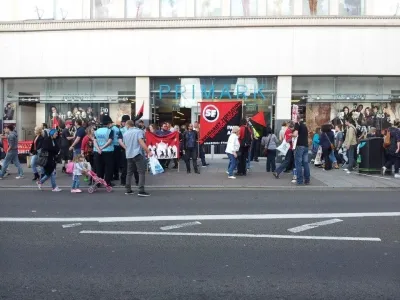
Mass pickets against workfare in Brighton

On Saturday, the Lib Dems' party conference was in Brighton. Following a protest march, there were simultaneous mass pickets of firms using workfare across Brighton. Rather than simply 'having our say' and being ignored by politicians, the idea was to disrupt a high profile coalition policy - the forced, unpaid work schemes known as workfare.

Workfare means unemployed people being forced to do unpaid work for their benefits. Workfare is a state subsidy to private businesses, providing free labour and undercutting the minimum wage. The government’s own research found that in countries that introduced workfare it could actually lower a jobseeker’s chances of finding a job. Where previously these roles would have been filled by paid staff, employers get to take advantage of a growing pool of jobseekers they won’t have to pay.

Tags

  • benefits
  • pickets
  • unemployment
  • workfare
  • retail
By fingersmalone, 10 September, 2012
s

Workfare in Spain

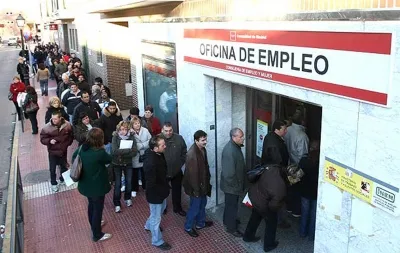
Spain might become the next country in the EU to introduce its own workfare scheme. The government is planning to introduce a compulsory work program for the unemployed. The workers on the program would be paid the official minimum wage but the placements aren’t voluntary and don't have to be connected to the person’s normal trade. The work could last as long as the person has entitlement to claim the dole.

Tags

  • austerity
  • workfare
  • unemployment
  • claimants and unpaid
  • international
  • minimum wage
  • North London
By Joseph Kay, 8 March, 2012
c

The workings of the Work Programme

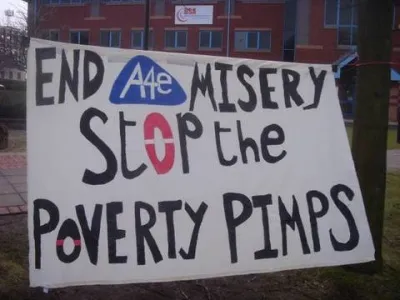
With around six jobseekers to every vacancy it may seem strange that the government is paying private companies to compete with jobseekers to take those jobs, but that is exactly what the Work Programme is about.

Leaked documents show that one of the contracted workfare providers, A4E, suggests daily priorities for its branches should include: reviewing job centre vacancies, newspaper listing, subscribing to job alerts and, of course ‘telesales calls’ (which is to say offering their services to the businesses that are recruiting).

These were and continue to be the tasks assigned to unemployed people as conditions for receiving Jobseeker’s Allowance (JSA) - with a requirement that activity records are kept and sanctions dished out for failure to satisfy the criteria set out in their jobseekers’ agreement.

Tags

  • unemployment
  • workfare
  • claimants and unpaid
By Joseph Kay, 21 February, 2012
c

What to do if you 'fail' your work capability assessment

Know your rights!

Some brief advice on the process of appealing a failed Work Capability Assessment (WCA), as well as some signposting to relevant advice bodies who may be able to assist you.

When you first receive the results of your ATOS WCA and it is a fail, the first thing that many do, as they are panicked and desperate, as they have had their money stopped, is to panic and phone the Job Centre Plus and ask about signing on for Jobseekers Allowance, which is what they want you to do, but there is an alternative and that is by asking for a reconsideration and/or appeal.

How to request reconsideration/appeal

Many claimants have found they have scored “0” points in their WCA and thus their benefits have been suspended. As the suspension notice usually arrives on or after the claimants usual pay day, panic ensues, followed by a call to Job Centre Plus and advice from Job Centre Plus to sign on for Job Seekers Allowance.

Tags

  • ATOS Origin
  • Know your rights
  • ESA
  • job centres
  • unemployment
  • practical advice
  • claimants and unpaid
By AKBlackandRed, 19 November, 2011

Organising against workfare

Workfare is a growing problem, as demonstrated by recent stories of a number of supermarkets had volunteered to be providers for the scheme and that young people were providing 30 hours a week of unpaid labour. This presents a problem both for the claimants trapped by this scheme, essentially as slave labour, and for the providers' workforce who are being undercut by those doing their job at practically no cost. Equally worrying is that, despite the growing anger over government attacks and emergence of anti-cuts groups across the country, nothing is being done to challenge this.
Tags

  • benefits
  • job security
  • job centres
  • job cuts
  • unemployment
  • workfare
  • employment rights
  • resistance
unemployment

Guides

Your rights at work

Why do we organise? Capitalism is shit, oppression is shit - but what can we at SolFed do about it?

Why do we organise?

This is our flag - it tells you what we stand for

this-is-our-flag

Direct Action #2 (2024)

Direct Action #2 (2024)

Anarcho-syndicalism in Britain – a little history (2015)

Anarcho-syndicalism in Britain – a little history (2015)

Office worker’s health and safety - your rights and how to use them (2015)

Office worker’s health and safety - your rights and how to use them (2015)

Anarchism and Anarcho-syndicalism (Rudolf Rocker, 2014)

Anarchism and Anarcho-syndicalism (Rudolf Rocker, 2014)

Fighting for ourselves - anarcho-syndicalism and the class struggle (2012)

Fighting for ourselves - anarcho-syndicalism and the class struggle (2012)

Theory & Practice 1 - Workmates - direct action workplace organising on the London underground (2011)

Theory & Practice 1 - Workmates - direct action workplace organising on the London underground (2011)

The Economics of freedom (2003)

The Economics of freedom (2003)

A history of anarcho-syndicalism (SelfEd Collective, 24 unit series, 2001)

A history of anarcho-syndicalism (SelfEd Collective, 24 unit series, 2001)

Out of the frying pan, a critical look at works councils (1998)

Out of the frying pan, a critical look at works councils (1998)

Health and safety at work - an anarcho-syndicalist approach (1997)

Health and safety at work - an anarcho-syndicalist approach (1997)

Theory & Practice 2 - Anarcho-syndicalism in Puerto Real (1994)

Theory & Practice 2 - Anarcho-syndicalism in Puerto Real (1994)
RSS feed