- A General Strike, Will It Happen?
- Domestic Violence is a Workplace Issue
- How To Support Victims And Survivors Of Domestic Violence At Work
- Solidarity Federation workplace organiser training
- Revitalising Our Collectives: Muddling Through
- Bosses claw back minimum wage increase from workers
- War, poverty, crisis & disease: The true face of the capitalist system
- About Direct Action and Solidarity Federation
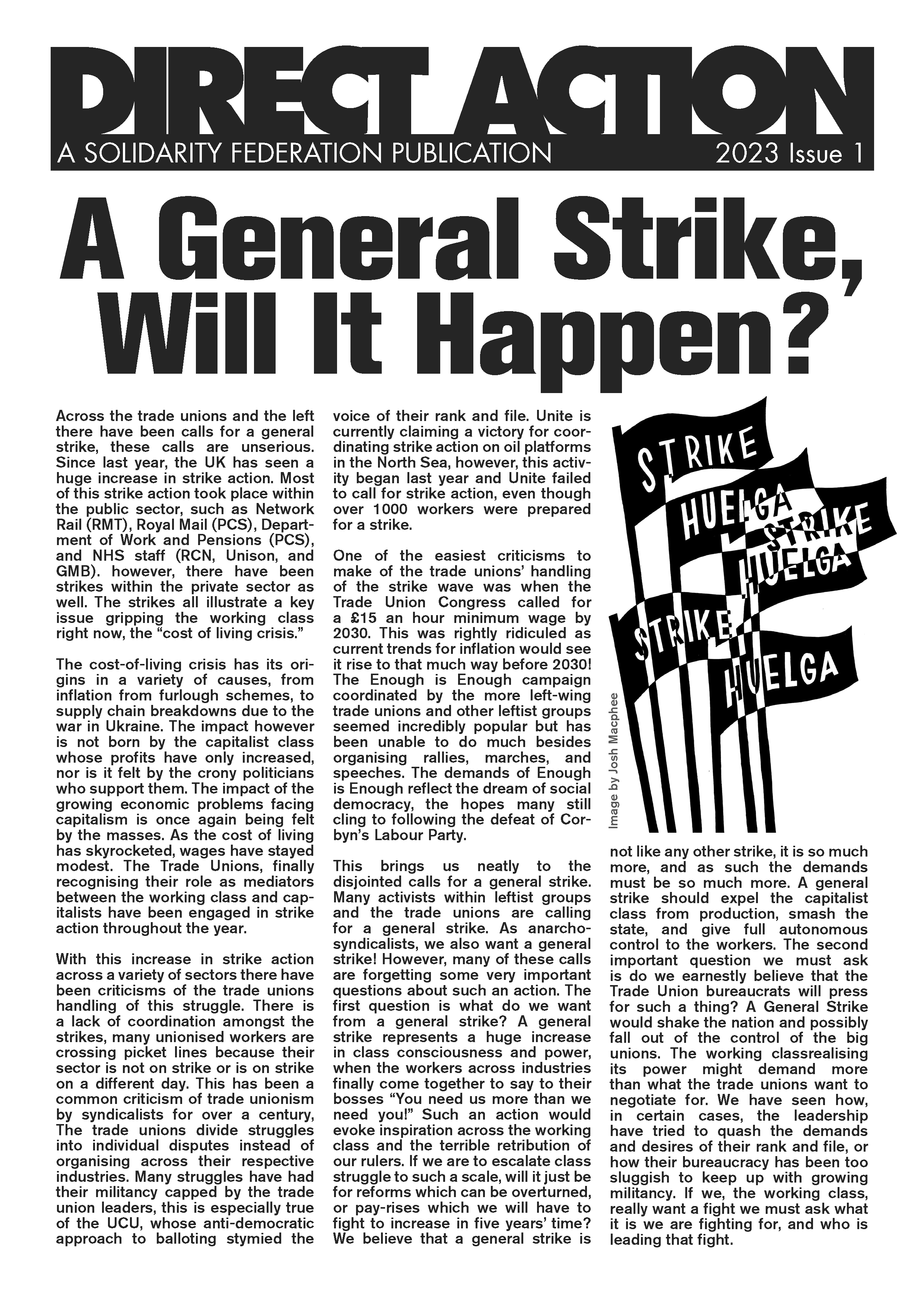
A General Strike, Will It Happen?
Across the trade unions and the left there have been calls for a general strike, these calls are unserious. Since last year, the UK has seen a huge increase in strike action. Most of this strike action took place within the public sector, such as Network Rail (RMT), Royal Mail (PCS), Department of Work and Pensions (PCS), and NHS staff (RCN, Unison, and GMB). however, there have been strikes within the private sector as well. The strikes all illustrate a key issue gripping the working class right now, the “cost of living crisis.”
The cost-of-living crisis has its ori- gins in a variety of causes, from inflation from furlough schemes, to supply chain breakdowns due to the war in Ukraine. The impact however is not born by the capitalist class whose profits have only increased, nor is it felt by the crony politicians who support them. The impact of the growing economic problems facing capitalism is once again being felt by the masses. As the cost of living has skyrocketed, wages have stayed modest. The Trade Unions, finally recognising their role as mediators between the working class and capitalists have been engaged in strike action throughout the year.
With this increase in strike action across a variety of sectors there have been criticisms of the trade unions handling of this struggle. There is a lack of coordination amongst the strikes, many unionised workers are crossing picket lines because their sector is not on strike or is on strike on a different day. This has been a common criticism of trade unionism by syndicalists for over a century, The trade unions divide struggles into individual disputes instead of organising across their respective industries. Many struggles have had their militancy capped by the trade union leaders, this is especially true of the UCU, whose anti-democratic approach to balloting stymied the voice of their rank and file. Unite is currently claiming a victory for coordinating strike action on oil platforms in the North Sea, however, this activity began last year and Unite failed to call for strike action, even though over 1000 workers were prepared for a strike.
One of the easiest criticisms to make of the trade unions’ handling of the strike wave was when the Trade Union Congress called for a £15 an hour minimum wage by 2030. This was rightly ridiculed as current trends for inflation would see it rise to that much way before 2030! The Enough is Enough campaign coordinated by the more left-wing trade unions and other leftist groups seemed incredibly popular but has been unable to do much besides organising rallies, marches, and speeches. The demands of Enough is Enough reflect the dream of social democracy, the hopes many still cling to following the defeat of Corbyn’s Labour Party.
This brings us neatly to the disjointed calls for a general strike. Many activists within leftist groups and the trade unions are calling for a general strike. As anarcho-syndicalists, we also want a general strike! However, many of these calls are forgetting some very important questions about such an action. The first question is what do we want from a general strike? A general strike represents a huge increase in class consciousness and power, when the workers across industries finally come together to say to their bosses “You need us more than we need you!” Such an action would evoke inspiration across the working class and the terrible retribution of our rulers. If we are to escalate class struggle to such a scale, will it just be for reforms which can be overturned, or pay-rises which we will have to fight to increase in five years’ time? We believe that a general strike is not like any other strike, it is so much more, and as such the demands must be so much more. A general strike should expel the capitalist class from production, smash the state, and give full autonomous control to the workers. The second important question we must ask is do we earnestly believe that the Trade Union bureaucrats will press for such a thing? A General Strike would shake the nation and possibly fall out of the control of the big unions. The working class realising its power might demand more than what the trade unions want to negotiate for. We have seen how, in certain cases, the leadership have tried to quash the demands and desires of their rank and file, or how their bureaucracy has been too sluggish to keep up with growing militancy. If we, the working class, really want a fight we must ask what it is we are fighting for, and who is leading that fight.
Domestic Violence is a Workplace Issue
In the UK 1 in 3 women and 2.5% of men will experience domestic violence in their life time. 1 in 5 working women have taken time off because of domestic abuse. And yet, only 5% of employers have specific domestic abuse policies in place to tackle the issue and support their employees [1], [2].
At time of writing, a discussion regarding revision of the legal definition of abuse contained in the Domestic Abuse Bill is taking place. It will now include reference to economic and financial abuse, acknowledging how abusers make their victims dependent by taking control of their resources. TheLaw may have good intentions, but it is not enough. We don’t have time to wait for its implementation, for further revisions, or to wait for associated funding and resources to reach our communities. We don’t have enough paper to list everyone who will remain unprotected under this Law.
For some people fleeing abuse can mean homelessness, or even deportation. Victims without access to public funds (asylum seekers and undocumented migrants) are denied access to shelter when trying to flee their abusers. They have no access to housing or benefits. The police force shares the migration status of abuse victims with the Home Office to assist immigration control. Ethnic Minority, Migrant, Disabled, LGBTQIA, and Unemployed Abuse Victims are and will remain at a higher risk of being left without support, and blamed for their misfortunes.
Furthermore, a combination of poor working conditions and sexism in workplaces can further impede Abuse Victims and Survivors’ ability to access resources and support they need. In creating workplace solidarity, we need to be aware of the fact that our colleagues may be experiencing abuse at home. However, we cannot dismiss the possibility of colleagues being abusers either.
It is our responsibility to educate ourselves and organise to create safer workplaces. If you are in a unionised workplace, get involved and push for better conditions. Ask for domestic abuse policies to be put in place, in line with VAWG (Violence Against Women and Girls) legislation. If your workplace is not unionised, you can still organise with your colleagues to improve your conditions. For example, you could create a support plan for Victims and Survivors, and ensure that no one gets disciplined at work as a result of being abused at home.
How To Support Victims And Survivors Of Domestic Violence At Work:
- Believe them. Respect their privacy. Confidentiality is essential, regardless of your relationship with a person. Do not discuss their private life with other colleagues, friends or management without their permission.
- Remember, fleeing abuse is not always an option. Listen and support, but do not act on or report their situation unless they are in immediate danger. Doing so could unintentionally worsen their situation.
- Help them with their workload, cover for them if they need time out. Do not snitch on them if they haven’t done their work.
- Change shifts or placements with them when possible so their abuser doesn’t know their working pattern.
If possible, answer the phone for them to avoid any calls from the abuser. - Offer to transport them to and from home, to avoid encountering their abuser
- Be prepared in case the abuser visits the workplace.
Show active support accompanying them in disciplinary hearings and sickness reviews. - If the abuser is one of your colleagues (or your boss) make sure they are never alone with them and help by recording evidences of the abuser’s behaviour.
- Take collective action against unfair dismissals and disciplinary action.
Demand Changes In Working Conditions And Workplace Culture To Support Victims:
- Flexible working arrangements, adjust workload while maintaining full pay.
- Paid time off.
- Specific paid leave differentiated from entitled annual leave.
- Adjust working hours, location, change telephone number/email to prevent their abuser from contacting them or visiting the workplace.
- No disciplinary action due to absences or low performance.
- Money advances to support survivors.
- Safe access to specialist services and information.
- Staff training and awareness to ensure any first response is safe and appropriate.
- Elaborate a Domestic Abuse Policy with a safety plan which establishes a support network for victims
Stopping Sexism and gender-based violence is everyone’s responsibility. Last year alone, 2.4 million adults experienced domestic abuse in the UK [3]. We can only change this by being aware of the problem, and organising to address it.
[1][2][3] Footnotes for this article and links for more help or information can be found using the QR code:
Solidarity Federation workplace organiser training
If you are interested in organising your workplace, the Solidarity Federation run a number of training courses including a course aimed at women, and one tailored for LGBTQ+ people who wish to organise in their workplaces. For more information, send an email to: solfed.training@gmail.com
Revitalising Our Collectives: Muddling Through
Many anarchists will have noticed that within some collectives certain difficulties arise when trying to adhere to our principles of horizontal structures.
Unfortunately, these problems tend to go unnoticed until a larger conflict arises and the whole structure becomes part of said conflict.
I think our problem is a reliance on informal and/or accidental elites. This occurs when certain people have a greater personal capacity or a particular set of skills which enable them to take up the lion’s share of vital tasks within the collective.
This is seen as laudable by other members but over time, this handful of people become the only ones who can take initiative in pursuit of the collective’s goals.
Decisions mandated by the collective body now require the energetic cooperation of these individuals in order to be enacted, allowing them to scupper any project they dislike, simply by dragging their feet. For example, few of us are interested in financial work, but if only one person can access the collective fund it can become a disaster if that person refuses to cooperate with the collective
Similarly, an individual may have a forceful or likeable personality which enables them to ‘get things done’ in the short term, but disallows others the same privilege over time. In this case, collective members can grow deferential towards them and cease acting for themselves.
My experiences and research on this topic has given me this general belief: the best collectives are the ones in which every member feels empowered to carry out their common goals in line with the expectations of other members. To counterbalance informal hierarchies, egalitarianism requires recognising that even the most marginal and inexperienced members have important contributions to make and to encourage their involvement. Many hands make light work, while a diversity of skills and creativity is superior to the monotonous whip- discipline of bosses. Plus, being the only one to ever take initiative is damn boring.
For collectives and spaces which have been suffering from low interest the pandemic may have compounded the problem. As many of the “old-timers” drop off this leaves fewer experienced operators alongside many newcomers. As a result, too many of the vital tasks in running spaces/collectives end up falling on the older members’ shoulders while the “new-blood” are confounded by decisions made in meetings and in some cases, they are not aware of them.
So, how should spaces and collectives engage these anarcho-enthusiasts itching to make themselves useful?
Bosses claw back minimum wage increase from workers
Workers at The Ivy Collection, which operates nearly 40 restaurants in the UK & Ireland, got a nasty shock after this year’s minimum wage increase. Staff found that changes to their service charge allocation had wiped out any benefit they should have seen from the increase in the minimum wage.
The standard practice at the chain of restaurants is to pay staff the minimum wage plus an hourly “commission” paid out of service charges. Cash tips paid by diners on top of the service charge, which are legally owned directly by staff, are allocated separately, as are those made via credit card.
The restaurant chain appears to have clawed back the cost of the minimum wage increase by cutting the amount staff normally earned from commission. Workers say that they had not been informed that their share of the service charge would be cut. The workers only discovered what had happened after asking managers why their pay did not appear to have risen after the minimum wage increase.
Such dubious practices will be outlawed by new laws due to come in next year. Under the new laws, employers will have a legal duty to allocate 100% of qualifying tips, gratuities and service charges to their staff with no deductions, save for tax and national insurance. The monies will have to be paid by no later than the end of the month, following the month in which the payment was made by the customer.
Employers will also have to have a clear written policy and process on tipping and critically, will have to keep a written record of their tipping practices. Under the new act employers will also have to give their workers the right to query their tips and access information about their tipping records.
The catch in the new law may well be the current proposal not to allow some of the bank fees/ administration costs to be deducted, this could deter employers from permitting tips/service charges by card. As 80% of transactions are now by card, this could in fact see a reduction in the number of tips being given.
Here lies the problem of individual employment rights, all too often employers find ways to get around them. That is why, as a union, Solidarity Federation always argues that the best way to challenge the power of the employer is by workers getting together and organising.
If you are encountering problems at work, please get in touch or better still why not join Solidarity Federation, the fighting union.
War, poverty, crisis & disease: The true face of the capitalist system
[Reprinted from NWBCW Liverpool]
Russia’s invasion of Ukraine is bringing the world ever closer to its boiling point. Once again the working class across the world are being asked to take sides in a conflict from which we have nothing to gain and everything to lose.
On the one hand Russia, attempting to reclaim what it has lost since the collapse of the USSR. On the other hand NATO, attempting to draw Ukraine further into its sphere of influence. In the background, imperialist line-ups are solidifying, with the EU states rallying behind the US and Russia turning to China.
While the war in Ukraine represents an escalation in the drive to generalised war, it is not the only battleground right now. Whether it’s Syria, Yemen or Palestine, the capitalist class are pitting workers against each other across the world. All in search of financial revenues, raw materials and cheap labour- power. Nationalism – that ideological weapon of divide and rule – calls us to kill and die for a cause which is not ours.
Alongside military conflict, we are in the midst of a class war with our living and working conditions as the sacrifice on the altar of profitability.
Through austerity we were forced to pay for the 2008 financial crash. But the global economy has never quite recovered. Even before the pandemic properly arrived, billions were being pumped into markets every day to keep them afloat and another recession was being predicted. The pandemic was only the spark that lit the flame. Now under the cover of restructuring, we are once again expected to pay for the crisis. Across workplaces we are seeing wages falling behind inflation, sackings, fire-and-rehire, pension and benefit cuts and various other assaults on our class.
Meanwhile at home we face food and fuel price rises, higher rents, more bills and more taxes. All the while the rich grow richer. The war, as it upsets supply chains even further, will make the situation even worse.
Finally, let’s not forget the climate crisis. Floods, fires and extreme weather events are gradually making whole swathes of the planet uninhabitable. The ruling class continues to treat the planet like their private backyard with little consideration for the biodiversity and environmental underpinnings of life on earth. Let’s face it, the capitalist conditions which created Covid- 19 and allowed it to spread, killing millions, are still in place. The threat of future pandemics looms large.
War, poverty, crisis and disease are creating whole generations of people scarred by a system tending towards barbarism: refugees, friends and families of those fallen ill, maimed and killed, the unemployed and the homeless.
This is a war on multiple fronts against all workers and the future of humanity. But we can resist. Attempts to defend our living and working conditions can sow the seeds of a wider movement which recognises that capitalism – the current system of production characterised by the existence of private property, wage- labour, money and states – is the source of the problem. We have to pose the social question and the possibility of creating a society where production is according to need, not profit, a global commonwealth where states and borders have disappeared, where independent organs created by the working class can begin to collectively address the problems facing humanity.
Likewise, the scattered anti-war actions that have been reported so far – protests in Russia, soldiers disobeying their orders in Ukraine, refusals to handle shipments by dockers in the UK and Italy, sabotage by railway workers in Belarus – need to take on the working class perspective to be truly anti-war, lest they get instrumentalised by one side or the other. Support for Russia or Ukraine in this conflict means support for war. The only way to end this nightmare is for workers to fraternise across borders and bring down the war machine. Don’t buy into nationalist propaganda!
This is why we say no war but the class war. The ruling classes are already waging their war on us and the planet. It’s up to the workers of the world – the great majority without whom everything grinds to a halt – to create the alternative.
about Direct Action
This is the first freesheet produced by Solfed in a few years. Named for our old journal, we’re starting small with the hope of expanding and improving in future issues. We hope to use this publication to spread anarcho-syndicalist ideas and contribute to contemporary theory and practice of revolutionary unionism.
We are actively seeking written contributions, as well as original art, photography and illustrations, so if you would like to contribute please email us at: DAeditors@protonmail.com
Solidarity Federation
The Solidarity Federation is an anarcho-syndicalist union, committed to the abolition of capitalism, the state and class society. We are the British section of the International Workers Association, with locals across the country. For more information follow the links via the QR Code to the right.
Solidarity Federation - Direct Action