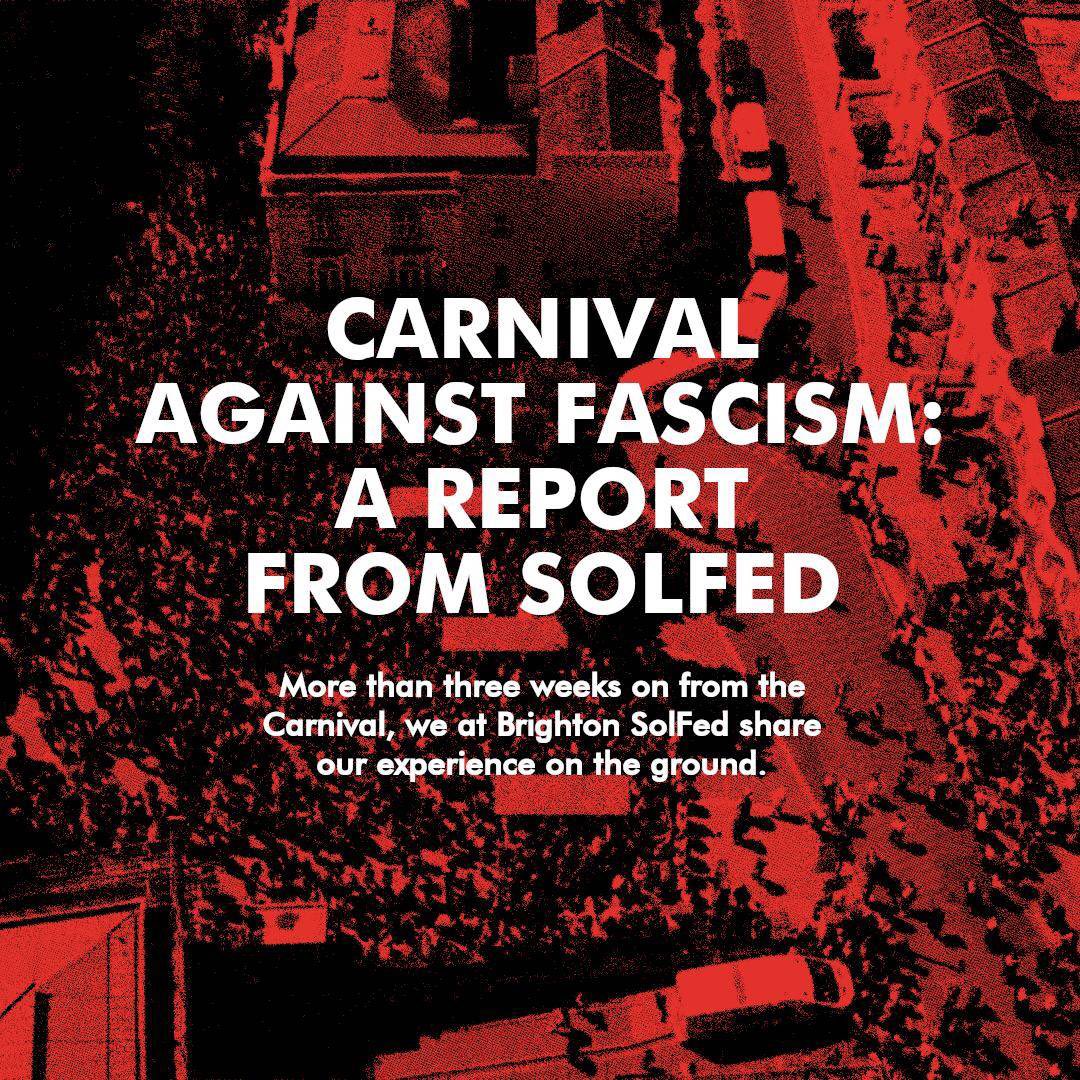
 More than three weeks on from the Carnival, we at Brighton SolFed share our experience on the ground.
Brighton SolFed was one of more than twenty groups that joined together to organise the Carnival Against Fascism, in response to a planned march by far-right group South East Patriots in favour of ‘mass deportations’ on the 13th of June.
 The last time the far-right had attempted a march on this scale through Brighton was during the infamous ‘Marches for England,’ which ended in 2014 after years of being outnumbered and humiliated by anti-fascist counter-demos. Perhaps they thought that, with the sharp rise in racist and anti-immigrant violence in this country in recent years, Brighton was a safer place for them to march. This terrifying possibility was what spurred us and many others into action.
 The activities of SolFed members on the day of the Carnival were as varied as the Carnival itself.
Some of these were more lighthearted than others: in the months leading up to the Carnival one member suggested creating an effigy of Nigel Farage, an idea which we loved. Weeks were spent moulding and creating Nigel’s abominable papier-mâché countenance: many onlookers on Queen’s Road were confused as to who the head was actually supposed to be, but luckily our rendition of his features was sufficiently grotesque.
Sadly he was weighing us down as we rushed to Seven Dials to block the fascists from marching there, and he had to be cast aside. He was last seen on Clifton Road with his paper-thin bonce bashed in, and is presumed to have been lost to the post-Carnival clean-up operation.
 Others volunteered to be part of the Carnival’s welfare team, handing out water bottles and earplugs and delivering first aid to carnival-goers. Others still were involved in more confrontational actovity with the fascists and the police. The cops seemed determined to clear a route for the fascists wherever they decided to march - first down Sidney Street, then up Terminus Road, then down Trafalgar Street. Antifascists were able to mobilise to block every route, but not without being subjected to physical force from men and women in uniform. A couple of our members were subjected to physical assault and, in one case, transphobic abuse from the police, along with other antifascists being pepper-sprayed, manhandled and intimidated in order to allow a hate march through the city.
 The zeal of these officers was in vain, however. The fascists were not able to march very far out of the station before they all took the train home - some travelled to Hove Lawns but only stayed for fifteen minutes after they were followed by a group of antifascists.
Coverage of the Carnival has quite understandably focussed on the massive numbers who turned out - an estimated 4,000 at the Carnival versus 300 at the far-right march. It is true that, if any of the people on the other side were local to Brighton at all, they could see that they were a small minority within their own city. However, the fact that the far right were able to assemble as many supporters as they had done during the height of the March for England days is cause for concern - especially in the context of much more well-attended far-right rallies across the country in recent years.
 Also well-publicised was the celebratory atmosphere of most of the Carnival. We are not against people turning up to demos to have a party as some people are - this is something the CAF organisers encouraged by naming it a carnival - and as previously mentioned, we were enthusiastic participants in the festivities. We would still like to draw attention to the work of antifascists on the ‘front’: moving quickly to stop the fascists’ route, forming a human chain to stop the cops from pushing them back, putting themselves at risk not just to express their displeasure at the far right, but to make sure they are incapable of marching in this city.
 Lastly: while of course the CAF organisers were a broad coalition of groups from various traditions, we believe that the Carnival demonstrates the success of organising based on anarchist principles. The Carnival required a lot of work and careful planning, but this was done by different groups working together and stepping up to tasks of their own initiative, without being imposed from the top down. Groups were aboe to respond quickly and spontaneously to the changing situation on the day to ensure the fascists did not have the upper hand.
In the end, the far right were defeated in Brighton on that day through the self-organisation and co-operation of autonomous groups to form an antifascist mass. This can point towards useful methods of organising, not just against the far right, but against other forms of oppression and exploitation, and in favour of a better world.