Home
Solidarity Federation
Section of the International Workers Association
CAPTCHA
Solve this simple math problem and enter the result. E.g. for 1+3, enter 4.
This question is for testing whether or not you are a human visitor and to prevent automated spam submissions.
User account menu
  • Contact
  • Log in
CAPTCHA
Solve this simple math problem and enter the result. E.g. for 1+3, enter 4.
This question is for testing whether or not you are a human visitor and to prevent automated spam submissions.
  • Home
    • About SolFed
    • Workplace organiser training
    • Industrial strategy
    • Community strategy
    • Constitution
  • SolFed
    • Brighton
    • Bristol
    • Edinburgh
    • Liverpool
    • Manchester
    • North London
    • Wales
    • Yorkshire
  • Industries and sectors
    • Claimants and unpaid
    • Education
    • Health and social care
    • Hospitality
  • Events & reports
  • Publications
    • Guides
      • Stuff your boss (doesn't want you to know)
      • Stuff your sexist boss (doesn't want you to know) (2018)
      • Stuff your landlord (doesn't want you to know) (2016)
      • Is your cleaning job killing you? A guide to cleaners health and safety (2017)
      • Office worker’s health and safety - your rights and how to use them (2015)
      • A migrant's guide to Manchester (2016) [en es]
      • A migrant's guide to London (2014) [en es pl]
      • Strike - a guide to walking out (2014)
    • Pamphlets and books
      • Anarcho-syndicalism in Britain – a little history (2015)
      • Office worker’s health and safety - your rights and how to use them (2015)
      • Anarchism and Anarcho-syndicalism (Rudolf Rocker, 2014)
      • Fighting for ourselves - anarcho-syndicalism and the class struggle (2012)
      • Workmates - direct action workplace organising on the London underground (2011)
      • The Economics of freedom (2003)
      • A history of anarcho-syndicalism (2001)
      • Health and safety at work - an anarcho-syndicalist approach (1997)
      • Out of the frying pan, a critical look at works councils (1998)
      • Anarcho-syndicalism in Puerto Real (1994)
    • Leaflets and flyers
      • Solidarity Federation Education Union (SFEU)
      • Solidarity Federation Hospitality Workers Union (SFHWU)
      • What is wage theft?
      • Why do we organise?
      • This is our flag - it tells you what we stand for
      • What is anarcho-syndicalism anyway?
      • Anarchism and Syndicalism (short version)
      • Anarchism and Syndicalism
      • Towards a better union
      • Protest is not enough
      • Building beyond elections
      • We should run our workplaces
      • We should run our communities
      • We should run our movements
    • Posters and stickers
    • Newsletters
      • Brighton Solidarity
        • Brighton Solidarity #3 (2015)
        • Brighton Solidarity #2 (2015)
        • Brighton Solidarity #4 (Winter 2014)
        • Brighton Solidarity #3 (Summer 2014)
        • Direct Action Solidarity #2 (Spring 2014)
        • Direct Action Solidarity #1 (Jan 2012)
        • Brighton Solidarity - spending review special (Oct 2010)
        • Brighton Solidarity - emergency budget special (Jun 2010)
        • Brighton Agitator #1 (Mar 2010)
        • Brighton Solidarity (Winter 2007)
      • Communication Worker
        • Communication Worker #8 (Jul 2001)
        • Communication Worker #7 (Jan 2001)
        • Communication Worker #6
        • Communication Worker #5
        • Communication Worker bulletin
      • Education Worker
        • Education Worker #10 (Apr 2013)
        • Education Worker #9 (Oct 2012)
        • Education Worker #8 (Mar 2012)
        • Education Worker #7 (Mar 2011)
        • Education Worker #6 (Jan 2011)
        • Education Worker #5 (Oct 2009)
        • Education Worker #4 (May 2009)
        • Education Worker #3 (Sep 2008)
        • Education Worker #2 (Jan 2008)
        • Education Worker #1 (2007)
        • Education Worker #9 (Summer 2002)
        • Education Worker #8 - special higher education issue (2002)
      • The Leveller
        • The Leveller #19 (May-Jul 2017)
        • The Leveller #18 (Aug 2016)
        • The Leveller #17 (Mar 2015)
        • The Leveller #17 (Dec 2014)
        • The Leveller #16 (Nov 2014)
        • The Leveller #15 (May 2014)
        • The Leveller #14 (Mar 2014)
        • The Leveller #13 (May 2013)
        • The Leveller #12 (Jun-Jul 2012)
        • The Leveller #11 (May 2012)
        • The Leveller #10 (Apr 2012)
        • The Leveller #9 (Mar 2012)
        • The Leveller #6 (May-Jul 2011)
      • Liverpool Anarchist
        • Liverpool Anarchist #21 (Apr 2022)
        • Liverpool Anarchist #20 (Mar 2022)
        • Liverpool Anarchist #19 (Feb 2022)
        • Liverpool Anarchist #18 (Dec 2021)
        • Liverpool Anarchist #17 (Nov 2021)
        • Liverpool Anarchist #16 (Oct 2021)
        • Liverpool Anarchist #15 (Sep 2021)
        • Liverpool Anarchist #14 (Aug 2021)
        • Liverpool Anarchist #13 (Jul 2021)
        • Liverpool Anarchist #12 (Jun 2021)
        • Liverpool Anarchist #11 (Apr 2021)
        • Liverpool Anarchist #10 (Dec 2020)
        • Liverpool Anarchist #9 (Oct 2020)
        • Liverpool Anarchist #8 (Aug 2020)
        • Liverpool Anarchist #7 (Jul 2020)
        • Liverpool Anarchist #6 (Mar 2020)
        • Liverpool Anarchist #5 (Feb 2020)
        • Liverpool Anarchist #4 (Jan 2020)
        • Liverpool Anarchist #3 (Dec 2019)
        • Liverpool Anarchist #2 (Nov 2019)
        • Liverpool Anarchist #1 (Oct 2019)
      • May Day Bulletin (Newcastle, 2014)
      • Public Service Workers Network bulletin
        • Public Service Workers Network #8 (Winter 1995)
        • Public Service Workers Network #6 (Spring 1995)
        • Public Service Workers Network #5 (Oct-Nov 1994)
        • Public Service Workers Network #4 (Jun-Jul 1994)
        • Public Service Workers Network #3 (Autumn 1993)
      • Spanner in the Works (West Yorkshire, April 2013)
      • Wildcat!
        • Wildcat! #13 (Jan 2013)
        • Wildcat! (Winter 2012)
        • Wildcat! #6 (Summer 2011)
        • Wildcat! #5 (Spring 2011)
        • Wildcat! #4 (Dec 2010)
        • Wildcat! #3 (Oct-Nov 2010)
        • Wildcat! #2 (Jul-Aug 2010)
        • Wildcat! Football for the fans NOT for fat cats! (Jul 2010)
        • Wildcat! #1 (May-June 2010)
    • Direct Action
      • Direct Action - Solidarity Federation
        • Direct Action #2
        • Direct Action #1
        • Direct Action #48 (Autumn 2009)
        • Direct Action #47 (Summer 2009)
        • Direct Action #46 (Spring 2009)
        • Direct Action #45 (Winter 2008)
        • Direct Action #44 (Autumn 2008)
        • Direct Action #43 (Summer 2008)
        • Direct Action #42 (Spring 2008)
        • Direct Action #41 (Winter 2007)
        • Direct Action #40 (Autumn 2007)
        • Direct Action #39 (Summer 2007)
        • Direct Action #38 (Spring 2007)
        • Direct Action #37 (Autumn-Winter 2006)
        • Direct Action #36 (Spring-Summer 2006)
        • Direct Action #35 (Summer 2005)
        • Direct Action #34 (Spring 2005)
        • Direct Action #33 (Winter 2004)
        • Direct Action #32 (Autumn 2004)
        • Direct Action #31 (Summer 2004)
        • Direct Action #30 (Spring 2004)
        • Direct Action #29 (Winter 2003)
        • Direct Action #28 (Autumn 2003)
        • Direct Action #27 (Summer 2003)
        • Direct Action #26 (Spring 2003)
        • Direct Action #25 (Winter 2002)
        • Direct Action #24 (Autumn 2002)
        • Direct Action #23 (Summer 2002)
        • Direct Action #22 (Spring 2002)
        • Direct Action #21 (Winter 2001)
        • Direct Action #20 (Autumn 2001)
        • Direct Action #19 (Summer 2001)
        • Direct Action #18 (Spring 2001)
        • Direct Action #17 (Winter 2000)
        • Direct Action #16 (Autumn 2000)
        • Direct Action #15 (Summer 2000)
        • Direct Action #14 (Spring 2000)
        • Direct Action #13 (Winter 1999)
        • Direct Action #12 (Autumn 1999)
        • Direct Action #11 (Summer 1999)
        • Direct Action #10 (Spring 1999)
        • Direct Action #9 (Winter 1998)
        • Direct Action #8 (Autumn 1998)
        • Direct Action #7 (Summer 1998)
        • Direct Action #6 (Spring 1998)
        • Direct Action #5 (Winter 1997)
        • Direct Action #4 (Autumn 1997)
        • Direct Action #3 (Summer 1997)
        • Direct Action #2 (Spring 1997)
        • Direct Action #1 (Autumn 1996)
        • Direct Action #2 (Winter 1994)
        • Direct Action #1 (Summer 1994)
    • Catalyst
      • Catalyst - Solidarity Federation
        • Catalyst #31 (Oct 2013)
        • Catalyst #29 (Feb 2012)
        • Catalyst #28 (Oct 2011)
        • Catalyst #27 (Jun 2011)
        • Catalyst #26 (Mar 2011)
        • Catalyst #25 (Dec 2010)
        • Catalyst #24 (Summer 2010)
        • Catalyst #23 (Spring 2010)
        • Catalyst #22 (Winter 2009)
        • Catalyst #21 (Summer 2009)
        • Catalyst #20 (Sping 2009)
        • Catalyst #19 (Nov 2008)
        • Catalyst #18 (Sep 2008)
        • Catalyst #17 (July 2008)
        • Catalyst #16 (Spring 2007)
        • Catalyst #15 (Autumn 2006)
        • Catalyst #14 (Spring 2006)
        • Catalyst #13 (Summer 2005)
        • Catalyst #12 (Apr 2005)
        • Catalyst #11 (Sep 2004)
        • Catalyst #10 (May 2004)
        • Catalyst #9 (Spring 2004)
        • Catalyst #8 (Autumn 2003)
        • Catalyst #7 (May 2003)
        • Catalyst #6 (Dec 2002)
        • Catalyst #5 (Dec 2001)
        • Catalyst #4 (May 2001)
        • Catalyst #3 (Feb 2001)
        • Catalyst #2 (Sep 2000)
        • Catalyst #1 (May 2000)
    • SelfEd
      • A history of anarcho-syndicalism
    • Reference
      • Student Radicals - an incomplete history of protest at the University of Sussex 1971-1975 (Ed Goddard, 2011)
      • Anarcho-syndicalism in the 20th Century (Vadim Damier, 2009)
      • Tom Brown's Syndicalism (1990)
      • Trade unionism or syndicalism? (Tom Brown, 1943)
      • The General Strike - vol 1 no 1 (Sam Mainwaring, 15 Feb 1904)
  • IWA

When it comes to the Crunch - Unpaid overtime in the Games Industry

By Auto, 20 April, 2011
t

Auto, a Solidarity Federation member and games industry worker writes about the practice of 'Crunch Time' - the long hours of unpaid overtime in the games industry and the reasons behind it.

Imagine if you had to give your company over fifteen hours of extra unpaid work a week. Imagine if you hadn’t been able to cook yourself a proper meal in over two months. Imagine if you came home late at night and left for work early in the morning, that’s if you even leave work at all. Welcome to the modern games industry!

The above is what is meant by the term ‘crunch time’, a phrase all too familiar to those in or around the games industry. Technically crunch time is any form of overtime (almost always unpaid) required by a game studio in order to complete a project on time. In reality however there are differing types of overtime, dependent on the country a company operates in, the particular labour laws they work under and whether or not they are owned by a large company. The type of crunching I do is technically voluntary.  I say ‘technically’ because even though I could theoretically refuse to do any overtime, you can bet that I wouldn’t last very long with the company if I didn’t. Overtime may not be obligatory, but it is expected.

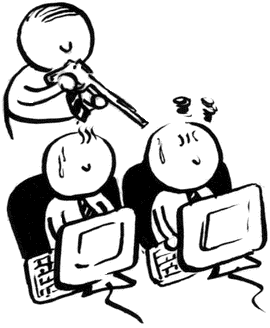
The other type of crunch time is mandatory unpaid overtime. This is every bit as soul-destroying as it sounds. Very common in North American games studios and those owned and run by big companies and publishers (such as EA, Activision, etc) where it is colloquially known as a ‘Death March’. In this case the company bosses have decided that the game will come out on release date X, with no schedule slippage allowed for. This is usually done for monetary reasons, where fears of a shrinking profit margin have grown too much for executives to bear. This decision inevitably means that huge amounts of work have to be compressed into incredibly small amounts of time. The solution to this problem is inevitably ‘Crunch Time’. This will usually involve working till late into the night (in extreme cases working overnight with little to no sleep), subsisting almost entirely on what cheap food (often junk) the company will provide and sometimes even going without weekend breaks – all without any pay.

  This is not an exaggeration. For the upcoming first-person-shooter game ‘Homefront’ publisher THQ has said that the New-York based studio ‘Kaos’ has been put into a ‘seven-day’ crunch period for two months in order to meet their scheduled release date of March 8th, 2011. So this dev team have been working unpaid overtime, without weekends for two months. Yet this is not the worst the industry has to offer. EA’s CEO, John Riccitiello, admitted that they had the Vancouver-based Black Box studio on a near constant crunch churning out yearly additions to EA’s Need for Speed franchise for five years. He says that ‘those days are gone’ and that they now have the team on much healthier ‘bi-annual cycle’. While it’s true that doing a bi-annual release schedule is much less stressful than doing a game yearly, someone had better tell Riccitiello’s findings to the EA Sports division. Those studios are still churning out a game a year for their respective franchises, and I’d be surprised if they weren’t being crunched just as hard as the devs at Black Box were.

   There have been one or two voices raised against the practice of crunch time, but they are often few and far between. We work in that most desirable of things, a creative industry. It’s common knowledge that for every single job in the games industry there are hundreds of people just waiting for their chance to get in – often influenced by very idealistic concepts of how the industry actually is. Combine this with a deliberately atomised work culture based around small, insular teams and there’s not much room for dissent. No one wants to be the one to put their head above the parapet. Yet even when arguments against crunch time are made, they often miss the heart of the matter.

 The first argument often made is based around how crunching affects our ‘Quality of life’. This is most definitely an issue, as being on crunch time is an awful sensation. Your life becomes an endless cycle of work, sleep and take-away food. You may stop getting the chance to see your friends, families and loved ones. Your working environment can become filled with stress, tension and hair-trigger tempers. The negative effect that crunch time has on day-to-day life is certainly one of the worst things about it, but focusing on this as the only part of the problem is kind of missing the point. It implies that working long hours unpaid would be absolutely fine if it could just be made more pleasant. Yet the stresses and strains of crunch time are inherently intertwined with it. The game developer’s quality of life doesn’t take a hit because he is doing badly managed unpaid overtime, it’s because he’s doing that much unpaid overtime in the first place.

The second type of argument comes from the ‘pragmatic management school’ of thinking. It puts forth the rather radical idea that perhaps this level of rapid, intense overtime isn’t very good for productivity. I can tell you this is true from personal experience. When you’re undergoing a particularly bad crunch time you can just completely zone out. The food makes you feel ill, the lack of sleep makes you distracted, and it takes you a lot longer to do even the simplest of tasks you would otherwise have sailed through.

   Yet this argument assumes that crunch time is something that companies should ideally avoid as being ‘bad for business’.  You will often hear it said that crunch time happens because of ‘bad planning’. That the schedule was put together way too tight from the outset at which point management  will turn around in desperation and decree crunch time in order to cover their own ineptitude. Yet this ignores the huge amounts of money made by big game companies who use crunch time the most. You don’t make those sort of profits without knowing exactly what you’re doing. Crunch time is used as a deliberate part of the game development cycle precisely because it works from the perspective of those who make their money at the top. Why was the schedule made so tight in the first place? Well, to save money on development costs and get a new title into stores as quick as possible. This drive to push games out quickly in order to maximise profits is what also drives companies to crunch their developers. Forcing such a large amount of free labour out of workers is another way to make more money out of a project, even if it is to the detriment of those workers’ lives and even to the quality of the project itself.

   This is the true issue with crunch time, that it is a form of blatant economic exploitation. The quality of life issues suffered by developers when crunching are symptoms of a much deeper disease. Games industry workers will often say that they put up with crunch time because they love games and love working with them. Of course we do. Yet look at other creative industries, such as film or television. Those who work in their respective mediums love them just as much as we love ours, yet also get paid for the hours they work. It is not a radical demand that someone be paid for the work they do - whether they love that work or not.  If we truly love games we should want to fight to end an industrial practice that harms not only us as workers, economically, physically and mentally, but also damages the games we make, by cutting creative endeavours down to fit a timescale defined by profit alone.

   Yet even though the culture of crunch-time is currently ingrained in the industry, we do not have to put up with it. The only reason that companies get away with demanding their employees work crunch time is because we the workers put up with it. If every games industry worker refused to work a single hour’s overtime, what would happen? If crunch time was as necessary and inherent in the industry as companies claim, then the industry would simply die. We all know that wouldn’t happen. What would be far more likely to happen would be that companies would learn that they could no longer leave the workforce out of the equation when planning new projects. Schedules would have to be re-thought to take account of workers unwilling to suffer so much purely for the profits of their bosses. Unpaid overtime is only so common in the games industry because we allow it to be. If enough industry workers banded together and refused to do it, it would become unworkable and would no longer be so ubiquitous.

   We’re obviously a long, long way away from anything like that happening in the industry, yet it helps to illustrate the point. We, as games industry workers, could choose to end crunch time if we truly wanted it to happen. It would need workers to stand together and support each other, both within a studio and across the whole industry, but it could be done. Our bosses can only dictate our lives and living conditions in this way if we allow them to do it. If we stand together and support one another, then we can be the ones to make the decisions, we can be the ones in control of our own lives. We want to work in an industry that helps produce the games we are passionate about, not just profits wrung from another late night with no pay.

We do this job because we love games. Let us work for our passion, not for our bosses’ profits.

    • unpaid overtime
    • journalists and media
    • working hours

    Guides

    Your rights at work

    About SolFed

    About SolFed

    Do you sometimes feel your union isn’t listening to you? (Solidarity Federation Education Union - SFEU)

    SFEU-flyer-2024-front

    What is wage theft?

    What is wage theft

    This is our flag - it tells you what we stand for

    this-is-our-flag

    Solidarity Federation Hospitality Workers Union (SFHWU)

    sfhwu leaflet front

    Stuff your boss (doesn't want you to know)

    Stuff your boss (doesn't want you to know)

    Why do we organise? Capitalism is shit, oppression is shit - but what can we at SolFed do about it?

    Why do we organise?

    Stuff your sexist boss (doesn't want you to know) (2018)

    Stuff your sexist boss (doesn't want you to know) (2018)

    Cost of living - Organise and fight back with the Solidarity Federation

    Cost of living - Organise and fight back with the Solidarity Federation

    Don't cross picket lines! Solidarity is the most powerful force in the world

    Don't cross picket lines

    Direct Action #2 (2024)

    Direct Action #2 (2024)

    Don't just moan - Organise!

    Don't just moan - Organise!

    Is your cleaning job killing you? A guide to cleaners health and safety (2017)

    Stuff your landlord (doesn't want you to know) (2016)

    Stuff your landlord (doesn't want you to know) (2016)

    Fed up with your landlord? Organise and fight back!

    Fed up with your landlord? Organise and fight back!

    A migrant's guide to Manchester (2016)

    A migrant's guide to Manchester (2016)

    SolFed supports trans liberation - transphobia is a workplace and housing issue

    SolFed supports Trans Liberation - transphobia is a workplace and housing issue

    Office worker’s health and safety - your rights and how to use them (2015)

    Office worker’s health and safety - your rights and how to use them (2015)

    Solidarity Federation - Where we stand

    Solidarity Federation - Where we stand

    Anarcho-syndicalism in Britain – a little history (2015)

    Anarcho-syndicalism in Britain – a little history (2015)

    Strike - a guide to walking out (2014)

    Strike - a guide to walking out (2014)

    Anarchism and Anarcho-syndicalism (Rudolf Rocker, 2014)

    Anarchism and Anarcho-syndicalism (Rudolf Rocker, 2014)

    There's power in a union

    theres-power-in-a-union

    A migrant's guide to London (2014)

    A migrant's guide to London (2014)

    Fighting for ourselves - anarcho-syndicalism and the class struggle (2012)

    Fighting for ourselves - anarcho-syndicalism and the class struggle (2012)

    Theory & Practice 1 - Workmates - direct action workplace organising on the London underground (2011)

    Theory & Practice 1 - Workmates - direct action workplace organising on the London underground (2011)

    The Economics of freedom (2003)

    The Economics of freedom (2003)

    A history of anarcho-syndicalism (SelfEd Collective, 24 unit series, 2001)

    A history of anarcho-syndicalism (SelfEd Collective, 24 unit series, 2001)

    Out of the frying pan, a critical look at works councils (1998)

    Out of the frying pan, a critical look at works councils (1998)

    Health and safety at work - an anarcho-syndicalist approach (1997)

    Health and safety at work - an anarcho-syndicalist approach (1997)

    Theory & Practice 2 - Anarcho-syndicalism in Puerto Real (1994)

    Theory & Practice 2 - Anarcho-syndicalism in Puerto Real (1994)

    RSS feed

    The Solidarity Federation is an anarcho-syndicalist union, a means for people seeking to improve our lives to organise in our workplaces and communities. SolFed brings together people in all occupations regardless of industry, sector or trade – whether we’re employed or not.

    SolFed seeks the abolition of capitalism and the institutions of power that are associated with it, such as the state. Our goal is to create a society centred on needs rather than profit, based upon the principle ‘from each according to ability, to each according to need’.

    We believe in the principle of direct action – that means doing something for ourselves and not expecting leaders or representatives to act on our behalf.

    SolFed members organise ourselves in a federation of local unions; in education we are in the Solidarity Federation Education Union (SFEU) and our members in hospitality are in the Solidarity Federation Hospitality Workers Union (SFHWU)

    Join us!