Home
Solidarity Federation
IWA
User account menu
  • Contact
  • Log in
  • Home
    • Intro
    • Workplace organiser training
    • Industrial strategy
    • Community strategy
    • Constitution
  • SolFed
    • Brighton
    • Bristol
    • Edinburgh
    • Liverpool
    • Manchester
    • North London
    • Wales
    • Yorkshire
  • Industries & sectors
    • Claimants and unpaid
    • Education
    • Health and social care
    • Hospitality
  • Events & reports
  • Publications
    • Guides
      • Stuff your boss (doesn't want you to know)
      • Stuff your sexist boss (doesn't want you to know) (2018)
      • Stuff your landlord (doesn't want you to know) (2016)
      • Is your cleaning job killing you? A guide to cleaners health and safety (2017)
      • Office worker’s health and safety - your rights and how to use them (2015)
      • A migrant's guide to Manchester (2016) [en es]
      • A migrant's guide to London (2014) [en es pl]
      • Strike - a guide to walking out (2014)
    • Pamphlets and books
      • Anarcho-syndicalism in Britain – a little history (2015)
        • 1. 19th century to 1914 - The First International, growth of industrial unionism and the Great Unrest
        • 2. 1914–1945 - State suppression and the Bolshevik turn – how Lenin’s seeming success drew militants to the Comintern
        • 3. 1945–1994 - The Anarchist Federation of Britain, Syndicalist Workers’ Federation and Direct Action Movement
        • 4. Today’s movement - A short look at the strategy and thinking of the modern Solidarity Federation
      • Office worker’s health and safety - your rights and how to use them (2015)
      • Anarchism and Anarcho-syndicalism (Rudolf Rocker, 2014)
        • Introduction
        • 1. Ideology of Anarchism
        • 2. History of anarchist philosphy, from Lao-Tse to Kropotkin
        • 3. The origins of anarcho-syndicalism
        • 4. Socialism and anarcho-syndicalism in France
        • 5. The role of the trade unions: anarcho-syndicalist view
        • 6. The struggle in Germany and Spain
        • 7. The political struggle: anarcho-syndicalist view
        • 8. Anarcho-syndicalism since the First World War
      • Fighting for ourselves - anarcho-syndicalism and the class struggle (2012)
        • Introduction
        • 1. The mainstream workers' movement
        • 2. Radical currents in the workers' movement
        • 3. Anarcho-syndicalism in the 20th century
        • 4. Capitalism and the class struggle since World War II
        • 5. Anarcho-syndicalism in the 21st century
        • Endnotes
      • Workmates - direct action workplace organising on the London underground (2011)
      • The Economics of freedom (2003)
      • A history of anarcho-syndicalism (2001)
      • Out of the frying pan, a critical look at works councils (1998)
      • Health and safety at work - an anarcho-syndicalist approach (1997)
      • Anarcho-syndicalism in Puerto Real (1994)
    • Leaflets and flyers
      • Solidarity Federation Education Union (SFEU)
      • Solidarity Federation Hospitality Workers Union (SFHWU)
      • Why do we organise?
      • This is our flag - it tells you what we stand for
      • What is anarcho-syndicalism anyway?
      • Anarchism and Syndicalism (short version)
      • Anarchism and Syndicalism
      • Towards a better union
      • Protest is not enough
      • Building beyond elections
      • We should run our workplaces
      • We should run our communities
      • We should run our movements
    • Newsletters
      • Brighton Solidarity
        • Brighton Solidarity #3
      • Education Worker
        • Education Worker #10 Victimisation (2013)
        • Education Worker #9 (2012)
        • Education Worker #8 Academy Special (2012)
      • Wildcat!
        • Wildcat! #13 (Jan 2013)
        • Wildcat! (Winter 2012)
        • Wildcat! #6 (Summer 2011)
        • Wildcat! #5 (Spring 2011)
        • Wildcat! #4 (Dec 2010)
        • Wildcat! #3 (Oct-Nov 2010)
        • Wildcat! #2 (Jul-Aug 2010)
        • Wildcat! Football for the fans NOT for fat cats! (Jul 2010)
        • Wildcat! #1 (May-June 2010)
      • May Day Bulletin (Newcastle SolFed, 2014)
    • Direct Action
      • Direct Action #2 (2024)
      • Direct Action #1 (2023)
      • Direct action #47 (Summer 2009)
    • Catalyst
      • Catalyst #29 (Feb 2012)
      • Catalyst #28 (Oct 2011)
      • Catalyst #27 (Jun 2011)
      • Catalyst #26 (Mar 2011)
      • Catalyst #25 (Dec 2010)
      • Catalyst #24 (Summer 2010)
    • SelfEd
      • A history of anarcho-syndicalism
        • Block 1
          • Unit 1: The Origins of Capitalism
          • Unit 2: Britain: The Radical Period 1750-1840
          • Unit 3: The First International
          • Unit 4: France 1870-1918 Early revolutionary unions
          • Unit 5: Revolutionary Syndicalism in Britain, 1870-1910
          • Unit 6: Revolutionary Syndicalism in Britain and Ireland, 1910-17
        • Block 2
          • Unit 7: Mexico 1870-1920: Colonialism and Revolution
          • Unit 8: USA 1886-1930 - The Wobblies
          • Unit 9: Anarcho-syndicalism in Argentina 1870-1939
          • Unit 10: Sweden 1889-1939
          • Unit 11: Russia I: 1850-1917
          • Unit 12 Russia II: 1917-30
        • Block 3
          • Unit 13: Going Global - International Organisation, 1872-1922
          • Unit 14: Anarcho-syndicalism in Britain, 1914-30
          • Unit 15 Spain, 1868-1936: Build-up to Revolution
          • Unit 16 Spain: Culture, education, women and sexuality
          • Unit 17: Spain 1936-39: Revolution and Civil War
          • Unit 18: Spain - The Collectives
        • Block 4
          • Unit 19: Britain, 1930-1950 - The Era of Reform
          • Unit 20: Britain, 1950-1990 - Decline of Social Democracy
          • Unit 21: anarcho-syndicalism 1939-99
          • Unit 22: Roots of modern anarcho-syndicalism: freedom, oppression & rebellion
          • Unit 23: Roots of modern anarcho-syndicalism: morality, culture & tactics
          • Unit 24: The spirit of anarcho-syndicalism
    • Letters
  • IWA

Breadcrumb

  1. Home
  2. industries, occupations and sectors
  3. claimants and unpaid

workfare

By Joseph Kay, 30 March, 2012

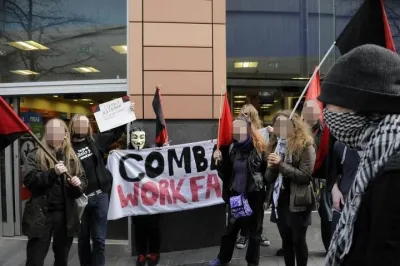
March 31st day of action against workfare

15  18 21 events and counting!

March 31st is a national day of action against workfare. This ties in with the international days of action called by the International Workers Association (IWA) - which includes a general strike in Spain on March 29th - and the M31 European Day of Action Against Capitalism. 
Attachment Size
SF general anti-workfare leaflet (111.07 KB) 111.07 KB
General leaflet as a word doc (1005 KB) 1005 KB
SF Holland & Barrett anti-workfare leaflet (189.22 KB) 189.22 KB
Holland & Barrett leaflet as a word doc (1.04 MB) 1.04 MB

Tags

  • workfare
By solfed-iwa, 28 March, 2012

Abolish workfare - the Solidarity Federation's guide to the government's unpaid work schemes

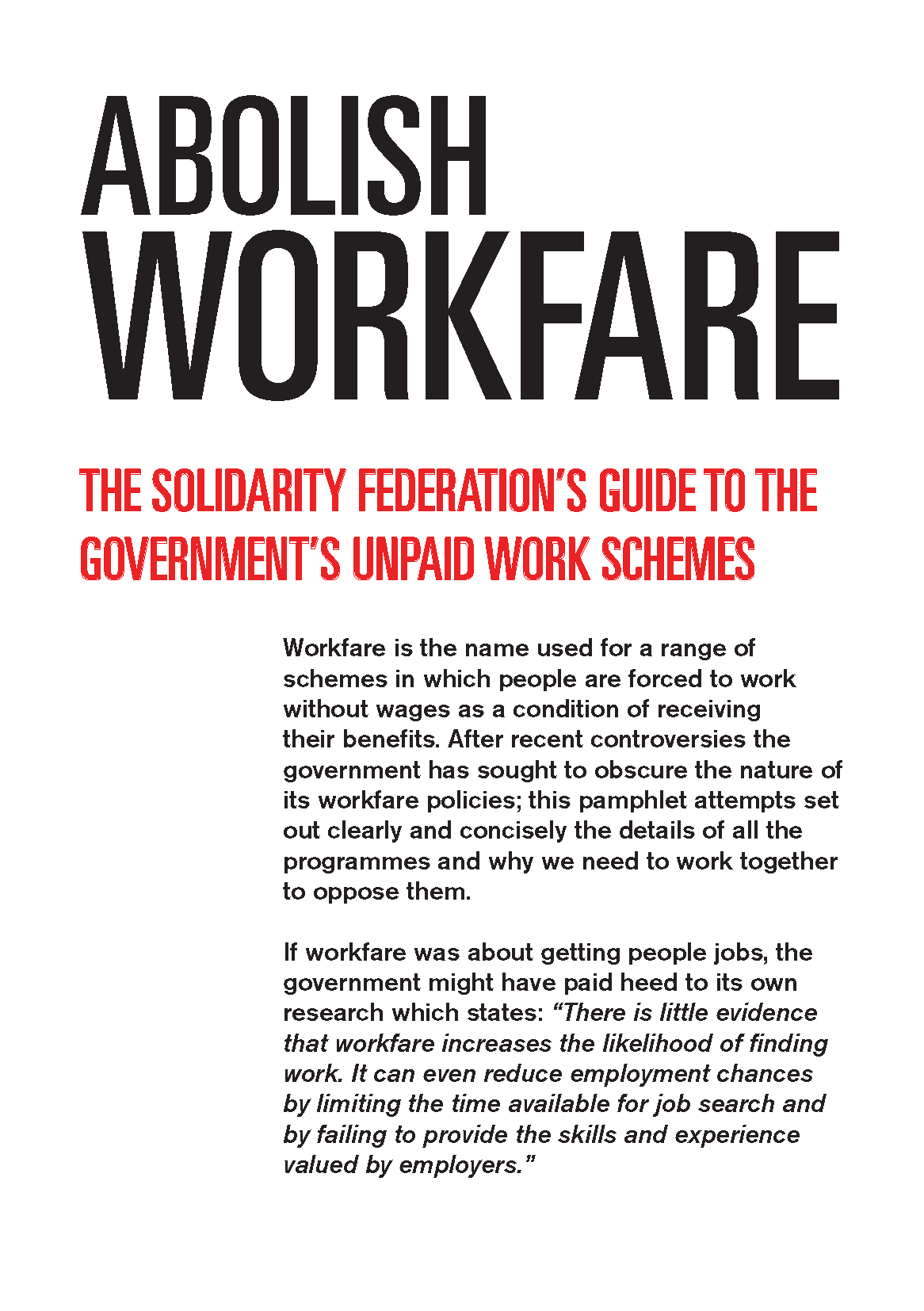
abolish workfareWorkfare is a term used to describe a range of schemes in which people are forced to work without wages in order to receive their benefits. After recent controversies the government has sought to obscure the nature of its workfare policies; this pamphlet will set out clearly and concisely the details of all the programmes and why we need to work together to oppose them.



If workfare was about getting people jobs, the government might have paid heed to its own research which states: “There is little evidence that workfare increases the likelihood of finding work. It can even reduce employment chances by limiting the time available for job search and by failing to provide the skills and experience valued by employers.”

Attachment Size
Abolish workfare - the Solidarity Federation's guide to the government's unpaid work schemes (263.2 KB) 263.2 KB
Workfare guide in easy-to-print booklet format (157.91 KB) 157.91 KB

Tags

  • leaflets and flyers
  • workfare
  • publications
  • claimants and unpaid
By Joseph Kay, 25 March, 2012

Don't forget the Work Programme

Workfare is a catch-all term that refers to a range of state sponsored wage-less work schemes. Recent withdrawals by high-street firms that had been involved in  the Jobcentre’s nominally voluntary ‘work experience’ scheme has put politicians on the defensive forcing them to emphasise the (dubious) voluntary nature of the scheme. However the same defence cannot be made of the coalition’s flagship Work Programme, a compulsory scheme with a ‘mandatory work related activity’ component. But aside from the recent controversies surrounding workfare provider A4E relatively little has been said with regard to the Work Programme, which forces jobseekers as well as many sick and disabled Employment Support Allowance claimants into mandatory unpaid work through a number of private companies.

Tags

  • workfare
  • claimants and unpaid
By Joseph Kay, 23 March, 2012
c

Sector-Based Work Academies - subsidising business with unpaid labour

Sector-Based Work Academies (SBWA) combine work experience-style placements with a short job-related training components. Launched in August 2011 SBWA are one of the Government’s 5 workfare-centred labour reform schemes in which unemployed people are compelled to perform unpaid work for private companies.

Tags

  • workfare
  • claimants and unpaid
By Joseph Kay, 23 March, 2012
c

'Work Experience' - the thin end of the wedge

The Work Experience scheme offered through the Jobcentre Plus (JCP) is one the five workfare schemes that are currently running in the UK. Recently this has become the best known of the workfare schemes thanks to the government’s damage limitation efforts after the negative publicity surrounding its policy of making people work without wages. By focusing on this scheme and emphasising the ‘voluntary' aspect of this particular scheme it sought to distract attention from the other compulsory schemes such as Mandatory Work Activity (MWA), the Work Programme (WP), and the Community Action Programme (CAP).

Tags

  • workfare
  • claimants and unpaid
By Joseph Kay, 23 March, 2012
c

The Community Action Programme - replacing jobs with unpaid labour

A new compulsory work scheme for the long-term unemployed was announced by the government in November 2011. The Community Action Programme (CAP) is currently being trialled (or ‘trailblazed’, in the government’s terminology) in four regions with the intention to implement the scheme nationally in 2013.

The CAP will be organised through private companies and in many ways resembles the Work Programme but with a greater focus on community work. Participation in the scheme is mandatory – refusal to take part will result in loss of benefits. Placements last six months at 30 hours a week of work with an additional 10 hours of job search under the supervision of the provider (source).

Tags

  • workfare
  • claimants and unpaid
By rich portsmouth, 20 March, 2012

Fighting Workfare At Royal Mail

Most people will have heard about the CWU leadership endorsing the Royal Mail's participation in the workfare scheme, whilst at the same time ignoring rank and file members views on forced labour and attacks on workers rights.

Concerned posties from SOLFED, IWW, Boycott Workfare, and CWU send you the following call out, and request for solidarity.

See you on the picket!

Solent Solfed 

NO TO WORKFARE AT ROYAL MAIL- APRIL 2ND 11am

Open Letter to all members of the Communication Workers Union, (CWU)

Tags

  • Boycott Workfare
  • Communication Workers Union (CWU)
  • Industrial Workers of the World (IWW)
  • communication, information technology and postal
  • workfare
  • Portsmouth
  • Solent
By Joseph Kay, 16 March, 2012
c

Disciplining the workforce: Mandatory Work Activity

Mandatory Work Activity (MWA) is one of the Government’s five unpaid labour schemes in which unemployed people may be required to participate or lose their benefits. According to Chris Grayling Mandatory Work Activity “is something where people have no choice but to participate, otherwise their benefits will stop until they do”

MWA is not voluntary and people of any age can be mandated to take part, even if they have been claiming Jobseeker’s Allowance for a short time (source). Job seekers are referred to the scheme at the discretion of a Jobcentre Plus advisor and placements are organised through private companies who arrange for the participant to work 30 hours per week for four weeks for no wage.

Tags

  • workfare
  • claimants and unpaid
By AKBlackandRed, 15 March, 2012

Day of action against workfare - Liverpool

The International Workers Association has called days of action against austerity, exploitation, and oppression on 29, 30 and 31 March. As part of this, on Saturday 31 March, Solidarity Federation locals will be taking action against workfare.

Following on from the succesful day of action initiated by Liverpool Uncut on 3 March, our aim is to spread the action beyond the City Centre and get claimants and local communities more involved.

Our action will take place in Wavertree, at a target to be announced on the day. There, as last time, we intend to engage staff directly and encourage them to organise against their employer's use of workfare as well as encouraging the public not to give their business to the target.

We encourage everyone to come along and take part, and make the point that as long as workfare persists so will direct action against providers.

Tags

  • demonstrations
  • direct action
  • workfare
  • events and reports
By Joseph Kay, 15 March, 2012

Day of action against workfare - Brighton

As part of the International Workers' Association days of action, Solidarity Federation Locals across the country will be taking action against workfare on Saturday 31st March. In Brighton, we will be meeting at the Clock Tower on the junction of Queens Rd and North St at 11am. Target to be confirmed, as firms are pulling out regularly at the moment. 

The following Monday (2nd April), there will be a communications blockade of the same target to keep up the pressure. 

  • SF workfare campaign page
  • Boycott Workfare (national campaign against workfare)
  • Brighton SF on twitter (keep an eye for updates on the day)

Tags

  • workfare

Pagination

  • First page
  • Previous page
  • …
  • Page 4
  • Page 5
  • Page 6
  • Page 7
  • Page 8
  • Page 9
  • Page 10
  • Page 11
  • Page 12
  • Next page
  • Last page
workfare

Guides

Your rights at work

Why do we organise? Capitalism is shit, oppression is shit - but what can we at SolFed do about it?

Why do we organise?

This is our flag - it tells you what we stand for

this-is-our-flag

Direct Action #2 (2024)

Direct Action #2 (2024)

Anarcho-syndicalism in Britain – a little history (2015)

Anarcho-syndicalism in Britain – a little history (2015)

Office worker’s health and safety - your rights and how to use them (2015)

Office worker’s health and safety - your rights and how to use them (2015)

Anarchism and Anarcho-syndicalism (Rudolf Rocker, 2014)

Anarchism and Anarcho-syndicalism (Rudolf Rocker, 2014)

Fighting for ourselves - anarcho-syndicalism and the class struggle (2012)

Fighting for ourselves - anarcho-syndicalism and the class struggle (2012)

Theory & Practice 1 - Workmates - direct action workplace organising on the London underground (2011)

Theory & Practice 1 - Workmates - direct action workplace organising on the London underground (2011)

The Economics of freedom (2003)

The Economics of freedom (2003)

A history of anarcho-syndicalism (SelfEd Collective, 24 unit series, 2001)

A history of anarcho-syndicalism (SelfEd Collective, 24 unit series, 2001)

Out of the frying pan, a critical look at works councils (1998)

Out of the frying pan, a critical look at works councils (1998)

Health and safety at work - an anarcho-syndicalist approach (1997)

Health and safety at work - an anarcho-syndicalist approach (1997)

Theory & Practice 2 - Anarcho-syndicalism in Puerto Real (1994)

Theory & Practice 2 - Anarcho-syndicalism in Puerto Real (1994)
RSS feed