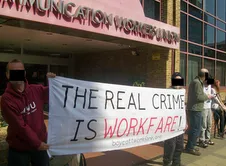
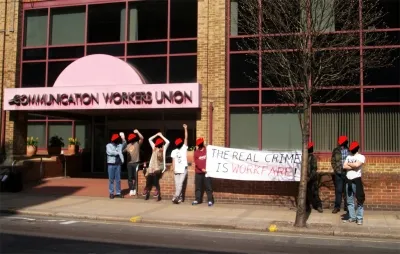
On Monday April 2nd members of London SF, Solent SF and the IWW joined Boycott Workfare activists to picket the headquarters of the Communication Workers Union over their support for workfare.
CWU officials have signed an agreement with the Royal Mail to allow DWP "Work Experience". People on the scheme face the threat of sanctions for refusal and if they do not take part they are likely to be sent on a number of other compulsory schemes.
The CWU leadership insists that their agreement with Royal Mail is for "voluntary" work experience only. Unless there is a guarantee that people leaving the scheme will not face sanctions the scheme is not voluntary. No such guarantee is in place.
Most people will have heard about the CWU leadership endorsing the Royal Mail's participation in the workfare scheme, whilst at the same time ignoring rank and file members views on forced labour and attacks on workers rights.
Concerned posties from SOLFED, IWW, Boycott Workfare, and CWU send you the following call out, and request for solidarity.
See you on the picket!
Solent Solfed
NO TO WORKFARE AT ROYAL MAIL- APRIL 2ND 11am
Open Letter to all members of the Communication Workers Union, (CWU)
In our medium sized delivery office we are now in week five of our revision using the “new delivery methods” (NDM). Our office has been divided into three phases: phase one starting five weeks before phase two and ten weeks before phase three.
These are HCT (high capacity trolleys; one postie pushing up to 105kgs) and shared vans (two workers in a van taking post with them and using golf cart-type trolleys to deliver). All bikes will be scrapped. I'm neither for nor against bikes generally but our patch has decided that there will be no bikes no matter the reason even if they are more efficient, cost effective or better for the health of the workers. And what a shambles it is because of this as well.
The revisions are based on both indoor and outdoor revision tools (computer programmes) used to 'optimise production' in the office or, as we all know at the sharp end, to cull our jobs.
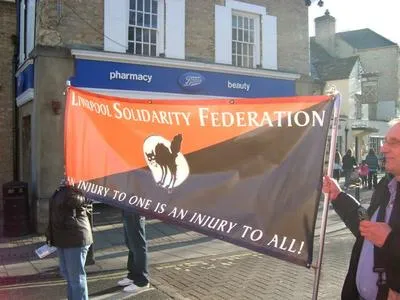
On Sunday 9th Solidarity Federation members joined the march in Witney, Oxfordshire, constituency of Prime Minister David Cameron. The march, against postal privatisation and austerity cuts, was organised by the CWU (Communication Worker's Union) Eastern Branch. Solidarity Federation members from the new Thames Valley local as well as from Liverpool and London handed out leaflets arguing for anarcho-syndicalist methods in struggle and introductory leaflets about the Solidarity Federation which were well received by marchers.
Over one hundred postmen and postwomen at Runcorn Delivery Office decided to celebrate Bastille Day in style and hold a 24-hour unofficial strike against working conditions.
Postal workers have now been promised a five day, forty hour week, but must find it themselves by increasing their workload. Deliveries have been over-loaded at Runcorn for years and repeated requests to management and the union have fallen on deaf ears. Even when proposals were put forward, management refused to implement them.
Workers at 34 BT call centres staged protests on Thursday 20th March over the company's plans to axe 2,200 jobs and transfer work to India. The battle goes to the heart of debates over capitalist globalisation. Companies are increasingly turning toward .outsourcing. many jobs to countries with lower labour costs. Call centres have become an initial flashpoint for workers. anger over the issue.
The Communication Workers' Union (CWU) has rejected the argument that opposing BT's plans will hit Indian workers. It said, “The CWU has no issue with India or Indian workers. Our issue is with BT”. BT plans to cut jobs involved with running the ‘192' directory enquiries service. It wants to transfer work to two call centres in Delhi and Bangalore. Behind the move is a scramble to cut costs and boost profits at the expense of workers everywhere.
Pell and Bales is a London call centre that raises funds on behalf of major charities. Since a venture capital company, ICENI, bought shares in P&B, the volume of calls staff must make has increased.
This added pressure led to friction between management and staff, and an increase in petty disciplinary actions and grievances.
Pat Carmody, a caller and CWU rep at Pell & Bales, helped build a fast-growing union that won a pay increase for the first time in 6 years and is capable of winning disciplinaries and grievances. Senior management were none too pleased.
In June, Carmody was suspended for writing an article for Socialist Worker in defence of a suspended colleague. Management claimed the article defamed the company and suspended him.
In June 2008 a solidarity picket outside of Pell & Bales’ office was called, attended by supporters, including workers from Shelter, the Solidarity Federation and the London Coalition Against Poverty.
In spite of the withdrawal of the Labour government’s plans to privatise the Royal Mail, postal workers’ campaign of strike action continues. In truth, postal workers consider privatisation has already happened, when the profitable parts of the business were hived off in the 2006 “liberalisation” exacerbating the problems the Royal Mail faces. The dispute is about “modernisation” – job cuts, attacks on pay, conditions and pensions – and the bullying which has passed for management in the Post for many years. CWU members believe that management are seeking to break the union.
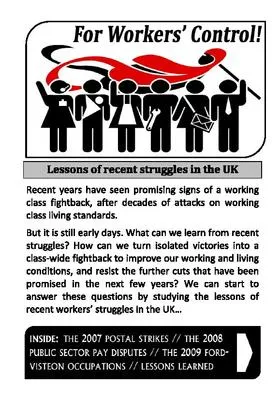
8-page leaflet looking at what we can learn from the 2007 postal strike, the 2008 public sector strike and the 2009 Visteon occupation.
The leaflet was produced for a demo against the Labour Party Conference on Sunday 27th September. It is based on several previously published articles and we try to draw the lessons of recent relevant struggles in the UK.
For Workers’ Control
Lessons of recent struggles in the UK
Recent years have seen promising signs of a working class fightback, after decades of attacks on working class living standards.
But it is still early days. What can we learn from recent struggles? How can we turn isolated victories into a class-wide fightback to improve our working and living conditions, and resist the further cuts that have been promised in the next few years? We can start to answer these questions by studying the lessons of recent workers’ struggles in the UK…