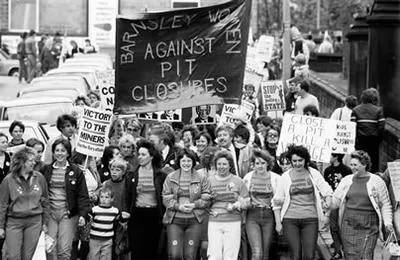
Written by Mal Finch, Women of the Working Class was adopted as the anthem of the Women Against Pit Closures campaign during the miners strike of 1984/85. The spirit of working-class resistance and self-reliance represented in the song is needed now more than ever. This song needs to be heard again far and wide.
"We don't need government approval for anything we do/We don't need their permission to have a point of view/We don't need anyone to tell us what to think or say/We've strength enough and wisdom of our own, to go our own way."
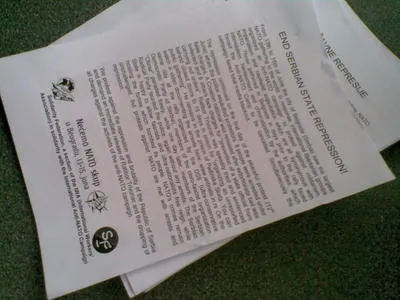
called by Solidarity Federation in solidarity with the International Anti-NATO Campaign.
Text of leaflet:
From 13th to 15th of June the city of Belgrade (Serbia) saw the largest NATO gathering in the world. In response, international libertarian groups organized an Anti-NATO campaign to protest against militarism, imperialism and capitalist exploitation which are all synonymous with NATO. Those gathered in Belgrade in days prior to the rally faced intimidation, harassment and criminalization by the authorities, which forced the Anti-NATO Camp to be cancelled. Simultaneously the campaign faced total media blackout.
Have others been following the results of the near-bankruptcy of this major player in the private sector ‘for profit’ care homes business in Britain? In addition to major changes of ownership and some home closures causing disruption to the residents, the Guardian 17 June reported on the company’s current proposals to slash the already poor working wages and conditions of it’s staff on top of cutting some 3,000 jobs.
My friend who works in one of their homes has indicated that even prior to this, non-filling of vacancies and ‘requests’ for more flexible working were common, but this seems to be a whole new level of attack. The GMB union is supposed to be ‘negotiating’ with the company but I don’t think the full impact of all this has got across to all the workers involved, or those in other or no unions, as far as I can tell.
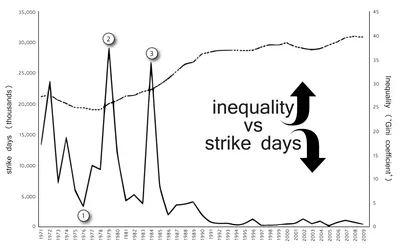
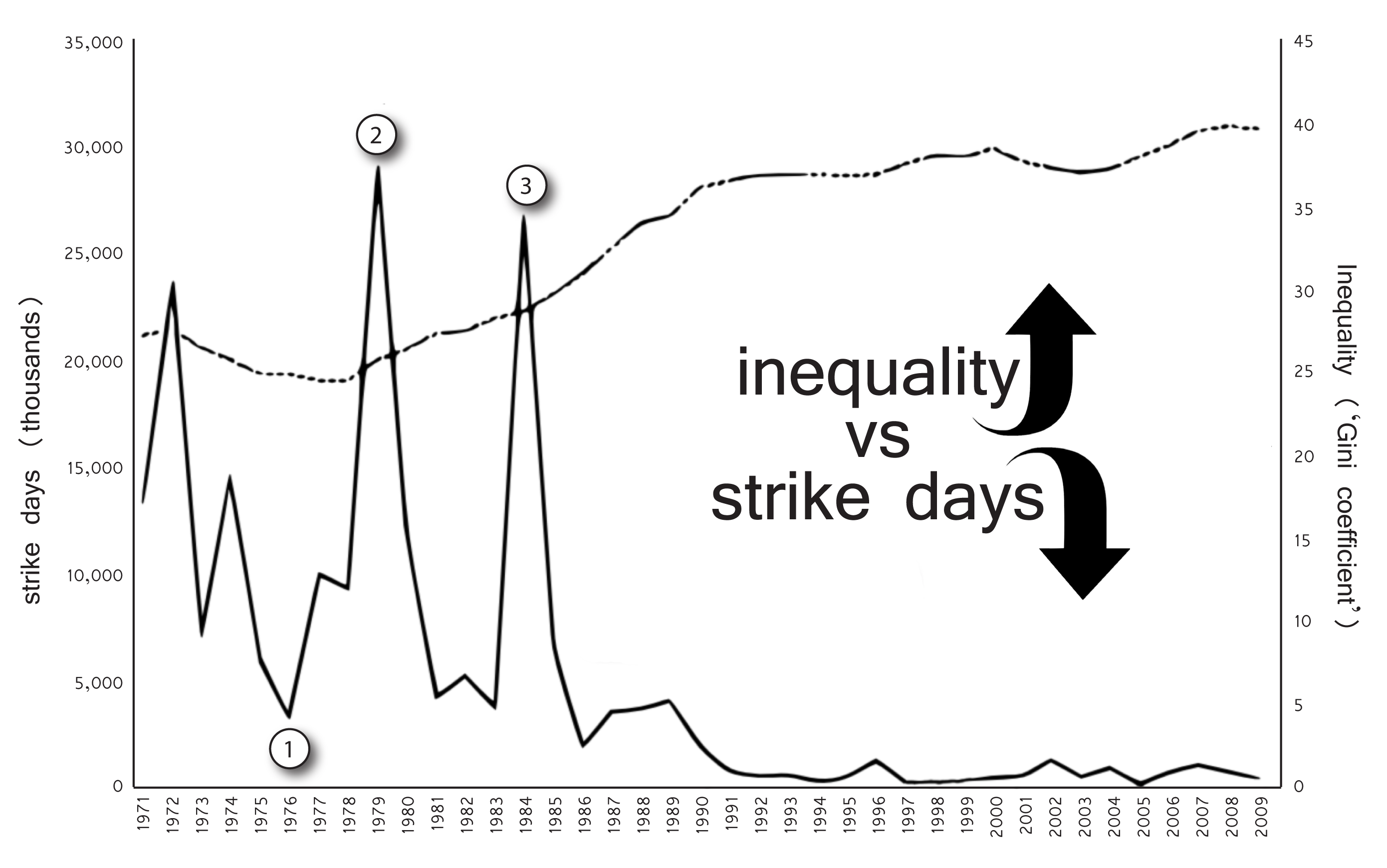
1. Labour call in the International Monetary fund (IMF), marking the end of the post-war setttlement and the beginning of rising inequality. This came despite several years of the TUC agreeing to hold down pay.
2. Workers respond with a wave of strikes, many of them unofficial. These culminate in the ‘Winter of discontent’ in 1978/9.
3. Thatcher’s Tory government smashes the workers’ movement, leading to a dramatic fall in strike days and a corresponding rise in inequality.
University leavers are increasingly taking low-skilled jobs, according to new research. A study by the Centre for Economics and Business Research found that 6 months after graduation around 40% of 2010’s graduates were “underemployed” in lower-skilled jobs, up from about 30% in 2006. The information casts further doubts over the controversial tripling of tuition fees, which provoked mass demonstrations across the country at the end of last year, as well as a spate of university occupations.
The fees hike was justified on the grounds that a degree is an “investment” in a career, and that the £9,000 per year would only be paid back out of earnings. However, studies have shown that due to interest building up on student debt, students could end up paying back double the headline amount. This could mean students being saddled with mortgage-sized debts of between £60,000 and £80,000 for a typical undergraduate degree.
Len, a postie from the South Coast writes about the effect of ‘modernisation’ in the Royal Mail, which looks bad for workers’ health and safety and bad for the service - all run by what a computer deems ‘optimal’.
A programme of revisions has been divided into three phases. In our medium sized delivery office we are now in week five of our revision using the “new delivery methods” (NDM).
These new delivery methods are high capacity trolleys (HCTs) with one postie pushing up to 105 KGs, and shared vans (2 posties in a van taking all the mail with them and using golf type and sized trolleys to deliver on foot in a loop from the back of a van). All bikes will be scrapped - even if they are more efficient, cost effective or better for the health of the workers.
Teachers at Shorefields College in the Dingle have once again taken strike action against the possibility of the school becoming an academy. The latest day of action has seen the fight grow, with support staff in the GMB walking out alongside teachers from the NUT and NASUWT.
The picket line was well supported. Parents, teachers and support staff were joined by several pupils from the school - whilst members of the Merseyside Network Against Fees and Cuts, Liverpool Trades Council and Liverpool Solidarity Federation were amongst those who turned up in support. The Liverpool Socialist Choir also added a bit of noise to the event, providing lively renditions of workers and trade union songs, old and new.
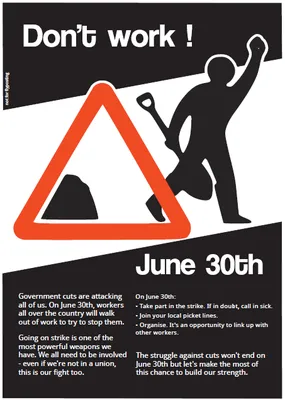
During the picket, members of Liverpool Solfed handed out the latest edition of our free newsletter, Wildcat, and the Education Workers' Network leaflet, All Out For June 30th, about next week's national strikes.
According to the headlines, UK unemployment fell 88,000 in the three months to April this year to 2.43 million, the biggest drop since the summer of 2000. This was heralded as proof that the government’s policies are working, and that the private sector is creating more jobs than the 143,000 public sector positions slashed during the same period. But dig a little deeper and the spin unravels.
The Office for National Statistics is open that the fall “was mainly due to an increase of 80,000 in the number of students not active in the labour market.” This seems to have been due to them simply being reclassified, rather than them all suddenly finding jobs. So that leaves just 8,000 jobs ‘created’.