Home
Solidarity Federation
IWA
User account menu
  • Contact
  • Log in
  • Home
    • Intro
    • Workplace organiser training
    • Industrial strategy
    • Community strategy
    • Constitution
  • SolFed
    • Brighton
    • Bristol
    • Edinburgh
    • Liverpool
    • Manchester
    • North London
    • Wales
    • Yorkshire
  • Industries & sectors
    • Claimants and unpaid
    • Education
    • Health and social care
    • Hospitality
  • Events & reports
  • Publications
    • Guides
      • Stuff your boss (doesn't want you to know)
      • Stuff your sexist boss (doesn't want you to know) (2018)
      • Stuff your landlord (doesn't want you to know) (2016)
      • Is your cleaning job killing you? A guide to cleaners health and safety (2017)
      • Office worker’s health and safety - your rights and how to use them (2015)
      • A migrant's guide to Manchester (2016) [en es]
      • A migrant's guide to London (2014) [en es pl]
      • Strike - a guide to walking out (2014)
    • Pamphlets and books
      • Anarcho-syndicalism in Britain – a little history (2015)
        • 1. 19th century to 1914 - The First International, growth of industrial unionism and the Great Unrest
        • 2. 1914–1945 - State suppression and the Bolshevik turn – how Lenin’s seeming success drew militants to the Comintern
        • 3. 1945–1994 - The Anarchist Federation of Britain, Syndicalist Workers’ Federation and Direct Action Movement
        • 4. Today’s movement - A short look at the strategy and thinking of the modern Solidarity Federation
      • Office worker’s health and safety - your rights and how to use them (2015)
      • Anarchism and Anarcho-syndicalism (Rudolf Rocker, 2014)
        • Introduction
        • 1. Ideology of Anarchism
        • 2. History of anarchist philosphy, from Lao-Tse to Kropotkin
        • 3. The origins of anarcho-syndicalism
        • 4. Socialism and anarcho-syndicalism in France
        • 5. The role of the trade unions: anarcho-syndicalist view
        • 6. The struggle in Germany and Spain
        • 7. The political struggle: anarcho-syndicalist view
        • 8. Anarcho-syndicalism since the First World War
      • Fighting for ourselves - anarcho-syndicalism and the class struggle (2012)
        • Introduction
        • 1. The mainstream workers' movement
        • 2. Radical currents in the workers' movement
        • 3. Anarcho-syndicalism in the 20th century
        • 4. Capitalism and the class struggle since World War II
        • 5. Anarcho-syndicalism in the 21st century
        • Endnotes
      • Workmates - direct action workplace organising on the London underground (2011)
      • The Economics of freedom (2003)
      • A history of anarcho-syndicalism (2001)
      • Out of the frying pan, a critical look at works councils (1998)
      • Health and safety at work - an anarcho-syndicalist approach (1997)
      • Anarcho-syndicalism in Puerto Real (1994)
    • Leaflets and flyers
      • Solidarity Federation Education Union (SFEU)
      • Solidarity Federation Hospitality Workers Union (SFHWU)
      • Why do we organise?
      • This is our flag - it tells you what we stand for
      • What is anarcho-syndicalism anyway?
      • Anarchism and Syndicalism (short version)
      • Anarchism and Syndicalism
      • Towards a better union
      • Protest is not enough
      • Building beyond elections
      • We should run our workplaces
      • We should run our communities
      • We should run our movements
    • Newsletters
      • Brighton Solidarity
        • Brighton Solidarity #3
      • Education Worker
        • Education Worker #10 Victimisation (2013)
        • Education Worker #9 (2012)
        • Education Worker #8 Academy Special (2012)
      • Wildcat!
        • Wildcat! #13 (Jan 2013)
        • Wildcat! (Winter 2012)
        • Wildcat! #6 (Summer 2011)
        • Wildcat! #5 (Spring 2011)
        • Wildcat! #4 (Dec 2010)
        • Wildcat! #3 (Oct-Nov 2010)
        • Wildcat! #2 (Jul-Aug 2010)
        • Wildcat! Football for the fans NOT for fat cats! (Jul 2010)
        • Wildcat! #1 (May-June 2010)
      • May Day Bulletin (Newcastle SolFed, 2014)
    • Direct Action
      • Direct Action #2 (2024)
      • Direct Action #1 (2023)
      • Direct action #47 (Summer 2009)
    • Catalyst
      • Catalyst #29 (Feb 2012)
      • Catalyst #28 (Oct 2011)
      • Catalyst #27 (Jun 2011)
      • Catalyst #26 (Mar 2011)
      • Catalyst #25 (Dec 2010)
      • Catalyst #24 (Summer 2010)
    • SelfEd
      • A history of anarcho-syndicalism
        • Block 1
          • Unit 1: The Origins of Capitalism
          • Unit 2: Britain: The Radical Period 1750-1840
          • Unit 3: The First International
          • Unit 4: France 1870-1918 Early revolutionary unions
          • Unit 5: Revolutionary Syndicalism in Britain, 1870-1910
          • Unit 6: Revolutionary Syndicalism in Britain and Ireland, 1910-17
        • Block 2
          • Unit 7: Mexico 1870-1920: Colonialism and Revolution
          • Unit 8: USA 1886-1930 - The Wobblies
          • Unit 9: Anarcho-syndicalism in Argentina 1870-1939
          • Unit 10: Sweden 1889-1939
          • Unit 11: Russia I: 1850-1917
          • Unit 12 Russia II: 1917-30
        • Block 3
          • Unit 13: Going Global - International Organisation, 1872-1922
          • Unit 14: Anarcho-syndicalism in Britain, 1914-30
          • Unit 15 Spain, 1868-1936: Build-up to Revolution
          • Unit 16 Spain: Culture, education, women and sexuality
          • Unit 17: Spain 1936-39: Revolution and Civil War
          • Unit 18: Spain - The Collectives
        • Block 4
          • Unit 19: Britain, 1930-1950 - The Era of Reform
          • Unit 20: Britain, 1950-1990 - Decline of Social Democracy
          • Unit 21: anarcho-syndicalism 1939-99
          • Unit 22: Roots of modern anarcho-syndicalism: freedom, oppression & rebellion
          • Unit 23: Roots of modern anarcho-syndicalism: morality, culture & tactics
          • Unit 24: The spirit of anarcho-syndicalism
    • Letters
  • IWA

Breadcrumb

  1. Home
  2. industries, occupations and sectors
  3. claimants and unpaid

benefits

By drumlit, 22 March, 2020

Corona Virus, Sick Pay & Benefits

Statutory Sick Pay

If you’re unable to work due to illness or are self-isolating due to Corona virus, and your employer doesn’t offer contractual sick pay, you can claim Statutory Sick Pay (SSP) if you usually earn at least £118 per week before tax. For the next 3 months at least, you can claim SSP from the first day of not working. Your employer pays SSP and you should tell them immediately, and at least within 7 days, that you need to claim it. You normally have to provide a GP fit note after 7 consecutive days of illness but at present you only need to provide a note from NHS 111 online 

If you qualify for SSP, you also qualify for some Universal Credit monthly payments towards rent costs and for Council Tax Reduction. Use the benefit calculator at the Turn2Us website to calculate how much you qualify for and how to apply for it

Tags

  • benefits
  • Covid-19
  • sickness
  • Brighton
  • health and social care
  • claimants and unpaid
By valentin, 24 September, 2015

Self-education in action

Self-education in actionDuring a September Saturday Brighton SolFed held a network and skills day covering; the immigration act and healthcare, the attack on benefits, fighting wage theft and anarchists on austerity. This full day, including a mighty lunch prepared by members, maintained a constant level of debate and information, concluding in practical action points to continue agitating around Brighton and beyond.

A dozen people attended, with a few new faces introduced. Though the intention was to have a broader participation, the level of contributions and emphasis on what can be done rather than purely information, made for a quality day.

Tags

  • benefits
  • anarchism
  • anarcho-syndicalism
  • hospitality
  • health and social care
  • education
By Joseph Kay, 22 October, 2012

Workfare sanctions extended from today

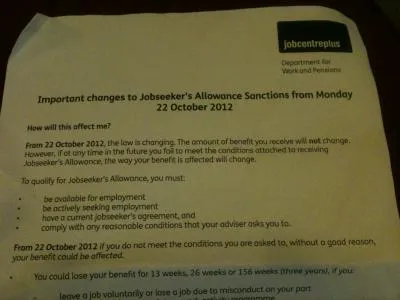
The governement has today significantly increased the sanctions for non-compliance with the benefits regime, including the controversial unpaid, forced work 'workfare' schemes. Under a 'three strikes' policy, benefits will be stopped for three months, six months, and then three years for failing to meet a series of conditions, many of which relate to workfare. According to a notiification letter given to all JSA claimants, this includes:

Tags

  • benefits
  • claimants and unpaid
  • exploitation
  • workfare
By Joseph Kay, 24 September, 2012

Mass pickets against workfare in Brighton

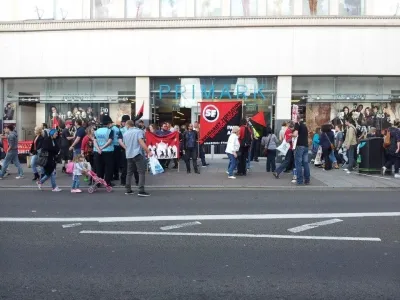
On Saturday, the Lib Dems' party conference was in Brighton. Following a protest march, there were simultaneous mass pickets of firms using workfare across Brighton. Rather than simply 'having our say' and being ignored by politicians, the idea was to disrupt a high profile coalition policy - the forced, unpaid work schemes known as workfare.

Workfare means unemployed people being forced to do unpaid work for their benefits. Workfare is a state subsidy to private businesses, providing free labour and undercutting the minimum wage. The government’s own research found that in countries that introduced workfare it could actually lower a jobseeker’s chances of finding a job. Where previously these roles would have been filled by paid staff, employers get to take advantage of a growing pool of jobseekers they won’t have to pay.

Tags

  • benefits
  • pickets
  • unemployment
  • workfare
  • retail
By Tom, 14 September, 2012
hull

ATOS picket - 28th of august.

On Tuesday the 28th of august members of Hull Solfed were joined by disabled activists in staging a protest outside the local office of official Paralympics sponsor Atos. Like similar demonstrations happening simultaneously around the country we wanted to shine a spotlight on Atos and its practices. Employed by the DWP to carry out work capability assessments declaring sick and disabled people 'fit for work', Atos uses an inhuman computer programme to do the testing, and trains its staff to push people off benefits. They profit from destroying the rights and lives of disabled people.

Tags

  • ATOS Origin
  • benefits
  • cuts
  • Hull
  • pickets
  • claimants and unpaid
  • Yorkshire
By Auto, 21 May, 2012
a

19th of May – Anti-Workfare Pickets in Reading and Oxford

On the 19th of May Thames Valley SolFed coordinated a day of action against Holland & Barrett as part of the national SF anti-workfare campaign. Pickets were held in both Reading & Oxford.

Tags

  • benefits
  • Holland & Barrett
  • Boycott Workfare
  • minimum wage
  • workfare
  • protests
  • Oxford
  • Reading
  • Thames Valley
By wysf07, 4 April, 2012

Newcastle Holland and Barrett Picket

Picket outside Holland and Barrett, Saturday 31st March. We managed to turn away a good proportion of customers, handing out leaflets at the door and to passers by. Despite being a Saturday in the Bigg Market - a popular drinking haunt for stag and hen parties - the picket went down well.

Tags

  • IWA-AIT
  • benefits
  • West Yorkshire
  • Yorkshire
By wysf07, 31 March, 2012
w

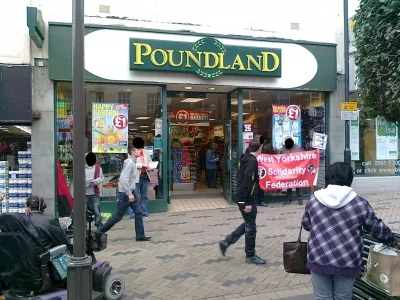
Anti Workfare Poundland Picket (Wakefield)

WYSF and SRSM were joined by members of AFed in the picket at Poundland. Although it started slow we distributed 250 leaflet well within the hour. Reception seemed pretty good and we retired to the pub to discuss future actions. Between the 3 groups it was decided to continue to picket such p[laces as Poundlandand to include A4e and BEST in future pickets. Thanks to everyone who turned out, keep tuned for future actions!

Tags

  • benefits
  • Afed
  • workfare
  • West Yorkshire
  • Yorkshire
By wysf07, 29 March, 2012
a

Thousands of disabled people and people on "sick" to lose benefits on the 30th April

As part of the Governments Welfare Reform Bill (now an Act), Contributory Employment and Support Allowance (ESA) will be limited to 12 months.  This comes into affect from the 30th April 2012 and for the first time is to be aplplied retrospectively.  This means that anyone who has been on Contribution based ESA for a year or more by April 30th will lose this benefit on April 30th.  For many this means relying on a partners income for others it means taking a cut in income while having to go on income based ESA.  The biggest losers are couples.

Tags

  • benefits
  • disability
  • ESA
  • West Yorkshire
  • Yorkshire
By Joseph Kay, 23 February, 2012
c

The logic of workfare

Workfare means unemployed people being forced to do unpaid work for their benefits. Tens of thousands of people are being forced into unpaid work, household name firms are profiting from free labour and disabled people face unlimited unpaid work or cuts in benefit. Workfare began under Labour with the New Deal in 1998, which became the Flexible New Deal in 2009. It is now being expanded by the Conservative-Liberal government under a number of different schemes including: ‘Work Experience’, ‘Mandatory Work Activity’, ‘the Community Action Programme’, ‘Sector Based Work Academies’, and ‘the Work Programme’.

Tags

  • benefits
  • workfare
  • claimants and unpaid

Pagination

  • Page 1
  • Page 2
  • Page 3
  • Next page
  • Last page
benefits

Guides

Your rights at work

Why do we organise? Capitalism is shit, oppression is shit - but what can we at SolFed do about it?

Why do we organise?

This is our flag - it tells you what we stand for

this-is-our-flag

Direct Action #2 (2024)

Direct Action #2 (2024)

Anarcho-syndicalism in Britain – a little history (2015)

Anarcho-syndicalism in Britain – a little history (2015)

Office worker’s health and safety - your rights and how to use them (2015)

Office worker’s health and safety - your rights and how to use them (2015)

Anarchism and Anarcho-syndicalism (Rudolf Rocker, 2014)

Anarchism and Anarcho-syndicalism (Rudolf Rocker, 2014)

Fighting for ourselves - anarcho-syndicalism and the class struggle (2012)

Fighting for ourselves - anarcho-syndicalism and the class struggle (2012)

Theory & Practice 1 - Workmates - direct action workplace organising on the London underground (2011)

Theory & Practice 1 - Workmates - direct action workplace organising on the London underground (2011)

The Economics of freedom (2003)

The Economics of freedom (2003)

A history of anarcho-syndicalism (SelfEd Collective, 24 unit series, 2001)

A history of anarcho-syndicalism (SelfEd Collective, 24 unit series, 2001)

Out of the frying pan, a critical look at works councils (1998)

Out of the frying pan, a critical look at works councils (1998)

Health and safety at work - an anarcho-syndicalist approach (1997)

Health and safety at work - an anarcho-syndicalist approach (1997)

Theory & Practice 2 - Anarcho-syndicalism in Puerto Real (1994)

Theory & Practice 2 - Anarcho-syndicalism in Puerto Real (1994)
RSS feed