
The University and College Union (UCU) is continuing its action in defence of fair pensions and fair working conditions. Staff will be on strike in February and March in relation to both the pension dispute and the “Four Fights” (pay, workload, casualization, structural inequality).
The Solidarity Federation Education Union (SFEU) supports this action because…
● University lecturers’ pay has fallen by 20%.
● One third of academic staff are on precarious, short-term contracts.
● Women university workers are still paid less than men, and more likely to be on these precarious contracts.
● BAME


 The University and College Union (UCU) is now in its third week of strike action over pensions, pay, equality issues, workload and casualization of the sector. Although developments are being kept pretty much in secret, branches have pressed the Union leadership for an open discussion and ratification of any agreements that we may collectively come to. Some branches have also been discussing what the next step could entail if there is insufficient progress. While the sector does not have a huge amount of power in some senses, unless railway unions or NHS workers, universities are increasingly
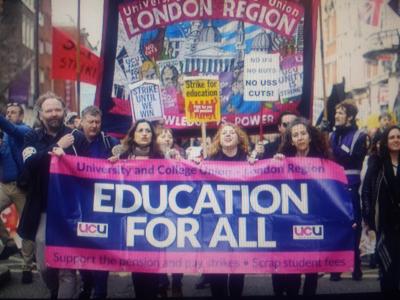 We are in the midst of the country’s biggest university strike ever in a dispute over pensions and the “four fights” of equality, pay, workload and casualization. On the last front, in some universities, there are up to 70% of lecturers who are on hourly paid or fixed term contracts. These are convenient for universities in what has grown to be a highly casualized sector but provide no security for workers who have often trained for up to ten years in their chosen subject. The representation of women and BME workers is also a key issue that the University and College Union is seeking action on
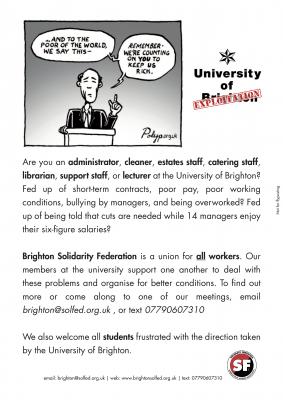 Working conditions in educational institutions are becoming more and more difficult. This is often linked to managers making cuts, establishing austerity measures, or asking all workers to do more for less. We currently organise as a network of workers at University of Brighton, and have links to other educational institutions.
 Five years ago, “zero hours” contracts came to the attention of the national media. While there is no one type of “zero hours” contract, in all cases workers receive no guaranteed weekly hours or income. Workers are paid only for the actual hours worked, and the employer is under no obligation to provide any work. Their use by employers in very many sectors of the British economy has mushroomed in recent years. In 2006, possibly 0.5% of the workforce had “zero hours” contracts (130,000). According to the Labour Force Survey, 901,000 people (representing 2.8% of all workers) were on contracts
 I work in admin at one of the universities in the city. Recently, one of my colleagues left the department for a new job. It was expected that I would take on some of their workload. This was not something I could really do, and when I started to be asked, I found it stressful. I talked about it at the drop-in, and a number of useful suggestions were made.
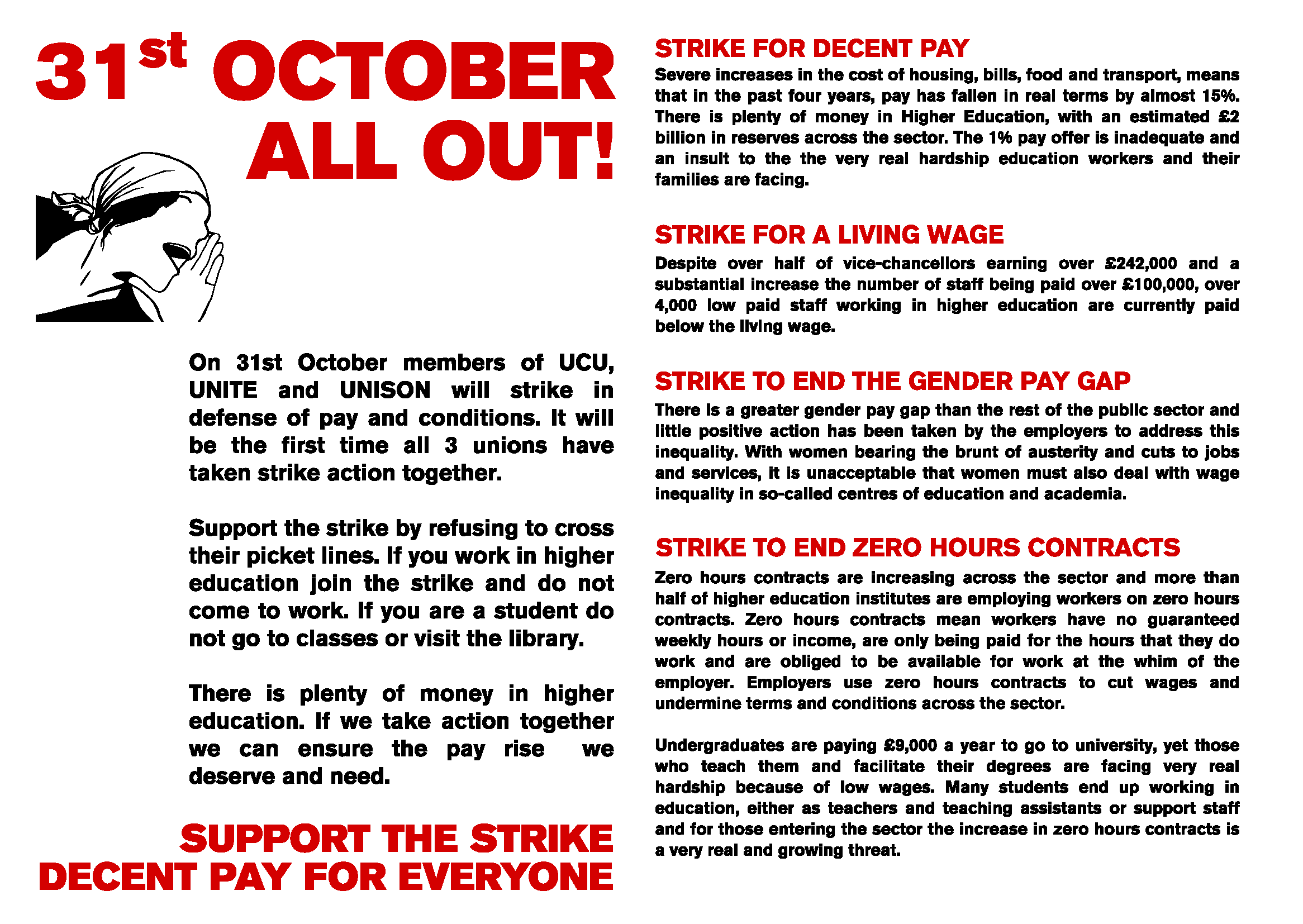 There is a strike in higher education on Thursday 31st October. All three big unions are walking out in fight for decent pay.