The trade union movement has been extremely important in furthering the desires of workers and improving our living conditions. This movement was vital in raising many workers out of the gruelling fourteen hour days, unsafe working conditions, poverty pay, and general degradation of the industrial revolution.
The right to protest is a key right within our political system, and the suppression of protest is a sign that a government has become oppressive and authoritarian.
The core assumption of our political system is that the government represents the will of the people and that this will is expressed through elections. Because of this, political parties are the most important organisations in mainstream politics and many people do not get involved in politics beyond voting.
Today the economy is divided into two broad classes of people. One is a small elite who control the vast majority of the wealth, organisation, and productive capacity of society; private business owners.
The majority of people are reliant on a web of different organisations and infrastructure in order to live full and happy lives. We need access to hospitals, transport, waste disposal, water, electricity, and many other municipal services in order to live.
We face many problems today. From economic stagnation and poverty, to state violence and oppression, to crumbling infrastructure and services, to discrimination and hatred based on any number of characteristics, to the possibility of complete environmental collapse. Many of these problems have been with us for hundreds of years, or have flared up again after progress was seemingly made against them. Many of those in power are unwilling to address these problems, and they often benefit directly from them. Worse still, popular movements to solve these problems have only won temporary relief and have often acted as a stepping stone to power for their leaders instead of creating lasting change.
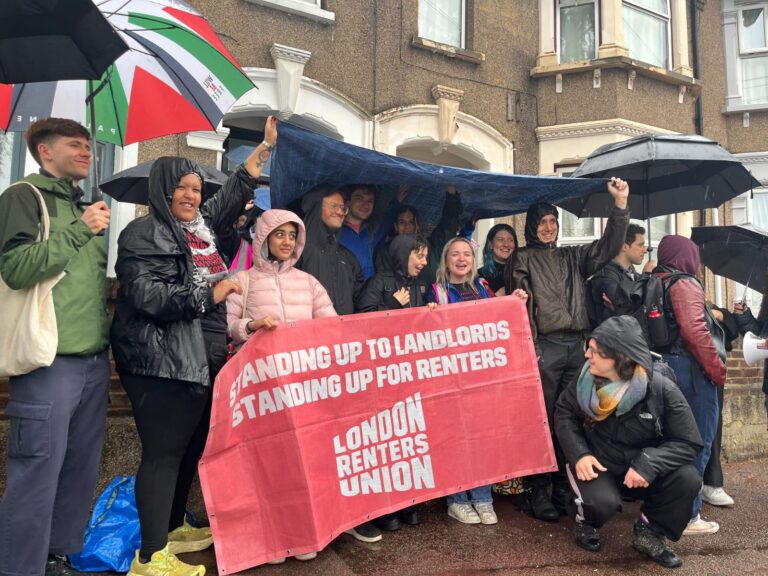
A planned eviction of of tenants in East London was stopped by people from London Renters Union blocking the doorway for five hours. The landlord and estate agents repeatedly came to the house, and people several times linked arms and blocked the door. Finally the landlord agreed to some breathing space for the tenants, who had nowhere to go, to find a new place.
Most evictions are not resisted, often the landlord does not even get a court order, tenants simply leave. Is it really worth doing eviction resistance, when the tenants will have to move out eventually?
 SolFedNL@riseup.net | twitter.com/nlsolfed | facebook.com/northlondonsf | network23.org/solfednl and find us on radar.squat.net
 ANARCHISM
 TWO IDEAS OF SOCIALISM
 A BLEAK FUTURE
 THE RIGHT TO PROTEST
 DEMOCRACY
 OWNERS AND WORKERS
 MEANS OF SURVIVAL
 A planned eviction of of tenants in East London was stopped by people from London Renters Union blocking the doorway for five hours. The landlord and estate agents repeatedly came to the house, and people several times linked arms and blocked the door. Finally the landlord agreed to some breathing space for the tenants, who had nowhere to go, to find a new place.