Today socialism is mostly associated with social democratic political parties like Labour or totalitarian states like North Korea. So close is this association that most people assume that socialism is an inherently statist idea that depends on great leaders to guide us to utopia through government action.
This kind of socialism has often been a disappointment to the working class, as it has never achieved a society in which we workers are empowered with real control over the economy we have built. At best it has achieved limited improvements to workers’ living conditions
The trade union movement has been extremely important in furthering the desires of workers and improving our living conditions. This movement was vital in raising many workers out of the gruelling fourteen hour days, unsafe working conditions, poverty pay, and general degradation of the industrial revolution.
However, the modern trade union movement seems unable to extend or defend those gains. For many workers, the next decade looks like it will be bleaker than the last, and in the long term we may be slowly sliding back to the soul crushing working conditions of the 19th century
The right to protest is a key right within our political system, and the suppression of protest is a sign that a government has become oppressive and authoritarian. Protest is seen as the voice of the people, and an important tactic to raise issues and push for changes that the political system would otherwise ignore.
However, protest has also had a very uneven record of bringing about such changes, especially on its own without other forms of political action. This pamphlet will argue that this is due to the limited ability of passive protest to effect politics, and will
The core assumption of our political system is that the government represents the will of the people and that this will is expressed through elections. Because of this, political parties are the most important organisations in mainstream politics and many people do not get involved in politics beyond voting. Most people do not even know what politics looks like outside of trying to win elections and those wanting progressive social change rely on parties like Labour, the Greens, or the Liberal Democrats.
This pamphlet will argue that this approach to politics is not enough to achieve
Today the economy is divided into two broad classes of people. One is a small elite who control the vast majority of the wealth, organisation, and productive capacity of society; private business owners. The other is the majority of workers who have little independent access to the means of survival and must work for one of these private owners in order to make the money we need to live. This structure has put workers in a position in which we must accept mistreatment by our employers or risk the insecurity and poverty of unemployment, and as such it is called “capitalism” as
The majority of people are reliant on a web of different organisations and infrastructure in order to live full and happy lives. We need access to hospitals, transport, waste disposal, water, electricity, and many other municipal services in order to live. Many of us do not own our own homes, but rent them from a landlord or local council. Even those who own a home or small business are reliant on the financial system that provides mortgages and other loans.
The organisations that run this infrastructure can be corrupt, cruel, and uncaring. Landlords, businesses, and government
We face many problems today. From economic stagnation and poverty, to state violence and oppression, to crumbling infrastructure and services, to discrimination and hatred based on any number of characteristics, to the possibility of complete environmental collapse. Many of these problems have been with us for hundreds of years, or have flared up again after progress was seemingly made against them. Many of those in power are unwilling to address these problems, and they often benefit directly from them. Worse still, popular movements to solve these problems have only won
These are some books we recommend for anyone who wants to learn more about anarchism and syndicalism
Short Introductions
Your Freedom is My Freedom (7 pages), by William Gillis – An excellent short introduction to the very core of anarchist though.
Direct Action (16 pages), by Émile Pouget – A classic introduction to the syndicalist, bottom up, and workplace focused approach to social change that Solidarity Federation advocates.
Ready to Fight (15 pages), by Shane Burley – An introduction to ways in which the principals of syndicalism can be taken out of the workplace and used to organise in the community.
The Spanish Revolution: Anarchy in Action (16 pages), by Iain McKay – A short history and analysis of the 1936 Spanish Revolution, perhaps the closest anarchism has ever come to overthrowing a modern nation state, and a high water mark for bottom up workers power in Europe.
Practical Pamphlets
How to Fire Your Boss (9 pages), by BossBusters – A compilation of workplace tactics other than formal strikes which workers can use to fight back against their bosses. Includes short examples of when and how these tactics have been used.
Anarcho-Syndicalism in Puerto Real (12 pages), by Pepe Gomez and others – A look at the Spanish Confederación Nacional del Trabajo (CNT-AIT) union organising in the shipyards of Puerto Real during 1980s and how that organising spread outside of the workplace into the community.
Workmates (18 pages), by Solidarity Federation – A look at Solidarity Federation organising on the London underground in the 1990s/2000s, building alternative structures outside of the unions based on mass meetings in the workplace.
Why Misogynists Make Great Informants (10 pages), by Courtney Desiree Morris – Reflections on how patriarchy damages movements, and how accepting such behavior from comrades puts everyone at risk.
Dare to Be A Daniel (27 pages), by Wilf McCartney – A history of one of Britain’s earliest syndicalist unions, The French Cooks Syndicate, written by one of its members.
The Seattle Solidarity Network (40 pages), by Walter Winslow- A look at members of the American Industrial Workers of the World (IWW) union finding ways to organise and successfully resist against bosses and landlords even when traditional unions are weak. This Network continues to be active to this day.
Workers Without Bosses (10 pages), by José Antonio Gutiérrez D. – A short history and analysis of the reclaimed factory movement that emerged in Argentina in the early 2000s, in which workers seized factories abandoned by their owners and ran them themselves.
Industrial Collectivization During the Spanish Revolution (13 pages), by Deirdre Hogan – A look at the workers collectives that seized workplaces in the 1936 Spanish Revolution and started to run the economy from the bottom up without bosses.
History and Theory
Anarcho-Syndicalism: Theory and Practice (71 pages), by Rudolf Rocker – A good introduction to classical anarcho-syndicalism as it was understood in the 19th and early 20th century. Some of the ideas in this short book/long pamphlet are old and a bit outmoded by modern standards, but it provides the solid basis on which more complex modern praxis has been built. Especially good in its coverage of the philosophical basis of anarchism, something that has not changed since Rocker’s time.
Fighting for Ourselves: Anarcho-Syndicalism and The Class Struggle (89 pages), by Solidarity Federation – Our modern take on anarcho-syndicalism, which is based on lessons learnt since the high point of classical anarcho-syndicalism. While it has been a few years since this was first published, it is still a good introduction to the specific perspective of the Solidarity Federation.
The Anarchist Collectives: Workers’ Self Management in the Spanish Revolution, 1936-1939 (168 pages), by Sam Dolgoff – A detailed look at how the anarchist collectives in the Spanish Revolution were run and how those collectives cooperated to manage broader regional economies. Contains many accounts from different sectors of the economy, both rural and urban. Important reading for an example of how anarchism works in practice in an industrial society.
Means and Ends: The Revolutionary Practice of Anarchism in Europe and the United States (259 pages), by Zoe Baker – An excellent analysis of the unifying ideas and practices behind the classical anarchist movement in Europe and the United States. Does not just cover anarcho-syndicalism, but is an important work for understanding the broader ideas which anarcho-syndicalism came out of, and situating anarcho-syndicalism amongst other currents within anarchism.
Rebel Alliances: The Means and Ends of Contemporary British Anarchisms (339 pages), by Benjamin Franks – A comprehensive analysis of the development of modern anarchism in Britain and Ireland, up to 2006, covering both theory and practice and how they interact with each other. If you want to understand Anarchism in the British Isles and only want to read one book, this is that book.
A History of Anarcho-Syndicalism (423 pages), by Solidarity Federation – Our expansive history of anarcho-syndicalism that covers the birth of capitalism and the socialist and labour movements that arose in opposition to it, anarchism as a distinct tendency within those movements, and the development of syndicalism and anarcho-syndicalism in Britain, France, Spain, Mexico, Russia, Argentina, the USA and other areas, from the 18th century to the start of the 21st century.
An Anarchist FAQ (3078 pages), by The AFAQ Editorial Collective – A huge resource for answering common questions about anarchism, often in great depth. We recommend that you do not attempt to read the entire FAQ as a book, but instead look for the specific questions you are interested in.
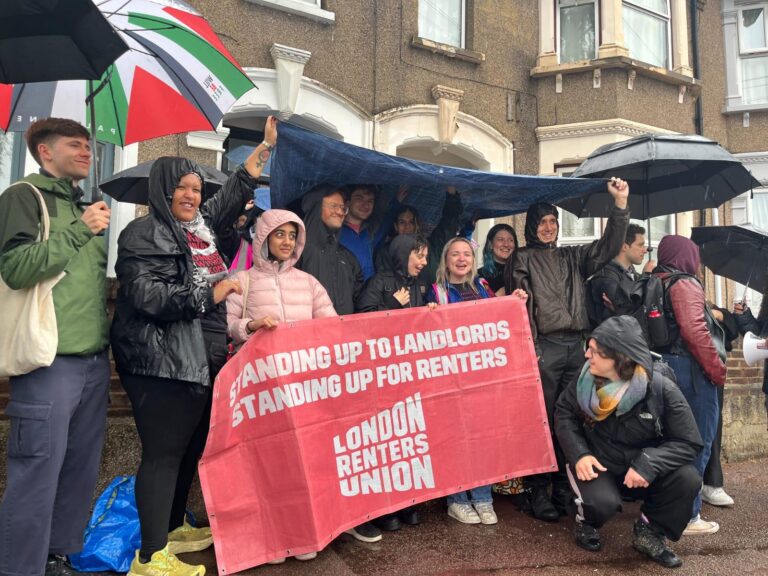
London Renters Union and other tenants in East London blocking the doorway for five hours, stopping an eviction
A planned eviction of of tenants in East London was stopped by people from London Renters Union blocking the doorway for five hours. The landlord and estate agents repeatedly came to the house, and people several times linked arms and blocked the door. Finally the landlord agreed to some breathing space for the tenants, who had nowhere to go, to find a new place.
Most evictions are not resisted, often the landlord does not even get a court order, tenants simply leave. Is it really worth doing eviction resistance, when the tenants will have to move out eventually?
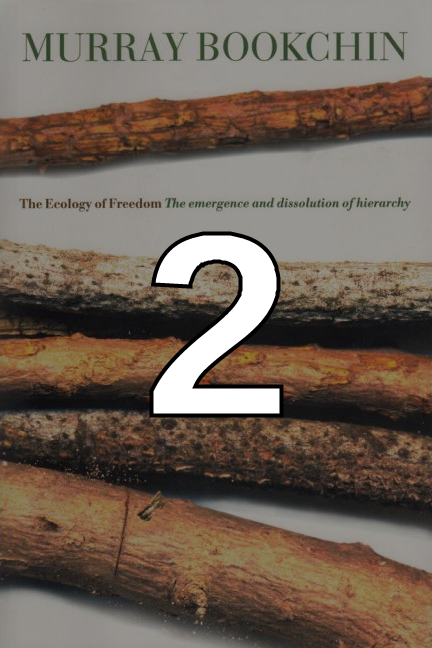
For our tenth reading group we will continue reading The Ecology of Freedom by Murray Bookchin. From the blurb:
“The very notion of the domination of nature by man stems from the very real domination of human by human. With this succinct formulation, Murray Bookchin launches his most ambitious work, The Ecology of Freedom. An engaging and extremely readable book of breathtaking scope, its inspired synthesis of ecology, anthropology, and political theory traces our conflicting legacies of hierarchy and freedom, from the first emergence of human culture to today’s globalized capitalism, constantly pointing the way to a sane, sustainable ecological future. On a college syllabus or in an activist’s backpack, this book is indispensable reading for anyone who’s tired of living in a world where everything is an exploitable resource.”
We are reading The Ecology of Freedom over three months. This month we will be reading chapters five to eight, staring with The Legacy of Domination and ending with From Saints to Sellers.
A free version of The Ecology of Freedom can be found on the Anarchist Library here and our friends at Freedom Press here have offered a 10% discount on physical copies for the reading group. Just quote “London SolFed Reading Group” or pop into Freedom for your general radical book buying needs.
The reading group will be meeting on Tuesday the 27th of May, 19:00, at Freedom Bookshop, 84b Whitechapel High St, London E1 7QX. You are welcome to come and join in the discussion even if you have not finished the reading or are jumping in half way through the book.
 SolFedNL@riseup.net | twitter.com/nlsolfed | facebook.com/northlondonsf | network23.org/solfednl and find us on radar.squat.net
 TWO IDEAS OF SOCIALISM
 A BLEAK FUTURE
 THE RIGHT TO PROTEST
 DEMOCRACY
 OWNERS AND WORKERS
 MEANS OF SURVIVAL
 We are reading The Ecology of Freedom over three months. This month we will be reading chapters five to eight, staring with The Legacy of Domination and ending with From Saints to Sellers.